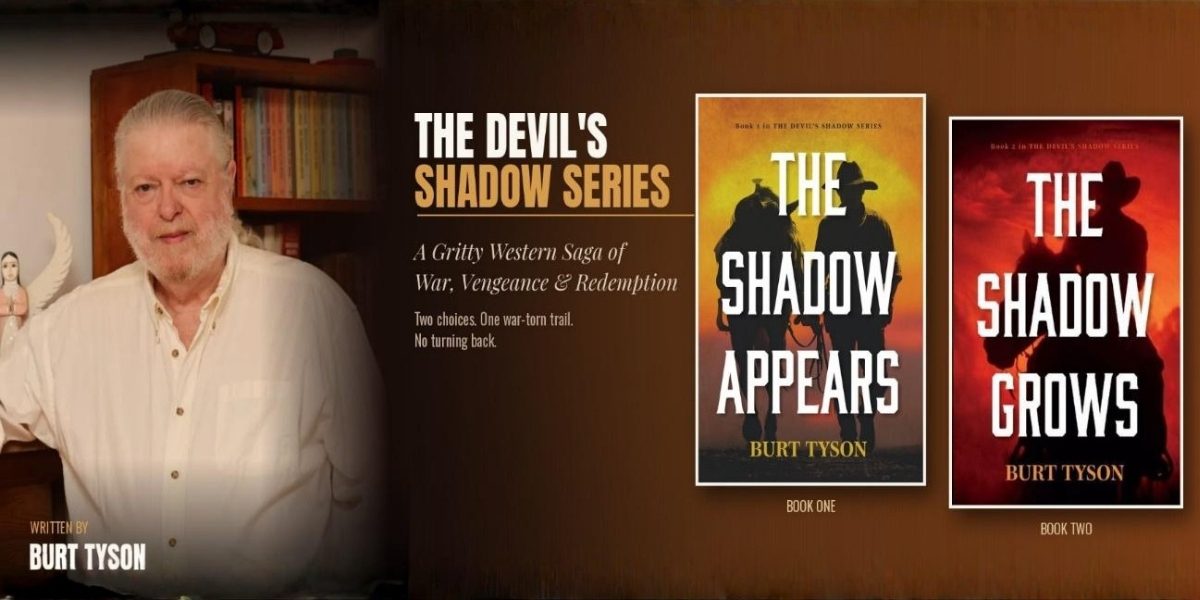

For author Jim Van Laan, writing under the pen name Burt Tyson, the journey into historical Western fiction began with a deeply personal question: what does a person do after losing everything?
That question became the foundation for what would eventually develop into the Devil’s Shadow series, a planned seven- or eight-book saga centered on Captain Robert Hester, a Civil War veteran whose journey takes him from the final days of the conflict into the American frontier and Mexico. Van Laan’s first completed manuscript was actually intended as the sixth book in the series, but he ultimately decided that The Shadow Appears needed to come first. The Shadow Grows follows as the second installment, with a third book, The Shadow Seeks a Home, planned for release.
The origins of the series can be traced back much further than its publication, however.
Van Laan recalls a difficult period in his own life when he experienced both a failed marriage and a failed business. At the time, he was searching for a metaphor that could help him understand failure and, more importantly, how someone could move beyond it. He found that metaphor in the image of a Confederate soldier returning from war to discover that his faith, family, home, and sense of purpose had been destroyed.
That idea became the genesis of the Devil’s Shadow series.
At the center of the story is Captain Robert Hester, a former member of Mosby’s Rangers. As the Civil War draws to a close, Hester is wounded and caught in a complicated world where military loyalties, personal survival, and the consequences of war collide. His story continues beyond the defeated Confederacy and eventually takes him toward Mexico, where he hopes to continue fighting and pursue vengeance against General Stoneman.
Yet Hester is not simply a conventional Western hero.
One of the most compelling elements of the character is the conflict between his capacity for violence and his underlying sense of honor. Hester loses members of his family and becomes consumed by revenge, but Van Laan deliberately avoids presenting him as either entirely good or entirely evil.
Instead, Hester reflects the complicated people the author believes existed during that period: individuals capable of extraordinary violence when protecting those they love, while also being willing to offer compassion and assistance to someone in need.
That moral complexity is particularly important because the world Hester inhabits offers little dependable justice. In the South and on the frontier, formal law enforcement could be distant or practically nonexistent. Communities sometimes had to depend on individuals to enforce their own understanding of right and wrong.
For Hester, that creates a difficult distinction between justice and revenge. His actions may be violent, but Van Laan says the character’s sense of honor helps restrain his darker impulses. The result is a protagonist who must continually confront the question of whether a person can remain fundamentally good while using violent methods in a violent world.
The meaning of the series’ title becomes clearer through Hester’s transformation. After traveling to Mexico, he becomes known as “The Devil’s Shadow,” so named when an evil hacendado says of him, “He is like the shadow before el Diablo; first you see the shadow, and then you see el Diablo.” The defenseless Mexicans he helps call him “The Angel of God,” two names that capture the two opposing forces within him: the honorable man and the man driven by vengeance and violence.
In The Shadow Grows, that internal conflict begins to change.
After abandoning the possibility of continuing the Confederate cause, Hester eventually reaches Copper Canyon without a clear purpose. His encounter with a Mescalero Indian elder becomes a turning point. Rather than remaining a man defined by loss and revenge, he begins developing a new sense of direction.
Van Laan describes The Shadow Grows fundamentally as a story about transformation: the movement from a man without purpose to a man who discovers purpose again.
That transformation is reinforced through unexpected relationships. Hester’s connection with the injured Indigenous woman teaches him survival skills while challenging his assumptions about people and culture. His decision to help others, including a half-dog, half-wolf and a vaquero named Miguel, gradually creates something he believed he had lost forever: family.
These relationships shift Hester’s focus away from revenge and toward connection, responsibility, and belonging.
Van Laan’s ability to build this historical world comes from a lifelong fascination with the Civil War. As a teenager living in Maryland, he was surrounded by major battlefields, including Gettysburg, Antietam, and Monocacy. Decades later, a mentor encouraged him to research the Confederate diaspora, including former Confederate soldiers who traveled to Mexico, Cuba, Brazil, Europe, Egypt, and other parts of the world after the war.
That research eventually found its way into his fiction.
But beneath the history, battles, horses, frontier landscapes, and gunfights is a philosophy that Van Laan says has influenced virtually everything he writes: the Cowboy Code.
For him, the code centers on principles such as keeping one’s word, choosing honesty over deception, recognizing the difference between right and wrong, confronting fear when duty calls, and helping others whenever possible. One of its central ideas is that those capable of protecting people who cannot protect themselves have a moral responsibility to do so.
That philosophy gives The Shadow Appears and The Shadow Grows their deeper identity. They are not simply stories about the American Civil War or the Old West. They are stories about what happens after a person has been broken by circumstances, and whether it is possible to rebuild a life around something greater than anger.
Through Burt Tyson, Jim Van Laan brings together historical research, Western tradition, personal experience, and a belief in self-reliance and moral responsibility. The result is a character-driven series in which the greatest battle is not always fought with weapons.
Sometimes, it is the battle to discover who you are after everything you once believed in has disappeared.