How Do Online Anime Name Generators Work?

By: John Glover (MBA)

Online anime name generators are fun and creative tools designed to help you come up with unique names for anime characters, stories, or fan fiction. Whether you’re a writer, a game developer, or just an anime fan looking for a cool name for your next cosplay, these generators can be incredibly useful. They work by using algorithms that combine different elements like personality traits, physical characteristics, and cultural references to generate names that fit the anime genre. You simply input some basic information or select certain criteria, and the generator spits out a list of names that you can use or get inspired by. This makes the process of naming characters much easier and more enjoyable, giving you more time to focus on developing your story or character.

How Do Anime Name Generators Function?

Anime name generators are quite straightforward in how they operate. These tools use algorithms to combine different elements like personality traits, physical attributes, and cultural references to create unique and fitting names for anime characters. When you visit an online anime name generator, you’ll typically start by entering some basic information. This can include your name, gender, or specific traits you want the name to reflect.

Once you input your data, the generator processes it through a set of predefined rules and databases of names. These databases often include traditional Japanese names, modern interpretations, and fantastical elements typical in anime. The result is a list of names that match your criteria.

Some generators even allow you to customize the parameters further, such as selecting the style or theme of the name. For example, you might want a name that sounds more heroic or one that fits a mystical character. By adjusting these settings, you get a name that’s more aligned with your vision.

Overall, the main goal of these tools is to save you time and boost your creativity by providing a variety of name options with just a few clicks.

What Are the Benefits of Using Anime Name Generators?

Using anime name generators comes with several benefits. Firstly, they save you a lot of time. Instead of racking your brain for the perfect name, you can generate multiple options with just a few clicks. This is especially useful if you’re working on a project with a tight deadline.

Secondly, these tools can spark creativity. Sometimes, seeing a unique name can inspire new character traits or storylines that you hadn’t considered before. It opens up possibilities and can lead to more dynamic and interesting characters.

Lastly, anime name generators help ensure that your names fit the genre. They often incorporate cultural and stylistic elements common in anime, making your characters feel more authentic and relatable to fans. This can enhance the overall quality of your work and make it more appealing to your audience.

How Can Anime Name Generators Enhance Creativity?

Anime name generators can be a fantastic tool to spark your creativity. By providing a diverse range of names, these generators help you break through creative blocks. Instead of spending hours trying to come up with the perfect name, you can quickly generate options that might inspire you in unexpected ways.

These generators often incorporate various elements like personality traits, cultural references, and unique combinations, which can lead you to think about your characters in new dimensions. For writers and artists, this means more time focusing on developing your story and less time stuck on naming characters.

Furthermore, the process of using these tools can introduce you to new themes and ideas, expanding your creative horizons. It’s a fun and efficient way to add depth and authenticity to your characters, making them more memorable and engaging for your audience.

Conclusion

Online anime name generators are valuable tools for anyone involved in the anime community. Whether you’re a writer, artist, or just a fan looking for a fun activity, these generators can help you find the ideal names for your characters. They save time, spark creativity, and provide a wide range of options tailored to fit different themes and traits. By using these tools, you can focus more on developing your stories and characters rather than getting stuck on naming them.

Published by: Holy Minoza

How is Technology Shaping the Future of Financial Advice?

By: John Glover (MBA)

The field of financial advice is changing quickly. Technological advancements and evolving consumer expectations are reshaping how financial guidance is provided and accessed. Gone are the days of solely relying on traditional face-to-face meetings with advisors. Today, digital platforms, robo-advisors, and a focus on sustainability are reshaping the industry. This article will explore how these trends are making financial advice more accessible, personalized, and aligned with your values. Get ready to discover how technology is changing the game in financial advisory services and what it means for your financial future.

How Are Digital Platforms Making Financial Advice More Accessible?

Digital platforms are revolutionizing the way you access financial advice. Gone are the days when you needed to schedule face-to-face meetings with advisors. Now, you can receive personalized financial guidance from the comfort of your home. These platforms are designed to be user-friendly, making it easier for you to navigate complex financial topics.

One of the main advantages of digital platforms is their ease of access. Whether you’re at home or on the go, you can manage your finances through mobile apps and online services. These tools offer real-time data and insights, allowing you to make timely and informed financial decisions.

Moreover, digital platforms often have lower costs than traditional advisory services. This increased affordability has made high-quality financial advice more accessible to a wider audience. You can now access a variety of services, such as budgeting tools and personalized financial guidance, all tailored to your specific needs.

In addition, the rise of these platforms has led to the growth of robo-advisors. These automated services use algorithms to manage your investments, offering a convenient and cost-effective alternative to human advisors. With digital platforms, financial advice is now a luxury but a readily available resource for everyone.

What Role Do Robo-Advisors Play in Modern Financial Advisory?

Robo-advisors are changing the financial advisory landscape by offering automated, algorithm-driven financial planning services. These digital platforms are designed to provide personalized financial guidance with minimal human involvement, making financial planning more accessible to a wider range of people.

One key advantage of robo-advisors is their ability to offer low-cost investment management. Traditional financial advisors often charge high fees, which can be a barrier for many individuals. However, robo-advisors typically charge a fraction of the cost, allowing more people to benefit from professional financial advice without breaking the bank.

Robo-advisors use advanced algorithms and data analytics to provide personalized financial strategies based on individual needs and goals. Typically, when you sign up, you’ll complete a questionnaire that assesses factors like your financial goals and preferences. The robo-advisor then uses this information to create and manage a strategy that aligns with your objectives.

Another significant benefit of robo-advisors is convenience. Using a smartphone or computer, you can manage your investments anytime, anywhere. This accessibility means you don’t need to schedule in-person meetings or wait for office hours to change your portfolio. Everything is at your fingertips, making financial management more straightforward and efficient.

Robo-advisors are also excellent tools for those interested in sustainable and ethical investing. Many platforms offer options to invest in portfolios that focus on Environmental, Social, and Governance (ESG) criteria, allowing you to align your investments with your values.

In conclusion, robo-advisors are playing a crucial role in modern financial advisory by democratizing access to financial planning, reducing costs, and providing personalized, convenient, and value-driven investment options. If you’re interested in exploring current trends in financial advice and how they are shaping the industry, robo-advisors are an option worth considering.

Why is Sustainability and Ethical Investing Gaining Traction?

Sustainability and ethical investing are becoming increasingly important in the world of financial advice. More and more clients are looking to align their investments with their personal values, focusing on companies that prioritize environmental, social, and governance (ESG) criteria.

This shift is driven by a growing awareness of global issues such as climate change, social inequality, and corporate governance. Investors are recognizing that their financial choices can make a difference, not just to their portfolios, but to the world at large. As a result, financial advisors are incorporating ESG factors into their investment strategies, offering clients opportunities to support sustainable and ethical businesses.

Moreover, there’s a growing body of evidence suggesting that sustainable investments can perform just as well, if not better, than traditional investments. This has helped dispel the myth that ethical investing comes at the cost of financial returns. By integrating sustainability into financial advice, advisors are not only meeting the demands of a more conscientious client base but also helping to drive positive change in the market.

In short, sustainability and ethical investing are gaining traction because they resonate with clients’ values and offer competitive returns, making them a win-win in the modern financial landscape.

How is Financial Literacy Empowering Clients?

Financial literacy is crucial in today’s world, empowering you to make informed decisions about your money. With the rise of financial education initiatives, you’re gaining access to resources and tools that demystify complex financial concepts. This knowledge helps you understand your financial situation better and make smarter choices regarding saving, investing, and managing debt.

Advisors are increasingly focusing on educating clients like you, offering workshops, webinars, and personalized sessions to boost your financial confidence. By learning about budgeting, investment strategies, and retirement planning, you can take control of your financial future. This empowerment leads to a more proactive approach to financial management, reducing reliance on advisors for every decision and fostering a sense of financial independence.

In essence, financial literacy transforms you from a passive participant into an active manager of your financial well-being, enabling you to navigate the financial landscape with confidence and clarity.

Summary

The world of financial advice is undergoing a significant transformation, driven by technological advancements and changing consumer expectations. Digital platforms are making financial advice more accessible than ever, while robo-advisors are offering automated, low-cost investment management. The growing focus on sustainability and ethical investing reflects a shift in client priorities, and financial literacy initiatives are empowering individuals to take control of their financial futures. As these trends continue to evolve, staying informed and adaptable will be key to leveraging the benefits of modern financial advisory services.

Disclaimer: This content is for informational purposes only and is not intended as financial advice, nor does it replace professional financial advice, investment advice, or any other type of advice. You should seek the advice of a qualified financial advisor or other professional before making any financial decisions.


Published By: Aize Perez

AI-Powered Automation Optimizing Medical Billing for Physicians

The U.S. healthcare sector is under siege from shrinking reimbursement rates and rising administrative burdens, worsening physician recruitment and attrition rates. This has the potential to cause a severe shortage of physicians, deteriorating the already-overburdened health system and making healthcare more inaccessible for many Americans. 

With the demands of medical billing becoming more complex and time-consuming due to regulatory changes, decreasing insurance reimbursements, and growing operational costs, many physicians and medical practices are finding it extremely hard to grow or even maintain their revenue levels. Practices’ profits are struggling because of missed claims, billing errors, and lengthy processing times. 

AI-Powered Automation Optimizing Medical Billing for Physicians

Photo Courtesy: Fellow Health Partners

Traditional methods of managing billing cycles, whether manual or using basic technology, may struggle to keep up with the demands of today’s changing environment. This has left many physicians with two options: either drastically cut costs by reducing staff and/or services (which will inevitably end up shrinking their revenue) or leverage advanced technologies like automation to optimize billing processes and ensure that revenue isn’t slipping through the cracks.

AI-driven automation in the medical billing revenue cycle is becoming an important tool for many physicians and practices, according to Michael N. Brown, founder and CEO of Fellow Health Partners (FHP), a well-regarded medical business solutions company. Compared to traditional manual processes, AI-powered solutions have the potential to enhance efficiency in the medical billing cycle. AI can identify patterns in denied claims, correct common errors, and even predict the likelihood of claim approval. This can help with billing errors, which account for substantial revenue loss and are significantly reduced.

FHP’s flagship solution is SAVi™, a proprietary platform that automates and optimizes the revenue cycle management process. It easily integrates with most electronic health record (EHR) systems while providing clients with real-time, 24/7 access to all their data. It is also easily customizable, allowing it to generate the most relevant reporting and analytics while reducing the administrative workload and increasing revenue. 

Brown notes that automation can lead to more efficient claim processing, potentially helping practices receive payments more quickly. By automating repetitive tasks such as data entry, billing submission, and follow-ups with payors, AI utilization can help ensure that a higher percentage of claims are accepted on the first submission, saving both time and money. Furthermore, by minimizing human error, automation allows for greater compliance with constantly changing regulations and payor policies, reducing the risk of fines or denied claims.

An automated, streamlined workflow can help reduce inefficiencies, such as underpayments and missed payments. Capturing all billable services is important for optimizing revenue for physicians and their practices, helping to support their ongoing operations. With increased efficiency in the billing cycle, practices may be able to grow without the need for significant investment in additional staff.

That being said, while automation provides medical practices with numerous benefits, it is no easy task that can be accomplished at the push of a button. It requires a tremendous amount of expertise and effort to develop, implement, and maintain these solutions. Typically, AI can often be applied to a majority of processes, while a smaller portion still requires the expertise and attention of skilled professionals. Therefore, it is crucial that practices upskill their workforces, transforming their roles from mostly clerical to those of highly educated professionals who have the expertise to solve the complicated issues that AI cannot.

“For physicians facing diminishing returns in today’s medical environment, automation provides a sustainable path to minimize costs while improving collections,” Brown says. “With claims processed faster, errors minimized, and workflows optimized, AI becomes not just an enhancement but a critical tool for survival. Automating business processes demands significant investments of time, money, and knowledge – and errors can be incredibly costly. Physicians and their practices will benefit from having an expert in revenue cycle management automation in their corner, allowing them to safeguard their revenue streams while minimizing the administrative burdens that often eat away at profitability.”

Disclaimer: This content is for informational purposes only and is not intended as financial advice, nor does it replace professional financial advice, investment advice, or any other type of advice. You should seek the advice of a qualified financial advisor or other professional before making any financial decisions.

Published by: Holy Minoza

NeuralSeek’s User-Friendly Interface Shatters Barriers to AI Adoption

By: Jamal Hamama

One of the most significant challenges businesses face is integrating AI technologies into their existing systems and workflows. Many organizations struggle with the complexity and technical competence required to wield AI’s power effectively. However, NeuralSeek, a highly advanced AI platform, challenges the very underpinnings of this concept by offering a user-friendly interface meant to make AI accessible to all.

The Importance of a User-Friendly Interface

A user-friendly interface is crucial for successfully adopting any technology, especially AI. An easy-to-navigate interface helps users properly utilize AI’s full potential without requiring extensive technical knowledge or programming skills. 

Simplifying the process of integrating AI into existing systems, a well-designed interface can significantly reduce the time and resources needed for implementation, making AI more accessible to a broader range of businesses.

NeuralSeek has taken a proactive strategy to ascertain that its platform is user-friendly and accessible to businesses of all sizes. The company’s focus on simplicity and ease of use is evident in its entire software model, which allows users to connect their internal data servers with their preferred large language models (LLMs) – all with the opportunity to configure these AI-powered virtual agents with minimal effort.

Among NeuralSeek’s most lauded features is its drag-and-drop functionality, which lets users create complex AI workflows without writing a single line of code. Based entirely on a visual panel for easier accessibility, NeuralSeek is a tool for business users and domain experts who wish to form their own AI-augmented processes without relying on specialized IT teams.

Overcoming the Challenges of AI Adoption

Despite AI’s immense potential, many organizations need help adopting and integrating AI technologies. Technical complexity is one of the most common challenges, with AI systems often requiring extensive technical familiarity to implement and maintain. This makes it difficult for businesses without dedicated AI specialists to use the technology effectively.

Data Integration is another significant challenge. Integrating AI with existing data sources and systems can be a complex and time-consuming process, requiring substantial resources and specialized knowledge—let alone the sheer skill needed to combine two entirely separate systems.

Lack of transparency is also a significant concern for many organizations. Many AI solutions operate as “black boxes,” making it difficult for users to understand how the system arrives at its decisions or recommendations. This can lead to security concerns, difficulty in specific use cases or a lack of trust between the AI vendor and its client company.

NeuralSeek addresses these challenges head-on with a user-friendly interface, simplifying the AI adoption and integration process. Its intuitive design allows non-technical staff to connect their knowledge bases quickly, select their preferred LLMs, and configure their virtual agents for various purposes, such as customer support, data analysis, and insight generation.

NeuralSeek’s User-Friendly Features

NeuralSeek’s focus on user-friendliness is evident in its recent updates and enhancements, as highlighted in the company’s changelog. The platform has designed its user interface to provide a more intuitive and streamlined experience, making it easier for users to navigate and access its various features.

NeuralSeek’s features like intent management, answer curation, and analytics make it an AI strategy-optimizing tool that drives better outcomes for businesses. Executives can leverage NeuralSeek to perform quality analyses at will, gaining valuable insights to make informed decisions and improve overall business performance. With NeuralSeek, businesses can harness the power of AI to enhance customer experiences, optimize strategies, and drive success in today’s competitive market.

The platform has also added support for many LLMs, allowing users to select the model that best suits their specific needs and requirements. NeuralSeek’s “mAIstro” feature enables users to create dynamic prompts that interact with their data, generate summaries, perform analytics, and create documents using a simple, no-code visual editor.

NeuralSeek has made its mission to break down the barriers that have traditionally prevented businesses from using AI in the past. With an intuitive, no-code platform and multi-end compatibility with various existing systems and workflows, NeuralSeek has made advanced AI capabilities something even small enterprises can look forward to.

Published by: Holy Minoza

Stealthly Review: The AI Humanizer for Bypassing Detection

In the ever-evolving landscape of digital content creation, tools that enhance the quality and authenticity of AI-generated text are gaining traction. One such tool is Stealthly, an AI humanizer designed to modify AI-generated text, making it more human-like and undetectable. This review explores the features, functionality, and potential of Stealthly as an effective solution for those seeking to humanize AI text.

What is an AI Humanizer?

AI humanizer is a tool that modifies content produced by AI, injecting human nuances, idioms, and natural language patterns. The goal is to produce text that not only reads like it was written by a human but also bypasses various AI detection systems. Stealthly AI positions itself as a leading player in humanizing AI text, employing advanced algorithms to achieve high success rates in humanizing AI text.

Why Humanize AI Text?

With the rise of AI-generated content, there are growing concerns regarding authenticity and originality. Educational institutions, content creators, and businesses require tools that ensure compliance with ethical standards. Humanizing AI text can help:

  • Reduce the risk of plagiarism.
  • Maintain academic integrity.
  • Enhance content quality for better readability and engagement.


Stealthly addresses these concerns by providing a platform that seamlessly integrates human-like qualities into AI text.

Features of Stealthly

High Success Rate

One of the notable features of Stealthly is its capability to humanize text, making it less detectable by various AI detection systems, including those like Turnitin and Originality.ai. This functionality is helpful for students and professionals who require polished writing to achieve their goals.

Advanced Algorithms

Stealthly employs sophisticated deep learning algorithms that have been trained on a vast dataset of over significant number of  texts. This extensive training allows the tool to identify specific elements in AI-generated content that may sound robotic or unnatural. By understanding these nuances, Stealthly can effectively rewrite text to incorporate a more human touch.

User-Friendly Interface

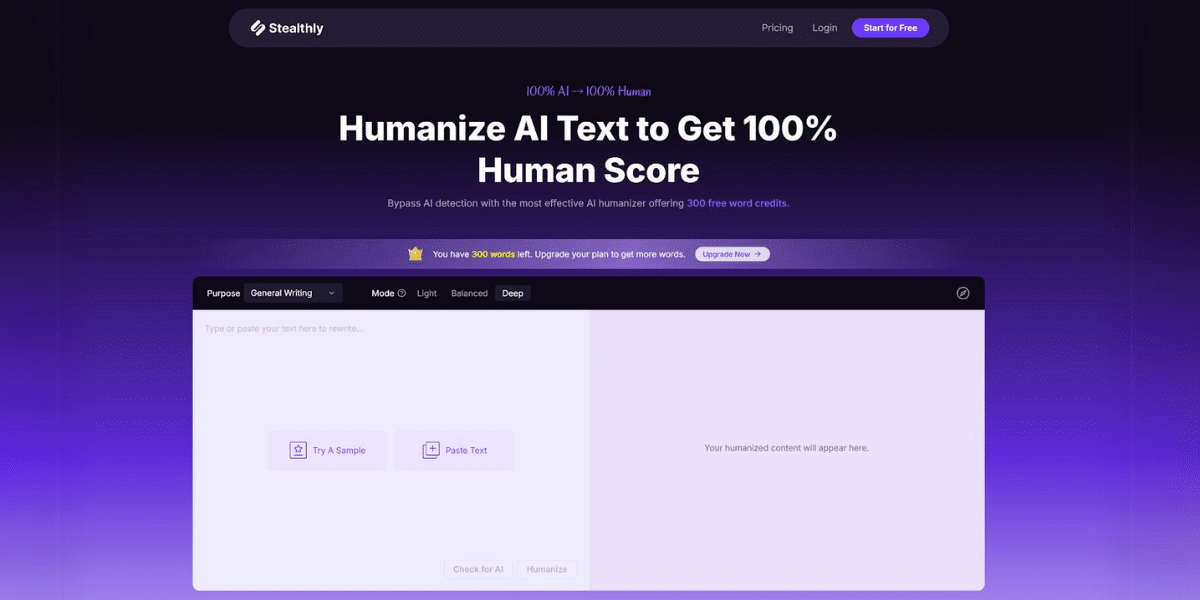
The interface of Stealthly is designed to be intuitive, catering to users of all technical backgrounds. The process of humanizing AI text is straightforward: users simply paste their text into the tool, click a button, and receive a revised version that adheres to the desired level of humanization. This ease of use makes Stealthly accessible to a wide audience, from students to professional writers.

Plagiarism-Free Guarantee

Stealthly emphasizes its commitment to producing original content. Each humanized output is designed to be free from plagiarism, addressing the concerns of users who must ensure their work adheres to academic and professional standards. This feature is particularly appealing to students who face stringent academic integrity policies.

Multi-Language Support

In an increasingly globalized world, the ability to humanize content in various languages is a significant advantage. Stealthly claims to support multiple languages, making it a versatile tool for businesses and individuals operating in diverse linguistic contexts. This feature enhances its usability for international users.

The Process of Humanizing AI Text

Step-by-Step Guide

1. Input AI-Generated Text: Users begin by pasting their AI-generated content into the Stealthly platform.
2. Select Humanization Mode: Stealthly offers different humanization modes—light, balanced, and deep—allowing users to choose the level of rewriting they prefer based on their specific needs.
3. Click Humanize: After selecting the desired mode, users simply click the humanize button to initiate the process.
4. Receive Humanized Content: The tool generates a revised version of the text, which aims to bypass AI detection while maintaining the original meaning and intent.

Modes of Humanization

  • Light Mode: This mode offers minimal changes, suitable for users who want to retain much of the original text while enhancing its readability.
  • Balanced Mode: This option strikes a middle ground, making moderate changes to improve the text without overhauling it completely.
  • Deep Mode: For users looking for a comprehensive rewrite, deep mode applies extensive modifications, significantly altering the structure and style of the original content.

Practical Applications of Stealthly

Stealthly Review The AI Humanizer for Bypassing Detection (2)

Photo Courtesy: stealthly.ai

Academic Writing

Students can greatly benefit from using Stealthly, especially in environments where originality is paramount. The tool allows students to take AI-generated essays and enhance them to meet academic standards. By humanizing their work, they can avoid false positives in detection systems and adhere to integrity policies.

Content Creation for Businesses

For marketers and content creators, the need for engaging and authentic content is critical. Stealthly assists in refining AI-generated marketing copy, blog posts, and social media content, ensuring that the output is not only human-like but also optimized for reader engagement.

SEO Considerations

Search engine optimization (SEO) is a crucial factor for online visibility. Google and other search engines are increasingly wary of low-quality or spammy AI content. By using Stealthly, webmasters can enhance their AI-generated content, reducing the likelihood of being penalized by search engines. The tool helps maintain high-quality standards that improve overall content effectiveness.

Bypassing AI Detection

How Does Stealthly Work?

Stealthly’s algorithms analyze the input text for characteristics commonly associated with AI writing, such as repetitive structures, unnatural phrasing, and lack of emotional nuance. By making targeted adjustments, the tool effectively alters these elements to create a version that feels more authentic.

Success Against AI Detectors

The ability to bypass AI detection systems is one of Stealthly’s strongest selling points. The tool has undergone rigorous testing against popular detectors, ensuring that its outputs are genuinely undetectable. This capability is particularly appealing to users concerned about the implications of using AI-generated content in academic or professional settings.

Limitations and Considerations

Potential Over-Reliance

While tools like Stealthly provide valuable support, there is a risk of over-reliance on AI humanizers. Users should maintain a balance between utilizing technology and developing their own writing skills. Relying solely on automated tools may hinder personal growth in writing and critical thinking.

Quality of Output

Although Stealthly aims for high-quality output, the effectiveness can vary based on the complexity of the original text. Users should review the humanized content carefully to ensure it meets their expectations and retains the intended message.

Ethical Implications

The use of AI humanizers raises ethical questions, especially in academic contexts. While the goal is to produce original, high-quality content, there is an ongoing debate about the appropriateness of using such tools in educational settings. Users should be aware of the policies and standards in their respective institutions regarding AI-generated content.

Summary: Is Stealthly Worth It?

In summary, Stealthly presents a compelling solution for those looking to humanize AI text. With its advanced algorithms, user-friendly interface, and robust capabilities for bypassing AI detection, it serves as a valuable resource for students, writers, and businesses alike. However, users should approach the tool with a mindful awareness of its limitations and ethical considerations.

For individuals and organizations that prioritize authenticity and engagement in their writing, Stealthly offers a practical means to achieve these goals. As the landscape of content creation continues to evolve, tools like Stealthly will likely play an increasingly important role in shaping how we interact with AI-generated content.

Published by: Josh Tatunay

What Are the Key Benefits of ALM Software?

Application Lifecycle Management (ALM) software is an all-inclusive solution designed to oversee every phase of an application’s lifecycle. From the initial idea through development, deployment, and maintenance, ALM software ensures that every phase is streamlined and efficient. It integrates various processes, such as project management, requirements gathering, testing, and quality assurance, into a single platform. This integration helps teams collaborate better, maintain clear communication, and stay aligned with business goals. In essence, ALM software improves productivity and enhances the final product’s quality by providing a structured and organized approach to application development.

How Does ALM Software Improve Application Development?

ALM software significantly enhances application development by streamlining processes and improving team collaboration. With ALM tools, you can manage the entire lifecycle of your application, from initial planning to deployment and maintenance, all in one place.

ALM software allows all stakeholders access to the same data, fostering transparency and aligning the team’s objectives. This shared understanding minimizes miscommunication, enabling quicker decision-making and streamlining the development process for greater efficiency.

Moreover, ALM tools automate many repetitive tasks, such as testing and deployment. This speeds up the development cycle and reduces the risk of human error. Automated testing ensures that bugs are caught early, improving the overall quality of the application.

One major advantage is the capability to monitor progress in real time. ALM software offers dashboards and reports that allow you to track your project’s status, pinpoint obstacles, and make informed, data-driven decisions. This visibility helps keep the project on track and within budget.

In essence, ALM software brings together various aspects of application development, making the process smoother, faster, and more efficient.

What Are the Stages of ALM?

Understanding the stages of Application Lifecycle Management (ALM) is crucial for effectively managing the entire lifecycle of your application. ALM typically involves several key stages:

  • Planning and Ideation: This is where it all begins. You gather requirements, define goals, and outline the project’s scope. It’s essential to get a clear picture of what you want to achieve and how you plan to get there.
  • Development: Once planning is done, you move on to development. Here, the actual coding happens. Developers work to create the features and functionalities defined in the planning stage. Collaboration and version control tools play a significant role in this phase to keep everyone on the same page.
  • Testing and Quality Assurance: After development, it’s time to ensure everything works as intended. Testing and QA are about finding and fixing bugs ensuring the application is reliable and performs well. Automated testing tools contribute to accelerating the process while enhancing precision.
  • Deployment: Once testing is complete, the application will go live. Deployment involves making the application available to users. This stage requires careful planning to minimize downtime and ensure a smooth transition.
  • Operations and Maintenance: After deployment, the focus shifts to monitoring and maintaining the application. This includes fixing any issues, updating the application to add new features or improve performance, and ensuring it remains secure.
  • Retirement: Every application eventually reaches the end of its lifecycle. Retirement involves decommissioning the application, ensuring data is properly archived, and transitioning users to new systems if necessary.

Understanding and managing these stages ensures your application remains effective, reliable, and aligned with business goals throughout its lifecycle.

Why Choose Orcanos for Your ALM Needs?

Orcanos offers a comprehensive ALM solution integrating project management, quality assurance, and regulatory compliance. This platform ensures seamless collaboration across teams, making managing the entire application lifecycle easier. Orcanos’s ALM software enhances visibility and control, helping you meet business goals efficiently. Whether you need robust traceability, defect tracking, or integrated risk management, Orcanos provides the tools to streamline processes and improve product quality. Their solution is particularly beneficial for regulated industries, ensuring compliance with industry standards.

Summary

ALM software streamlines the entire application development lifecycle, enhancing efficiency, collaboration, and quality. Orcanos offers a robust ALM solution that integrates project management, quality assurance, and compliance, ensuring smooth and effective application development from start to finish.


Published By: Aize Perez

What is an SMB Server and How Does It Work?

An SMB (Server Message Block) server is a network protocol used for sharing files, printers, and other resources across a network. It operates on a client-server model, where the server hosts the resources and the clients access them. Essentially, an SMB server allows multiple users to access shared resources, making it easier to collaborate and manage files without needing to transfer them individually.

SMB servers are widely used in both corporate and home networks. They are particularly useful in environments where different operating systems, like Windows and Linux, need to interact seamlessly. By using SMB, you can set up shared drives that can be accessed by anyone with the right permissions, streamlining the process of file sharing and network resource management. This makes SMB servers an essential part of many IT infrastructures.

How Does an SMB Server Facilitate File Sharing?

An SMB server simplifies file sharing by acting as a central hub where all your files and resources are stored. When you set up an SMB server on your network, it allows different devices, whether they run on Windows, Linux, or macOS, to access and share files seamlessly. This is done through the Server Message Block (SMB) protocol, which manages the data exchange between the client devices and the server.

With an SMB server, you can create shared folders that multiple users can access. This means you don’t need to email files back and forth or use external storage devices. Instead, files are stored in one place, making collaboration easier and more efficient. Plus, SMB servers support various access controls, so you can decide who gets to see and modify specific files, enhancing both security and organization.

What Are the Key Versions of the SMB Protocol?

The SMB protocol has evolved significantly over the years. It started with SMB v1, which, although groundbreaking at the time, is now considered outdated and insecure. SMB v2 came with Windows Vista, improving performance and security. It introduced features like pre-authentication integrity. The latest, SMB v3, debuted with Windows 8 and Server 2012, offering enhanced security with features like end-to-end encryption. Each version has built on the previous, addressing vulnerabilities and adding capabilities, making SMB a robust choice for network file sharing. Always aim to use the latest version for optimal security and performance.

How to Set Up an SMB Server?

Setting up an SMB server is straightforward and can be done in a few steps. First, you need to install the necessary software. If you’re using a Linux-based system, install Samba using a package manager like apt or yum. For example, on Ubuntu, you would use sudo apt install samba.

Next, create a directory to share. You can do this with a command like mkdir /srv/samba/shared_folder. Then, configure the Samba settings by editing the smb.conf file located in /etc/samba/. Add your shared folder details under a new share definition.

After configuring, restart the Samba services to apply the changes. Use commands like sudo systemctl restart smbd and sudo systemctl restart nmbd. Finally, set up user permissions and ensure your firewall allows SMB traffic.

For a more detailed guide, check out this link.

How to Secure an SMB Server?

Securing an SMB server is crucial to protect your data and network. Start by avoiding SMBv1, as it’s outdated and prone to attacks like WannaCry. Opt for SMB3, which offers better security features like encryption and secure dialect negotiation. Make sure to restrict SMB access to trusted networks only. Implementing strict network policies and using strong authentication methods will further safeguard your server. Regularly update your SMB software to patch any vulnerabilities. By following these steps, you can significantly reduce the risk of unauthorized access and data breaches.

Which SMB Server Software Should You Use?

Choosing the right SMB server software can make a big difference in your network’s performance and security. If you’re looking for a robust, open-source option, Samba is a popular choice. It’s widely used in Linux and Unix systems and offers great compatibility with Windows clients. Samba supports various features like file and print sharing, making it versatile for many use cases.

On the other hand, if you need commercial support and advanced features, Visuality Systems provides strong alternatives. Their solutions are designed to work across different platforms, including Windows, iOS, and real-time operating systems. Visuality Systems offers OEM-friendly licensing, which can be a significant advantage if you’re integrating SMB into commercial products.

Both options have their strengths, so your choice should depend on your specific needs, including budget, required features, and the level of support you need.

Summary

Understanding SMB servers is essential for efficient file sharing and network resource management. From setting up and securing an SMB server to choosing the right software, these servers play a crucial role in maintaining seamless operations in a networked environment. Stay updated on the latest SMB protocols for optimal security and performance.


Published by: Khy Talara

Inventory vs. Fixed Assets: Understanding the Key Differences

One of the toughest things I could grasp when I first started running a company was differentiating inventory from fixed assets. Although they are both under the category of assets, their classification, tracking, and management differ most importantly. These two types of assets have different uses in the company; hence, good asset management and financial decision-making depend on an awareness of the differences.

In this post, I’ll explain the main distinctions between inventory and fixed assets, gently mentioning fixed asset software so you can grasp how each performs inside a company and why proper management of them is so crucial.

What Is Inventory?

First, let’s consider inventory, which comprises every item a company either uses or markets during manufacturing. For a retail store, for instance, your inventory is the assortment of goods you offer to consumers. Should you run a manufacturing company, your inventory would consist of completed goods, work-in-progress items, and raw supplies.

To address a frequently asked question now: Is inventory an asset? Indeed, inventory is regarded as a current asset. This means that usually, within a year, it’s something you can rapidly turn into cash as part of your normal business cycle. For instance, clothes sales in a retail store bring in money for the business.

Inventory is a current asset; thus, it should be used or sold over a brief period. This distinguishes it from long-term assets like property or machinery meant to support the company over several years.

Inventory vs. Fixed Assets

Photo: Unsplash.com

Can Inventory Be Depreciated?

Another quite common question is, Can inventory be depreciated? The answer is no. Depreciation pertains to long-term assets subject to obsolescence or wear and tear that gradually lose value. Inventory, being a short-term asset with a different use pattern than fixed assets, is not depreciated. Rather, inventory is expensed when sold; your income statement shows the cost of goods sold (COGS) reflecting this.

Key Points About Inventory:

  • Inventory covers manufacturing products, raw supplies, and goods for sale.
  • Within a year, this current asset should be convertible into cash.
  • Sold inventory is expensed rather than depreciated.

What Is a Fixed Asset?

Conversely, fixed assets are long-term assets used in companies to run across an extended period of time. These comprise buildings, machinery, computers, and vehicles—that is, practically any major piece of equipment or property the business owns that will be used for more than a year.

What is a fixed asset? A fixed asset is a physical, tangible item bought by a company for long-term use. These resources help the business run but are not directly sold to consumers like inventory. A company truck or piece of manufacturing equipment, for instance, is a fixed asset since it is essential in producing income over time but not a product the company intends to market.

Fixed assets are usually subject to depreciation as they age or become obsolete. Depreciation reflects an asset’s declining value year after year and distributes its cost over its useful life.

Inventory vs. Fixed Asset

Photo: Unsplash.com

Key Points About Fixed Assets:

  • Among fixed assets are operational-related property, machinery, tools, and vehicles.
  • These are long-term assets meant for use over several years.
  • Depreciation of fixed assets helps to adjust for obsolescence or wear and tear.

Intangible Assets: A Special Category of Fixed Assets

Furthermore, it is crucial to note that not all fixed assets are physical. Though they lack a physical presence, intangible assets, including patents, trademarks, and software, fall under the same category and are rather difficult to monitor. Like physical fixed assets, these assets still have long-term worth and can be amortised or depreciated over time.

For instance, that patent your company owns for a product is regarded as an intangible asset. Although you cannot handle it like a piece of equipment, your business will benefit from it, and it will be devalued similarly over its useful lifetime.

Is Inventory a Current Asset? Yes, and Here’s Why It Matters

As mentioned,  Inventory is categorised as a current asset. The difference here is significant since current assets are the tools enabling a company to remain short-term operational. Properly managing your inventory guarantees that you have the correct quantity of goods to satisfy consumer demand without tying down excessive cash.

Conversely, fixed assets are classified as long-term assets, so they require different management. For the company, these assets constitute a major outlay of funds that must be closely maintained and recorded over their lifetime.

Asset Management and Tracking Systems

Having the correct systems in place is absolutely vital when handling both fixed assets and inventory. Although inventory varies often, fixed assets are more constant but still must be precisely counted.

Many companies depend on fixed asset software to track and control long-term assets. This kind of program lets companies monitor maintenance, repair, and asset depreciation schedules. A fixed asset inventory system can also enable tracking and documenting the whereabouts and state of your assets, preventing any gaps.

Comparably, an asset tracking system lets companies track Inventory, movement, and availability. By using the appropriate tracking system, businesses can maintain an ideal balance of inventory, preventing overstocking or running out of important goods.

Inventory vs Fixed Assets: A Summary of the Key Differences

Let’s dissect the main variations between fixed assets and  Inventory:

  • Nature of the Asset: Inventory is short-term and intended for sale, while fixed assets are long-term and intended to support business operations.
  • Depreciation: Inventory is not depreciated but expensed when sold. Fixed assets are depreciated over their useful life to reflect wear and tear.
  • Asset Type: Inventory is a current asset because it’s expected to be turned into cash within a year. Fixed assets are long-term and used over several years.
  • Usage: Inventory represents goods for sale, while fixed assets include machinery, property, and equipment used in the business.
  • Management: Inventory is tracked for movement and sales, while fixed assets are tracked for location, condition, and depreciation.

Final Thoughts

In my experience, managing a company’s financial situation depends on knowing the distinctions between inventory and fixed assets. Although both are vital, they play rather different functions. While fixed assets support long-term growth by keeping operations running efficiently, inventory is all about keeping cash flowing through sales.

By means of appropriate asset management and tracking systems, you can guarantee that your company maintains control over both its current and long-term assets. Whether you are tracking inventory levels or handling fixed asset inventory, knowing each type of asset will enable you to remain competitive and make better commercial decisions.

Clearly separating inventory from fixed assets will help you to maximise your operations, guarantee accurate accounting, and preserve a strong balance sheet.

Published by: Nelly Chavez

The Hidden Economics of IT Staffing Agencies: Beyond Recruitment

While IT staffing agencies are primarily known for connecting businesses with talent, their impact on the economy and workforce extends far beyond mere recruitment. They play a vital role in shaping labor markets, influencing job dynamics, and responding to broader economic trends. By delving into the less visible aspects of IT staffing agencies, we can uncover their significant economic contributions and the implications for both businesses and job seekers.

The Gig Economy and IT Staffing

The gig economy has fundamentally altered how companies approach staffing, and IT staffing agencies are at the forefront of this change. By facilitating contract and freelance work, these agencies enable a more flexible labor market.

Economic Fluidity: IT staffing agencies contribute to economic fluidity by allowing companies to quickly adjust their workforce based on project needs. This flexibility not only benefits employers but also helps stabilize the economy during fluctuations. When businesses can scale their workforce up or down, they can respond to market demands without incurring the overhead costs associated with permanent hires.

Income Diversification for Professionals: For IT professionals, the gig economy offers opportunities for income diversification. Many skilled workers are now opting for freelance roles or short-term contracts that allow them to take on multiple projects simultaneously. This trend empowers individuals to manage their careers proactively and increases their earning potential, providing them with greater financial security.

The Role of IT Staffing in Economic Recovery

As economies worldwide face uncertainties, IT staffing agencies can play a crucial role in recovery efforts. By facilitating job placements, they contribute to overall economic resilience.

Quick Reemployment: During economic downturns, traditional hiring can slow significantly. IT staffing agencies help mitigate this by quickly matching displaced workers with new opportunities, thereby reducing unemployment rates. This rapid reemployment not only supports individuals but also helps stabilize industries that rely heavily on tech talent.

Upskilling Initiatives: To better serve their clients, many IT staffing agencies are investing in upskilling initiatives. By providing training and resources to candidates, agencies ensure that job seekers are equipped with the latest skills demanded by the industry. This focus on upskilling not only benefits the workforce but also bolsters the overall economy by enhancing productivity and innovation.

Local Economic Impact

The presence of IT staffing agencies can significantly affect local economies. Their operations can stimulate growth in various sectors, particularly in tech hubs.

Supporting Small Businesses: IT staffing agencies provide essential support for small and medium-sized enterprises (SMEs) that may not have the resources to maintain a full-time IT team. By connecting these businesses with skilled professionals, agencies help them access the technical expertise needed to compete effectively in the market. This support can lead to increased job creation and economic growth within local communities.

Economic Clusters: In regions with a high concentration of tech talent, IT staffing agencies contribute to the formation of economic clusters. These clusters foster collaboration among businesses, educational institutions, and government entities, driving innovation and attracting investment. As a result, local economies become more vibrant and resilient, benefitting from the synergies created by this interconnected ecosystem.

Changing Workforce Demographics

The changing demographics of the workforce are shaping how IT staffing agencies operate and engage with candidates.

Millennial and Gen Z Influence: Younger generations prioritize work-life balance, flexibility, and meaningful work. IT staffing agencies are adapting their offerings to meet these preferences, promoting remote opportunities and contract roles that align with these values. This shift not only enhances job satisfaction for employees but also enables companies to attract and retain top talent.

Diversity in Hiring: As organizations increasingly recognize the value of diversity, IT staffing agencies are prioritizing diverse candidate pools. By actively seeking candidates from various backgrounds, agencies contribute to a more inclusive workforce that can drive creativity and innovation. This emphasis on diversity is not just socially responsible; it also makes economic sense, as diverse teams tend to outperform their homogeneous counterparts.

The Future of IT Staffing Agencies

The landscape of IT staffing agencies is set to change dramatically in response to evolving market demands and technological advancements.

Integration of Advanced Technologies: The use of AI and machine learning in recruitment is just the beginning. IT staffing agencies are likely to integrate more advanced technologies to analyze workforce trends, predict skill shortages, and match candidates with positions more effectively. This tech-driven approach will enhance their value proposition to both clients and candidates.

Expanding Global Reach: As remote work becomes the norm, IT staffing agencies are poised to expand their global reach. By connecting talent from around the world with businesses in need of specialized skills, agencies will help create a more interconnected workforce. This globalization of talent not only enhances diversity but also fosters collaboration across borders, leading to innovative solutions and economic growth.

The impact of IT staffing agencies extends far beyond the act of recruitment. By shaping labor markets, facilitating economic recovery, and supporting local economies, these agencies are key players in the broader economic landscape. As they adapt to changing workforce demographics and technological advancements, their role will only grow more critical.

For businesses and job seekers alike, understanding the multifaceted contributions of IT staffing agencies offers valuable insights into how to navigate the evolving job market. In a world where flexibility, diversity, and innovation are paramount, these agencies stand out as essential partners in achieving workforce success.

Published by: Martin De Juan

How AI-Powered Automation is Transforming Healthcare Revenue Cycles

The healthcare industry is in the midst of a technological revolution, with artificial intelligence (AI) leading the charge in transforming processes across the board. One of the most significant areas of transformation is the revenue cycle, where AI-powered automation is reshaping how healthcare organizations manage their finances. This advancement is not just a trend but a crucial shift toward a more efficient, error-free, and profitable future for healthcare providers.

What is the Healthcare Revenue Cycle?

The revenue cycle in healthcare refers to the entire financial process that encompasses patient services from registration and appointment scheduling to final payment collection. It includes billing, coding, claims processing, and payments. Efficient management of the revenue cycle is vital for the financial health of healthcare organizations, ensuring that providers are paid accurately and promptly for their services.

However, the complexity of manual processes in the revenue cycle often leads to delays, errors, and significant administrative overhead. With the growing demand for healthcare services, these inefficiencies are magnified, causing financial strain on organizations.

That’s where AI-powered automation comes in. AI has the potential to completely overhaul the traditional revenue cycle, leading to increased productivity, accuracy, and financial performance.

The Benefits of AI-Powered Revenue Cycle Automation

Enhanced Efficiency

Healthcare organizations handle thousands of transactions daily, from patient registrations to final bill payments. The traditional revenue cycle relies heavily on manual labor, with staff often toggling between multiple systems to complete tasks such as coding, billing, and payment processing. This manual effort is not only time-consuming but also prone to human error.

AI-powered automation offers a solution by streamlining these tasks. For example, AI can automate the claims submission process, reducing the time taken from days to mere minutes. By implementing revenue cycle automation, healthcare organizations can ensure that repetitive tasks such as data entry and claims processing are handled efficiently and with fewer errors.

Reduction of Errors and Denials

One of the most significant challenges in revenue cycle management is dealing with denied claims. Denials occur for various reasons, including coding errors, incomplete documentation, or eligibility issues. These denials can lead to delayed payments and increased administrative costs as teams work to resolve the issues.

AI-powered tools excel at pattern recognition and data validation, allowing them to identify errors in real-time and correct them before the claim is submitted. For example, AI-driven systems can automatically flag discrepancies in coding or missing patient information, ensuring that claims are complete and accurate. This not only reduces denial rates but also speeds up the payment process.

In fact, many healthcare organizations that have adopted AI-driven revenue cycle solutions report a significant drop in their denial rates and faster turnaround on payments, resulting in improved cash flow and reduced administrative costs.

Improved Financial Forecasting

In an industry where margins are slim, accurate financial forecasting is essential. AI’s predictive analytics capabilities allow healthcare providers to gain insights into their revenue cycle performance. By analyzing historical data, AI can predict trends such as seasonal fluctuations in claims or potential bottlenecks in payment processing.

For instance, an AI-powered system can help a hospital predict when it may experience a spike in claim denials due to changes in regulations or payer behavior. Armed with this knowledge, the revenue cycle management team can proactively adjust their strategies to mitigate these issues, preventing a negative impact on the organization’s cash flow.

Additionally, AI can help identify opportunities for cost reduction by analyzing workflow inefficiencies and recommending process improvements. This level of insight into the revenue cycle allows healthcare organizations to make data-driven decisions that optimize their financial performance.

Real-World Impact: The AI Advantage in Revenue Cycle Automation

Consider a large health system that struggled with managing its vast amounts of clinical and financial data. The system was burdened by high denial rates, delayed payments, and a backlog of claims that were stuck in the review process. Manual intervention was required at every step, leading to inefficiencies and high operational costs.

After adopting AI-powered automation for its revenue cycle management, the health system saw dramatic improvements. Automated claims processing reduced submission times by 80%, and the system’s AI-driven tools flagged potential errors before submission, decreasing the denial rate by 30%. What used to take a team of billing specialists weeks to complete was now done in a matter of hours, thanks to the integration of automation technologies.

By reducing the need for manual processing, the organization not only improved its operational efficiency but also freed up valuable staff time that could be redirected to more strategic tasks, such as improving patient care and optimizing service delivery.

The Future of Healthcare Revenue Cycle Management

The future of the healthcare revenue cycle lies in AI-powered automation. As healthcare organizations face increasing pressure to reduce costs while improving patient outcomes, the adoption of AI technology becomes essential.

Scalability and Flexibility

AI-driven solutions offer scalability that manual processes simply cannot match. As a healthcare organization grows, so does the volume of claims, bills, and other transactions. With AI, the revenue cycle can be scaled effortlessly, handling increased workloads without the need for additional staff or resources.

Moreover, these AI tools are flexible and adaptable. As regulations and payer requirements change, AI systems can be updated to ensure compliance, reducing the risk of audits or penalties. By automating tasks such as eligibility verification, charge capture, and payment posting, healthcare providers can stay ahead of changes in the industry.

AI and Human Collaboration

One of the misconceptions about AI in healthcare is that it will replace human workers. However, the reality is that AI augments human capabilities, allowing healthcare staff to focus on higher-value tasks. By handling routine tasks such as billing and coding, AI frees up staff to engage in more complex problem-solving and patient-focused activities.

In addition, AI systems can work alongside revenue cycle management teams to provide insights and recommendations. For example, AI can analyze payer behavior and suggest strategies to improve claim acceptance rates, enhancing the overall financial performance of the organization.

Conclusion

AI-powered automation is transforming the healthcare revenue cycle, offering unprecedented opportunities for efficiency, accuracy, and financial performance. As healthcare organizations continue to navigate complex regulatory environments and financial pressures, embracing AI-driven revenue cycle automation becomes not just an option but a necessity.

By implementing AI in revenue cycle management, healthcare providers can reduce administrative costs, improve cash flow, and enhance overall operational efficiency. The future of healthcare is one where AI and automation work hand in hand with human expertise, creating a streamlined, data-driven approach to managing the revenue cycle that benefits both providers and patients.


Published By: Aize Perez