
By: Natalie Johnson
Most conversations about AI and human work run the same exercise. Sort tasks into what machines take and what people keep.
ICONIC Leadership refuses the exercise. Instead of sorting tasks, the book sorts capabilities and asks a harder question. Which ones get more valuable as the technology gets better rather than less?
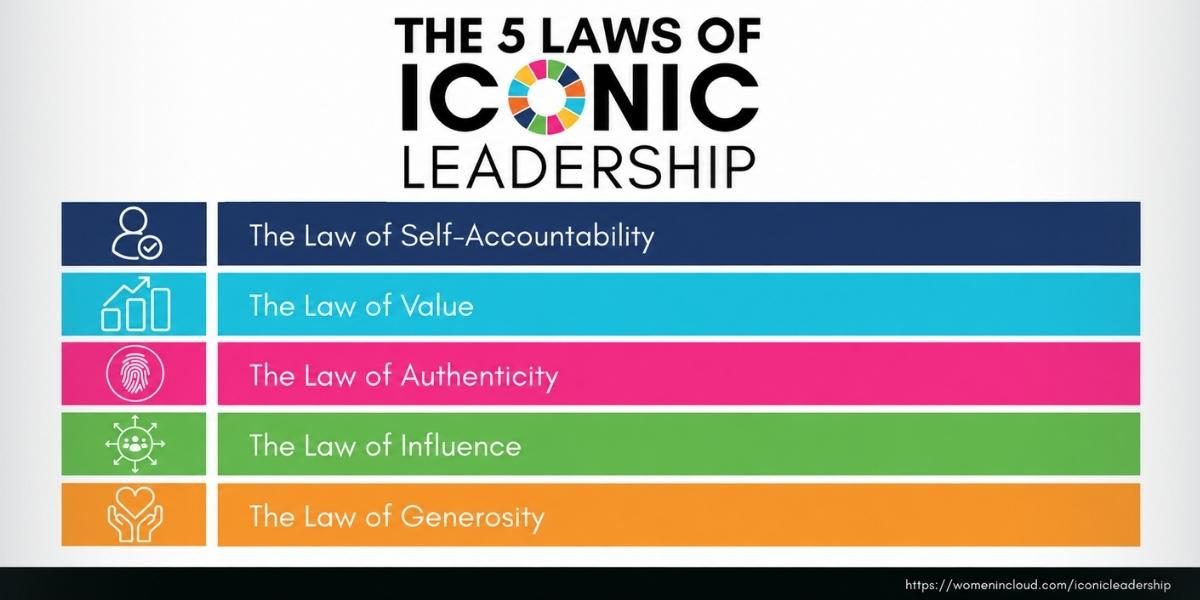
Its answer is five. Value, Influence, Authenticity, Generosity, and Self-Accountability.
They were pulled from the working frameworks of twenty leaders across technology, healthcare, capital, government, and public policy, curated by Dee Dee Walsh and Chaitra Vedullapalli.
One. Value
Not output. Value, defined as the judgment call about what is worth doing at all.
AI has compressed the cost of execution. Drafting, analyzing, summarizing, and modeling now take minutes. What has not been compressed is deciding which of those things should have been done.
This one comes first because everything downstream inherits it. A team executing flawlessly against the wrong priority now does so much faster.
Two. Influence
Karen Cone, one of the twenty contributors, works this law through funding data. Companies founded by women receive roughly 2 percent of venture capital. Founding teams that include both women and men receive a substantially larger share.
Her argument is that the gap does not close through better pitch decks. It closes when someone builds a platform that changes who gets into the room. Influence functioning as infrastructure, not persuasion. AI can generate the argument. It cannot be the person other people follow into a risk.
Three. Authenticity
This is the law with the hardest number attached.
Edelman’s 2025 Trust Barometer, covering more than 33,000 people across 28 countries, found 68 percent globally believe business leaders deliberately mislead them, up 12 points since 2021. Trust in CEOs splits nearly in half depending on grievance level, at 64 percent against 30 percent.
The reading here is that the default posture has flipped. Audiences no longer start from good faith. Every statement has to re-earn belief.
Generative tools made polished communication effectively free, which means polish stopped working as a signal. The scarce thing is a leader whose stated position and actual behavior match under observation.
Four. Generosity
The least intuitive entry on the list, and the one the contributors defend most directly.
Akhtar Badshah spent a decade running global philanthropy at Microsoft. Ram Dutt scaled the Sankara Eye Foundation model from one hospital to twenty. Sherlaender Phillips works on the 123-year parity gap and the case for closing it through infrastructure rather than time.
Their shared position is that generosity compounds. Opportunity handed to someone else returns as network, reputation, and access, on a timeline longer than a quarter.
AI optimizes for a defined return. It does not act on returns nobody has scoped yet.
Five. Self-Accountability
The DDI 2025 Global Leadership Forecast makes the case for the last law. Among roughly 13,000 leaders surveyed, only 32 percent expressed confidence in the leadership above them.
Two out of three leaders do not trust the layer running the organization.
DDI also found that leaders who do trust their senior executives are 2.2 times more likely to be excited about using AI at work and 2.8 times less likely to resist it.
That makes accountability operational rather than moral. An AI rollout inside a low-trust organization does not fail on tooling. It fails because nobody moves, and the people who own that outcome are the people who announced it.
Why five and not fifty
The short list is the point.
Most frameworks for the AI era expand. More competencies, more capability maps, more skills to develop. ICONIC Leadership goes the other way, arguing that the honest inventory of what cannot be automated is small, and that treating it as small is what makes it usable.
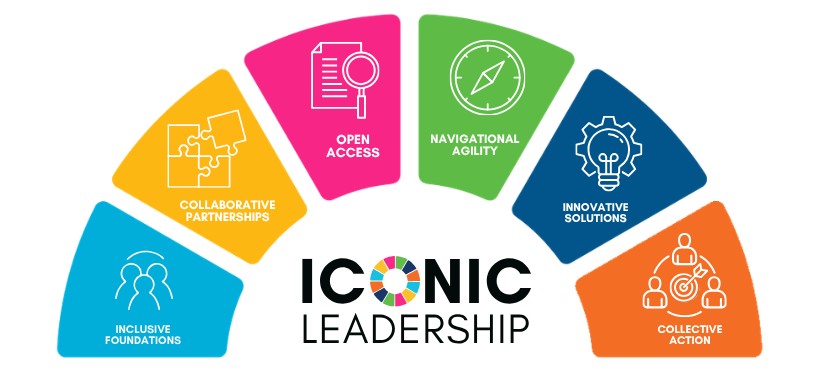
The five laws sit alongside ICONIC Arc Pillars the twenty contributors converged on independently: inclusive foundations, open access, innovative solutions, navigational agility, collective action, and collaborative partnerships.
None of them are technical.
If the technology really is universal and the execution gap really is closing, then value, influence, authenticity, generosity, and self-accountability stop being soft skills. They become the only variables left.