

When an engineering team needs more capacity, the choice of how to add it matters more than most managers realize. “We’ll just outsource it” and “let’s bring in some contractors” sound similar but describe very different arrangements, with very different levels of control, cost, and risk. Pick the wrong model and you either micromanage a vendor you should have trusted, or lose visibility over work you needed to steer. This article lays out the three main models honestly: staff augmentation, project outsourcing, and managed services, with a comparison table, a real cost breakdown, and a checklist for deciding which fits your situation.
Three Models Explained
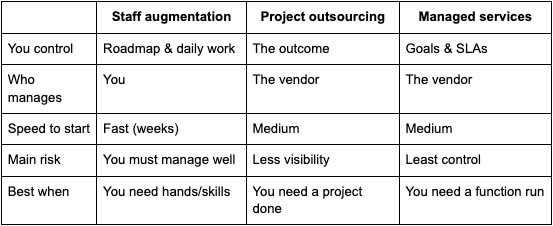
The three models sit on a spectrum of how much you hand over. Staff augmentation adds individual engineers to your existing team; they work under your management, in your tools, on your roadmap. You direct the work day-to-day; you have simply added hands and skills. Project outsourcing hands a whole, defined project to a vendor who manages delivery and returns an outcome; you care about the result, not the how. Managed services go furthest: a provider runs an entire function for you against agreed goals and service levels, and you stay hands-off.
None is inherently better. They answer different questions. The mistake is choosing by habit or by whichever a salesperson pitched, rather than by how much control you actually want to keep.
Comparison: Control, Cost, Speed, Risk
The Real Cost: In-House Vs An Augmented Team
Managers often compare an augmentation rate to an in-house salary, see the rate is higher, and stop there. That’s misleading, because a salary hides costs the rate already includes: recruitment fees (or the weeks your team spends interviewing), payroll taxes and benefits (often 20–40% on top of salary), equipment and software, a manager’s time for hiring and onboarding, and the weeks an employee sits idle between projects, still fully paid. Add the two-to-three months before a new hire ships a line of code, and the fully-loaded cost of an in-house hire usually meets or beats an augmentation rate, without the freedom to scale down when the work does. The fair comparison is fully-loaded cost against fully-loaded cost, not rate against bare salary.
A Worked Cost Example
Numbers make it concrete, so here’s an illustrative calculation (round figures, adjust to your market). Say a mid-level developer’s salary is $70,000 a year. Add about 30% for taxes, benefits, and paid leave, roughly $21,000. Add a recruitment fee of around $10,000, plus $5,000 for equipment, software, and a laptop. Add a slice of a manager’s time; call it $8,000. Before you count a single day of downtime, you’re already near $114,000, against an advertised salary of $70,000. A senior augmented engineer on a monthly rate can land at a similar annual figure, but with none of that overhead on your books and the freedom to stop the moment the project ends.
And that ~$114,000 still ignores the weeks between projects when the hire is paid but under-used, and the two to three months before they ship anything. Once all of that is on the table, the fully-loaded cost of the in-house hire typically meets or beats the augmentation rate, and augmentation keeps a flexibility the salary doesn’t, because you can scale it down the moment the work does. This is why the sticker-price comparison misleads so reliably: it sets an all-inclusive rate against a bare salary, calls the salary cheaper, and quietly ignores everything the salary doesn’t show. Run your own numbers on a fully-loaded basis before you decide.
How To Run A Low-Risk Trial
Whatever model you lean toward, you do not have to commit blind. A short, paid trial de-risks the decision more than any sales call. Define a small, real piece of work with clear acceptance criteria, something you can genuinely judge in two to four weeks. Watch not just whether the code works, but how the team communicates: do they ask good questions, flag problems early, and fit your process? Confirm that working hours overlap enough for same-day answers. Keep the option to replace a poor-fit person without penalty. A partner confident in their people will happily start this way; reluctance to trial is itself a useful signal.
When Each Model Wins
A quick rule of thumb: choose by what you are missing. If you know exactly what to build and simply need more hands or a specific skill, staff augmentation fits; you keep control and add capacity. If you have a well-defined project but neither the people nor the desire to manage it, outsourcing fits. If you want an ongoing function, support, infrastructure, a whole product line, run for you against SLAs, managed services fit. The clarifying question is always the same: do you want to direct the work, hand over a result, or hand over a responsibility?
Onboarding An Augmented Engineer Well
Augmentation fails most often not because the engineer is weak but because the onboarding was thoughtless. Treat an augmented engineer like a new hire, because functionally they are one. Give them access to repositories, the backlog, documentation, and communication channels on day one, not day five. Pair them with someone on your team for the first week so questions get answered fast. Start them on small, scoped tickets that build context before handing over anything critical. And set the reporting rhythm explicitly, daily stand-up, weekly summary, whatever suits , so expectations are clear from the start. Teams that invest a focused week here get a productive contributor by week two; teams that throw someone in cold spend a month wondering why it is not working.
Red Flags When Choosing A Partner
Not every provider is worth a trial. A few warning signs worth heeding: they cannot or will not let you interview the actual engineers before you commit; they resist a small paid trial and push for a long contract immediately; their working hours barely overlap yours yet they promise seamless collaboration anyway; and they answer questions about their process with marketing language instead of specifics. A good partner is comfortable being tested on their people, their communication, and their work, because that is where they are strong. Discomfort with scrutiny early is rarely a problem that improves once the contract is signed.
Hidden Risks And How To Mitigate Them
Every model carries risks worth naming up front. With outsourcing and managed services, knowledge can walk out the door when the contract ends; mitigate it by insisting on documentation and shared repositories from day one. Time-zone gaps can slow everything down; prefer partners with genuine working-hour overlap so questions get answered the same day, not the next. Quality is the universal risk; mitigate it with a small paid trial, clear acceptance criteria, and the right to replace a poor-fit engineer. With augmentation specifically, the risk is on your side: it only works if you actually manage the people, so it suits teams with the bandwidth to lead.
A Checklist To Pick Your Model
- Do you know precisely what needs building? Yes → augmentation or outsourcing. No → discovery first.
- Do you want to manage the work day-to-day? Yes → augmentation. No → outsourcing or managed services.
- Is the need defined and finite, or ongoing? Finite project → outsourcing. Ongoing function → managed services.
- Do you have management bandwidth right now? Plenty → augmentation works well. Thin → lean toward a model where the vendor manages.
- How important is scaling up and down quickly? Very → augmentation offers the most flexibility.
Where To Start
If the checklist points you toward adding senior engineers under your own management, the practical first step is a short conversation with a provider about the specific roles, seniority, and time-zone overlap you need, plus a small trial before any long commitment. Providers such as Peppernode offer team extension on exactly this basis: vetted engineers who join your stand-ups and tools with US and UK working-hour overlap, and most reputable firms will happily start with a trial engagement so you can confirm the fit before scaling. Whichever partner you choose, judge them on the trial, not the pitch.
One nuance worth adding: these models aren’t mutually exclusive across a company. Many teams run a stable in-house core for the work that defines them, augment it with external engineers when demand spikes or a specific skill is missing, and outsource a self-contained side project no one on the team has time to own. Thinking in terms of a portfolio rather than a single choice is often the most cost-effective approach, because it matches each piece of work to the model that fits it instead of forcing everything through one arrangement.
The Takeaway
There is no universally best way to add engineering capacity, only the model that fits how much control you want to keep and how well-defined the work is. Decide that first, compare costs on a fully-loaded basis rather than rate against salary, and start small. Get those three things right, and the model almost picks itself.
Disclaimer: The cost figures and comparisons in this article are illustrative and may vary based on location, provider, project scope, employment costs, and contract terms. Readers should conduct their own assessment before making staffing or outsourcing decisions.