
By: Andrew Carter
Most leadership books work with existing vocabulary. They take familiar concepts, reframe them, and offer new frameworks built from language everyone already recognizes. Mark Morse did something different. He looked at a specific moment in the lifecycle of disruption, the critical space between when something hits and when a leader responds, and decided that no existing word was adequate to describe it. So he invented one.
Stopportunity.
The word sounds simple. The idea behind it is not. A Stopportunity is not simply a pause. It is not a timeout, a reset, or a moment of reflection. It is the opportunity hidden inside the stop, the thing that becomes visible only when a leader is willing to interrupt the momentum long enough to hear what the disruption is actually trying to say. And according to Mark, most leaders never hear it, not because they’re not smart enough but because the pressure to react immediately is louder than anything else in the room.
Where the Idea Actually Came From
The concept didn’t emerge from theory. It emerged from three very different schools of experience converging at once.
Entrepreneurship taught Mark to prepare before disruption arrives. Never let one client represent more than 20 percent of revenue. Keep a financial cushion for the thin months. Don’t mistake one strong quarter for a hiring trend. You learn to ready the ship before the storm, not during it.
Jazz taught him something related but different. As a musician, the unexpected is not an exception. It is a feature. A bandleader changes direction mid-performance. A soloist takes the music somewhere nobody planned. You learn to listen, adapt, and respond without losing the rhythm. You stay inside the structure while remaining genuinely open to what emerges.
Then Mark shattered his elbow. Everything around him kept moving at full speed. He physically couldn’t. He had to trust the team he had built and let go in a way that entrepreneurship almost never requires. What initially felt like a painful disruption became a lesson in faith, trust, and ultimately the power of the pause itself. The idea crystallized: disruption doesn’t have to be merely an obstacle to survival. An opportunity is often hidden inside the stop.
That needed a name. Stopportunity was it.
The Real Cost of Skipping the Pause
Mark’s observation about what happens when leaders skip the pause is precise and uncomfortable. The PAUSE framework he has built around the Stopportunity concept has five stages: Prepare, Assess, Understand, Strategize, and Execute. Of those five, he believes Understand is the one most consistently shortchanged by high-capacity leaders under pressure.
Once a situation has been assessed and the problem seems clear, everything pushes toward strategy and execution. Leaders are experienced. They’re decisive. People are looking to them for answers. Speed feels like leadership. But experience and ego can work against clarity at exactly that moment. The Understand phase asks a leader to stay with the problem a little longer, ask more whys, challenge the first assumption, and separate the symptom from the actual cause.
Skip that step, and you can build a perfect strategy for the wrong problem. Execute it beautifully, consume resources, and end up right back where you started. The problem was never solved because it was never fully understood. Mark has watched this happen across hundreds of organizations. The pause isn’t where momentum goes to die. It’s where momentum earns its direction.
The Word and What It Signals
Inventing a word is a specific kind of intellectual claim. It says: this thing exists, it matters, and we need language to see it clearly. That is what Mark was doing when he coined Stopportunity. Not branding. Not marketing. Naming something real that was going unrecognized because it had no name.
The leaders who read this book and start seeing Stopportunities in their own organizations will find them everywhere, not just in the dramatic moments of crisis but in the quiet signals that precede them. A customer behavior that has started to shift. A talented employee asking a question nobody else is asking. A strategy still producing results, but not quite like it used to. A period of tremendous success where momentum itself makes it difficult to question what comes next.
The moments are inevitable. What a leader does with them is entirely up to them.
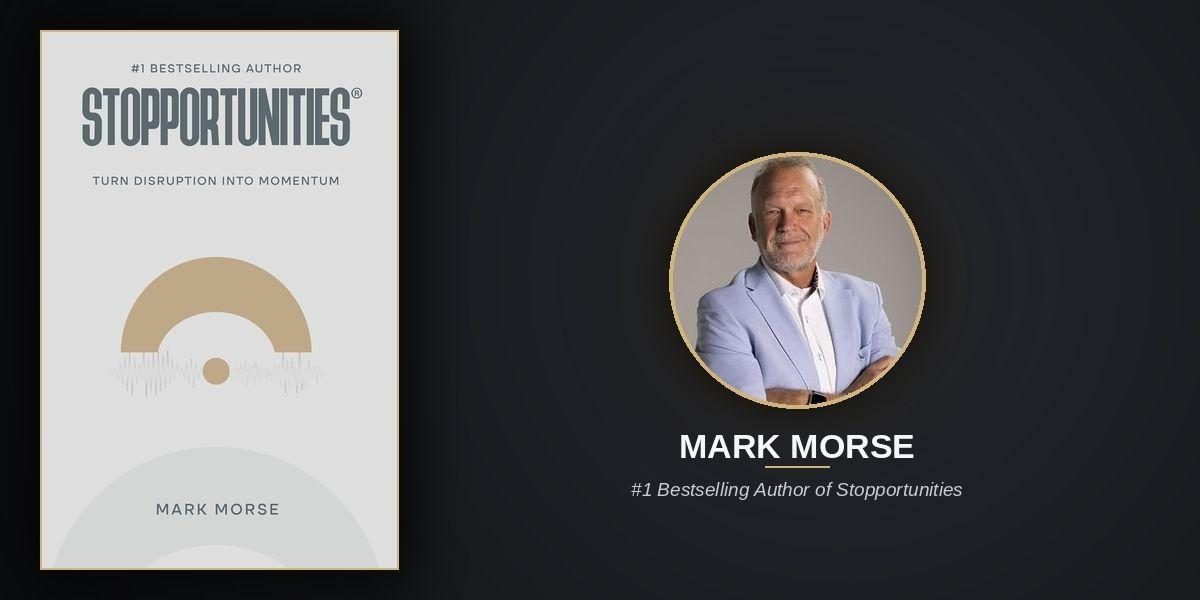
If you’re ready to stop reacting to disruption and start turning it into momentum, Stopportunities by Mark Morse is available now on Amazon. The word exists because the moment does. Now you need the framework.