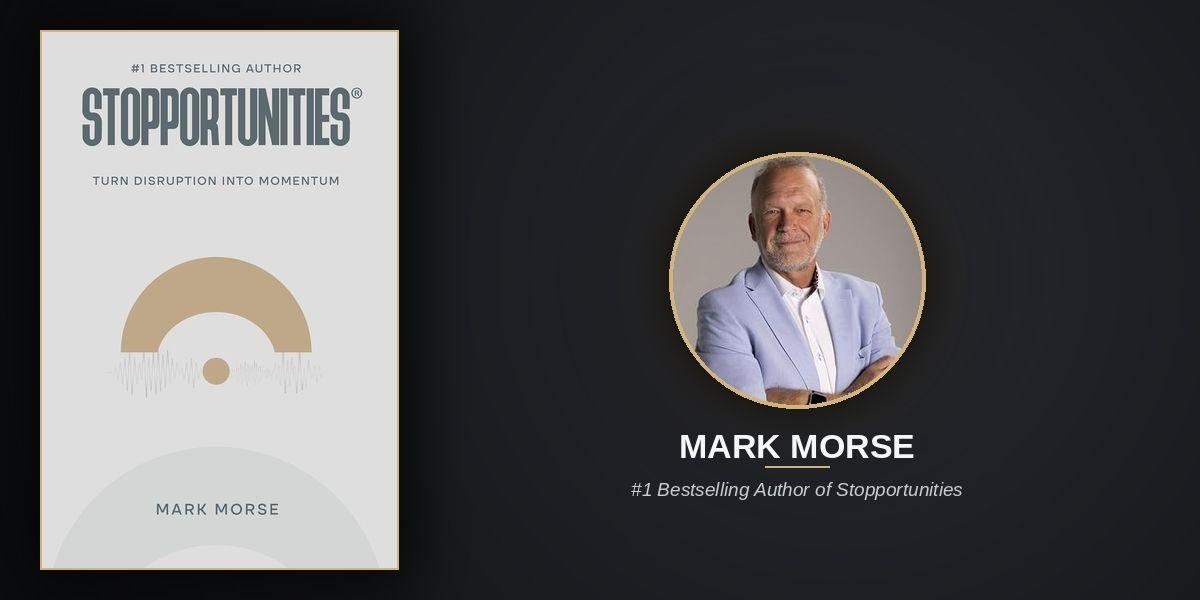
Mark Morse Invented a New Word Because the Old Ones Weren’t Doing the Job. That Word Might Change How You Lead.

By: Andrew Carter

Most leadership books work with existing vocabulary. They take familiar concepts, reframe them, and offer new frameworks built from language everyone already recognizes. Mark Morse did something different. He looked at a specific moment in the lifecycle of disruption, the critical space between when something hits and when a leader responds, and decided that no existing word was adequate to describe it. So he invented one.

Stopportunity.

The word sounds simple. The idea behind it is not. A Stopportunity is not simply a pause. It is not a timeout, a reset, or a moment of reflection. It is the opportunity hidden inside the stop, the thing that becomes visible only when a leader is willing to interrupt the momentum long enough to hear what the disruption is actually trying to say. And according to Mark, most leaders never hear it, not because they’re not smart enough but because the pressure to react immediately is louder than anything else in the room.

Where the Idea Actually Came From

The concept didn’t emerge from theory. It emerged from three very different schools of experience converging at once.

Entrepreneurship taught Mark to prepare before disruption arrives. Never let one client represent more than 20 percent of revenue. Keep a financial cushion for the thin months. Don’t mistake one strong quarter for a hiring trend. You learn to ready the ship before the storm, not during it.

Jazz taught him something related but different. As a musician, the unexpected is not an exception. It is a feature. A bandleader changes direction mid-performance. A soloist takes the music somewhere nobody planned. You learn to listen, adapt, and respond without losing the rhythm. You stay inside the structure while remaining genuinely open to what emerges.

Then Mark shattered his elbow. Everything around him kept moving at full speed. He physically couldn’t. He had to trust the team he had built and let go in a way that entrepreneurship almost never requires. What initially felt like a painful disruption became a lesson in faith, trust, and ultimately the power of the pause itself. The idea crystallized: disruption doesn’t have to be merely an obstacle to survival. An opportunity is often hidden inside the stop.

That needed a name. Stopportunity was it.

The Real Cost of Skipping the Pause

Mark’s observation about what happens when leaders skip the pause is precise and uncomfortable. The PAUSE framework he has built around the Stopportunity concept has five stages: Prepare, Assess, Understand, Strategize, and Execute. Of those five, he believes Understand is the one most consistently shortchanged by high-capacity leaders under pressure.

Once a situation has been assessed and the problem seems clear, everything pushes toward strategy and execution. Leaders are experienced. They’re decisive. People are looking to them for answers. Speed feels like leadership. But experience and ego can work against clarity at exactly that moment. The Understand phase asks a leader to stay with the problem a little longer, ask more whys, challenge the first assumption, and separate the symptom from the actual cause.

Skip that step, and you can build a perfect strategy for the wrong problem. Execute it beautifully, consume resources, and end up right back where you started. The problem was never solved because it was never fully understood. Mark has watched this happen across hundreds of organizations. The pause isn’t where momentum goes to die. It’s where momentum earns its direction.

The Word and What It Signals

Inventing a word is a specific kind of intellectual claim. It says: this thing exists, it matters, and we need language to see it clearly. That is what Mark was doing when he coined Stopportunity. Not branding. Not marketing. Naming something real that was going unrecognized because it had no name.

The leaders who read this book and start seeing Stopportunities in their own organizations will find them everywhere, not just in the dramatic moments of crisis but in the quiet signals that precede them. A customer behavior that has started to shift. A talented employee asking a question nobody else is asking. A strategy still producing results, but not quite like it used to. A period of tremendous success where momentum itself makes it difficult to question what comes next.

The moments are inevitable. What a leader does with them is entirely up to them.

If you’re ready to stop reacting to disruption and start turning it into momentum, Stopportunities by Mark Morse is available now on Amazon. The word exists because the moment does. Now you need the framework.


Introducing Toxically Ever After

By: Shawn Mars

A Debut Novel by Nicole Stone

She lost nearly everything, and turned what she learned into fiction that doesn’t look away.

Toxically Ever After: A Story of Toxic Love, Addiction, Survival, Perseverance and Starting Over follows Grace Everly through the gray areas of love and addiction most stories skip past. Written by debut novelist, finance professional, and mother of three Nicole Stone, it’s a raw, unflinching look at why we stay, why we return, and how we find our way back to ourselves.

Stone’s path to publishing was anything but conventional. Originally from the Baltimore, Maryland area and now based in Southwest Florida, she did not come to fiction through writing programs or years spent planning an author career. Instead, writing emerged during a period when she was building an entirely different chapter of her life.

More than three years after beginning that rebuild, Stone has turned her attention to fiction, creating characters willing to live in the uncomfortable spaces between bad decisions, consequences, and second chances. Her own experiences give her perspective on the subjects she writes about, but they do not dictate the story.

“Your worst chapter doesn’t have to be your last,” Stone says. “I’m not ashamed of where I’ve been. I’m proud of what I built after it.”

Why Grace Everly’s Story Matters

Grace Everly is fictional, flawed, and unapologetically human.

She stays when readers may want her to leave. She goes back when she knows better. She makes impulsive and destructive choices, rationalizes what is happening around her, and sometimes loses herself in the process.

Stone wanted it that way.

Rather than writing a heroine who always recognizes the red flags and makes the right decision, Stone created a woman who exists in the uncomfortable space between knowing something is hurting her and actually being ready to walk away from it.

Through Grace, Toxically Ever After dives into the messy realities of toxic love and addiction, why people stay, why they go back, the destructive choices they make along the way, and what it takes to finally break the cycle.

The novel doesn’t rush toward redemption or clean up the difficult parts along the way. Grace is allowed to be contradictory, frustrating, vulnerable, and human. For Stone, those imperfections are part of what makes the character worth following.

Stone’s own experiences give her a personal connection to many of the novel’s themes, but Grace has a story of her own. Fiction gave Stone the freedom to explore those difficult subjects without the constraints of telling her own story.

From Manuscript to Debut Author

Writing the novel was only one part of bringing Toxically Ever After into the world.

Stone has taken an unusually hands-on role in launching her first book, directing the creative vision surrounding her author platform, website, branding, and promotion. She has approached becoming an author much the same way she approached writing the novel: by learning as she goes and taking an active role in the process.

For someone whose professional background is in finance rather than publishing, the experience has meant learning an entirely new industry, from developing an author brand to preparing a book for release and figuring out how to introduce both herself and Grace Everly to readers.

What began as one novel is quickly becoming something larger: the start of a new creative career.

Readers can learn more about Stone through her official author website. Toxically Ever After is available for pre-order through Amazon and Barnes & Noble.

Taking the Book Beyond the Launch

Photo Courtesy: Nicole Stone

One part of Stone’s release plans carries a particularly personal meaning.

She intends to donate copies of Toxically Ever After to women at the Lee County Jail in Southwest Florida, a place Stone herself once spent time.

Rather than making that experience the center of her author story, Stone sees the donation as a way to bring the book to readers who might connect with Grace from a very different vantage point.

“Donating copies to the women at the Lee County Jail is personal for me,” Stone says. “I’ve sat where they’re sitting. If one woman reads Grace’s story and comes away believing her own story isn’t over, then putting the book in her hands matters to me.”

For Stone, there is something full-circle about returning with a novel bearing her name. The donation connects where she has been with what she is building now without requiring either one to define the other.

What Comes Next for Grace Everly

Photo Courtesy: Nicole Stone

Toxically Ever After may be Stone’s first novel, but she is already looking beyond her debut.

Stone is writing a prequel that will take readers deeper into Grace Everly’s past, exploring the early relationships, experiences, and choices that shaped the woman readers eventually meet in Toxically Ever After.

Instead of simply continuing Grace’s story, Stone is going backward to answer the question underneath it:

How did Grace become Grace?

The prequel will explore how toxic patterns take root long before their consequences become obvious, giving readers a look at Grace before the unraveling and a deeper understanding of how she became the woman readers meet in Toxically Ever After.

It also signals something important about Stone’s plans as an author. Toxically Ever After was not intended to be a single project followed by a return to life as it was before.

It is the beginning of what comes next.

Readers can follow Nicole Stone for updates on the upcoming prequel through her author page on Facebook.

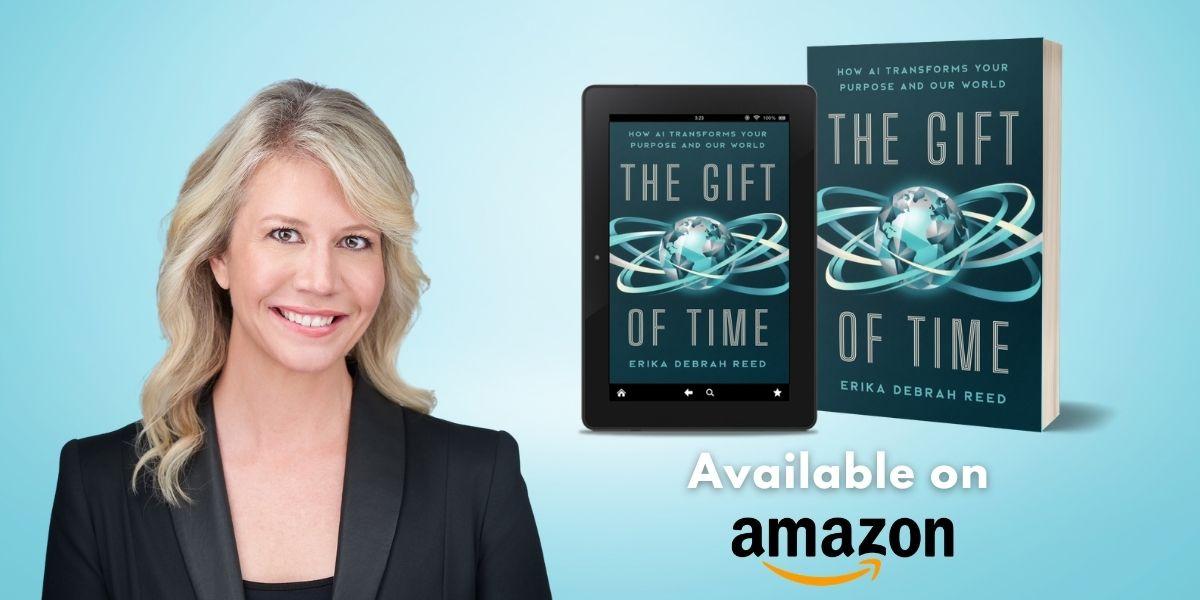
Erika Debrah Reed Isn’t Asking What AI Will Take From Us. She’s Asking What It Will Give Us. That Question Changes Everything.

By: Schiamarelly Pinckert

The conversation about artificial intelligence has settled into a familiar and exhausting shape. Jobs will disappear. Skills will become obsolete. Entire industries will be disrupted beyond recognition. The language is almost always about loss, and the emotional register is almost always fear.

Erika Debrah Reed walked into that conversation and asked a completely different question. Not what AI is going to take away. What it might give back.

The Gift of Time: How AI Transforms Your Purpose and Our World is built around a premise that sounds almost provocative in the current climate. What if AI could return to us something we have been quietly losing for decades, time itself? Not hours in the abstract but the specific, personal, irreplaceable hours that get consumed by commuting, repetitive tasks, fragmented attention, and the grinding administrative overhead of modern life. What if a thousand of those hours a year came back? What would we do with them?

Why the Fear Narrative Is Causing Real Harm

Erika is direct about what the current rhetoric is producing in people. The relentless focus on what AI will destroy is generating fear and anxiety that is causing unnecessary stress at an individual level. It is shaping how people relate to a technology that is already here, already embedded in their lives, and already changing the conditions of work in ways more nuanced and interesting than the displacement narrative captures.

Jobs will transform, she argues. They will not simply be replaced. That distinction matters enormously for how people prepare, how they think about their skills, and how they choose to engage with AI rather than retreat from it. The person who understands that distinction is positioned very differently from the person who is simply waiting to be made obsolete.

She also points to something the mainstream conversation almost entirely ignores: the benefits of autonomous mobility. Transportation underpins the economy. When transportation becomes more efficient, the cost of moving goods goes down. And when commuting time is reclaimed, dead hours spent behind a wheel or on a train become hours that can be used for something more constructive and meaningful. Rest. Time with family. Reading. The kind of restoration that most people can’t find enough of in the current structure of their days.

The Question Nobody Is Asking

The most interesting part of Erika’s framework is what she asks people to do with the time AI returns. And her answer is deliberately not prescriptive, because she believes the answer depends entirely on how a person measures the subjective value of their own time.

People who value achievement may work more. People who value joy may invest that time in family, in sport, in mastering something they have always wanted to learn. People who value meaning may find their way to civic participation, volunteerism, or creative work that the press of daily obligation never left room for. The gift of time is not a directive. It is an opening. What matters is whether people approach that opening with intentionality or simply fill it with more of what they were already doing.

Intentionality Over Productivity

The deepest challenge Erika identifies is not technological. It is psychological and cultural. People have been so thoroughly shaped by productivity culture that, when time opens up, the instinct is to fill it with more output. If AI gives someone three extra hours, the fear is that those three hours simply become three more hours of work. The extraordinary gift becomes another optimization metric.

What has to change, she argues, is not just what the technology can do but how people relate to time itself. Intentionality over productivity. The willingness to ask not just what can be accomplished but what actually matters, and to protect the answer from the relentless pressure to do more.

Writing the book changed how she moves through the world. She describes choosing to be an active participant in change rather than a passive observer, the author of her own life rather than a subject of AI’s unfolding agenda. That orientation is at the heart of everything the book asks of its readers.

If you’re tired of the fear narrative around AI and ready for a more honest conversation about what it might actually give us, The Gift of Time by Erika Debrah Reed is available now on Amazon. The technology is already here. The question is what you’re going to do with the hours it returns.