
By Sienna Cross
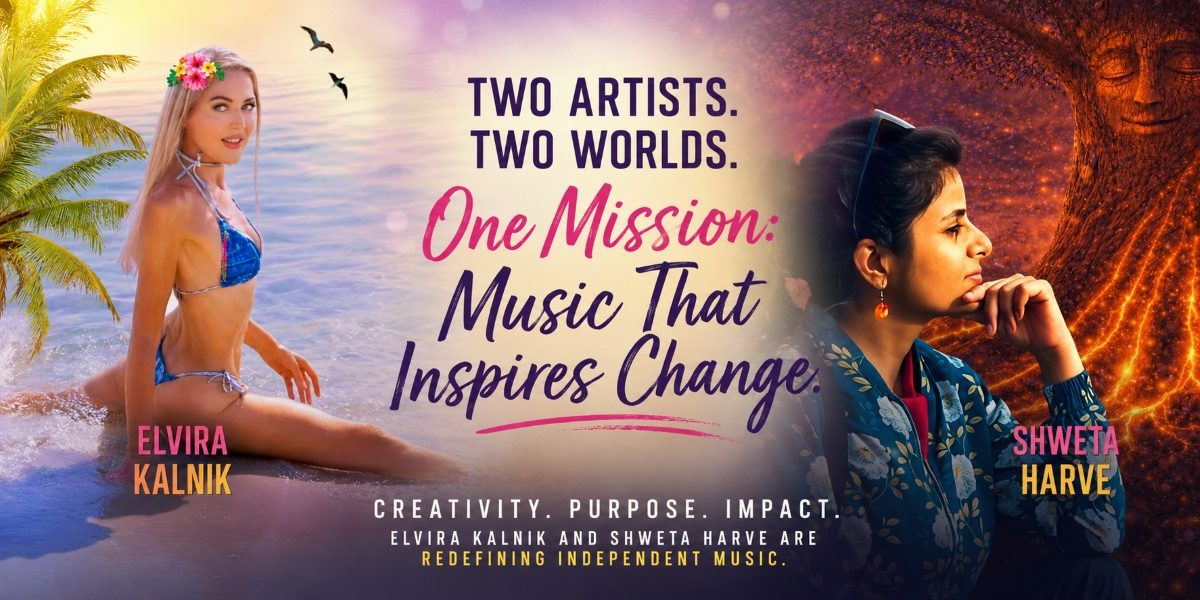
In an era when independent artists are no longer limited by geography, genre, or industry expectations, two women are proving that originality is one of the most valuable currencies in modern music. Though their artistic approaches differ dramatically, Elvira Kalnik and Shweta Harve have each built careers on fearless creativity, authentic storytelling, and an unwavering commitment to using music as a vehicle for something greater than entertainment.
Rather than chasing trends, both artists have spent years cultivating unmistakable artistic identities. The result is a pair of careers that illustrate how today’s independent musicians can achieve international recognition by remaining unapologetically themselves.
For Elvira Kalnik, creativity has never existed within a single discipline. The European-born, U.S.-based artist is equally at home as a singer, songwriter, producer, filmmaker, fashion designer, actor, and multimedia visionary. Beginning her musical journey at an early age, writing songs as a teenager, and producing her first album before turning fifteen, Kalnik developed a creative philosophy built around limitless exploration. Her classical vocal training became the foundation for music that fuses electronic production, cinematic storytelling, fashion, and visual art into one immersive experience.
That multidisciplinary approach has earned her recognition far beyond traditional music circles. Her visually ambitious music videos have collected honors at festivals across Europe and the United States, while performances such as her appearance at the United Nations Humanitarian Gala have reinforced her reputation as an artist whose work combines entertainment with inspiration. Her Presidential Award for Outstanding Leadership and Community Impact further reflects the breadth of her influence beyond the recording studio.
Recent releases, including “Blind Love,” “It’s Valentine,” and the revitalized “Summer Time,” demonstrate Kalnik’s ability to balance emotional depth with vibrant electronic production. Whether examining the illusions that accompany romance or celebrating the joy found in living fully in the present, her music consistently encourages listeners to look inward while embracing optimism.
Shweta Harve’s path, while equally ambitious, is rooted in a different artistic mission. Her music often serves as social commentary, using memorable melodies and accessible pop sensibilities to spark conversations about issues many artists avoid. Rather than focusing solely on personal experiences, Harve frequently expands her songwriting into examinations of empathy, digital culture, human relationships, and environmental consciousness.
That willingness to engage with larger themes has become one of her defining characteristics. Instead of offering easy answers, Harve invites listeners to reflect on their own role in shaping a more compassionate world. Her work balances emotional honesty with thoughtful observation, creating songs that resonate long after the music ends.
Her acclaimed single “What the Troll?” exemplifies this philosophy. Addressing the growing impact of online toxicity and cyberbullying, the song transforms a contemporary social issue into a universally relatable anthem about kindness, accountability, and choosing empathy over cruelty. Rather than condemning technology itself, Harve challenges listeners to consider how they interact with one another in an increasingly connected world.
Likewise, her more recent work, “Have You Loved Like a Tree?,” continues that trajectory by exploring humanity’s relationship with nature, patience, generosity, and unconditional love. The song offers a quiet but powerful reminder that growth often happens slowly and that strength can coexist with gentleness. Together, these releases reveal an artist committed to creating music that encourages reflection without sacrificing accessibility.
What makes Kalnik and Harve particularly compelling is that both understand the modern independent artist must think beyond songs alone.
Kalnik constructs entire artistic worlds. Every release extends into fashion, film, design, choreography, and visual symbolism. Her projects feel more like multimedia exhibitions than conventional singles, inviting audiences into immersive creative experiences that blur the boundaries between artistic disciplines.
Harve, meanwhile, focuses on building conversations. Her releases become starting points for discussions about mental health, digital responsibility, environmental stewardship, and emotional resilience. Her artistry lies not only in writing memorable music but in inspiring audiences to think differently after the final note fades.
Despite these contrasting methods, both women share remarkable similarities.
Neither artist appears interested in fitting neatly within commercial expectations. Both embrace independence as an opportunity rather than a limitation. Both have cultivated international audiences without relying on traditional industry gatekeepers. And perhaps most importantly, both believe that music should carry emotional and cultural significance.
Their careers also demonstrate the growing power of female artists who refuse to be defined by a single role. Kalnik moves effortlessly between producer, performer, filmmaker, and designer. Harve combines songwriting with advocacy, using her platform to elevate conversations that extend well beyond the music industry.
In today’s global music landscape, authenticity often resonates louder than marketing budgets. Elvira Kalnik and Shweta Harve exemplify that reality. One creates expansive audiovisual universes fueled by imagination and innovation; the other crafts thoughtful songs that encourage compassion and social awareness. Both remind audiences that independent music can be simultaneously artistic, meaningful, and commercially relevant.
As their careers continue to evolve, these two artists are helping redefine what success looks like for modern independent musicians. They prove that originality remains one of the most powerful creative forces available, and that when artists stay true to their vision, borders, genres, and expectations become little more than starting points for something extraordinary.