
How Dr. Kevin A. Powe’s Orthodox Biblical Hermeneutics Reclaims Scripture as Formation, Not Mere Information
In many contemporary theological environments, biblical interpretation has become increasingly fragmented, divided between hyper-academic criticism on one side and deeply subjective devotionalism on the other. The result has been a growing hermeneutical instability within both church and academy, where Scripture is often reduced either to an object of detached analysis or a mirror for personal projection. Into this widening divide enters Dr. Kevin A. Powe with a substantial new theological curriculum that seeks to restore interpretive coherence through historical orthodoxy, Christocentric theology, and spiritual formation.
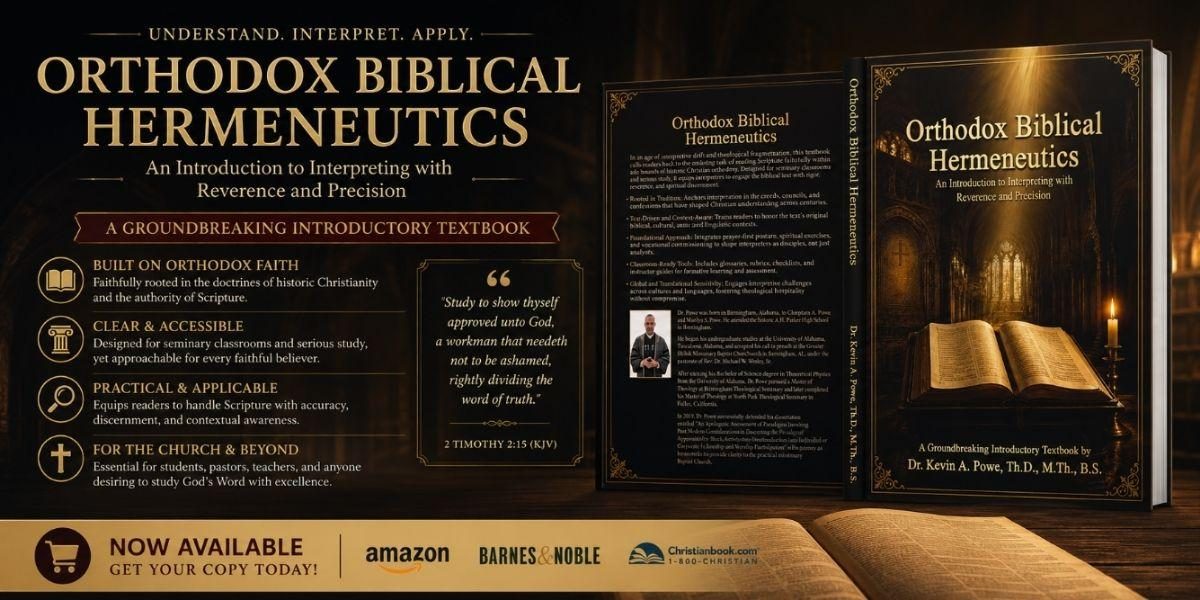
The forthcoming Orthodox Biblical Hermeneutics: Divine Entendre, Scriptural Reverence, and the Pathway to Theosis arrives not merely as another academic text on hermeneutics, but as a carefully developed response to the theological consequences of interpretive relativism. Written for pastors, seminary professors, graduate theology students, and advanced scholars, the work insists that faithful interpretation requires more than technical proficiency alone. It requires reverence, ecclesial rootedness, theological continuity, and spiritual humility.
At the heart of the series lies a conviction deeply embedded within historic Christian tradition. Scripture possesses an organic unity centered upon the person of Christ. Dr. Powe’s approach rejects the increasingly common tendency to read the Old and New Testaments as disconnected theological voices shaped primarily by competing communities or sociological developments. Instead, the series advances a canonical and Christ-centered lens in which covenant, kingdom, sacrifice, exile, prophecy, incarnation, redemption, and consummation form one continuous redemptive narrative culminating in Christ Himself.
This Christocentric framework becomes especially important in the author’s treatment of typology and Divine Entendre, a theological concept developed extensively throughout the curriculum. Rather than embracing arbitrary allegorical readings detached from textual context, Divine Entendre argues that Scripture contains divinely intended layers of meaning that take place progressively across redemptive history while remaining grounded in the historical-grammatical sense of the text. The result is a hermeneutic that preserves exegetical discipline while recovering the theological depth characteristic of patristic and classical Christian interpretation.
What distinguishes the project further is its integration of rigorous academic methodology with spiritual formation. In an era when theological education is frequently criticized either for intellectual abstraction or anti-intellectual simplification, the author refuses both extremes. The curriculum repeatedly emphasizes that hermeneutics is not simply the mastery of interpretive technique, but the formation of the interpreter. Prayer, moral attentiveness, contemplation, ecclesial accountability, and the illumination of the Holy Spirit are treated not as optional devotional additions, but as essential dimensions of faithful exegesis.
The broader curriculum reflects this integrated vision with unusual thoroughness. Alongside the primary textbook, the series includes a fully developed Companion Interactive Student Workbook and a TRACS-Aligned Instructor Manual designed specifically for seminary and graduate-level theological instruction. Together, these resources provide glossaries, exegetical exercises, guided reading frameworks, theological case studies, classroom activities, discussion prompts, examinations, grading rubrics, and structured syllabi adaptable for both traditional semesters and intensive academic formats.
For theology professors and ministry educators, the practical implications are substantial. The series offers not only a robust theological framework but also a classroom-ready academic architecture capable of sustaining serious graduate-level engagement. For pastors and ministry leaders, it provides a disciplined alternative to interpretive individualism while equipping readers to handle Scripture with greater theological precision and pastoral responsibility.
Perhaps most importantly, the Orthodox Biblical Hermeneutics collection restores an increasingly neglected truth within modern theological discourse: that Scripture was never intended merely to inform the intellect, but to conform the believer to Christ. In Dr. Powe’s vision, interpretation is ultimately an act of discipleship. One that demands intellectual rigor precisely because the biblical text is sacred.
As theological institutions continue searching for resources capable of bridging scholarship, orthodoxy, and spiritual formation, this forthcoming series positions itself as a defining contribution to contemporary hermeneutical education.
Pre-orders for the Orthodox Biblical Hermeneutics collection will now be available.