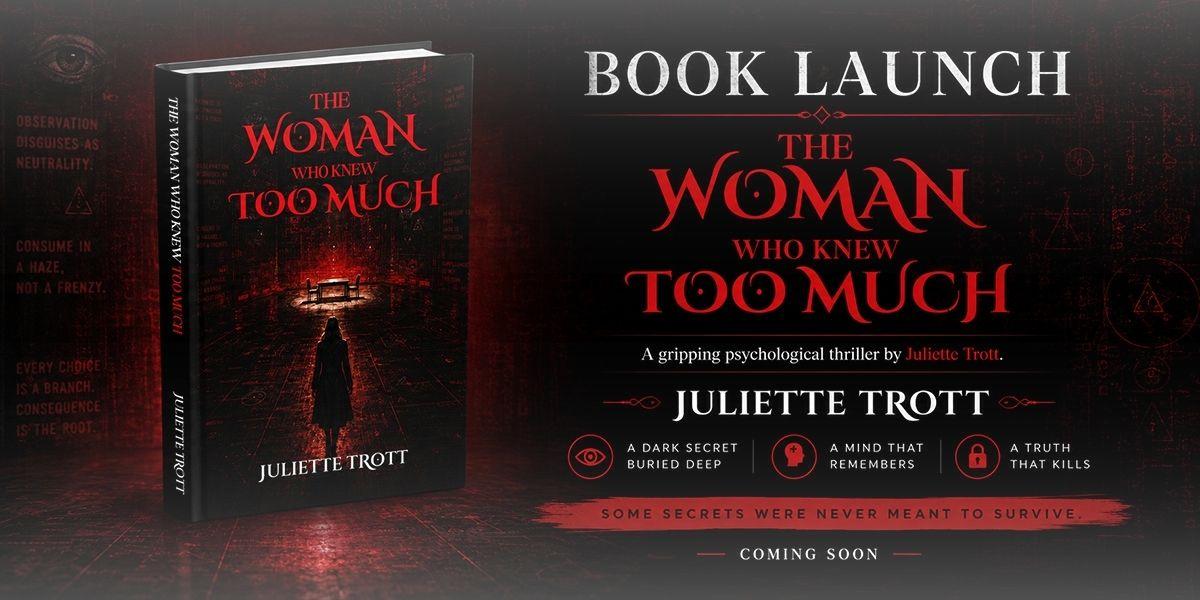
There is something uniquely unsettling about a story that refuses to let certainty exist. Not because it withholds answers, but because it quietly forces readers to question the systems, institutions, and narratives they instinctively trust. Juliette Trott’s The Woman Who Knew Too Much operates in exactly that space. A psychologically layered thriller where truth is not simply hidden, but carefully engineered.
At its surface, the soon-to-be-released novel begins with a familiar image. A woman was found dead in a luxury hotel bathtub, a scene quickly classified as suicide. But from its earliest pages, Trott establishes an atmosphere that feels wrong in ways both subtle and deeply unnerving. The stillness of the water. The precision of the room. A note too clean to belong to someone moments from death. Detective Cal Mercer recognizes what others are too eager to ignore. This is not grief arranged by tragedy, but a performance arranged for belief. That distinction becomes the emotional engine of the novel.
What makes this upcoming book particularly compelling is that it never relies solely on suspense to sustain momentum. Instead, it explores the psychology of control, who shapes narratives, who benefits from silence, and how institutions often protect themselves by manufacturing versions of reality that feel easier to accept. The novel’s recurring imagery of water becomes especially powerful in that context. Here, water is not cleansing or peaceful. It is containment. Distortion. Erasure.
Juliette’s world is populated by people carrying invisible fractures beneath polished exteriors. Mercer himself is not presented as a heroic detective untouched by damage. He is exhausted, isolated, and painfully aware of how systems bend truth for convenience. Meanwhile, Mara Sloane, a professor specializing in ethics and behavioral influence, becomes one of the novel’s most fascinating figures precisely because she exists in moral grayness. She understands manipulation academically long before she realizes she may be trapped inside it personally. That emotional ambiguity gives the novel unusual depth for the genre.
Rather than offering simplistic villains or easy revelations, the author constructs a narrative where fear emerges from recognition. The terror is not only that someone is capable of orchestrating these deaths, but that the machinery enabling it already exists, in bureaucracy, institutional loyalty, public perception, and the human tendency to accept polished explanations over uncomfortable truths.
The novel also succeeds because of its cinematic restraint. The author does not overwhelm scenes with excessive exposition or melodrama. Silence often carries more weight than dialogue. A paused glance, a surveillance blackout, an unfinished sentence. These details accumulate into a suffocating sense of paranoia that steadily tightens around the reader.
Beneath the psychological tension lies something profoundly human: the fear of losing ownership of one’s own reality. The fear that memory itself can be manipulated. That survival may come with consequences worse than exposure. And perhaps most hauntingly, that the people trusted to protect truth may be the ones most invested in burying it.
In an era increasingly shaped by misinformation, curated narratives, and institutional distrust, the book feels strikingly timely. It is not simply a thriller about murder. It is a story about perception, control, and the terrifying ease with which truth can be rewritten when powerful people decide the public should see something else. And once the novel plants that idea in your mind, it becomes impossible to shake.
Some stories entertain. Others linger. The Woman Who Knew Too Much does both and leaves readers questioning every version of the truth long after the final page.
The Woman Who Knew Too Much joins Juliette Trott’s growing list of psychological thrillers. It continues her interest in the secrets that powerful people work hardest to keep buried.
Knowledge has no power until it is applied. The need for practical hands-on learning is more critical. With learners in 100+ countries and certification coverage across AWS, Azure, Google Cloud, DevOps, and AI, Whizlabs continues to strengthen its position in cloud certification preparation.
With 5 million learning hours logged in their hands-on labs and Sandboxes, Whizlabs considers this milestone a major leap forward in delivering immersive, practice-driven cloud learning for the global technology workforce.
This achievement marks the surge in learners’ inclination towards practical learning in this technology-driven era. Through a diverse portfolio of learning resources, Whizlabs has consistently refined its upskilling approach to emphasize real-world application alongside certification readiness. They continue to build and sustain this idea, striking a balance between trust, impact, and global relevance.
Rooted with Real Impact
Since its inception, Whizlabs has been driven by a simple yet powerful mission: to make tech learning accessible, hands-on, and future-ready. As cloud and AI converge, Whizlabs is investing in AI-integrated lab environments, scenario-based simulations, and next-generation cloud certification pathways aligned with emerging enterprise needs. Learners worldwide rely on Whizlabs’ labs and Sandboxes to gain practical exposure in this fast-growing domain.
Achieving 5 million learning hours reflects the amount of engagement and trust that they have built over the years. Learners were committed. They stayed, practiced, and grew. As enterprises shift toward skills-first hiring models, validated practical experience is increasingly becoming a decisive factor in cloud and AI recruitment.
Hands-on Learning and Expertise Matter in Today’s Cloud-First Environments
According to industry insights from the National Association of Colleges and Employers (NACE) and the World Economic Forum, employers consistently prioritize practical experience and job-ready skills over theoretical knowledge alone. In today’s cloud-first environments, knowing the concepts isn’t enough. Teams need professionals who can deploy, secure, troubleshoot, and scale real-world solutions under pressure.
Certifications validate understanding, but hands-on execution builds true expertise and workplace credibility. At Whizlabs, we believe learners develop that confidence through consistent practice, real-world scenarios, and applied learning that prepares them for real-time challenges.
Through real cloud environments, scenario-driven assessments, instant performance insights, reliable lab access, and custom sandboxes, Whizlabs equips learners with a workforce-ready foundation to move into high-impact roles in cloud computing, DevOps, and software engineering.
Trusted by learners globally, Whizlabs continues to earn strong recognition for the quality and impact of its learning ecosystem. The platform is highly rated by learners across review platforms, including Capterra, Trustpilot, and G2, reflecting consistent learner satisfaction and real-world value.
These ratings and industry badges reinforce Whizlabs’ position as a dependable certification preparation partner for aspiring cloud and AI professionals worldwide.
Photo Courtesy: Whizlabs
Forging a Better Learning Experience
Whizlabs today has evolved as a trusted knowledge companion, providing accessibility, affordability, and in-depth content for cloud and tech certification. It’s a go-to resource hub for individuals, teams, and enterprises. And their achievement of 5 million learning hours in hands-on labs and Sandboxes marks their progress toward a practice-first ed-tech transformation.
The team expresses its gratitude to the incredible learning community of learners, educators, and partners, who have been so committed and supportive. They are enhancing and co-creating a learning platform that is relevant to learners and offers a much better experience, an act of giving back to the community itself.
“We see this milestone as a catalyst for deeper innovation. At Whizlabs, we are accelerating innovation to build immersive, intelligent learning experiences that prepare professionals for the rapidly evolving world of cloud and AI.”
— Krishna Srinivasan, CEO, Whizlabs
As cloud and AI continue to reshape the global technology workforce, Whizlabs remains focused on expanding its practice-first learning ecosystem. By strengthening exam-driven certification preparation and delivering hands-on, real-world learning experiences, they aim to equip professionals with the capabilities required to succeed in high-impact cloud and AI roles worldwide.
How AI Cinematic Video Generators Are Cutting Production Time. Here’s Why Creators Are Rethinking How They Work.
The numbers behind AI video production are hard to ignore. According to recent industry data, the average time to produce a 60-second video has dropped from 13 days to just 27 minutes when AI tools are part of the workflow. People using AI video report a 68% faster time-to-publish for video campaigns, and the shift is not limited to large production houses or marketing departments. Independent creators, educators, brand storytellers, and production teams across industries are restructuring how they approach video content entirely.
The driver is not unusual. It is an operational necessity.
Video demand has outpaced what traditional production can deliver at the speed modern distribution channels require. Content that once took weeks to build visually is now expected to go live in days. For most creator-led teams, the math on traditional production workflows no longer adds up. Hiring videographers, sourcing locations, directing shoots, and going through multiple editing rounds is a cycle that produces one video where five are needed.
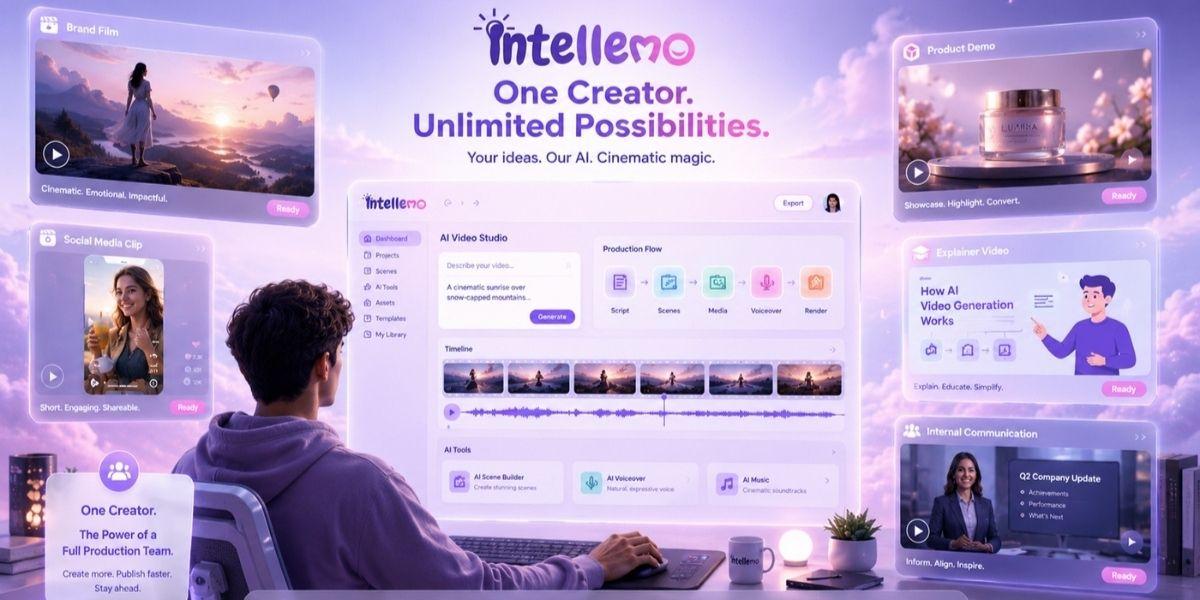
AI cinematic video generators address this not by reducing limitations on visual quality but by compressing the time and resource cost of every production stage. Scene-building, character generation, voiceover syncing, and narrative structuring that previously required a full production team can now be handled by a single person with the right platform. Brand storytelling, product demos, educational content, explainer videos, and internal communications are all being produced this way.
What the Workflow Shift Actually Looks Like
For creators who have moved to AI-assisted production, the practical change is significant. AI video tools save the average marketing team 34 hours per week previously spent on video production and editing. The time savings are comparable across non-marketing use cases as well, wherever video production involves repetitive technical stages that do not actually require human hands.
The quality bar has also shifted. AI tools have reduced production costs by 91%, from roughly $4,500 per minute to around $400, while minimizing the average 60-second video production time from 13 days to 27 minutes. For creators who were previously priced out of cinematic-quality output, that cost compression opens up production at a scale that was not financially feasible before.
There are a few specific areas where AI video generation has had the most measurable impact on creator workflows:
• Volume without added headcount: A solo creator or small team can produce content at a rate that previously required a full agency setup, without the overhead that comes with it.
• Consistency across scenes and formats: AI platforms that maintain character continuity and voice tone reduce the inconsistency that often comes with rushed or outsourced production.
• Faster iteration on creative direction: Testing different visual treatments for the same concept becomes practical when generation takes minutes rather than days.
The Pricing Model Creators Are Paying Attention To
One area where AI video platforms differ significantly is in how they charge. The standard model in most tools involves billing at multiple points in the generation process, including intermediate outputs like image elements and scene assets that creators cycle through before reaching a final video.
Platforms like Intellemo AI charge only when a final video is generated. Intermediate steps such as image element generation and scene-building assets are not billed separately, which means creators are not accumulating costs as they work through the production process. For teams producing video at volume, the distinction in how charges are structured has a real and practical effect on overall production costs.
Where This Is Heading
AI video generation volume grew 840% between January 2024 and January 2026. That rate of adoption reflects something beyond experimentation. Creators who have integrated AI cinematic tools into their workflows are not returning to traditional production for standard content categories. The economics and timeline advantages are too significant to walk back from.
Fifty-seven percent of creative agencies report at least a 38% reduction in production timelines after adopting AI video. What these tools are doing is not replacing creative judgment. They are handling the mechanical layers of production so that creative judgment has more room to operate. For creators building sustainable, high-output workflows, that is proving to be a meaningful shift in how video gets made.
About Intellemo AI
Intellemo AI is an AI-powered cinematic video generation platform built for brands, creators, and businesses. The platform supports production of brand films, product demos, social media content, explainer videos, and full cinematic story formats from simple text prompts. Intellemo AI is trusted by hundreds of millions of creatives and businesses globally and is a Google Premier Partner and Meta Business Partner.
How Dr. Kevin A. Powe’s Orthodox Biblical Hermeneutics Reclaims Scripture as Formation, Not Mere Information
In many contemporary theological environments, biblical interpretation has become increasingly fragmented, divided between hyper-academic criticism on one side and deeply subjective devotionalism on the other. The result has been a growing hermeneutical instability within both church and academy, where Scripture is often reduced either to an object of detached analysis or a mirror for personal projection. Into this widening divide enters Dr. Kevin A. Powe with a substantial new theological curriculum that seeks to restore interpretive coherence through historical orthodoxy, Christocentric theology, and spiritual formation.
The forthcoming Orthodox Biblical Hermeneutics: Divine Entendre, Scriptural Reverence, and the Pathway to Theosis arrives not merely as another academic text on hermeneutics, but as a carefully developed response to the theological consequences of interpretive relativism. Written for pastors, seminary professors, graduate theology students, and advanced scholars, the work insists that faithful interpretation requires more than technical proficiency alone. It requires reverence, ecclesial rootedness, theological continuity, and spiritual humility.
At the heart of the series lies a conviction deeply embedded within historic Christian tradition. Scripture possesses an organic unity centered upon the person of Christ. Dr. Powe’s approach rejects the increasingly common tendency to read the Old and New Testaments as disconnected theological voices shaped primarily by competing communities or sociological developments. Instead, the series advances a canonical and Christ-centered lens in which covenant, kingdom, sacrifice, exile, prophecy, incarnation, redemption, and consummation form one continuous redemptive narrative culminating in Christ Himself.
This Christocentric framework becomes especially important in the author’s treatment of typology and Divine Entendre, a theological concept developed extensively throughout the curriculum. Rather than embracing arbitrary allegorical readings detached from textual context, Divine Entendre argues that Scripture contains divinely intended layers of meaning that take place progressively across redemptive history while remaining grounded in the historical-grammatical sense of the text. The result is a hermeneutic that preserves exegetical discipline while recovering the theological depth characteristic of patristic and classical Christian interpretation.
What distinguishes the project further is its integration of rigorous academic methodology with spiritual formation. In an era when theological education is frequently criticized either for intellectual abstraction or anti-intellectual simplification, the author refuses both extremes. The curriculum repeatedly emphasizes that hermeneutics is not simply the mastery of interpretive technique, but the formation of the interpreter. Prayer, moral attentiveness, contemplation, ecclesial accountability, and the illumination of the Holy Spirit are treated not as optional devotional additions, but as essential dimensions of faithful exegesis.
The broader curriculum reflects this integrated vision with unusual thoroughness. Alongside the primary textbook, the series includes a fully developed Companion Interactive Student Workbook and a TRACS-Aligned Instructor Manual designed specifically for seminary and graduate-level theological instruction. Together, these resources provide glossaries, exegetical exercises, guided reading frameworks, theological case studies, classroom activities, discussion prompts, examinations, grading rubrics, and structured syllabi adaptable for both traditional semesters and intensive academic formats.
For theology professors and ministry educators, the practical implications are substantial. The series offers not only a robust theological framework but also a classroom-ready academic architecture capable of sustaining serious graduate-level engagement. For pastors and ministry leaders, it provides a disciplined alternative to interpretive individualism while equipping readers to handle Scripture with greater theological precision and pastoral responsibility.
Perhaps most importantly, the Orthodox Biblical Hermeneutics collection restores an increasingly neglected truth within modern theological discourse: that Scripture was never intended merely to inform the intellect, but to conform the believer to Christ. In Dr. Powe’s vision, interpretation is ultimately an act of discipleship. One that demands intellectual rigor precisely because the biblical text is sacred.
As theological institutions continue searching for resources capable of bridging scholarship, orthodoxy, and spiritual formation, this forthcoming series positions itself as a defining contribution to contemporary hermeneutical education.
Pre-orders for the Orthodox Biblical Hermeneutics collection will now be available.
What Will You Be Able to See Under a High-Power Microscope?
Point a high-power microscope at the right sample, and a hidden layer of the world snaps into focus, revealing living cells, creatures swimming in a single drop of pond water, and the fibers in your shirt looking like twisted rope. This guide covers exactly what shows up at high magnification, what stays invisible no matter how far you push it, and how to match the right tool to whatever you want to look at.
What Does “High Power Microscope” Actually Mean?
“High power” describes a magnification level, not one specific machine. On most microscopes, it refers to the stronger objective lenses (usually 40x and 100x), which combine with a 10x eyepiece to reach 400x to 1000x total. That’s the range where individual cells and microorganisms become visible. Two very different instruments deliver this kind of power, and the one you’re using shapes what you’ll actually see.
Biological compound microscopes
These shine light through a thin, see-through sample resting on a glass slide. Because the light passes through the specimen, compound microscopes are built for transparent things: cells, tissue slices, and single-celled organisms. This is the classic microscope from biology class.
Digital microscopes and USB/HDMI microscopes
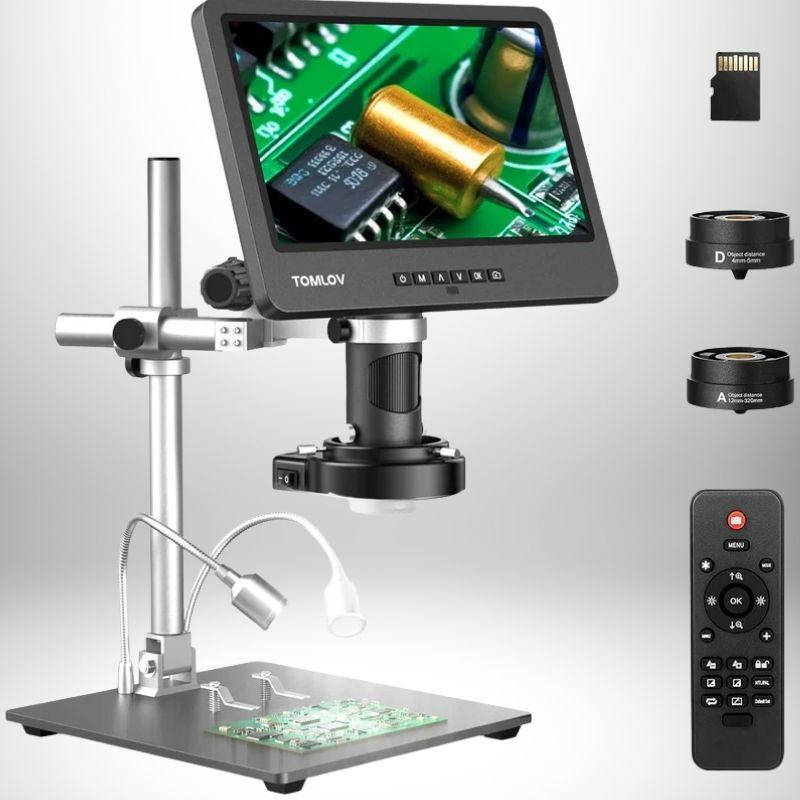
A digital microscope lights the subject from above and sends the image to a screen instead of an eyepiece. Since the light bounces off the surface, these are made for solid, opaque objects like coins, circuit boards, fabric, and insects. You view everything on an LCD or monitor, which makes sharing and recording effortless.
Photo Courtesy: TOMLOV
How Is High Power Different From Low Power?
Low power (around 40x to 100x total) gives you a wide field of view and plenty of depth, so you can take in a whole insect, a flower part, or an entire coin at once. High power trades that trade for detail. The field narrows, the depth of focus shrinks, and you need a thinner, flatter, better-prepared sample, but in return, you see structures that low-power simply can’t resolve. Most sessions start at low power to find the subject, then switch to high power to study it up close.
What Can You Actually See Under High Power?
This is where the payoff lands. At high magnification, things your eye glides right past turn into detailed, surprising landscapes. But what you can see splits cleanly along one line: anything transparent and alive needs a compound (biological) microscope shining light up through a slide, while solid, opaque surfaces are a digital microscope’s job. Here’s how that plays out.
Cells and basic biological structures
This is strictly compound-microscope territory. Because cells are transparent, you need light passing up through a thin slide to see inside them, and a digital microscope can’t light objects from above can’t. On a compound scope, a sliver of onion skin shows brick-like plant cells with clear walls, and a stained cheek smear reveals animal cells with a dark nucleus. The oil-immersion 100x lens brings out larger structures, but only if the slide is thin and stained.
Tiny living organisms in water samples
This is a compound microscope task, too. A single drop of pond or aquarium water, lit through from below, is one of the most rewarding things to view. Under high power, you’ll spot amoebas oozing along in a slow, jelly-like crawl, paramecia darting about, and green threads of algae. Watching them move in real time is when most people realize a microscope shows a living world.
Micro details in everyday materials
Here, the digital microscope takes over. Opaque objects can’t be lit from below, so they suit a digital scope lighting the surface from above. A strand of hair becomes a scaled rope, table salt turns into glassy cubes, and a newspaper photo splits into tiny dots of cyan, magenta, and yellow ink. Ordinary stuff becomes genuinely strange this close.
What You Won’t Be Able to See Even Under High Power
There’s a hard ceiling on what light can show. Optical microscopes (compound or digital) can’t resolve anything smaller than about 200 nanometers, a limit set by light’s wavelength. That puts viruses out of reach, and most bacteria sit at the blurry edge of what a school scope manages. Seeing a virus takes an electron microscope instead.
Practical Applications of High Power Microscopes
Quality control in manufacturing and electronics inspection
On a production line, high magnification catches the defects a quick visual check sails right past, including hairline cracks, surface contamination, cold or bridged solder joints, and components sitting slightly out of alignment on a circuit board. Catching these early, before a board ships or a part moves down the line, saves expensive rework and returns later. It’s one of the most common professional reasons people reach for serious magnification.
Scientific research and laboratory analysis
Research labs lean on high power almost every day. Biologists examine cell cultures to track how they grow and respond to treatments, microbiologists identify bacteria and other organisms in a sample, and materials scientists study the fine structure of metals, fibers, and compounds. Whenever a question comes down to “what is this made of” or “what’s happening at the cellular level,” high magnification is usually the first tool someone reaches for.
Education and STEM learning in schools
Research labs lean on high power almost every day. Biologists examine cell cultures to track how they grow and respond to treatments, microbiologists identify bacteria and other organisms in a sample, and materials scientists study the fine structure of metals, fibers, and compounds. Whenever a question comes down to “what is this made of” or “what’s happening at the cellular level,” high magnification is usually the first tool someone reaches for.
Jewelry, coins, and fine-detail inspection work
For jewelers and collectors, the fine details are the whole point. A jeweler checks stone settings, clarity, and the tiny inclusions that affect a gem’s value, while a coin collector examines mint marks, die cracks, scratches, and surface wear that separate a common piece from a valuable one. At this level, the difference between a confident grade and a costly guess often comes down to how clearly you can see.
Who Is a High Power Microscope Ideal For?
Students and beginners in science education
A first microscope rewards curiosity almost immediately. You don’t need exotic samples to get hooked; a drop of pond water, a sliver of onion skin, or a single strand of your own hair is enough to reveal something genuinely surprising. For anyone just starting out, that quick payoff matters because it keeps the interest alive long enough to build real skill, and it quietly turns “science homework” into actual exploration.
Teachers and classroom demonstrations
A screen-based model changes how a class learns together. Instead of lining students up to take turns at a single eyepiece, a teacher can put one specimen on a monitor, let the whole room see the same thing at once, point out details, and discuss them live. It saves time, keeps everyone engaged, and makes it easy to capture an image to reuse in the next lesson or share with students afterward.
Engineers and electronics repair technicians
For soldering and board-level repair, magnification with steady, even lighting makes fine work far more accurate. Modern components are small enough that the naked eye can’t reliably tell a clean joint from a flawed one, so a good scope is a necessity. Viewing on a screen also keeps both hands free.
Hobbyists, collectors, and DIY enthusiasts
Coin and stamp collectors, model builders, miniature painters, and weekend tinkerers all benefit from a scope that reveals the detail their hands are working with. Whether it’s confirming a collectible’s authenticity, painting a tiny figure cleanly, or just exploring for fun, magnification adds precision and enjoyment to any small-scale hobby.
Choosing the Right Digital Microscope for Your Needs
When to choose a digital microscope over a biological microscope
If you mostly want to inspect solid objects (coins, electronics, jewelry, everyday materials) and you’d rather watch a screen than squint through an eyepiece, a digital model is the practical pick. If your interest is cells and living microorganisms, you’ll want a compound microscope with transmitted light and slides. The full Tomlov digital microscope range is sorted by use case, which makes matching a model to your subject quicker than reading through spec sheets.
When higher optical magnification is required
Be cautious with headline numbers like “2000x” on digital models, since the top of that range often leans on digital zoom that softens the image. For genuinely fine detail, optical magnification and lens quality matter far more than the biggest number printed on the box.
Matching the Right Microscope to Your Subject
A high-power microscope opens up a layer of the world that’s always been there, just out of reach, including cells, microbes, crystals, and textures you won’t un-see. The trick is matching the tool to the target: transmitted light and slides for living things, a screen-based scope for solid surfaces, and an electron microscope for anything smaller than light can resolve. Get that right, and the device fades into the background, and what stays with you is the detail.
FAQs
What can you see at 1000x magnification?
At 1000x (typically the oil-immersion limit of a school compound microscope), you can see individual cells clearly, including the nucleus, plus larger bacteria and single-celled organisms. Viruses stay invisible.
Can a high-power microscope see bacteria?
Larger bacteria, yes, especially with staining at 1000x. But they sit near the limit of optical resolution, so they show up as small rods or dots rather than detailed structures.
Do I need a compound or a digital microscope?
Choose a compound microscope for cells and microorganisms on slides. Choose a digital microscope for solid objects like coins, circuit boards, and everyday materials viewed on a screen.
Why does everything look upside down through a microscope?
A compound microscope’s lenses flip the image, so it appears upside down and reversed. Move the slide right and the view shifts left, and it just takes a little practice.
As conversations around PFAS, microplastics, and long-term chemical exposure grow, some consumers are taking a closer look at the cookware they use daily.
For many people, cooking at home feels like one of the healthiest choices they can make. They buy organic groceries, filter their water, and spend more time preparing meals instead of ordering takeout. What often goes unquestioned, however, is the cookware sitting on the stove.
That growing concern is part of what led to the rise of companies like TAIMA®, a US-based cookware brand focused on pure-titanium kitchenware for health-conscious consumers who want to reduce unnecessary chemical exposure in the kitchen.
Why Titanium Cookware Is the New Health Conversation
Over the last several years, public awareness around PFAS and other industrial chemicals has increased significantly. Consumers have become more attentive to ingredient labels, food packaging, and water quality. Cookware is now entering that same conversation.
Many conventional pans rely on chemical coatings or materials that can wear down over time through repeated heating, scratching, or daily use. Plastic cutting boards have also come under scrutiny as research on microplastics continues to develop.
For TAIMA®’s founder, that realization became personal.
“I research everything I put in, on, or around my body,” the founder explains. “When I realized how many kitchen tools could expose people to unnecessary chemicals or materials that they never intended to consume, it changed the way I looked at cookware completely.”
That perspective became the foundation for the company’s line of titanium cookware, including cookware bundles, pots, utensils, and titanium cutting boards.
A Titanium Pan and a Different Approach to Non-Stick Cooking
Photo Courtesy: Taima Titanium
TAIMA® centers its products around pure titanium, the same material commonly used in surgical implants, pacemakers, and dental implants due to its durability and corrosion resistance.
Its flagship titanium pan avoids traditional chemical coatings entirely. Instead, the cooking surface uses the company’s proprietary SlipScale™ technology, which delivers natural nonstick performance without PFAS, PTFE, or PFOA.
That distinction matters to consumers who have grown skeptical of disposable cookware and coating degradation.
Unlike coated pans that may need replacement after a few years, TAIMA® positions its cookware as a long-term investment. The titanium pans are dishwasher-safe, oven-safe up to 1,150°F, compatible with every major stovetop, including induction, and backed by a lifetime warranty.
For buyers who cook frequently, durability has become part of the value equation alongside health considerations.
Why Titanium Cookware Bundles Are Gaining Attention
Many consumers researching safer cookware are no longer replacing a single pan at a time. Instead, they are rethinking the entire kitchen environment, from pots and utensils to the surfaces used for food preparation.
TAIMA®’s titanium cookware sets combine pans, pots, utensils, and cutting boards into a coordinated kitchen system designed for consumers who want greater consistency in the materials they cook with every day. The company’s titanium cookware collections focus on long-term durability and material transparency rather than disposable convenience products.
Its Titanium Cutting Board has also become a popular choice for consumers looking to replace heavily worn plastic kitchen surfaces.
The Appeal of Pure Titanium Cookware in Everyday Kitchens
Interest in titanium cookware has historically been limited by availability and price. Most consumers are far more familiar with stainless steel, ceramic, cast iron, or traditional non-stick options.
That is changing as more shoppers prioritize material transparency.
TAIMA® says many customers discover the brand while researching PFAS exposure, hormone health concerns, or ways to reduce plastic use at home. The audience tends to skew older, often homeowners who are already intentional about wellness purchases and prefer products built for longevity rather than replacement cycles.
Consumers searching for a high-quality titanium pan often seek cookware that balances performance with long-term durability. The company’s pure titanium pan remains its flagship product, particularly among buyers seeking cookware without chemical coatings or synthetic nonstick layers.
Titanium Cookware Performance Still Matters
Health concerns may drive interest, but cookware still has to perform well in daily life.
That is one reason TAIMA® emphasizes practicality alongside material purity. Consumers want cookware that handles high temperatures, works across different stovetops, cleans easily, and maintains consistent cooking performance.
The company’s approach reflects a broader shift in consumer thinking. More shoppers are questioning not only what they eat but also how that food is prepared.
For some households, that means replacing older cookware piece by piece. For others, it means investing in materials they believe better align with their long-term values around health, durability, and transparency.
As awareness of cookware materials continues to grow, pure titanium is becoming part of a broader conversation about what people bring into their homes and use every day.
When people hear the phrase party performance boosters, they often assume it means stimulants or quick fixes. In reality, the most effective party performance boosters are usually the ones that support your body’s natural energy systems, hydration, and recovery processes before fatigue ever has a chance to set in.
Whether you’re heading to a festival, an all-day celebration, or a high-energy weekend with friends, maintaining stamina is about more than simply staying awake. It’s about supporting your body so you can stay energized, comfortable, and present throughout the experience.
The good news is that certain nutrients have been studied for their role in energy production, hydration, physical performance, and recovery. Understanding how these ingredients work can help you make more informed decisions when evaluating dietary supplements designed for endurance and wellness.
Why energy and endurance matter at festivals and events
A weekend at a festival can place surprising demands on the body. Hours of walking, dancing, standing, and exposure to heat can challenge both physical and mental stamina.
Unlike intense training in a gym, festivals often involve sustained low-to-moderate physical activity over an extended period. This exertion can affect energy levels, hydration status, and overall comfort.
As a result, many people look for ways to optimize their endurance and reduce fatigue before it becomes a problem. While proper nutrition, sleep, and hydration remain the foundation, certain nutrients may help support these goals.
The science behind party performance boosters
The best party booster products aren’t necessarily the ones with the strongest stimulant effect, but those that focus on supporting natural energy production, antioxidant protection, hydration, and recovery. Many modern formulas combine vitamins, minerals, antioxidants, and amino acids into a convenient capsule format designed to support overall wellness.
Let’s look at some of the ingredients commonly found in these formulas and why they matter.
Vitamin C and antioxidant support
One of the most researched nutrients for overall wellness is vitamin C. Beyond its role in immune health, vitamin C functions as a powerful antioxidant.
During prolonged physical exertion, the body naturally produces oxidative stress. Antioxidants help support the body’s ability to manage this process and maintain normal cellular function.
Many high-quality supplement formulas include vitamin C because it supports recovery and helps maintain overall vitality during demanding activities.
B vitamins and energy production
B vitamins play a critical role in converting food into usable energy. Nutrients such as thiamine (vitamin B1), vitamin B6, and vitamin B12 support normal metabolism and help maintain healthy energy production.
Many energy supplements contain significant amounts of B vitamins because, even though they don’t create energy on their own, they help the body efficiently utilize the nutrients consumed through food. For people participating in long events, these vitamins may help sustain energy and reduce the fatigue associated with prolonged activity.
Magnesium for endurance and recovery
Magnesium is involved in hundreds of biological processes, including muscle function, nerve signaling, and energy metabolism, which is why it’s frequently included in formulas designed to support endurance performance and recovery. Many people also report that adequate magnesium intake helps them feel more balanced after prolonged physical exertion.
Among the nutrients commonly included in performance-focused supplements, magnesium remains one of the most widely studied and respected.
Green tea extract and natural energy
Unlike aggressive stimulants, green tea extract offers a more balanced approach to energy support because it contains naturally occurring compounds that enhance focus and alertness while also providing antioxidant benefits. This combination makes it a popular ingredient in products designed to help people stay alert throughout long events without relying exclusively on high doses of caffeine.
For individuals looking for natural energy, green tea extract is often viewed as a more measured option than traditional stimulant-heavy products.
Alpha-lipoic acid and CoQ10
Two ingredients that frequently appear in advanced formulas are alpha-lipoic acid and Coenzyme Q10 (CoQ10). Both compounds play roles in cellular energy production. CoQ10, in particular, is involved in mitochondrial function, which is often referred to as the body’s energy production system.
Because of these functions, both compounds are commonly included in supplements intended to support better performance, endurance, and overall vitality.
L-carnitine and amino acid support
L-carnitine is one of several amino acids and amino acid derivatives commonly used in performance formulas. Its primary role is helping transport fatty acids into cells, where they can be used for energy production. This function has made L-carnitine a popular ingredient in products focused on endurance, recovery, and physical performance.
Plant-based extracts and wellness support
Many modern supplements incorporate plant-based ingredients alongside vitamins and minerals.
Herbal extracts have long been used in traditional wellness practices. While ingredients such as panax ginseng, tribulus terrestris, and other herbal compounds are frequently discussed in the supplement industry, consumers should always review ingredient lists carefully and understand the intended purpose of each ingredient.
Some products focus on energy, others on recovery, and some on broader wellness goals, such as supporting vitality or maintaining overall balance.
What party performance boosters are not
It’s important to understand what supplements cannot do. No dietary supplement can replace proper sleep, hydration, or nutrition. And no product can completely eliminate fatigue if the body has been pushed beyond its limits.
Likewise, products marketed as testosterone boosters, enhancers, or performance aids should be evaluated carefully. Claims involving testosterone levels, increased muscle, strength gains, blood flow, low libido, anabolic effects, or dramatic physical transformations often require closer scrutiny.
Consumers should look for transparent formulas, evidence-based ingredients, and realistic expectations.
The boost you need to party all night
The best party performance boosters aren’t about pushing your body harder. They’re meant to support the systems that already help you perform at your best.
Ingredients such as vitamin C, B vitamins, magnesium, green tea extract, alpha-lipoic acid, CoQ10, and L-carnitine are commonly included in modern dietary supplements because they support energy production, recovery, hydration, and overall wellness.
Whether you’re preparing for a festival, a long celebration, or any high-energy event, focusing on smart nutrition, hydration, and evidence-based supplementation can help you maintain stamina, support recovery, and feel your best throughout the experience.
Disclaimer: This article is for informational purposes only and does not constitute medical advice. The statements made regarding dietary supplements have not been evaluated by the Food and Drug Administration. These products are not intended to diagnose, treat, cure, or prevent any disease or health condition. Individual results may vary. Always consult a qualified healthcare provider before starting any new supplement, particularly if you are pregnant, nursing, taking medication, or have an existing medical condition.
A Story That Begins in A Village and Speaks to The World
Some books are written to inform. Some are written to inspire. A rare few manage to do both while carrying the emotional truth of a lived life. Kadam: Quest for Global Health Innovation in Nepal, by Dr. Shreedhar Paudel, belongs to that rare category.
At first glance, the book may seem like the personal story of a physician who rose from a modest rural upbringing to become a psychiatrist, public health leader, and faculty member in one of America’s most respected medical environments. But Kadam does something deeper than that. It traces the movement of one man’s conscience, from the hills and villages of Nepal to the hospitals and academic institutions of the United States, and then back again through action, service, and a determined refusal to forget where he came from.
Dr. Paudel’s journey is remarkable not because it follows a familiar success arc, but because it resists easy simplification. This is not a polished tale of triumph where every hardship becomes a convenient stepping stone. It is a candid, often vulnerable reflection on what it really takes to build something meaningful across continents, cultures, institutions, and expectations. In that honesty lies the real power of the book.
The Making Of A Mission
Born and raised in Jajaragaun in Nepal’s Dang district, Dr. Paudel grew up in an environment where beauty and hardship coexisted. His early memories are not just nostalgic details. They are foundational to the worldview that shaped his life. He writes from the perspective of someone who has seen what limited access to health care looks like up close. He understands what it means when a village has no bridge, when a child walks barefoot to school, when basic care is far from guaranteed, and when community members rely on under-resourced local health workers for urgent needs.
That beginning matters because Kadam is not simply about professional achievement. It is about moral continuity. The child who witnessed inequality in rural Nepal became the physician who could not stop thinking about how to respond to it.
Even after his education took him to Kathmandu, then onward to the United States, the central question remained the same:How do you turn personal advancement into collective impact?
That question sits at the heart of the manuscript!
More Than A Doctor, More Than An Author
Today, Dr. Shreedhar Paudel serves as an attending psychiatrist at Massachusetts General Hospital and as an Assistant Professor of Psychiatry at Harvard Medical School. He also holds leadership roles as cofounder and President of Health Foundation Nepal, USA, and cofounder and Executive Director of the Nepal Institute of Mental Health in Nepal. On paper, those titles signal achievement. In the pages of Kadam, they become something more intimate and more demanding: responsibility.
The manuscript does not present those positions as badges of prestige. Instead, it frames them as platforms from which service must be expanded. That distinction is one reason the book feels human rather than promotional. Dr. Paudel repeatedly acknowledges that the work described in the manuscript was not built by one person alone. He credits colleagues, cofounders, supporters, local leaders, volunteers, mentors, and family. He even includes a direct apology to anyone who may have felt pressured by the demands of fundraising and movement-building in the early years.
That kind of honesty is unusual…
It reveals a writer who is not trying to appear flawless. He is trying to be truthful…
What Kadam Actually Offers Readers
The subtitle, Quest for Global Health Innovation in Nepal, captures the core of the book, but it only scratches the surface of its broader impact. This is not just a narrative about nonprofit development or public health systems; it is a powerful journey about empowerment, growth, resilience, and the positive transformation of communities. It’s a story of purpose-driven leadership, the joy of making a difference, and the harmony between personal ambition and a deep commitment to service.
The manuscript explores the formation of Health Foundation Nepal, the challenges of building a nonprofit structure in both the United States and Nepal, and the long process of transforming an idea into projects that could touch real lives. It goes on to cover community-based healthcare models, rural clinics, disaster relief after Nepal’s 2015 earthquake, mental health work, tele-mental health efforts during COVID-19, the growth of the Nepal Institute of Mental Health, and efforts to imagine a broader national center for mental health. Along the way, it also reflects on maternal and child health, chronic disease, rehabilitation, fundraising fatigue, volunteer burnout, and the emotional realities of trying to lead meaningful work while maintaining a family and full-time medical career. What makes all of this readable is that Dr. Paudel writes from direct experience, not from a distance.
He is not theorizing about service…
He is documenting what it cost, what it changed, and why it still matters…
Why This Story Resonates Beyond Nepal
Although the setting of Kadam is deeply rooted in Nepal, its meaning extends far beyond one country. This is a book for anyone who has ever wrestled with the question of how to give back without romanticizing the work. It will resonate with immigrants, first-generation professionals, physicians, nonprofit founders, mental health advocates, public health students, and readers who understand the emotional complexity of belonging to more than one place at once.
There is also something especially timely about this story. We are living in an era when people are increasingly skeptical of large systems and increasingly hungry for meaningful, human-scale change. Kadam enters that conversation with a grounded voice. It does not claim that one person can fix everything. It shows what can happen when one person decides to begin, builds with others, and stays committed through setbacks.
That is perhaps why the manuscript feels both personal and public…
It is the story of one life, but it also becomes a case study in citizen-led compassion…
The Emotional Center Of The Book
Perhaps the most compelling aspect of Kadam is that it never loses sight of the people behind the projects. Even when the manuscript discusses organizations, programs, or systems, the emotional weight remains human. Families made sacrifices. Friends answered repeated calls for help. Colleagues gave time and expertise. Communities trusted outsiders enough to partner in building something new. Patients and vulnerable populations remained at the center of the work.
The book’s endorsements reinforce this impression. Those who have worked closely with Dr. Paudel describe not only his discipline and leadership, but also his humility, sincerity, and willingness to keep going when easier paths existed. That combination gives the manuscript credibility. It suggests that Kadam is not just admired for what it documents, but for the integrity with which it was lived.
Another detail deepens that impression: Dr. Paudel states that 100 percent of the book’s proceeds will be donated to charity. That decision is fully aligned with the spirit of the manuscript. It turns the book itself into an extension of the mission it describes.
A Quiet But Lasting Kind Of Inspiration
There are books that motivate through grand rhetoric. Kadam inspires differently. Its impact comes from steady truth. It reminds readers that service is rarely glamorous, that leadership is often exhausting, and that meaningful change usually begins long before conditions feel ideal.
That is why this manuscript deserves attention. It offers something more durable than a momentary uplift. It offers perspective. It asks what a life of purpose can look like when built step by step, with no guarantee of ease and no illusion of solitary greatness.
For readers in New York and beyond, Kadam is a powerful reminder that the most important journeys are not always measured by how far someone travels from home, but by how faithfully they carry home within them.
In a world that often celebrates visibility over substance, Dr. Shreedhar Paudel’s Kadam stands as a thoughtful, moving, and deeply necessary work.
Read it not only to understand one physician’s path, but to reconnect with a larger truth:Compassion becomes transformative when it is organized, sustained, and put into action.
For anyone interested readers, institutions, and communities alike—this book offers a truly meaningful story with a real-world purpose. It’s definitely worth picking up, sharing with others, and supporting.
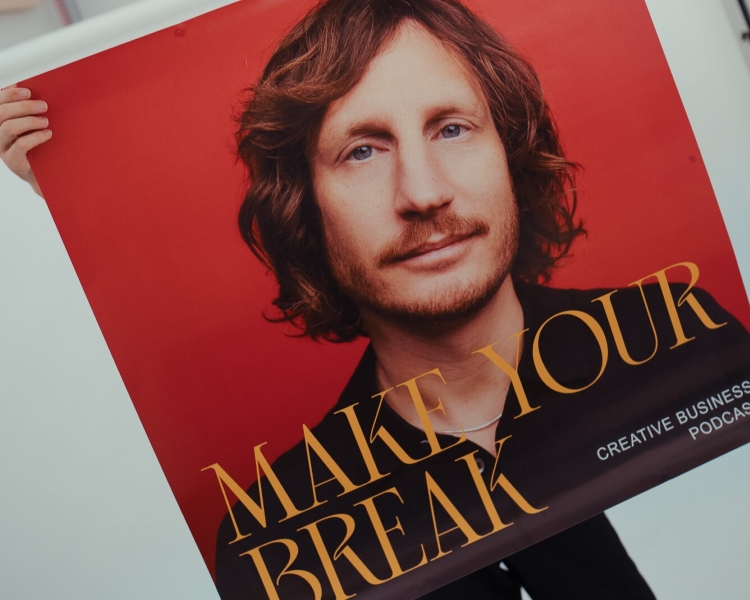
Australian author, keynote speaker, photographer, and entrepreneur Jai Long has announced the upcoming worldwide release of his debut self-help book, Make Your Break, which will be available from November 3 through leading bookstores and major online retailers.
The book is designed for creatives, entrepreneurs, freelancers, and professionals who are trying to move forward in a world that feels uncertain, fast-moving, and harder to predict. Rather than presenting success as a fixed path, Make Your Break focuses on helping readers create their own opportunities, take action with more confidence, and build a clearer direction in life and business.
Born in Australia on September 17, 1986, Long now lives in Byron Bay, New South Wales. He has built a career across photography, business education, publishing, speaking, and entrepreneurship. Today, he serves as CEO across several ventures, including Jai Long Co., Long House Press, Six Figure Business Map, NoSkin, and The Metamorphosis.
His new book marks one of the most important projects of his career so far. According to Long’s team, Make Your Break was created to help people who feel stuck, overwhelmed, or unsure about their next move. The book speaks directly to those facing shifting industries, changing markets, career pressure, and personal uncertainty.
At its core, Make Your Break is about moving from hesitation to action. It encourages readers not to wait for perfect timing or complete stability before making important decisions. Instead, Long shares practical ideas, mindset shifts, and business lessons that show how people can build momentum even when the path ahead is not fully clear.
Long’s authority comes from years of building businesses and helping other creative professionals do the same. Before becoming widely known as a business educator and speaker, he built a strong international reputation as a photographer. Through his earlier businesses, Free The Bird and Heartbreak Booth, Long became recognized in the wedding and creative industries.
His photography career included major industry recognition. He was named Runner-Up Australian Wedding Photographer of the Year by Capture Magazine and was also listed among the Top 30 Wedding Photographers in the World by Rangefinder Magazine. These achievements helped establish him as one of the notable creative professionals to emerge from Australia’s wedding photography scene.
Since 2015, Long has expanded his work beyond photography. He has spoken on stages around the world, appeared at major conferences, led workshops, hosted masterminds, and taught creative entrepreneurs how to build profitable and sustainable businesses. His work has been featured in publications and platforms including Capture Magazine, Hello May, Rangefinder, Together Journal, Forbes, and Heart & Hustle.
Photo Courtesy: Jai Long
Long is also the host of the Make Your Break podcast, where he interviews creators, entrepreneurs, and business leaders about mindset, strategy, leadership, and the process of turning big goals into real results. The podcast has become an important part of his wider education platform and reflects many of the themes now being expanded in his upcoming book.
The release of Make Your Break comes at a time when many professionals are rethinking traditional career paths. The rise of independent work, personal brands, online education, and creator-led businesses has opened new doors, but it has also created more competition and uncertainty. Many people are looking for practical guidance that goes beyond motivation and gives them a way to make decisions, build confidence, and take useful action.
Long’s message is based on the idea that uncertainty is not something people can always avoid. Instead, they need tools to move through it. Make Your Break gives readers a framework for creating the next chapter in their lives and businesses, especially when the old rules no longer feel reliable.
The book also reflects Long’s broader mission as a speaker and educator. Through Jai Long Co., Six Figure Business Map, Long House Press, and his other platforms, he has worked with creatives and entrepreneurs who want to build businesses that are profitable, sustainable, and aligned with their values.
Long speaks English and is known for his clear, direct, and practical teaching style. His personal details, including his Australian background, Byron Bay residence, and creative career path, have become part of the story behind his work. Standing 5 feet 9 inches tall, Long has built a public profile around entrepreneurship, self-leadership, and creative independence rather than a traditional corporate route.
With Make Your Break, Long is aiming to reach a wider global audience. The book has an ambitious goal of becoming a New York Times bestseller, but its larger purpose is to create impact by helping more people step into their next stage with clarity and courage.
Make Your Break by Jai Long will be released worldwide on November 3 and will be available through all leading bookstores and major online platforms.
For years, selling a home in New York came with an easy workaround. Sellers were required to complete a property condition disclosure form covering everything from plumbing and electrical systems to flooding history and structural issues. But they didn’t actually have to fill it out. Instead, they could hand the buyer a $500 credit at closing and skip the form entirely.
Most sellers took that option. Most buyers barely noticed the credit or understood what they were giving up.
That changed. New York’s legislature closed the workaround, and sellers across New York City, Long Island, and Westchester are now required to provide a complete disclosure form before the contract is signed. Alexander Paykin, Esq., founder of Paykin Law and a New York real estate attorney with extensive experience in residential and commercial transactions, explains what the change means for both sides.
What the Disclosure Form Covers
The property condition disclosure form requires sellers to answer detailed questions about what they know regarding the home’s physical condition. This includes the electrical system, plumbing, roof, foundation, heating, drainage, any history of flooding or water damage, and environmental concerns.
The form is not a professional inspection report. It is a sworn statement from the seller based on their own knowledge. Sellers are not expected to investigate things they don’t know. But if they are aware of a problem, they are required to disclose it.
Why the Old System Mostly Worked for Sellers
Under the previous rules, most sellers opted to pay the $500 credit rather than complete the form. The logic was simple: a completed form creates a paper trail of known defects. A $500 credit creates nothing.
Buyers were assumed to be on notice that they needed to conduct their own due diligence, hire an inspector, get an engineering report, and investigate the property themselves. The credit was effectively a signal that said the seller wasn’t providing information, and the buyer should go find it on their own.
That arrangement favored sellers who preferred not to put known issues in writing. It also meant buyers sometimes closed with an incomplete picture of what they were getting.
What Changed and Why It Matters
With the disclosure now mandatory, sellers cannot substitute a credit for the form. If there are known issues with the property, those issues have to be stated before the contract is executed.
For sellers, this creates both a responsibility and a risk. Failure to disclose a known defect isn’t just a civil matter. It can support a fraud claim after closing. Sellers who are uncertain whether something rises to the level of a required disclosure should consult an attorney before completing the form, not after.
For buyers, the mandatory disclosure adds a layer of information that was previously optional. But it does not replace a professional inspection. The disclosure form tells a buyer what the seller knows. A qualified inspector tells a buyer what the seller may not have noticed, disclosed, or even been aware of. Both documents serve different purposes, and both still matter.
How the Disclosure Fits Into the Transaction
The disclosure form is typically provided alongside the contract and the seller’s rider. The buyer’s attorney reviews everything and prepares a response, which may include questions, pushback on specific terms, or requests for further information based on what the disclosure reveals.
If the disclosure surfaces something significant, such as a history of basement flooding, an unresolved electrical issue, or a structural concern, the buyer has options. They can negotiate a price adjustment, require the seller to remedy the issue before closing, include a contingency that allows exit if an inspection confirms the severity, or simply walk away before the contract is signed.
The moment before contracts are executed is when a buyer has the most leverage. Once signed, the ability to exit without losing the deposit depends entirely on what contingencies were included.
What Sellers Should Do Before Listing
Sellers are better positioned when they think carefully about the property’s condition before a listing goes live, not after an offer arrives.
Sellers who complete the disclosure honestly and early give their attorneys time to address issues before a buyer uses them as leverage. Those who rush to complete the form after an offer comes in often find themselves in a weaker position, responding to questions rather than getting ahead of them.
Working through the disclosure with an experienced real estate attorney before listing is a straightforward step that can prevent larger problems at the worst possible moment.
For buyers and sellers with questions about New York real estate transactions, Paykin Law offers new matter consultations for clients across New York City, Long Island, and Westchester.
Alexander Paykin, Esq., is a New York real estate and commercial attorney and founder of Paykin Law. The firm handles real estate transactions, litigation, foreclosure, and landlord-tenant matters across the New York metro area.
Disclaimer: This article is based on information provided by the expert source cited above. It is intended for general informational purposes only and does not constitute legal, financial, or real estate advice. Readers should conduct their own research and consult qualified professionals before making any real estate or financial decisions.