
By: Matt Emma
In an era where much of alternative music is shaped by algorithms, trend cycles, and rapid-fire releases, E11ΞVΔN approaches songwriting from a different angle entirely. The project, led by musician and songwriter V Ruskin, is rooted less in calculated branding and more in exploration, an evolving creative process built around instinct, technical discipline, and emotional clarity.
That balance between craftsmanship and unpredictability sits at the center of E11ΞVΔN’s growing presence in the alternative and indie rock space. With the release of the Reflections album earlier this year and the upcoming single “Here Comes the Rain,” the project is beginning to establish a distinct identity: atmospheric yet grounded, technically informed without losing its human edge.
Ruskin’s relationship with music stretches back decades. He describes himself as having been drawn to it almost instinctively from childhood, eventually picking up a guitar at age nine and immersing himself in playing through his teens and twenties. His background includes training at performing arts schools, collegiate study in Jazz Performance, Music Theory, and Composition, and formal training at a recording conservatory. He also spent time interning under engineer and producer Matt Grabe, observing professional recording sessions and refining his understanding of arrangement and production.
That foundation shaped the technical side of his musicianship, but E11ΞVΔN is less about perfectionism than it is about uncovering something honest in real time.
“I thrive on discovery,” Ruskin explains. “A riff will appear out of nowhere, and I’ll keep layering ideas until it reveals itself as a song.”
That philosophy gives the project its sense of movement. Rather than presenting E11ΞVΔN as a static band with rigid definitions, Ruskin describes it as a “project-band” built around world-building, a continuously unfolding creative universe where each release becomes part of a larger narrative.
The sound itself pulls from a broad spectrum of influences deeply embedded in late-90s and early-2000s alternative culture. Echoes of bands like Soundgarden, Incubus, Circa Survive, Deftones, Glassjaw, and The Postal Service surface throughout the project’s DNA, not through imitation, but through atmosphere and structure. There is a noticeable emphasis on dynamics, texture, and melody, paired with an understanding of tension that comes from Ruskin’s deeper theoretical background.
Still, the story behind E11ΞVΔN is not framed as a traditional reinvention narrative. Ruskin is careful to avoid positioning the project as a “comeback.” Instead, it represents a sharpening of focus after years spent balancing life outside of music.
During his thirties, much of his energy shifted toward family responsibilities and entrepreneurship, including building a successful pool business while raising children. At the same time, however, he endured a series of deeply difficult personal experiences, including profound loss and a prolonged divorce process that consumed years of emotional and financial bandwidth.
Those pressures coincided with the making of Reflections, a project completed while Ruskin was simultaneously working exhausting weeks running his business and navigating major upheaval in his personal life. Rather than allowing those circumstances to halt the creative process, he used the record as a form of structure and discipline.
“I needed to prove to myself that I could finish something massive,” he says.
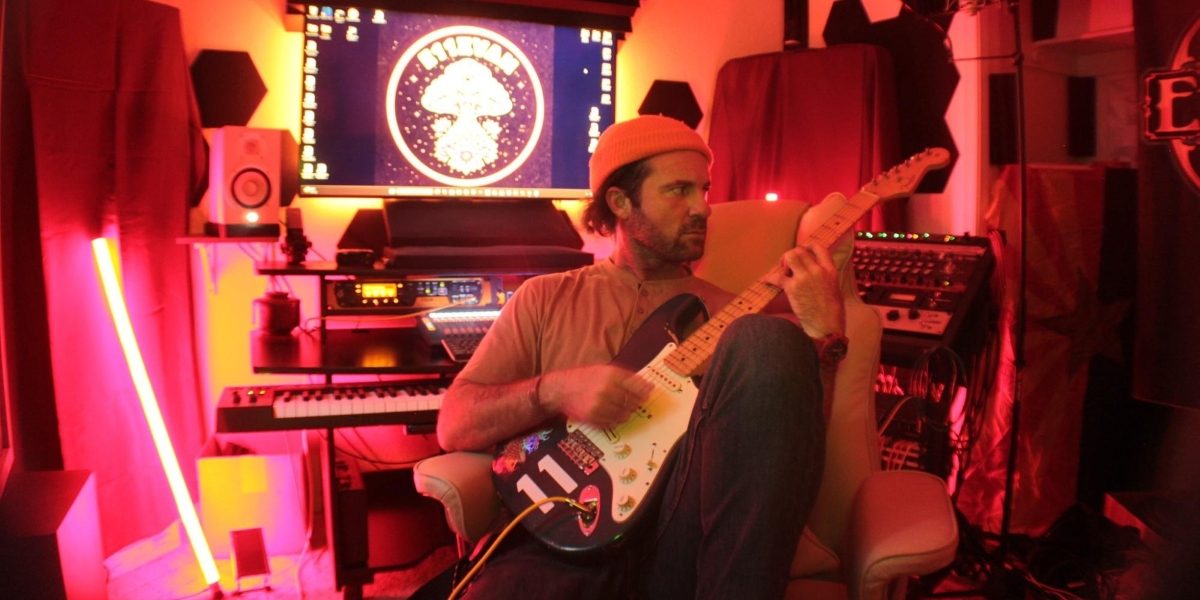
Much of the album was shaped inside 3134 Studios, which Ruskin describes as a creative sanctuary during that period. The process became less about escape and more about transformation, taking instability and redirecting it into something tangible and lasting.
That same sense of transformation is tied directly to the origin of the E11ΞVΔN name itself. According to Ruskin, the project emerged after a profound personal moment in which he experienced what he describes as a complete emotional release following an extended period of feeling detached from reality. At the exact moment the experience ended, he looked at the clock and saw 11:11.
The synchronicity stayed with him.
“Had it been 11:12, the project might not exist,” he says.
Rather than treating the moment as mythology, Ruskin speaks about it more as a shift in perspective, a realization that not every setback needs to be carried forward indefinitely. That mindset now informs the way he approaches music. Instead of trying to control every outcome, he focuses on consistency, intuition, and craftsmanship.
That approach is especially evident in the rollout surrounding “Here Comes the Rain,” an upcoming single that continues the sonic direction introduced on Reflections. While details surrounding the release remain intentionally understated, the track is positioned as another step deeper into the atmosphere E11ΞVΔN is building. The single also features Adriel Zang and continues Ruskin’s emphasis on collaboration over isolation.
For someone with a background rooted in technical training, Ruskin speaks surprisingly little about virtuosity. He seems far more interested in energy, mood, and emotional precision than in showcasing complexity for its own sake. Even his collaborative history reflects that balance.
One notable chapter in his earlier career involved playing with the band This Century, an experience he credits with giving him firsthand exposure to the level of discipline required to operate professionally within the music industry. He also points to the influence of Sean and Alex Silverman, whose songwriting approaches left a lasting impression on his own creative philosophy. Beyond that, his past collaborative work with drummer and songwriter Ryan Gose further strengthened his production and recording instincts through various recording and mixing sessions over the years.
Those experiences appear to have shaped the professional mindset behind E11ΞVΔN without overwhelming its identity. The project feels informed by years of study and experience, but not burdened by them.
That balance may explain why E11ΞVΔN arrives at a moment when many listeners are gravitating back toward emotionally grounded alternative music. The renewed interest in guitar-driven records, layered songwriting, and textured production has created space for artists who prioritize depth over immediacy. Yet Ruskin’s work avoids leaning too heavily on nostalgia.
While traces of the late-90s and early-2000s alternative era are present, the goal does not appear to be revivalism.
Instead, E11ΞVΔN operates more like a continuation of that lineage filtered through present-day perspective and lived experience.
Looking ahead, Ruskin’s ambitions remain focused but expansive. He plans to continue building the project into a live experience while deepening collaborations with other artists operating in adjacent creative spaces. More than anything, though, he seems committed to longevity, to creating work that outlasts the moment it was made.
For now, that journey continues with “Here Comes the Rain,” a release that signals another chapter in a project still revealing itself piece by piece.
In a landscape often driven by immediacy, E11ΞVΔN is choosing something slower and more deliberate: building a world one song at a time.
Keep up to date with E11ΞVΔN:
https://distrokid.com/hyperfollow/e11evan/here-comes-the-rain/
https://open.spotify.com/artist/49gmp51WMM8VicCLHBybPJ?si=_3xU9kXOT6uIXT2Ee_xfjQ