


A business loan is an agreement in which a lender provides money to a company, and the company promises to repay it, plus a cost, under stated terms. That’s the entire idea. The complications arise from how many ways those terms can be written.
And yes, some business loans can be funded within about 24 hours. Mostly, these are short-term online products given to applicants with solid, easily verified revenue. Long-term bank and SBA loans generally take weeks or months.
To really understand what you’re signing, it helps to take a loan apart the way a mechanic takes apart an engine. Here are the nine parts of any business loan, what each part does, and how each one affects speed.
Part 1: The Principal
The principal is the amount you borrow. It sounds simple, but look at the difference between the stated principal and your net proceeds. If you borrow $100,000 and a 4% origination fee comes off the top, $96,000 lands in your account, yet you repay as though you had received the full $100,000.
Effect on speed: Larger principal amounts require more documentation. Requests that are modest relative to your monthly deposits usually move fastest.
Part 2: The Price
Lenders express price in several ways, and they aren’t interchangeable.
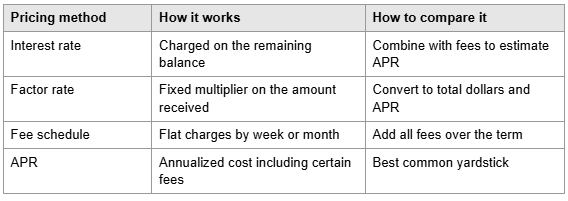
A simple interest loan gets cheaper as you pay down principal, because each charge is based on what you still owe. A factor rate doesn’t behave that way: the full cost is usually set on day one.
Effect on speed: None directly, but fast money almost always costs more than slow money. When you’re paying a premium, you should know what you’re buying.
Part 3: The Term
The term is how long you have to repay. Short terms run a few months. Commercial real estate loans can run for decades. Term and purpose should roughly match: use short money for short needs, and long money for long-lived assets. A resource such as this comparison of banks and an online funding platform can show how terms differ by source, although any comparison should be read critically.
Effect on speed: Short terms carry less risk for the lender, and that’s one reason short-term products clear underwriting faster.
Part 4: The Payment Schedule
Monthly payments are common at banks. Weekly or daily payments are common at fast online lenders. Because more frequent debits reduce your available cash sooner, a $2,000 monthly payment and a $460 weekly payment can feel very different to a business with uneven receipts.
Effect on speed: Frequent payments let a lender spot trouble early, which helps justify quicker decisions on thinner paperwork.
Part 5: Collateral
Collateral is property pledged to secure repayment. Specific collateral could be a building, truck, or machine. A blanket lien, filed through a UCC-1 statement, claims nearly all business assets in general. Many “unsecured” loans still include such a lien, so the label may not mean what you assume.
Effect on speed: Appraisals and title reviews are slow. Loans that don’t need them are the ones that can move in a day.
Part 6: The Personal Guarantee
A personal guarantee makes you individually responsible if the company can’t pay. Incorporating an LLC doesn’t protect you from a debt you’ve personally guaranteed. Most small business loans include one. An unlimited guarantee covers the entire balance, while a limited guarantee caps your exposure.
Effect on speed: A guarantee gives the lender extra comfort without any additional review of assets.
Part 7: Covenants and Conditions
Covenants are promises you make for the life of the loan. Examples include keeping insurance, delivering financial statements, maintaining a minimum cash balance, or not taking on additional debt. Breaking one can trigger a default even when your payments are current. New products keep changing these conditions as well, as this Washington City Paper piece on card-based lending shows.
Effect on speed: Bank loans tend to have more covenants and take longer to document. Fast products have fewer covenants but often stricter payment terms.
Part 8: Default and Remedies
This section explains what the lender may do if something goes wrong: raise the rate, demand the full balance, seize collateral, or pursue a guarantor. Look for acceleration clauses, default interest rates, and confessions of judgment, which some states restrict.
Effect on speed: None, but it’s the section rushed borrowers most often skip and later regret.
Part 9: The Lender
The final part is the party on the other side. Your options include banks, credit unions, SBA-approved lenders, online lenders, community development financial institutions, and funding marketplaces that connect you with others. Each one comes with different incentives. A marketplace may be compensated by the funder it places you with, and a comparison website may be paid by listed companies.
Effect on speed: This is the biggest factor of all. Bank credit committees meet on schedules. Automated cash-flow underwriting can return a decision in minutes or hours.
Assembling the Parts: Which Loans Can Move in a Day?
Now combine those nine parts. A fast loan generally has a modest principal, higher pricing, a short term, frequent payments, no appraised collateral, a personal guarantee, few covenants, and an online provider. A slow loan has the opposite profile.
• Often possible in about a day: short-term online loans, some lines of credit, revenue-based products, and certain merchant-focused financing
• Sometimes possible: small equipment deals and bridge financing that relies on cash flow
• Rarely possible: bank term loans and commercial mortgages
• Effectively not possible: standard SBA 7(a) and 504 loans
Learning the basics in advance gives you time to explore without pressure. The Fundivi business funding resources library is one place to read about product types, and many Small Business Development Centers offer free counseling as well.
What You Need for a One-Day Attempt
If you do need to move quickly, prepare:
• Three to six months of complete business bank statements
• Identification for each significant owner
• EIN and formation details
• A debt schedule
• A concise description of why you’re borrowing
Then apply early on a weekday, respond quickly to questions, and ask about wire versus ACH timing. Approval, of course, remains up to the lender.
The Question to Ask Before Any Loan
Will this money produce or protect more than it costs? Debt that buys inventory you can sell at a healthy margin is a tool. Debt that covers a monthly loss is a delay. Make sure you know which one you’re looking at, because the paperwork will look identical. Comparison hubs, including the BestWorkingCapitalLoans.com lender guides, can help you identify candidates once you’ve answered it.
A Quick Vocabulary Check
Two more terms come up constantly. Amortization is the process of paying down principal over time through scheduled payments. A balloon payment is a large sum due at the end of a loan whose regular payments didn’t fully repay it. Before signing, confirm whether your loan fully amortizes.
Frequently Asked Questions
What’s the difference between a loan and an advance?
A loan creates a debt with repayment terms. An advance is typically structured as a purchase of future receivables, and it may be subject to different rules.
Is a business loan the same as a personal loan used for business?
No. A personal loan is underwritten on you individually and affects your personal credit directly. Business loans are based largely on company performance, although guarantees are common.
Do I need an LLC to get a business loan?
Not always. Sole proprietors can qualify, but lenders generally want a registered business and a dedicated business bank account.
Can I get a business loan with no revenue?
It’s difficult. Options may include microloans, startup programs, or personal credit, but most fast products require revenue.
Is the interest deductible?
Business interest is often deductible, subject to tax rules and limits. Ask your tax professional about your specific situation.
How do I find out the real cost?
Ask for total repayment, net proceeds, and APR. If some of those figures aren’t available, calculate them before you agree.
Can I have more than one business loan at a time?
Sometimes, if your cash flow supports the payments and existing agreements allow it. Check for restrictions on additional debt before applying.
Disclaimer: This article is provided for general informational and educational purposes only and should not be considered financial, business, legal, tax, or lending advice. Business loan terms, eligibility requirements, costs, repayment structures, and approval decisions vary by lender and borrower circumstances. Fast funding is not guaranteed, and borrowers should carefully review all loan documents, fees, repayment obligations, collateral requirements, and personal guarantees before accepting financing. Readers should consult qualified financial, legal, or tax professionals regarding their specific situation before making borrowing decisions.