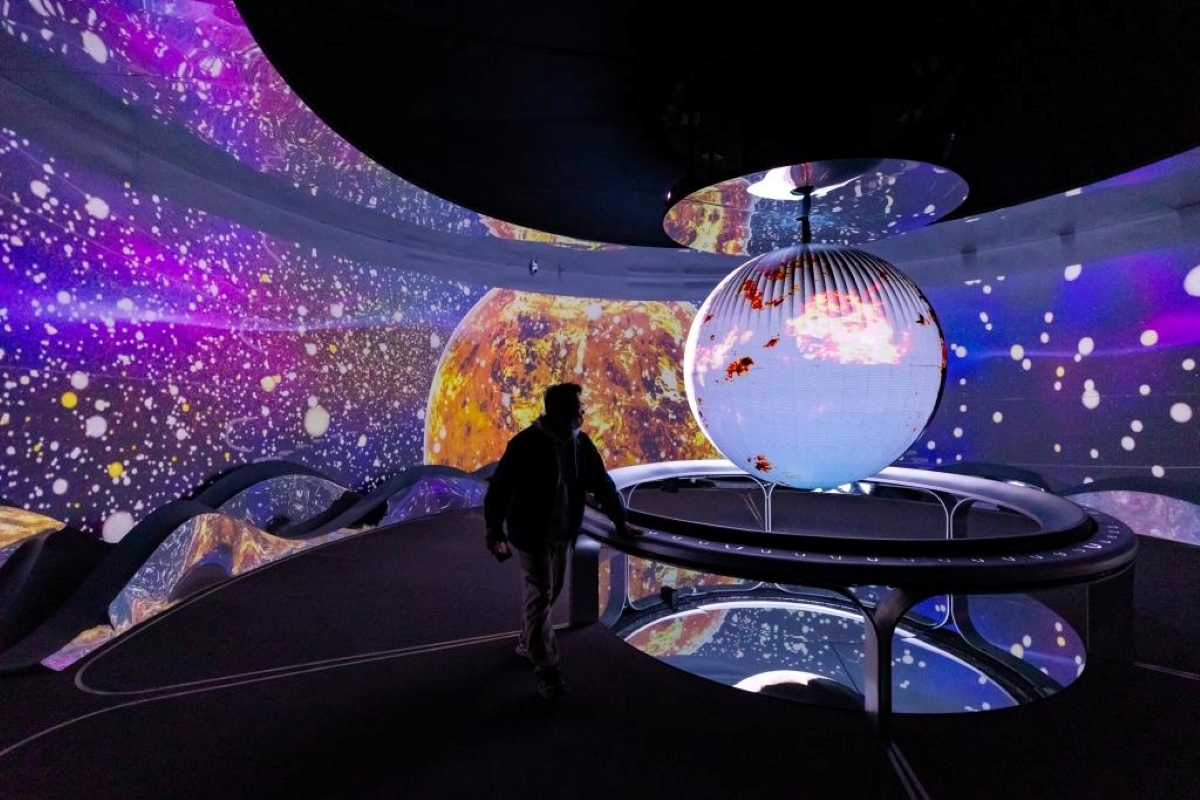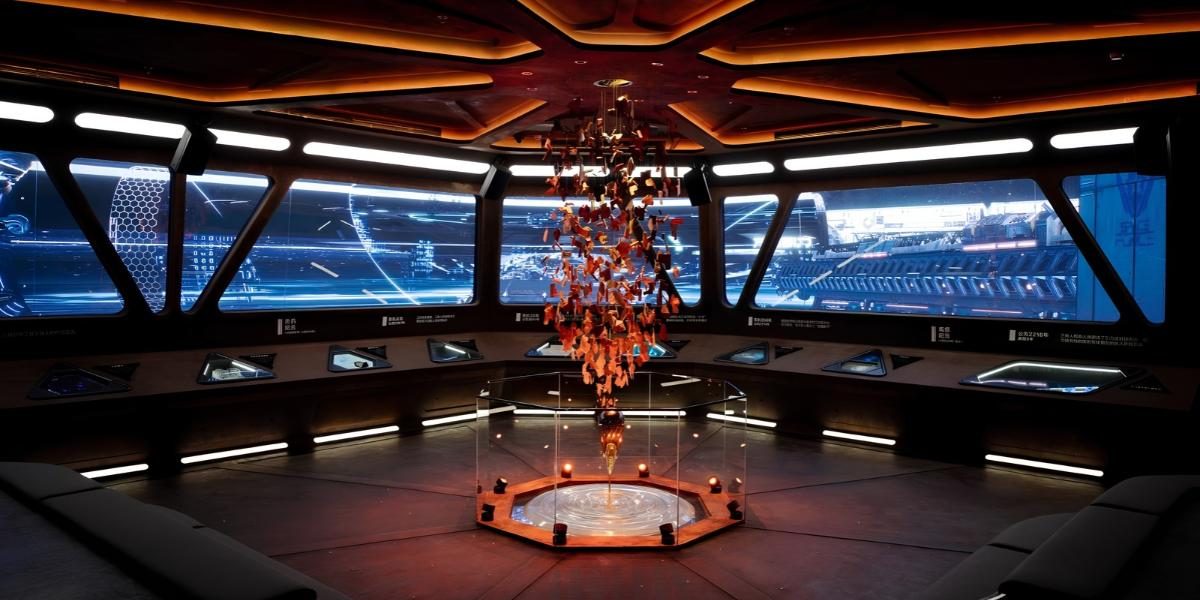

Production design is more than the creation of a backdrop. It is the art of constructing environments that become part of the storytelling itself. In immersive theatre, this relationship takes on another dimension: space is no longer simply something an audience looks at, but something they enter, move through, and experience.
For production designer Wanxin Joseph Jin, this is where spatial storytelling begins. His approach is rooted in translating narratives and imagined worlds into physical environments. In Three-Body: Beyond Gravity, an immersive experience inspired by Liu Cixin’s acclaimed science-fiction universe, he set out to transform the vast, futuristic imagination of the novel into a tangible world in Shanghai, China.
Spanning 3,400 square meters at SenseTime’s West Bund AI Plaza, the project ran from April 2023 to November 2024. Its ambition extended beyond recreating scenes from a science-fiction story. The challenge was to translate complex scientific ideas, futuristic technologies, and the evolution of human civilization into a cohesive spatial experience, one in which architecture, environment, and technology could work together to bring an imagined future to life.
Imagining a World Beyond Human History
Working closely with the creative team, writers, and directors, Jin immersed himself in the novel’s universe and the world developed through its adaptation into a script. What fascinated him was the idea of a generation of humanity living aboard a spacecraft, suspended between the remnants of an old civilization and the possibility of an entirely new one. He began to see the spaceship as more than a vessel for transportation. It became a bridge between human history and an unknown future, as well as a living organism, capable of producing its own systems of order, authority, fear, ambition, and nostalgia. This interpretation became the conceptual foundation of his design. Rather than approaching the environment as a conventional futuristic spaceship, he imagined it as a future colony: a self-contained ecosystem in which architecture, technology, and everyday human life had evolved together over generations.
His visual references extended beyond conventional science-fiction imagery. Biomimetic architecture and solarpunk aesthetics offered a vocabulary for imagining how future human habitats might function and feel. Organic geometries, fluid surfaces, integrated structures, and natural forms informed the architectural language, while the contrast between the cold, controlled conditions of space and the intimacy of human life suggested a nuanced material palette. The result was a future that was neither entirely mechanical nor sterile: technologically advanced yet inhabited, monumental in scale yet intimate enough to suggest everyday human existence.
Translating Imagination into a Spatial Language
Turning this vision into a buildable environment required research, experimentation, and technical development. Working with the wider design and production team, Jin spent months exploring architectural layouts, spatial configurations, materials, surface treatments, and installation possibilities. Each design decision had to serve both the narrative and the practical demands of a large-scale immersive production.
The challenge was to establish a consistent visual language across distinct environments, ensuring each space communicated its own function and atmosphere while remaining part of the same fictional universe. Rather than treating the project as independent exhibition sets, Jin approached it as an interconnected world. Architecture, scenic elements, lighting, materials, and integrated technologies were considered together, allowing the environment to feel like a functioning ecosystem rather than decorative installations. This required constant movement between imagination and execution: testing how organic architectural forms could be constructed, how materials might communicate the passage of time, and how technological elements could become part of the architecture rather than additions to it.
A Multidisciplinary Approach to Production Design
Jin’s approach to this project is rooted in a background that bridges theatre, film, and themed entertainment. A graduate of the Scenic Design program at CalArts, he developed an understanding of how space, narrative, and visual composition can shape an audience’s experience. His experience in theme park and entertainment design further expanded this perspective, introducing him to the technical and practical considerations of building fantastical environments at scale, spaces that must communicate ideas visually while engaging audiences through movement, interaction, and atmosphere.
Having studied and worked across the United States and China, he brings an international perspective to his design practice, drawing from architectural languages, cultural references, and approaches to spatial experience. Science fiction has long been another source of inspiration. From the speculative worlds of Philip K. Dick to the expansive universe of Frank Herbert’s Dune, he has been drawn to stories that imagine how technology, politics, architecture, and human civilization might evolve together. These influences inform his interest in creating environments that feel not simply futuristic, but as though they belong to a fully realized world with its own history and internal logic.
Experimentation as a Creative Process
For Jin, a refined visual language does not necessarily require a refined process. He allows ideas to develop through experimentation, testing, and pushing concepts beyond their initial boundaries.
Throughout Three-Body: Beyond Gravity, this meant exploring surface treatments, sculptural forms, architectural installations, and material combinations. From the monumental structures of the Gravity Hall to the intimate environmental details, each element offered an opportunity to investigate how form and material could shape the fictional world’s atmosphere.
He is particularly interested in the tension between a visually controlled final environment and the expansive, sometimes chaotic process behind it. An organic form might emerge from multiple sketches and material tests; an architectural surface might undergo repeated transformations before reaching its final expression. His philosophy is to begin with creative abundance, allowing ideas to expand, collide, and evolve before refining them into a coherent design. In a project about an immense and unpredictable universe, this openness to experimentation became especially meaningful.
Ultimately, Three-Body: Beyond Gravity demonstrates how production design can extend beyond visual representation into spatial storytelling. By translating an imagined universe into an interconnected physical environment, Jin sought to create more than a futuristic setting: a world audiences could step into, navigate, and experience as though it had a life of its own.