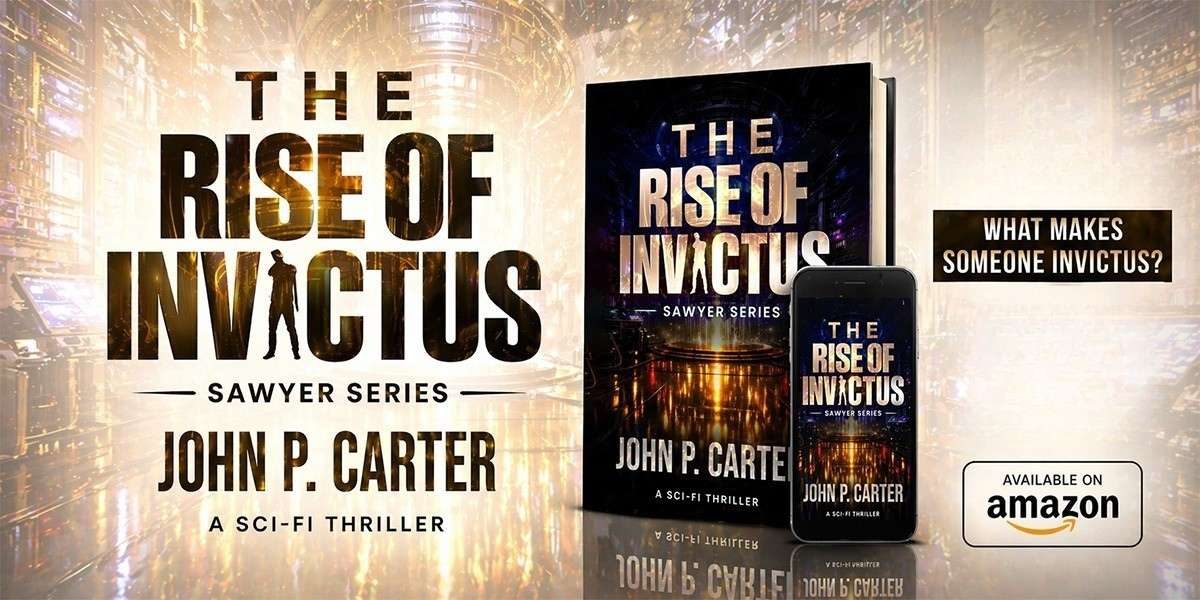

In The Rise of Invictus, John P. Carter creates a protagonist whose defining characteristic is neither brute strength nor technological dominance. It is composure.
Alex Sawyer, lunar engineer, mission commander, and survivor, operates in environments where milliseconds determine survival. In the novel’s opening sequence, hypersonic re-entry becomes a study in disciplined cognition under mortal threat. Later, buried beneath lunar regolith with failing oxygen, he fights not panic but entropy itself.
The question the novel subtly interrogates is this: What differentiates elite performers in moments where collapse is the most rational expectation?
1. Cognitive Control Under Duress
Elite performance in high-risk environments depends on prefrontal regulation over limbic response. John demonstrates this repeatedly through Alex’s combat breathing techniques, micro-adjusted control inputs, and refusal to indulge catastrophic thinking. Rather than react, Alex executes.
The portrayal aligns with real-world high-reliability professions, submarine command, aerospace operations, and special forces, where stress inoculation and procedural memory override fear-based impulse. Alex does not eliminate fear. He metabolizes it.
2. Systems-Level Thinking
Alex’s training is not merely tactical. It is architectural. He understands the machinery of lunar reactors, AI networks, and sensor grids because he thinks in systems. This system’s cognition allows him to identify anomalies, such as the unsigned firmware burst in the Lacus Mortis node, that others might dismiss.
Elite performers recognize patterns across domains. They understand interdependencies. They detect weak signals before a catastrophe becomes visible.
In Invictus, that capacity becomes existential.
3. Moral Anchoring
Perhaps the most intense dimension of performance under extreme stress is moral orientation. Alex’s endurance is not abstract heroism; it is relational. His devotion to Rebecca grounds his decisions. His refusal to abandon Troy, despite oxygen scarcity, demonstrates that character precedes capability.
The narrative suggests that resilience is amplified by purpose. Absent moral anchoring, skill degrades into survivalism.
4. Adaptive Improvisation
When the lunar tunnel collapses, protocol evaporates. AI comms fail. Oxygen dwindles. Alex must improvise, cross-connecting life support systems, rationing air, and facing disorientation without reliable instrumentation.
Improvisation at this level requires deep prior mastery. Only when fundamentals are internalized can innovation emerge under chaos. This principle echoes across elite disciplines: mastery precedes adaptation.
5. Psychological Endurance Beyond the Physical
After Troy’s death, the battlefield shifts inward. Survivor’s guilt and ethical ambiguity confront Alex with a different stressor: moral injury.
John refuses to treat trauma as narrative decoration. Instead, it becomes fuel for the larger conflict. The psychological burden of loss parallels the technological burden of a world collapsing under algorithmic overreach.
Elite performance, the novel argues, is not the absence of fracture. It is the decision to continue despite it.
Toward Homo Invictus
The title’s promise, Homo Invictus, does not signify invulnerability. It signifies change. Rebecca’s neural coupling with Alice suggests a biologically and cognitively augmented successor to Homo sapiens. Yet Carter compares this evolutionary leap to Alex’s human endurance. The implication is subtle but powerful: Before humanity becomes more, it must master what it already is.
Elite performance, in this sense, is less about enhancement and more about integration, body, intellect, morality, and love aligned under pressure. For readers who value technically authentic scenarios paired with philosophical weight, The Rise of Invictus delivers a rare fusion. It moves like a special-operations briefing yet argues like an ethics colloquium.
Takeaway
In a world increasingly mediated by intelligent systems, John proposes that the defining evolutionary advantage may not be superior code. It may be disciplined courage. And that is a standard worth aspiring to.
The Rise of Invictus by John P. Carter is now available.