
By: Elena Mart
“The Southern Cross flickered cool shades of white and blue above a carelessly cluttered den, holding space for every small heart that has ever had to learn how to survive before it learned how to belong.”
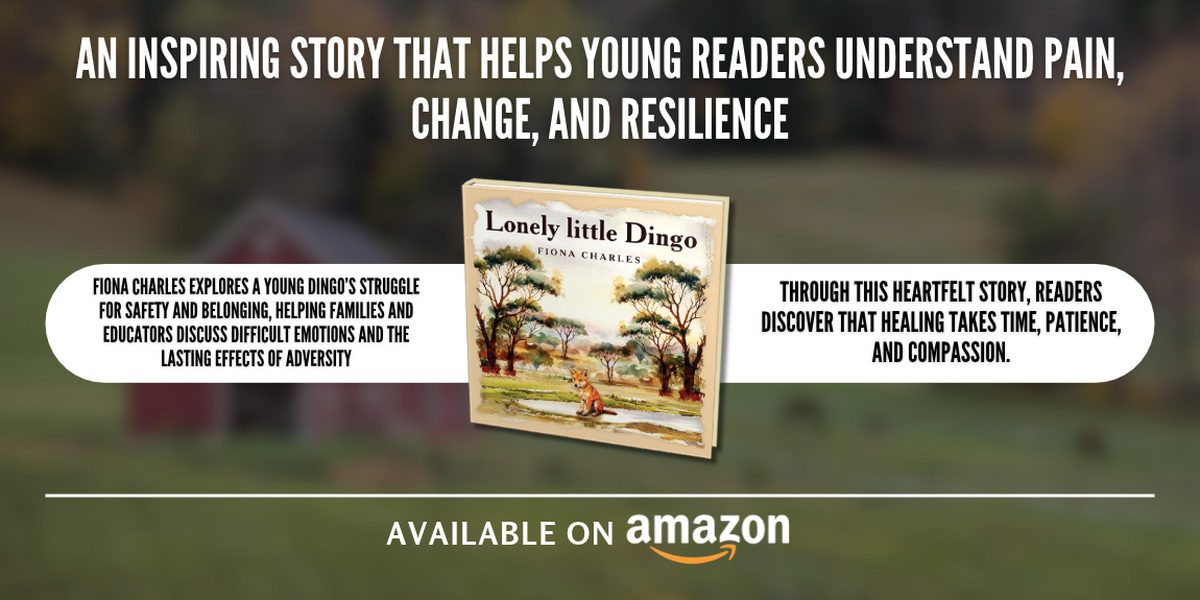
Where most picture books about animals promise comfort by the final page, wrapping up heavy emotional truths in neat, predictable bows, they offer soft landings where every conflict is instantly resolved and every trauma is washed away with a warm hug, Lonely Little Dingo,the striking debut from Queensland author Fiona Charles, completely flips the script. It refuses to tie everything up neatly, choosing instead to honor the messy, complicated, and entirely authentic reality of healing, displacement, and survival.
The story opens beneath a breathtaking night sky as a newborn dingo opens his eyes to the stars for the very first time. Charles writes that the Southern Cross “flickered cool shades of white and blue above a carelessly cluttered den”. It is a quiet, stunning image, but the book quickly strips away that initial comfort, sustained by gorgeous, moody illustrations throughout.
The den is packed with too many wild dogs to count, and it smells heavily of competition and caution. For a tiny, vulnerable pup like Dingo, it is far from a safe haven. The young dingo is “unsure who will be nurturing him,” navigating a daily pattern defined by “a toothy growl here and a sharp snap there,” followed by a nasty bite that spells trouble. When Little Dingo lets out an agonizing yelp, he is simply “dismissed again”. And it becomes glaringly clear that the overcrowded den “Is no place for the vulnerable pup?”
As the days press forward, Little Dingo grows braver. In sunlit scenes bathed in watercolor washes of ochre, rust, and green, he sniffs a vibrant pink wildflower and discovers that the world outside the suffocating den is fresh, bright, and much calmer. Anyone who has ever watched a child find a moment of relief at a friend’s house, a quiet school corner, or out on a sports field will instantly recognize this profound shift.
As the pup wanders a little farther each day, “leaving the chaos of the den behind”, he has no inkling of the danger waiting just ahead. And when the peaceful exploration is shattered by a sudden, terrifying sound: “SNAP!”, as the pup tragically steps into a heavy metal leg-hold trap, and a sharp pain stabs through his hind leg, the book explains his exhaustion, hunger, and total immobilization; he can only “await his fate”.
Where many classical children’s stories treat a rescue as the ultimate happy ending, Charles smartly treats it as the messy middle. “Unfamiliar hands” carry the injured pup to “a new warm,
clean den” that feels and smells entirely strange. Significantly, his first instinctual question is not whether he is safe, but rather, “Where are the other wild dogs?”
This is the book’s emotional heart, a truth well known to child-welfare workers, foster parents, and counselors: true safety rarely feels like immediate relief. At first, it simply feels foreign. Though Little Dingo is fed, bandaged, and washed, “healing well and growing very strong,” he greets his well-meaning human carers with “a hiss and gnarled teeth”. He tears apart his cozy bed and claws furiously at the cage. In a poignant thought-bubble sequence, he replays the biting and growling of his past, feeling “sad and angry again, an unpleasant but familiar feeling”.
Charles captures the delicate psychological nuance that when a child has known only hardship, anger and sadness can feel oddly reliable and comforting. Another page notes that his “heart is damaged, yet he still yearns to see his fractured family one more time”. The book refuses to pretend that a mistreated creature instantly stops missing the ones who harmed them. For children navigating complex family separations, foster placements, or overwhelming life upheavals, seeing that exact contradiction on the page is worth more than any hollow reassurance.
The visual storytelling carries an immense amount of emotional weight as the palette shifts deliberately from the claustrophobic, amber-lit dark of the den to the bright outdoor washes and, finally, to the stark, sterile blues and whites of the clinic. For example, when flashing police and ambulance lights wash across the clinical walls, the scene is unsettling and confusing for Dingo to realise whether he is safe or still in danger.
On the final spreads, Little Dingo is “released, discarded, and left to fend for himself”. He is unsure of his future and where to begin as we see him walking “aimlessly forward”. It is a small, courageous orange silhouette on a long, winding path under the night sky, and in a masterclass of emotional resonance, as Charles writes, “His only companion is hope”.
This book leaves the conclusion open for children, and some readers will find that frustrating, especially parents who want a sturdier landing for small children. On the other hand, many children who go through upheaval, whether through foster placement, family separation, or a series of unfamiliar adults, do not get tidy resolutions. They get to see and experience the next step, wanting to know where the path leads them.
With the largest child-welfare systems in the country, shelters and clinics are filled with children who know what it means to move from one unfamiliar place to another. This book is a valuable resource for teachers and counselors seeking stories that acknowledge these experiences without sensationalizing them. Lonely Little Dingo offers a good way to explore these difficult subjects
and helps children understand that anyone can carry feelings they may not yet be ready to express directly. This book is also a great conversation starter, as after reading it prompts us to ask our children, Why do you think Little Dingo hissed at the people who helped him? What do
you think he was feeling when he remembered the den? It makes complex emotions safe to explore. Quietly operating as a powerful animal-welfare narrative as well, the book highlights the genuine hazards of leg-hold traps in the Australian bush, sparking organic empathy for wildlife that young readers might otherwise overlook.
Rooted in the practical, unsentimental tenderness of an author who works with children daily and brings the steady, grounded patience of a seasoned sports coach, Fiona Charles has crafted a modern classic. It reminds us that healing takes time, independence must sometimes be forged in solitude, and no matter how dark the night gets, hope is always worth carrying forward.
If you are a parent, educator, or caregiver, this picture book is a great story to read to your children because it offers a gateway to conversations. It teaches children about compassion for animals, the consequences of wildlife traps, and the understanding that healing takes time and, at times, they have to survive on their own, nurturing independence.
“Lonely Little Dingo” is a worthy addition to any bookshelf, reminding us all that no matter how dark the night gets, hope can always guide our path forward if we believe in ourselves and have the will to find it.
Are you ready to join Dingo on his extraordinary journey through this beautiful picture book? Head over to Amazon to purchase your copy today: a.co/d/06eevBvv
About the Author
Charles lives in sunny Queensland with her husband of more than 25 years. She is a mother to four adult children and two adult stepsons, with two daughters-in-law and five grandchildren so far, and she works with children daily. She is also a sports coach, having coached AFL, rugby league, and touch football. That background shows in the book’s practical, unsentimental tenderness of a coach who knows that a hurt kid does not need a speech. They need steady adults and room to be difficult.
Book Details
Book Name: Lonely Little Dingo
Author Name: Fiona Charles
ISBN Number: 979-8953260770
Ebook Version: Kindle edition on Amazon
Paperback Version: Paperback edition on Amazon