
By: Alexander Sebastian
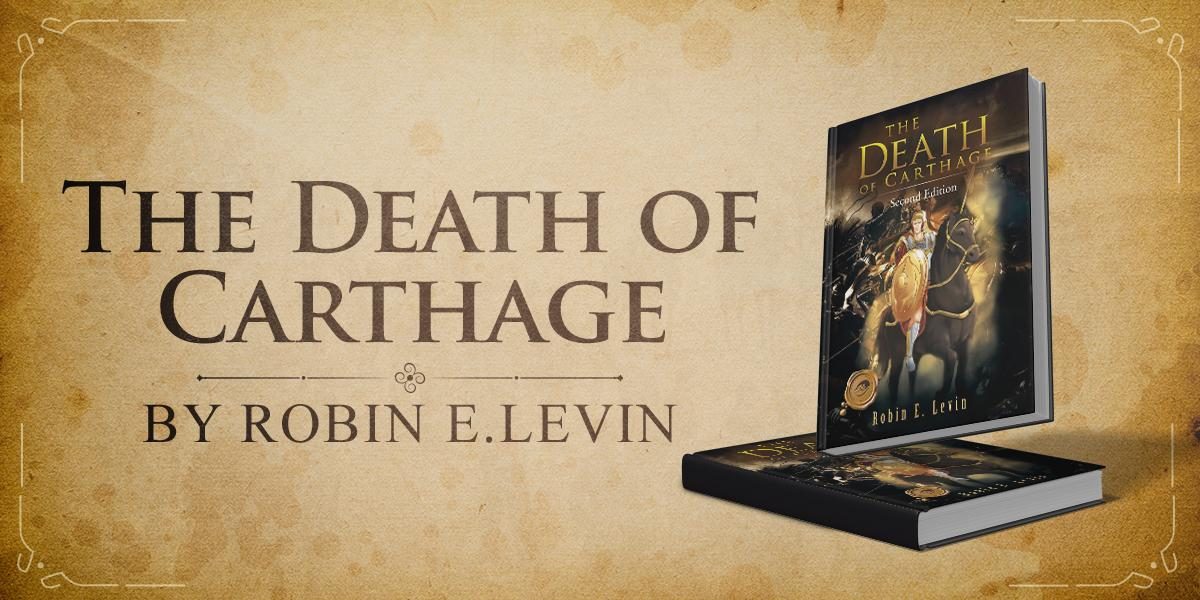
Robin E. Levin’s The Death of Carthage offers something different from the typical Roman epic. It is not a sweeping panorama of generals and senators told from above. It is a ground-level account of one of history’s longest and most consequential conflicts, narrated by three ordinary people whose lives are shaped by it. Levin draws on Livy and Polybius for the historical bones, then fills in the human texture that ancient historians left out: the boredom of camp life, the awkwardness of homecoming, the moral weight of survival.
The author is not a career novelist. Levin was born in Baltimore in 1949, moved to California in 1957, and has spent most of her adult life in San Francisco. She graduated from the University of California, Berkeley, in 1971 with a degree in anthropology and zoology, and worked as a clinical laboratory scientist specializing in lipids at Quest Diagnostics until retiring in 2012.
The Death of Carthage is her first published novel, the product of a lifelong interest in ancient history that began in junior high school and was encouraged by a mother who watched I, Claudius on Masterpiece Theatre and read every Colleen McCullough novel about Rome. Levin has said the book grew directly out of her reading of Livy’s account of the Second Punic War, which struck her as a story that practically demanded novelization.
Three Voices, One Long War
The novel is built in three sections, and each section is told by a different first-person narrator. The first is Lucius Tullius Varro, a young Roman eques drafted into the cavalry at the start of the Second Punic War. He serves under Publius Cornelius Scipio Africanus from the early campaigns in Hispania through the final defeat of Hannibal at Zama. The second narrator is his cousin Enneus, captured at the Battle of Lake Trasimene and sold into slavery on a Greek estate, where he remains for more than two decades. The third is Enneus’s son Hector, who comes of age in Rome and eventually witnesses the destruction of Carthage in 146 B.C.
This structure gives the book something that single-protagonist Roman novels often lack. By moving the point of view across three generations and three positions in Roman society, Levin presents the same long conflict from inside the cavalry, inside slavery, and inside the literate Greek-Roman expatriate world that produced figures like Polybius.
Drawn from the Ancient Sources
Levin’s research foundation is solid. The novel draws primarily on Livy’s Ab Urbe Condita, Polybius’s Histories, Appian of Alexandria, with additional material from Plutarch and Silius Italicus. Quoted passages from these classical authors appear as chapter epigraphs and are carefully footnoted at the back of the book. The major military and political events follow the sequence preserved in the ancient record. Readers familiar with the period will recognize Cannae, Baecula, Ilipa, Zama, the trial of the Scipios, and the long final siege under Scipio Aemilianus, all rendered with attention to what the surviving sources actually say.
The Human Cost of Empire
One of the most distinctive choices in The Death of Carthage is Levin’s willingness to dwell on slavery. Section Two of the novel is given over entirely to Enneus, who spends twenty-one years as a shepherd on a Greek estate before Titus Quinctius Flamininus negotiates the release of Roman captives. The account is unromantic. Enneus is flogged. He is starved. He survives by reading aloud from memory and by quietly accepting that, as he puts it, his loyalty is to his back, which does not want to be flogged.
When he returns to Rome, his mother is dead, and his brother was killed at Cannae. His old property has been taken over by squatters who do not believe his claim. The novel handles this without melodrama. It treats homecoming after captivity as a slow, awkward process that involves favors, family debts, and the practical need to find work.
Politics, Personalities, and Cato
Readers who enjoy political intrigue will find plenty of it. The rivalry between Scipio Africanus and Marcus Porcius Cato runs through the entire book and is presented with both sides given their best argument. Cato’s case for the destruction of Carthage is laid out at length. So is Scipio Nasica Corculum’s case that Carthage should be preserved as a rival to keep Rome alert. The eventual fall of Africanus, hounded out of public life over alleged financial malfeasance, is shown as a kind of political assassination by procedure, and the novel makes its sympathies clear without sermonizing.
Filling a Genre Gap
Levin has noted that while ancient Rome is a crowded subject in historical fiction, novels focused specifically on the Punic Wars are rare. The Death of Carthage was written in part to address this. Readers who came of age on Colleen McCullough’s First Man in Rome sequence, or on the I, Claudius adaptations, will find familiar terrain handled in a fresh way. The book is not a battle-by-battle military history in fictional dress. It is a study of how a hundred-year war reshaped private lives.
A Three-Generation Saga of Rome and Carthage
The Death of Carthage is available on Amazon for readers interested in historical fiction set during the Second and Third Punic Wars. The novel covers roughly a hundred years of Mediterranean history through the eyes of three connected narrators.
Levin shares historical insights, behind-the-scenes notes, and news about upcoming releases on Instagram and Facebook.