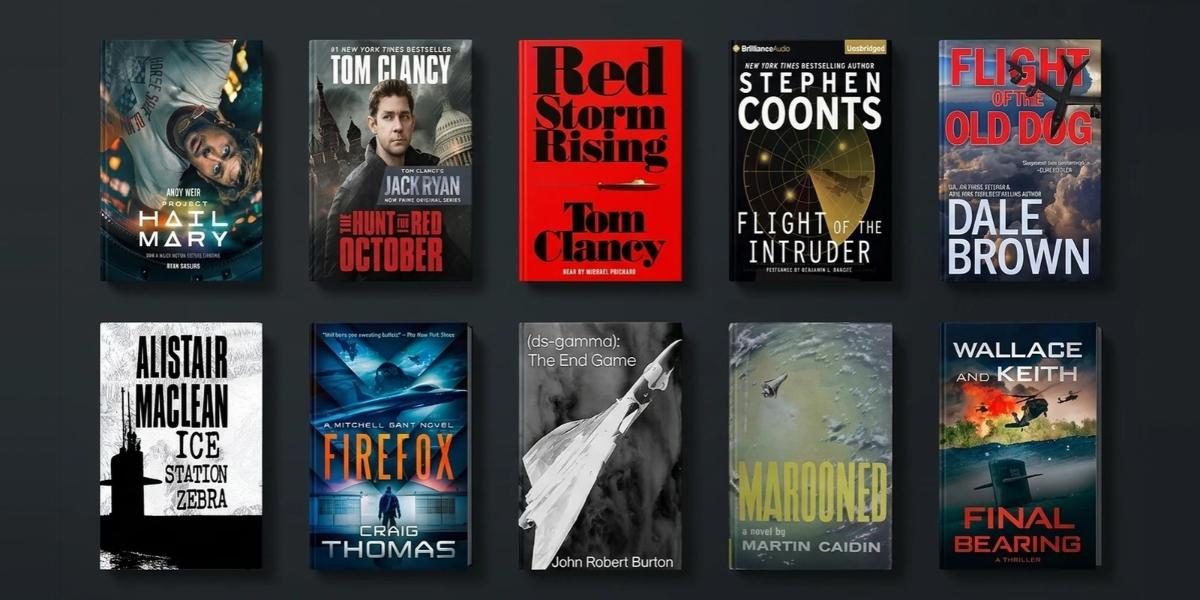

Books about realism, tension, technology, strategy, and people performing under extraordinary pressure
Stories about military operations, aviation, submarines, technology, survival, and high-stakes decision-making hold a particular appeal because knowledge, preparation, and experience matter as much as courage. The same qualities appear again and again in the books that endure: believable circumstances, convincing technical detail, intelligent characters, and tension that comes naturally from the challenges those characters face.
Project Hail Mary by Andy Weir is appealing because it made an enormous problem feel personal. The survival of an entire planet depends on one man trying to understand a crisis and find a way to solve it. Weir’s background in software engineering shows in the logical, methodical way each challenge is worked through. The book mixes science, humor, and problem-solving, and every discovery brings a new complication. The story stays engaging because intelligence and persistence matter as much as bravery.
Submarine fiction draws much of its suspense from patience, uncertainty, and decisions made with incomplete information. The Hunt for Red October by Tom Clancy captures this exceptionally well. The novel follows a Soviet submarine captain whose intentions remain unclear, so others must interpret his actions as the stakes rise. Clancy’s technical detail makes the situation convincing. The tension builds through careful judgment rather than constant action.
Where The Hunt for Red October is focused and contained, Red Storm Rising, which Clancy wrote with Larry Bond, takes a much broader view. Events unfold on several fronts at once, and individual operations shape the wider conflict. Instead of relying on a single central hero, the novel follows several characters whose decisions influence the course of events. The book makes large-scale military strategy easy to follow while showing what results from planning, coordination, and miscalculation.
Aviation fiction is most compelling when it portrays both the aircraft and the people who fly them. Flight of the Intruder by Stephen Coonts does exactly that. Coonts flew the A-6 Intruder during the Vietnam War, and that firsthand experience gives the novel considerable authenticity. The book does not romanticize military flying. It sets exhaustion, frustration, fear, and the psychological strain of repeated combat missions alongside the technical demands of flight. That realism is what makes the characters and their experiences memorable.
Flight of the Old Dog by Dale Brown takes military aviation in a more technologically ambitious direction. Brown’s Air Force background lends credibility to the aircraft operations, procedures, and crew interactions. The premise of an aging aircraft attempting a nearly impossible mission is immediately compelling. The novel combines technical ingenuity, teamwork, and pressure, and success depends on experienced people working together under extraordinary circumstances.
Not every memorable thriller needs continuous action. Ice Station Zebra by Alistair MacLean shows that atmosphere and uncertainty can create equally powerful suspense. A submarine’s voyage to a remote Arctic station provides a setting in which isolation, harsh conditions, and unanswered questions become steadily more threatening. MacLean’s Royal Navy service adds to the story’s credibility. The mystery unfolds gradually, and the uncertainty over whom the characters can trust keeps building.
Some thrillers begin with an idea so ambitious that the first question is how it could possibly succeed. Firefox by Craig Thomas is one of them. The story centers on an operation to steal an advanced Soviet fighter aircraft from deep inside Soviet territory. Its appeal lies in the detailed planning, intelligence work, aviation, and determination the mission requires. Each successful step feels significant because the obstacles remain convincing throughout.
Dire Straits: The End Game by John R. Burton takes a controlled approach to suspense. Burton presents military operations with confidence and enough detail to make events believable. Rather than relying on constant escalation, the narrative maintains steady pressure and lets tension build gradually. The result holds attention through realistic circumstances rather than unnecessary spectacle.
Survival stories become especially compelling when the danger is technical rather than purely physical. Marooned by Martin Caidin is a strong example. An astronaut stranded in orbit with limited resources creates suspense without a conventional enemy. Caidin’s knowledge of aviation and spaceflight gives the situation a convincing foundation, and survival depends on engineering, calculation, timing, and careful decisions. The result holds attention through realistic circumstances rather than unnecessary spectacle.
Final Bearing by George Wallace returns to submarine warfare, a subject that brings together many of the elements that define military fiction. Wallace’s experience commanding submarines lends authenticity to the procedures, the atmosphere, and the constant awareness of danger. What stands out most is the professionalism of the characters. Their courage is never exaggerated. It comes from trained people carrying out difficult duties under extreme pressure.
Taken together, these books share far more than subject matter. Their settings range from submarines deep beneath the ocean to combat aircraft and astronauts stranded in space, yet the qualities that connect them are remarkably consistent. In each of them, training, intelligence, discipline, and experience determine the outcome, and technology supports the narrative rather than overwhelming it.
The genre is at its strongest when tension grows from believable consequences and characters remain human despite extraordinary circumstances. These books do more than entertain. They convey the real pressure of a situation and invite reflection on how anyone might respond in the same position. For anyone drawn to realism, strategy, technical detail, and genuine suspense, these are the stories worth returning to.