
Exploring Ceramide Biology, Endocannabinoid Signaling, and Epidermal Barrier Function
The skin’s protective barrier depends on a complex arrangement of lipids, particularly ceramides, cholesterol, and free fatty acids. Among these components, ceramides play a central role in maintaining the structural integrity and permeability of the stratum corneum. Scientific research into their production and regulation has led to investigations of specialized lipid molecules, including N-palmitoyl serinol (NPS), also known as Neuromide®.
N-palmitoyl serinol is an N-acyl serinol compound that has attracted scientific interest because of its relationship with ceramide metabolism and the endocannabinoid system. Research has examined its potential to influence ceramide production through cannabinoid receptor type 1 (CB1)-dependent signaling, particularly in experimental models of skin inflammation. These findings have expanded scientific understanding of the relationship between lipid signaling and epidermal barrier function.
Chemical Structure and Early Scientific Development
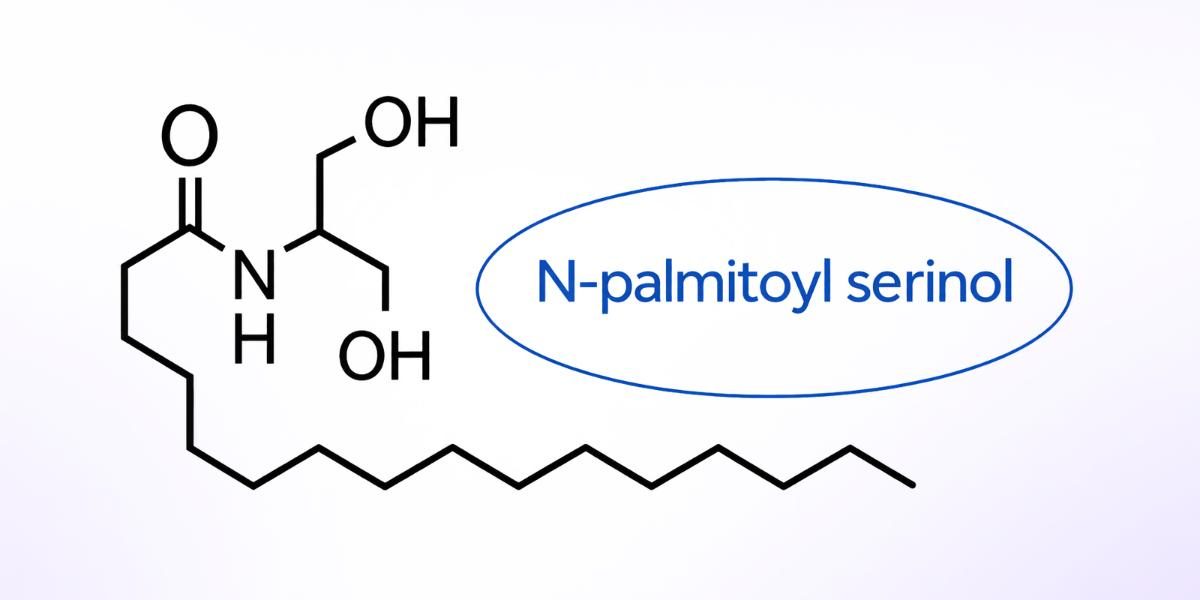
N-palmitoyl serinol consists of a palmitoyl fatty-acyl chain attached through an amide bond to serinol, chemically identified as 2-amino-1,3-propanediol. Its molecular formula is C19H39NO3, and it is registered under CAS Number 126127-31-9 and FDA Unique Ingredient Identifier Z0RQQ7PY44. Neuromide® is one of its recognized trade names.
The early scientific investigation of N-acylated serinols emerged from research into synthetic ceramide analogues. In 2000, Bieberich, Kawaguchi, and Yu published a study in the Journal of Biological Chemistry titled “N-Acylated Serinol Is a Novel Ceramide Mimic Inducing Apoptosis in Neuroblastoma Cells.”
The researchers synthesized N-palmitoylated serinol, also known as C16-serinol, and examined its biological activity in neuroblastoma cells. Their findings showed that the compound increased endogenous ceramide concentrations by approximately 50–80% and induced apoptosis in rapidly dividing cells under the experimental conditions.
The study also identified involvement of protein kinase C zeta (PKCζ), providing early evidence that N-acylated serinols could influence cellular signaling and sphingolipid metabolism.
Although this research focused on neuroblastoma cells rather than skin biology, it established an important foundation for subsequent investigations into N-palmitoyl serinol and its relationship with ceramide production.
Ceramides and the Epidermal Permeability Barrier
Understanding the potential relevance of N-palmitoyl serinol requires examining the biological importance of ceramides.
The stratum corneum is the outermost epidermal layer and serves as the principal permeability barrier. Its structure consists of corneocytes surrounded by an extracellular lipid matrix. Ceramides account for approximately half of the epidermal lipid content by mass and contribute significantly to the organization of the lipid layers responsible for limiting water loss and protecting against external substances.
Ceramides are produced through two principal biochemical pathways. The first is de novo synthesis, which involves serine palmitoyltransferase and subsequent enzymatic reactions, including those catalyzed by ceramide synthases (CerS). The second involves the breakdown of sphingomyelin through sphingomyelinase enzymes, generating ceramides from existing membrane lipids.
Different ceramide species contain fatty-acid chains of varying lengths. Very-long-chain ceramides, particularly those containing C22–C24 fatty acids, contribute to the specialized lipid organization of the epidermal barrier.
Research has shown that ceramide composition can become altered in inflammatory skin conditions, including atopic dermatitis. Reduced levels of certain long-chain ceramides have been associated with impaired barrier organization, making the regulation of epidermal ceramide production an important subject of dermatological research.
The Epidermal Endocannabinoid System and CB1 Signaling
The endocannabinoid system is a biological signaling network involving endogenous lipid mediators, cannabinoid receptors, and associated metabolic enzymes. Its components are present in several tissues, including the skin, where they participate in the regulation of epidermal homeostasis, keratinocyte proliferation, differentiation, and inflammatory responses.
Cannabinoid receptor type 1 (CB1) is a G-protein-coupled receptor involved in several cellular signaling pathways. Previous research in neuronal and other cell types demonstrated that CB1 activation could influence ceramide production through both sphingomyelin hydrolysis and de novo synthesis.
However, the relationship between CB1 signaling and epidermal ceramide production had received less attention.
This provided the scientific basis for investigating N-palmitoyl serinol, an analogue of the endocannabinoid N-palmitoyl ethanolamine, as a potential regulator of epidermal lipid metabolism.
N-Palmitoyl Serinol and CB1-Mediated Ceramide Production
A significant contribution to this research area came in 2021, when Shin and colleagues published “N-Palmitoyl Serinol Stimulates Ceramide Production through a CB1-Dependent Mechanism in In Vitro Model of Skin Inflammation” in the International Journal of Molecular Sciences.
The study investigated whether N-palmitoyl serinol could stimulate epidermal ceramide production through endocannabinoid-related signaling.
Researchers used human epidermal keratinocytes and an interleukin-4 (IL-4)-induced inflammatory model. IL-4 treatment was used to create experimental conditions associated with reduced cellular ceramide levels, reflecting an aspect of inflammatory skin conditions such as atopic dermatitis.
The results demonstrated that N-palmitoyl serinol increased ceramide production in the treated keratinocytes. The compound influenced both de novo ceramide synthesis and sphingomyelin hydrolysis pathways.
Importantly, the researchers observed increases in ceramides containing long-chain fatty acids, particularly C22–C24 species. They also examined the involvement of ceramide synthases, including CerS2 and CerS3, which participate in the production of specific long-chain ceramides.
A particularly important finding concerned CB1 receptor activation. When researchers introduced AM-251, a CB1 antagonist, the stimulatory effect of N-palmitoyl serinol on total ceramide production and long-chain ceramide levels was substantially blocked.
This finding supported the involvement of CB1-dependent signaling in the compound’s effects on epidermal ceramide metabolism.
The study provided experimental evidence connecting N-palmitoyl serinol, cannabinoid receptor signaling, and ceramide production in human keratinocytes. It also introduced a new perspective on how endocannabinoid-related pathways may influence epidermal lipid homeostasis.
Evidence from Topical Application Studies
Further research examined whether the laboratory findings could translate into measurable improvements in skin-barrier function.
In 2021, Wen and colleagues published a study in the Canadian Journal of Veterinary Research titled “Topical N-palmitoyl serinol, a commensal bacterial metabolite, prevents the development of epidermal permeability barrier dysfunction in a murine model of atopic dermatitis-like skin.”
The researchers evaluated topical N-palmitoyl serinol in normal mice and a model of inflammatory skin-barrier dysfunction.
Application of a 0.5% N-palmitoyl serinol preparation twice daily for one week reduced basal transepidermal water loss and accelerated barrier recovery following experimental disruption.
In the inflammatory model, topical application also reduced transepidermal water loss and increased stratum corneum hydration. The researchers additionally observed partial prevention of epidermal hyperproliferation and inflammatory cell infiltration.
The study discussed several possible mechanisms, including increased ceramide production, interactions with G-protein-coupled receptors, and cannabinoid receptor-mediated regulation of cutaneous inflammation.
These findings provided additional evidence of potential skin-barrier relevance. However, the investigation was conducted in mice, and the authors emphasized that clinical benefits in humans remained to be established.
Scientific Significance and Future Research
The research history of N-palmitoyl serinol demonstrates the growing importance of understanding lipid-mediated biological signaling in skin science.
Its initial investigation as a ceramide mimic established an early connection with sphingolipid metabolism. Subsequent research expanded this understanding by examining its relationship with the endocannabinoid system and CB1-dependent regulation of epidermal ceramide production.
The 2021 keratinocyte study was particularly significant because it connected CB1 activation with the production of long-chain ceramides associated with epidermal barrier organization. Complementary animal research provided preliminary evidence that topical N-palmitoyl serinol could influence measurable barrier parameters.
Together, these investigations offer a scientific foundation for further exploring N-palmitoyl serinol in skin-care formulation development. Nevertheless, additional controlled human studies are needed to establish its clinical effectiveness, optimal application conditions, and long-term safety.
Neuromide® represents the ingredient’s development within the broader field of lipid-based skincare research. Its scientific relevance lies in the investigation of how specialized lipid compounds may influence biological pathways involved in epidermal homeostasis.
As research into the skin barrier and endocannabinoid signaling continues, N-palmitoyl serinol remains an example of how molecular investigations can open new directions in understanding and developing advanced skincare ingredients.
Disclaimer: This article is provided for general informational and educational purposes only and is not intended to provide medical advice, diagnosis, or treatment. The research discussed includes laboratory and animal studies, and findings observed in experimental models should not be interpreted as proof of clinical effectiveness in humans. N-palmitoyl serinol (Neuromide®) has been investigated in relation to ceramide metabolism, CB1 signaling, and skin-barrier function, but additional controlled human studies are needed to establish its clinical effectiveness, appropriate use, and long-term safety. Readers should consult a qualified healthcare professional or dermatologist regarding individual skin conditions, symptoms, or treatment decisions.