
By: Elena Mart
There are poetry collections that ask to be read from beginning to end, and there are collections that seem to ask something different of the reader: to enter them, wander through them, and discover the connections between poems that at first appear to belong to entirely different worlds.
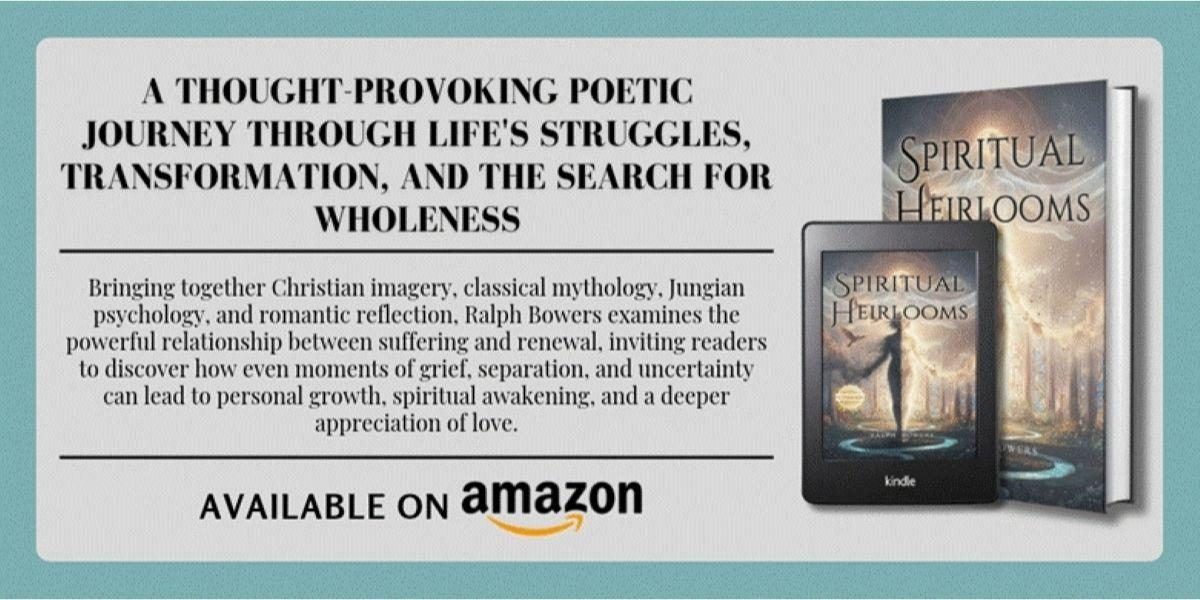
Ralph Bowers’ Spiritual Heirlooms belongs to the latter category.
It is a collection deeply concerned with love, faith, memory, mythology, imagination, loss, renewal, and the mysterious relationship between the visible and invisible worlds. Its poems move freely among Christian imagery, classical mythology, Jungian psychology, romantic poetry, dream imagery, nature, mysticism, and the language of personal experience. Yet beneath that variety is a persistent concern: transformation.
Bowers repeatedly returns to the possibility that what appears broken, divided, lost, or incomplete may contain the beginnings of something whole.
That idea announces itself almost immediately.
The opening poem, “Drawn Into Dreams,” introduces a feminine figure described as a “living representative of the Goddess.” The speaker watches an image apparently dissolve, only for “winds of imagination” to reconstruct it. The figure ultimately takes up residence in what Bowers calls “the museum of my soul,” where surrounding statues and images begin to come alive.
The image is an unusually effective introduction to the collection because it establishes one of its central principles: imagination is not merely decorative. It is transformative.
The mind does not simply remember. It reconstructs.
The imagination does not merely escape reality. It can become a means of discovering another dimension of it.
And the beloved is not always simply a beloved.
She can become Muse, Goddess, mirror, guide, interlocutor, or embodiment of wisdom.
This is one of the most distinctive features of the collection. Bowers repeatedly places masculine and feminine figures into symbolic relationships in which neither exists comfortably in isolation. The poems are fascinated by pairing, reflection, union, separation, and reunion. In “Cynthia And Endymion,” for example, the speaker moves toward a vision of cosmic unity in which individual fragments are “interlaced” and ultimately held together within a larger whole.
The poem’s mythology is not used simply as ornament.
It is being used as a language for consciousness.
This is important because Bowers’ poetry frequently asks the reader to move between levels of meaning. A moon can remain a moon, but it can also become a feminine presence, an archetypal figure, a memory, or a doorway into spiritual contemplation. A beloved can remain an individual person while simultaneously becoming a representation of something larger. A garden can be a garden while also recalling Eden. A journey can be physical while simultaneously suggesting psychological or spiritual passage.
The result is poetry that is deliberately associative.
Bowers does not always explain the connections for the reader. Instead, he allows images to accumulate until their relationships begin to emerge.
That method becomes particularly visible in “Moon and Sea,” where the natural image of the moon held within the sea becomes an occasion for the speaker to imagine himself in Eden, possessing immortality and sitting alongside Christ. The poem collapses the distance between nature, biblical imagery, myth, and personal spiritual experience.
Elsewhere, Bowers approaches spiritual experience through the language of recovery and transformation.
In “Dr. Feel Good,” the hero’s victory is described through the release of a victim from Sheol and a return to “the land of the living.” Trials remain part of existence, but the poem insists that suffering need not be the final vocabulary of a life. Its striking image of shackles transforming into flowers captures something fundamental to the collection: what binds a person at one stage of the journey may become material for growth at another.
This movement from bondage toward freedom recurs throughout the book.
In “Returning on the Heels of His Sister,” the speaker imagines a return to the garden after confronting forces of separation and illusion. The poem invokes Sophia, angels, Lucifer, the Garden, and the “broken souls” who might be lifted beyond decay. The religious imagery is unmistakable, but the poem also functions as an allegory of psychological integration: fragments are gathered, separation is challenged, and the individual moves toward wholeness.
This is where Bowers’ engagement with psychological ideas becomes especially interesting.
Throughout the collection, opposites repeatedly seek some form of reconciliation: masculine and feminine, body and spirit, reason and imagination, suffering and joy, mortality and transcendence, separation and union.
Rather than treating these opposites as problems that must simply be eliminated, Bowers often treats them as necessary elements of the creative and spiritual process.
His poetry is consequently less interested in choosing one side of an opposition than in discovering what becomes possible when the two sides enter into relationship.
That principle also explains the unusual range of voices and registers within the collection.
There are poems that sound like devotional meditations. Others resemble love poems. Some are playful, whimsical, or almost folkloric. Others are dense with philosophical and mythological allusion. The collection can move from an intimate declaration of love to a cosmic meditation without appearing to regard the transition as unnatural.
That breadth is part of the point.
For Bowers, the spiritual life is not confined to solemn language.
Joy matters.
Play matters.
Desire matters.
Dreams matter.
The natural world matters.
So does humor.
In “The Remedy,” for instance, spiritual or emotional renewal is approached through movement, play, sunlight, children, and the simple act of finding one’s way upward again. The poem ultimately suggests that the capacity for renewed joy already exists within the human heart.
That is one reason it would be misleading to reduce the book to a poetry collection about sadness.
Loss is certainly present. So are longing, separation, mortality, memory, and pain. But the collection repeatedly refuses to allow those experiences to have the final word.
Even grief becomes material for transformation.
Even absence becomes a form of presence.
Even darkness can become the condition through which light is recognized. The title itself provides a key to this way of thinking.
An heirloom is ordinarily something inherited and preserved because it carries meaning beyond its material value. Bowers expands the idea considerably. In Spiritual Heirlooms, what can be passed from one generation to another is not necessarily an object. It can be an idea, a memory, a poem, a spiritual insight, a relationship, an experience of love, or a way of seeing.
Poetry itself becomes an heirloom.
That conception places Bowers in conversation with the long tradition of poets who regarded poetry as something more consequential than verbal decoration. His work is saturated with literary memory, and his references and allusions create an extended conversation between contemporary experience and older traditions.
Dante, Christian mysticism, classical mythology, Romantic poetry, biblical imagery, Jungian psychology, and Eastern philosophical traditions all appear within the collection’s imaginative field.
Yet Bowers is not simply reproducing those traditions.
He repeatedly alters them.
He places them beside one another.
He turns them around.
He asks what happens when a familiar myth is viewed from another angle.
This is particularly apparent in his treatment of mythological relationships. Familiar stories become raw material for new configurations, allowing the old symbols to acquire different emotional and spiritual implications.
In that sense, Bowers’ method resembles the very process he describes in “Drawn Into Dreams”: an image is taken apart and reconstructed until it can be encountered differently.
The past is not discarded.
It is reimagined.
This may be the collection’s most ambitious literary project.
Bowers writes as someone deeply conscious of having inherited a tradition, but equally conscious that inheritance does not require imitation. The old stories, symbols, and archetypes become instruments through which contemporary questions can be explored.
What is love?
What survives loss?
How does a person become whole?
Can imagination reveal something that rational analysis cannot?
Can suffering be transformed without being denied?
What does spiritual renewal actually feel like from inside an individual life? And perhaps most importantly: what does a person leave behind?
The final question returns us to the title.
The book is ultimately about what remains.
Not simply what remains after death, although mortality is part of its vocabulary. What remains after grief.
What remains after separation.
What remains after a crisis of identity.
What remains after the old version of the self has been dismantled.
Again and again, Bowers answers with some variation of the same proposition: love remains, faith remains, imagination remains, memory remains, and the possibility of transformation remains.
That conviction reaches its clearest expression in the collection’s later spiritual poems.
“In the Light of Love” describes a life changed by the arrival of spiritual light. The speaker moves from darkness and limitation toward faith, movement, singing, and a willingness to continue despite obstacles. The poem explicitly embraces paradox, declaring that faith can hold what reason alone cannot.
Here, the collection’s various strands finally begin to converge.
The mythology becomes spiritual metaphor.
The beloved becomes a vehicle for transformation.
The imagination becomes a form of discovery.
The Hero’s Journey becomes a model for moving through difficulty.
The Jungian language of opposites becomes a vocabulary for integration. And poetry itself becomes an offering.
That is perhaps the most revealing way to approach Ralph Bowers’ Spiritual Heirlooms. It is not a collection that demands that every symbol be decoded, but a body of work that invites the reader to participate in its process of association.
There are poems here that are immediately accessible and affectionate. There are others that demand considerably more from the reader. Some announce their meaning directly. Others deliberately create a maze of references and images through which the reader must travel.
But the maze is part of the experience.
Bowers has spent years gathering symbols, stories, spiritual ideas, literary influences, memories, relationships, and observations. In this collection, those materials have been placed into conversation with one another.
The resulting book is eclectic by design.
It is romantic and devotional, mythological and psychological, playful and serious, intimate and cosmic.
Most importantly, it is animated by a belief in transformation.
The poems do not ask us to pretend that suffering never existed.
They ask what might become possible after it.
And perhaps that is the most enduring meaning of a spiritual heirloom: not an object preserved untouched in a cabinet, but something living that can be received, interpreted, transformed, and passed forward.
Bowers’ inheritance is poetry itself.
And Spiritual Heirlooms is his attempt to place that inheritance into the hands of another reader.
Book Details:
Book Name: Spiritual Heirlooms
Author Name: Ralph Bowers
ISBN Number: 979-8952064010
Paperback Version: Click Here