
By: Matthew Kayser
When Yu Xiong presented Second Skin at Threads of Tomorrow on September 13, the collection was more than a competition entry, it was the moment a Parsons classroom project stepped onto a professional runway.
Presented by Kore Production, a New York-based fashion, performing arts and visual production company, Threads of Tomorrow welcomed more than 300 guests to Loft 39 during the NYFW SS27 season. Kore Production developed the competition as a professional platform for emerging designers, bringing runway production together with live performance, visual art and industry networking. This multidisciplinary approach reflects the company’s broader focus on creating opportunities that connect emerging creative talent with New York’s fashion and arts communities.
Following a live audience vote, Xiong was named the winner of the emerging designer competition. Her prize package includes a fully produced runway presentation during New York Fashion Week, runway opportunities at Fashion Week Brooklyn and Fashion Week of Queens, and additional industry support intended to help her continue developing her work beyond the competition.
Born and raised in China, Xiong is now a senior Fashion Design student at Parsons School of Design. Her interest in fashion began with clothing as a form of self-expression, but her education pushed her toward a deeper question: How can clothing change the way someone feels in their body and moves through the world?
Xiong also credits her family with making it possible for her to pursue fashion in New York. At Parsons, she learned to connect personal experience with research, fittings and construction, moving from an initial idea through repeated material tests. That process helped her understand design as more than image-making: each decision about transparency, volume and fit can influence how a wearer occupies space and how others perceive the body.
Moving to New York sharpened that inquiry. Growing up in China, she was often conscious of whether an outfit felt appropriate and how others might respond to it. In New York, she became more comfortable experimenting with dress and more aware of its ability to shape confidence. That contrast drew her to the balance between visibility and protection.
“I don’t think clothing is only about hiding or revealing the body,” Xiong said. “It can also give someone control over how much of themselves they want to show in a particular moment.”
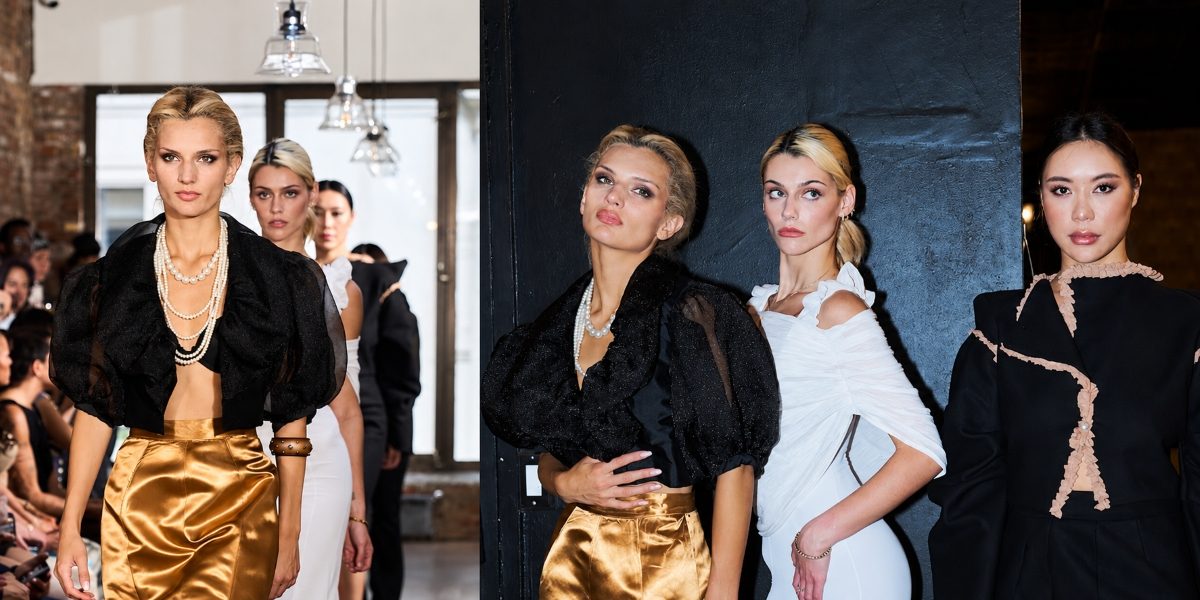
Second Skin grew from that idea. The collection treats clothing as a layer between the body and the outside world, exploring the tensions between protection and exposure, softness and structure, personal visibility and space. Xiong combined sheer materials, draping and body-conscious silhouettes with structured forms and exaggerated volume.
A defining look pairs a voluminous black sheer top with a fitted gold skirt. The transparent fabric exposes the body, while the top’s exaggerated volume creates a sense of distance around it. The controlled silhouette of the skirt intensifies the contrast, allowing the wearer to appear both exposed and protected.
Seeing the garments move on models before a live audience became a turning point for Xiong. Beyond research, fittings and classroom critiques, she began to understand how movement, presentation and audience response become part of a garment’s meaning. The experience gave her greater confidence in developing an independent design perspective.
Xiong is now developing her Parsons senior thesis collection, The Body as Draft. The project views the body as an evolving form, continually rewritten by age, experience, memory and self-perception. Through transformable garments, adjustable structures, layering and combinations of sheer and opaque materials, she examines who controls what is revealed, concealed or changed.
Her research includes interviews with women of different ages about how their relationship with their bodies changes over time. For Xiong, transformability is not only a technical device: adjustable structures allow the wearer to decide how a garment sits on the body and how much it reveals at a given moment. By bringing those choices together with personal accounts of bodily change, she hopes to create work that feels personal while remaining open to different interpretations and connections.
“My work usually begins with a question rather than a specific aesthetic,” she said. “I use research, material experimentation, construction and visual storytelling to explore the relationship between the body, identity and the outside world.”