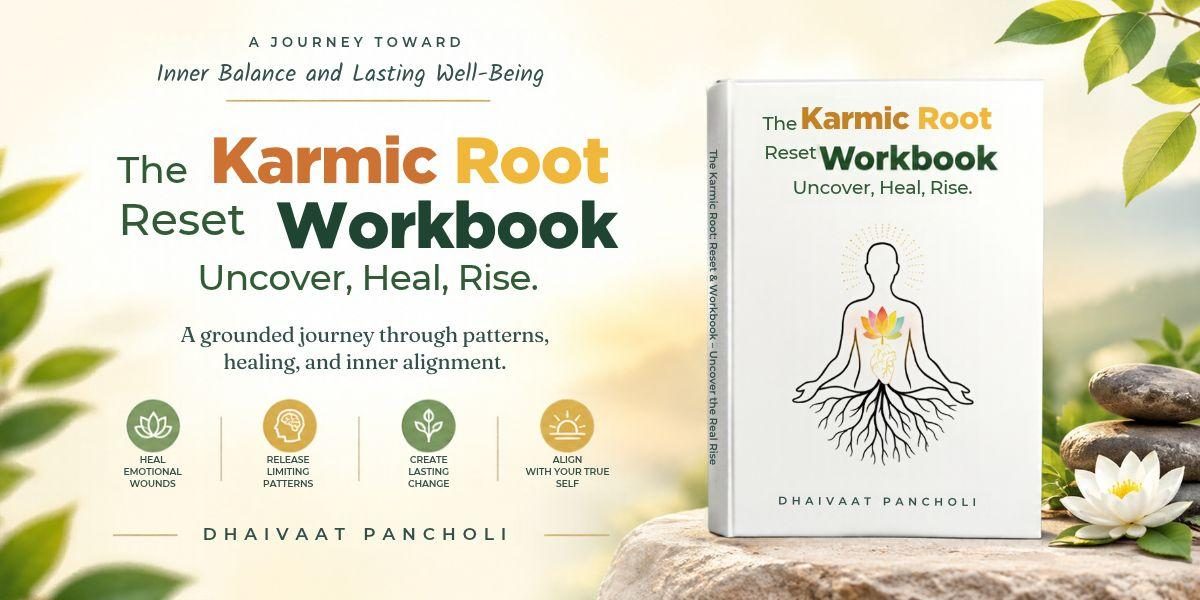

In The Karmic Root Reset Workbook: Uncover, Heal and Rise, Dhaivat Pancholi examines how inherited beliefs, emotional habits, and repeated reactions can shape adult life, and how greater awareness can create room for different choices.
Some habits are easy to recognize. Others appear as recurring arguments, familiar disappointments, or the persistent feeling of having to earn acceptance. A person may leave one difficult relationship only to encounter similar dynamics elsewhere, or promise to establish healthier boundaries before falling back into old responses. Over time, these repetitions can feel less like choices and more like an unchangeable part of life.
Dhaivat Pancholi’s The Karmic Root Reset Workbook: Uncover, Heal and Rise considers what may lie beneath such cycles. Rather than presenting karma solely as a matter of fate, punishment, or cosmic reward, Pancholi approaches it as the accumulation of repeated choices, emotional imprints, inherited beliefs, and unconscious reactions.
The distinction matters. If recurring difficulties are understood only as personal failures, self-criticism can become another cycle to escape. If they are examined with curiosity, however, they may offer information about learned behaviors, family conditioning and the beliefs that continue to influence everyday decisions.
Family Stories People Carry
Families pass on more than names, traditions and memories. They also communicate ideas about security, success, affection, responsibility and acceptable behavior. Some lessons are spoken openly; others are absorbed from silence, conflict, or the ways adults respond to uncertainty.
A child who learns that disagreement threatens belonging may become an adult who struggles to say no. Someone raised to associate worth with achievement may find rest uncomfortable or measure personal value by productivity. These responses can begin as adaptations to a particular environment and persist long after that environment has changed. The workbook invites readers to examine such patterns without automatically assigning blame to previous generations. Its emphasis is on recognizing what has been inherited, understanding how it operates, and deciding what deserves to continue.
This approach gives the idea of generational legacy a practical dimension. Honoring a family’s history does not require repeating every behavior it contains. Nor does acknowledging past harm require reducing relatives to their mistakes. The work begins with an honest assessment of the present.
From Awareness to Choice
The workbook combines karmic ideas with psychological reflection, mindfulness and somatic awareness. It encourages readers to consider not only what they think, but also how recurring situations register in the body and influence their responses. Its central framework follows five steps: Reveal, Untangle, Interrupt, Release, and Rewrite.
Reveal asks readers to notice patterns as they occur. Untangle explores their possible origins. Interrupt creates a pause between an old trigger and a familiar reaction. Release considers what no longer protects or serves the individual. Rewrite focuses on practicing alternative responses until they become more available in daily life. The sequence is not presented as a demand for instant resolution. The workbook emphasizes emotional pacing, repetition, and the importance of feeling sufficiently grounded to engage with difficult material. Readers are encouraged to pause when exercises become activating and return when ready.
That emphasis challenges the expectation that change should happen through willpower alone. Recognizing a pattern may be an important beginning, but lasting behavioral change also requires opportunities to respond differently.
Different Relationship With the Past
Dhaivat’s approach does not ask readers to deny their history or treat every hardship as a lesson they were destined to receive. Instead, it invites them to distinguish between what shaped them and what they can choose now.
That distinction offers a measured form of agency. The past may explain a reaction without making that reaction inevitable. An inherited belief may influence a decision without having the final word.
Takeaway
For readers who find themselves repeating familiar emotional cycles, The Karmic Root Reset Workbook: Uncover, Heal and Rise offers a structured place to begin asking better questions, and to practice answers that reflect who they want to become.
Ready to examine the patterns you carry and make room for new choices? Explore The Karmic Root Reset Workbook: Uncover, Heal and Rise by Dhaivat Pancholi.