
For generations, mathematics has been taught as a subject built around formulas, procedures, and repetition. Students often learn how to solve problems by following rules and steps without fully understanding why those steps work. While this approach may help them pass exams, it rarely builds the confidence or logical thinking needed beyond the classroom.
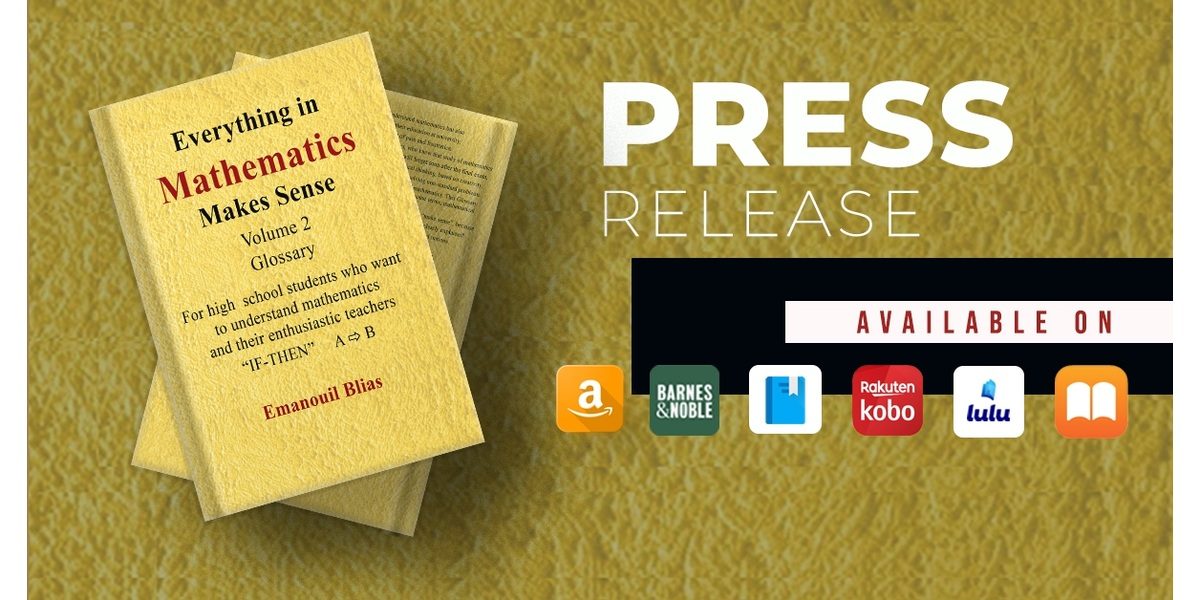
Educator and mathematician Emanouil Blias, in Logical Reasoning and Proofs in High School Mathematics (Volume 2): Everything in Mathematics Makes Sense, believes there is a better way.
Drawing on more than three decades of teaching experience in Russia and Canada, Emanouil Blias has developed an advanced mathematics course that encourages students to think differently about the subject. Rather than presenting mathematics as a collection of rules and formulas to memorize, his work focuses on helping readers understand the logic behind every concept, theorem, and proof. The goal is simple but powerful: replace memorization with genuine understanding.
This philosophy shapes every part of his second volume of advanced elementary mathematics. Instead of asking students to accept mathematical facts without question, the book invites them to explore where those facts come from. Definitions, reasoning, and proofs are treated as essential learning tools rather than optional additions.
Emanouil argues that many students struggle with mathematics not because the subject is beyond their abilities, but because they never receive clear explanations of its foundational ideas. Concepts such as divisibility, odd and even numbers, fractions, algebra, and geometrical transformation often become mechanical exercises instead of opportunities to develop logical thinking. By revisiting these topics with greater precision and encouraging students to ask “why,” the book seeks to close those gaps in understanding.
The result is a resource that extends beyond traditional problem-solving. Readers are encouraged to examine mathematical statements, evaluate logical arguments, and recognize the reasoning that connects one idea to another. Throughout the course, mathematical proof becomes less of an intimidating academic exercise and more of a practical way of thinking clearly.
This emphasis on reasoning also prepares students for future academic pursuits. As universities increasingly expect students entering fields such as computer science, engineering, economics, and finance to possess strong analytical skills, mathematical thinking becomes more valuable than ever. Logical reasoning is not confined to mathematics alone; it influences programming, scientific research, data analysis, and everyday decision-making.
Logical Reasoning and Proofs in High School Mathematics (Volume 2): Everything in Mathematics Makes Sense also highlights an important distinction between knowing how to complete a calculation and understanding why a mathematical principle works. Emanouil Blias believes that true mathematical confidence comes from understanding the structure behind problems rather than memorizing isolated techniques. That confidence can help students approach unfamiliar challenges with curiosity instead of anxiety.
To reinforce this mindset, the course places significant emphasis on mathematical language, carefully developed definitions, and structured reasoning. A comprehensive glossary of 240 terms is a significant feature of the book. These glossary terms, logical statements, exercises, and guided discussions encourage readers to build what the author describes as a genuine mathematical culture. Instead of treating mathematics as a subject of shortcuts, the book presents it as a disciplined way of thinking.
Another distinctive feature is its frequent use of “Explain why” prompts. Rather than simply arriving at the correct answer, students are encouraged to justify their reasoning in their own words. This process strengthens communication skills while reinforcing conceptual understanding, helping readers internalize ideas instead of relying solely on memory. It is well known that when someone explains a mathematical concept to another person, they both gain a deeper understanding.
Although the material challenges readers to think carefully, Emanouil does not present mathematics as an exclusive subject reserved for gifted students. He argues that with proper explanations, patience, and consistent effort, many more students are capable of mastering mathematical reasoning than they may believe. His decades of classroom experience have convinced him that understanding is achievable when instruction focuses on clarity and logical reasoning rather than memorization.
In the book, the author explains that mathematics is a form of art that expresses beauty through logical perfection and numerical and geometric relationships. Achieving success and enjoying mathematics requires dedication and time. However, the author suggests that developing logical thinking can benefit students both academically and socially.
At a time when education continues to evolve alongside rapidly advancing technology, Emanouil Blias offers a timely reminder that the greatest value of mathematics lies not only in finding answers using technology, but in learning how to think. His work encourages students to replace uncertainty with understanding and to discover the logical beauty that has always been at the heart of mathematics.