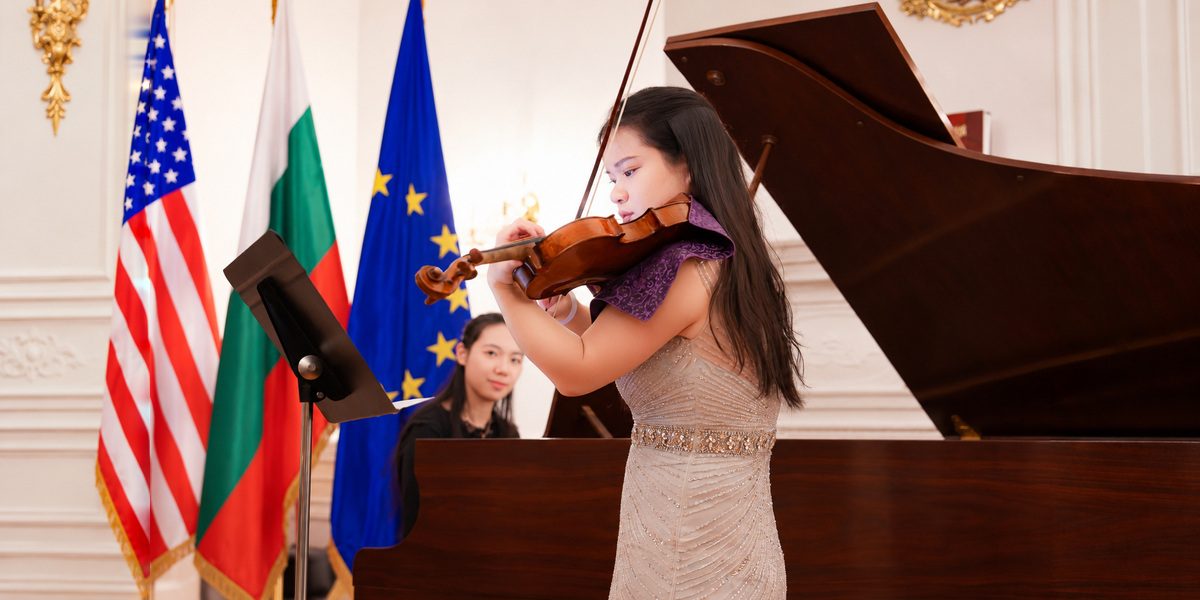

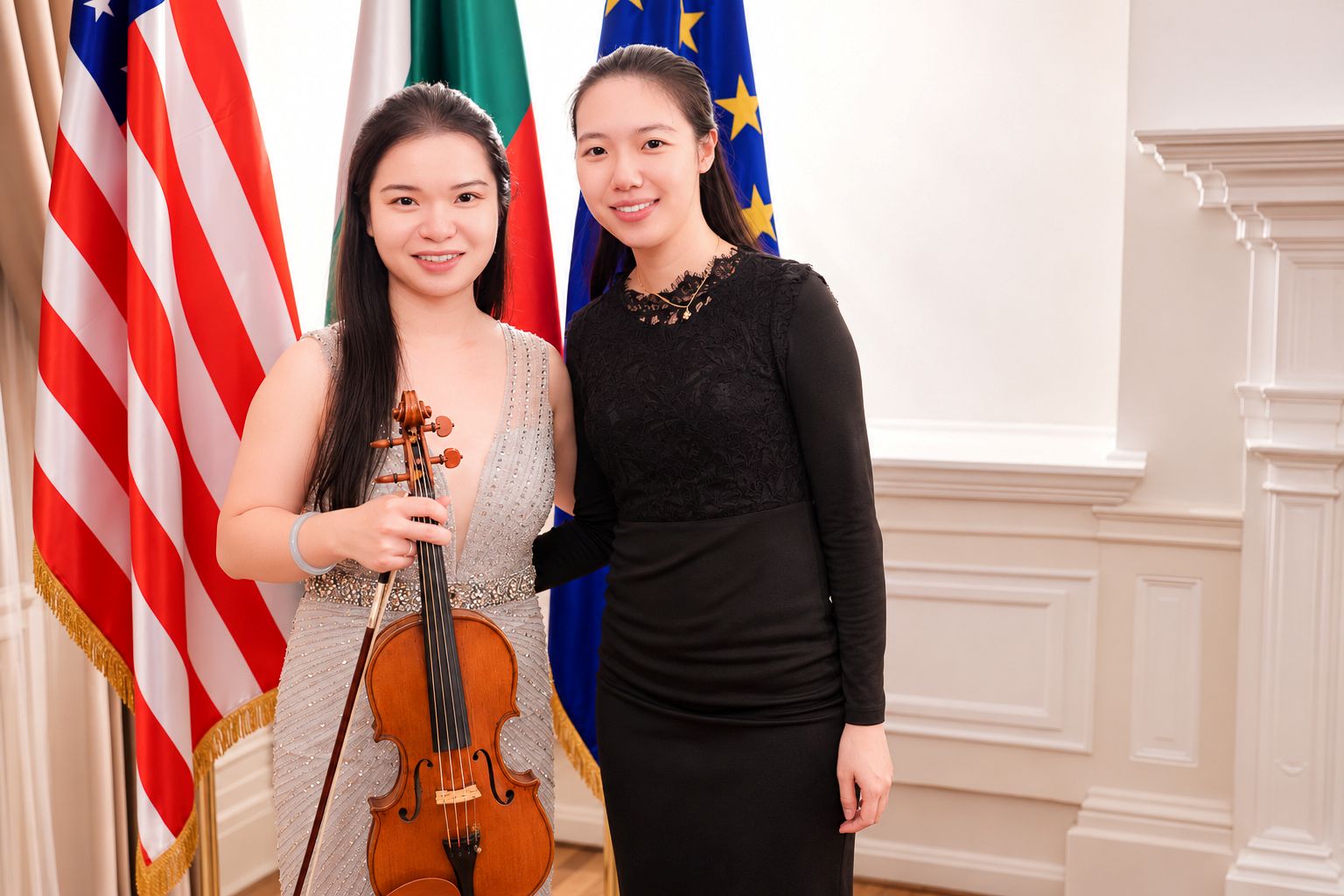
Invited to perform at the Washington International Young Artist Music Series (WIYAMS) for the second consecutive year, violinist Xiang Fang returned to the Bulgarian Embassy in Washington, D.C., on October 9. Two contrasting audience reactions became a lasting memory of the evening: during Dance of the Yao People, she recalled seeing listeners in the front row wiping away tears; after the spirited Hunan Flower Drum, she heard cheers.
The performance, with pianist Chenchun Ma, formed part of the closing concert of the 2026 Washington International Young Artist Music Series, or WIYAMS. Together, they presented the world premiere of composer Wang Xinyang’s Two Chinese Pieces (2011–13), bringing his violin-and-piano arrangements of familiar Chinese musical material to a Washington audience drawn from diverse cultural communities and ethnic backgrounds.
Fang is a Doctor of Music candidate at Indiana University’s Jacobs School of Music. Based in Naperville, Illinois, she maintains an active schedule of solo and chamber music performances across China, North America and Europe. The Washington appearance brought together several strands of her musical life: discovering new works through collaboration with living composers, developing close musical partnerships with colleagues, and connecting with listeners across cultural backgrounds through her personal artistic voice.
Two Instruments, Many Voices
Wang is an internationally active composer, a winner of multiple important awards, whose works have been performed and commissioned by various important orchestras and music festivals.
In discussing their collaboration, Wang praised Fang’s experience with contemporary works, her mastery of the classical repertoire, and her ability to bring musical styles from different cultures to life.
Written mainly in 2011 as jocular and practice pieces, and partly revised for viola and piano in 2013, Two Chinese Pieces came from Wang’s early student days, when he was experimenting with folk-related musical materials. Wang is known for his highly personal contemporary musical language, which is supported by a strong foundation in traditional musical upbringing and skills. Although Two Chinese Pieces is not a true representation of his compositional work, it offers a small glimpse into this musical background.
The lyricism, interwoven musical lines, and sophistication of Dance of the Yao People evoke the beauty of China’s rural landscapes and the romantic life of the Yao people. The intricate arrangement for violin and piano even gives a sense of orchestral fullness.
Hunan Flower Drum brings together another range of voices, weaving melodies and motifs from Liu Hai Kan Qiao (Liu Hai Cuts Firewood), a classic of Hunan flower-drum opera, and Yue Liang Ba Ba, a traditional Hunan children’s song passed down orally from generation to generation. Playful rhythms and changing textures bring these familiar tunes to life while preserving their folk character. The violin and piano answer one another like two voices in conversation, echoing the call-and-response between husband and wife in Liu Hai Kan Qiao.
Sounds of Home, Shared Through Performance
For Fang, a native of Changsha, Hunan, these musical references carried a personal connection to her home region. Performing them in Washington offered a way to share that connection with listeners whose own cultural memories and experiences might be very different.
For Fang and Ma, conveying the music’s character called for more than a lyrical presentation of familiar tunes. Clear rhythmic gestures and responsive exchanges between the instruments were central to expressing the humor, warmth and exuberance of Hunan Flower Drum. Their close partnership helped bring its conversational quality to life.
The exchange had begun before the embassy concert. At an open rehearsal at Skydome Hall, the home performance space where Fang hosts free community concerts in Naperville, Illinois, she and Ma shared the program with local listeners. The music moved from that intimate gathering to Washington, finding another audience and another setting.
Fang values WIYAMS for the freedom it gives artists to choose repertoire and express a personal artistic voice, as well as the conversations that continue with audiences after a performance.
For Fang, the evening’s significance lay in the empathy and appreciation expressed by Washington listeners from different cultural and ethnic backgrounds. She understood the tears during Dance of the Yao People as a response to its wistful beauty, awakening cherished memories and a shared longing for beauty. The cheers after Hunan Flower Drum brought a joyful counterpart, as music rooted in Chinese life and tradition found shared emotional meaning across cultures.