
For many water treatment businesses, digital marketing is still evaluated primarily through one number: cost per lead.
Hydro Demand founder Uneeb Aamer believes that number is useful, but rarely tells the entire story.
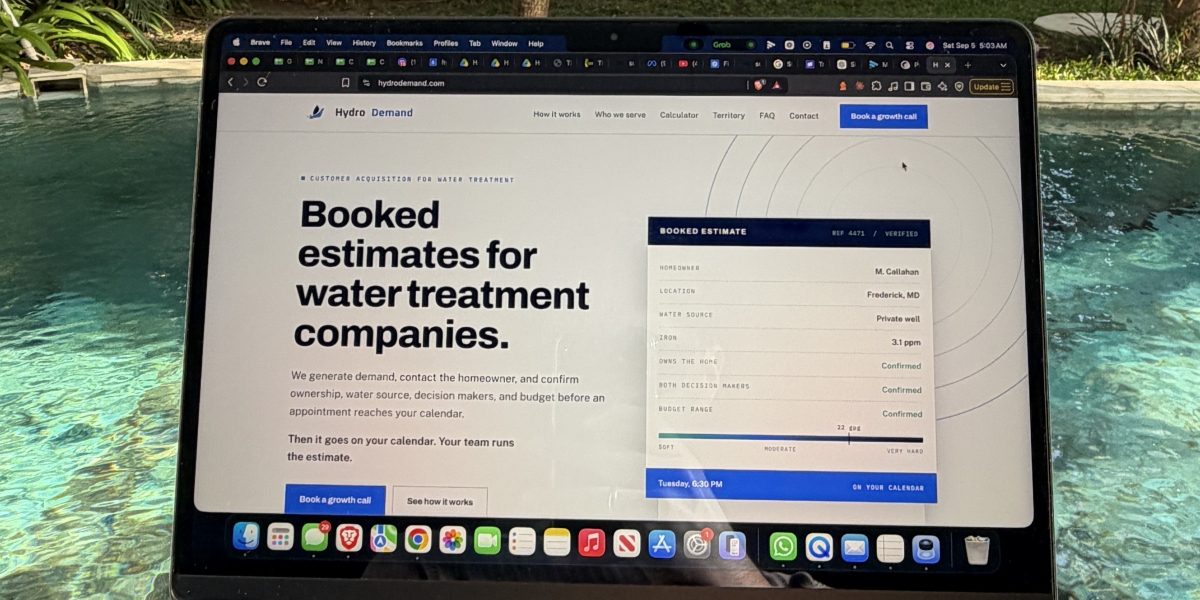
Hydro Demand is a customer acquisition and performance marketing company focused on residential water treatment businesses. Its work includes Meta advertising, creative strategy, lead generation, qualification, follow-up, and appointment generation.
The company’s approach begins with a simple distinction.
A lead is not necessarily a sales opportunity.
Somebody can complete a form and never answer the phone.
A prospect may live outside the dealer’s service territory.
The person may not be the homeowner or relevant decision maker.
They may misunderstand the service being advertised.
Or they may have very little intention of making a purchase.
All of those people can still appear as successful leads inside an advertising dashboard.
To a water treatment dealer, however, their value is very different.
Water Treatment Has a Different Buying Journey
Residential water treatment is not identical to many emergency home service categories.
When a furnace fails during winter or a pipe bursts, the homeowner often has an immediate reason to act.
Water treatment can involve a longer consideration period.
A homeowner may recognize scale buildup, staining, unpleasant odor, hard water, dissatisfaction with drinking water, or an aging treatment system without immediately contacting a dealer.
That means water treatment advertising frequently has two jobs.
It has to create awareness around the problem and then give the homeowner a reason to take the next step.
That makes creative and positioning particularly important.
A homeowner who already knows they need a whole-home system behaves differently from somebody who has only recently begun thinking about water quality.
Hydro Demand therefore treats the advertisement as more than a mechanism for reducing cost per lead.
The message also influences the type of customer entering the funnel.
What Happens After the Lead?
A typical Meta campaign might begin with an advertisement on Facebook or Instagram.
A homeowner responds.
That creates a lead.
But several conversions still have to happen before the dealer makes money.
The person has to become contactable.
The opportunity has to qualify.
The homeowner has to agree to an appointment or consultation.
That appointment has to take place.
And eventually the dealer has to sell.
This is why Aamer believes marketers should evaluate performance further downstream.
“You can generate inexpensive leads and still create a poor result for the dealer,” he says. “The question is how efficiently those leads turn into actual sales opportunities.”
Defining a Qualified Water Treatment Opportunity
Hydro Demand generally looks for several basic signals before treating a prospect as a qualified opportunity.
The person should be a homeowner or relevant decision maker.
The property should fall within the dealer’s service territory.
The homeowner should actually be interested in a water treatment service the company provides.
And the prospect should be considering taking action within a reasonable timeframe.
Those basic filters matter because in-home sales capacity is expensive.
A representative may travel to the property, evaluate the water, inspect the home, discuss treatment options, explain financing, and present a system.
Sending that representative to somebody who misunderstood an advertisement can cost significantly more than the original lead.
Qualification protects that capacity.
Moving From Cost Per Lead to Cost Per Appointment
Hydro Demand still monitors cost per lead.
But Aamer places significant weight on cost per qualified appointment because it represents something much closer to a monetizable event.
For many campaigns, the company works toward approximately $100 in advertising spend per qualified appointment after the campaign has generated enough data to mature.
Aamer emphasizes that this is an operating target rather than a universal warranty.
Market size, competition, creative, offer structure, average system price, geography, and campaign maturity can all change the number.
The principle matters more than the exact figure.
Marketing should be measured against an event that has economic value to the dealer.
A qualified appointment does.
Why the Dealer’s Sales Team Matters
Advertising performance also cannot be completely separated from the sales organization receiving the opportunities.
Two companies can receive the same number and quality of appointments and produce very different financial outcomes.
If one dealership closes 40 percent of qualified presentations and another closes 10 percent, their allowable acquisition costs are completely different.
That is why Hydro Demand looks at average ticket, sales close rate, margins, geographic coverage, and capacity when thinking about scale.
A business with strong sales economics can often afford to spend more aggressively to acquire qualified opportunities.
That can become a meaningful competitive advantage.
How Meta Advertising Changes Buyer Intent
Meta is particularly relevant to this discussion because Facebook and Instagram frequently create demand rather than simply capture somebody already searching.
Creative therefore affects the buyer who responds.
A promotion built almost entirely around price may attract more price-sensitive homeowners.
A problem-focused advertisement can attract somebody already frustrated with staining, scale, taste, odor, or an existing system.
An educational advertisement can reach somebody who suspects something is wrong but has not started actively shopping.
No single approach wins in every market.
Hydro Demand’s approach is to test those messages and then look at what happens after the click.
Which advertisements create real conversations?
Which generate qualified appointments?
Which ultimately contribute to customer acquisition?
That feedback is more valuable than simply selecting the advertisement with the lowest lead cost.
From Lead Generation to Customer Acquisition
Hydro Demand’s broader philosophy is that water treatment companies should view marketing as a connected acquisition system.
Advertising creates attention.
Lead capture identifies interest.
Qualification identifies fit.
Appointment setting creates a sales opportunity.
The dealer converts that opportunity into revenue.
When those stages are measured together, companies can identify where the actual constraint exists.
Sometimes the business needs more leads.
Sometimes it needs better qualification.
Sometimes it needs better follow-up.
Sometimes the advertising is performing, but the sales process needs improvement.
Understanding the difference is what makes customer acquisition scalable.
About Hydro Demand
Hydro Demand is a customer acquisition and performance marketing company focused on residential water treatment businesses. Its work includes Meta advertising, creative strategy, lead generation, lead qualification, follow-up, and qualified appointment generation.
Media Contact
Uneeb Aamer
Founder, Hydro Demand
uneeb@hydrodemand.com
866-850-3239
https://hydrodemand.com/