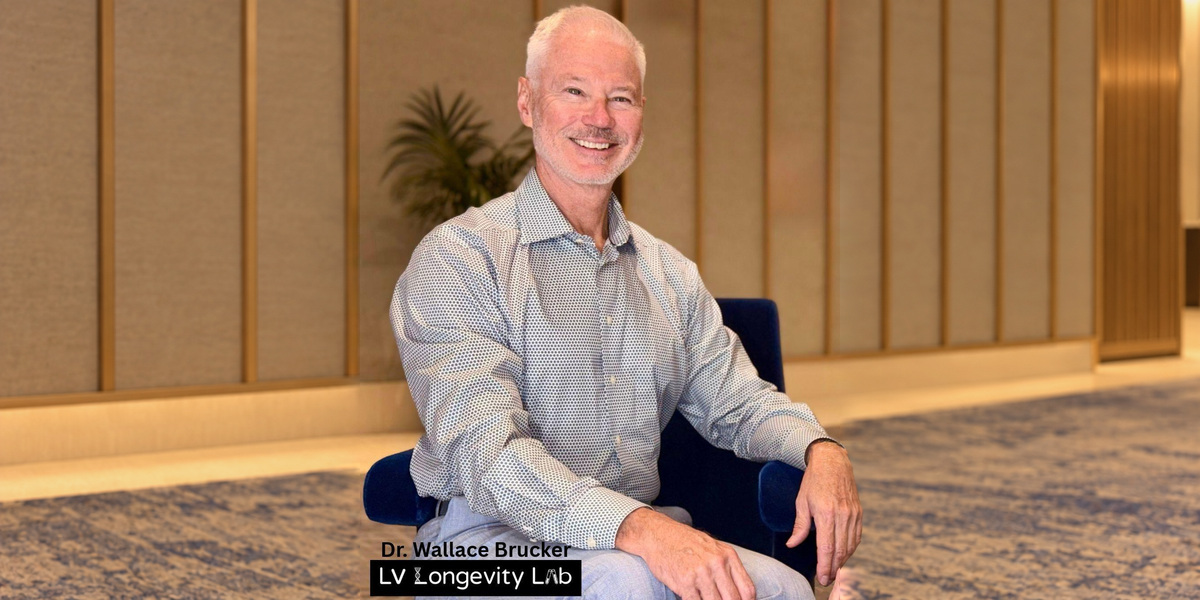
As millions track sleep, heart rate, and glucose on wearables, LV Longevity Lab’s Dr. Wallace Brucker explains why biometric data only matters when a physician can interpret it and act on it
LAS VEGAS, NV, October 4, 2026. Americans have never had more data about their own bodies. Oura rings track sleep. Whoop bands measure recovery. Apple Watches log heart rate and estimate VO2 max. Continuous glucose monitors flag every spike. Yet for all this information, most people are left with the same uneasy feeling: their device is telling them something is off, and they have no idea what to do about it. According to Dr. Wallace Brucker, MD, founder of LV Longevity Lab in Las Vegas, that gap between data and action is one of the biggest missed opportunities in modern health.
“People are walking around with more health data on their wrist than a hospital had access to a generation ago,” said Dr. Brucker. “But data without interpretation is just noise. I have patients come in anxious because their recovery score is low or their HRV keeps dropping, and no one has ever helped them understand what it actually means for their health. That’s the problem I want to solve.”
Wearables have been a genuine breakthrough for awareness. They’ve made millions of people pay attention to sleep quality, resting heart rate, heart rate variability, activity, and even blood sugar, metrics that were once invisible. Dr. Brucker is quick to credit them for that.
“I love that patients are engaged. These devices have done something remarkable. They’ve made people curious about their own physiology,” he said. “A wearable that nudges you to walk more or shows you how alcohol wrecks your sleep is doing real good. I never want to discourage that. But awareness is the first step, not the last one.”
The trouble, Dr. Brucker explains, is that consumer devices are built to estimate and motivate, not to diagnose. A smartwatch’s VO2 max reading is an approximation. A recovery score is an algorithm’s best guess. And a single flagged metric, viewed in isolation, can cause needless worry or, worse, give false reassurance.
“A watch can tell you your resting heart rate is creeping up, but it can’t tell you why,” said Dr. Brucker. “Is it stress? A thyroid issue? Overtraining? Early cardiovascular change? A hormone imbalance? The number is a clue, not an answer. You need a physician who can connect that clue to real diagnostics and a real history to make it meaningful.”
That’s precisely the role Dr. Brucker plays at LV Longevity Lab. Rather than dismissing the data patients bring in, he treats it as a valuable starting point and then pairs it with clinical-grade testing that consumer devices can’t replicate. Where a watch estimates VO2 max, Dr. Brucker measures it directly using the clinic’s PNOĒ metabolic analyzer. Where a wearable hints at metabolic stress, he runs comprehensive blood panels, hormone evaluations, and inflammatory markers to look for underlying causes.
“The magic happens when you combine the two,” Dr. Brucker said. “Your wearable shows me patterns over time in your real life: how you’re actually sleeping, recovering, and moving. My testing shows me what’s happening inside at a level the device can’t see. Put those together, and suddenly we’re not guessing. We have a complete picture, and more importantly, a plan.”
That plan is where the data finally becomes useful. Based on both the patient’s biometric trends and their clinical results, Dr. Brucker builds a personalized longevity strategy that may include hormone optimization, metabolic and nutritional changes, targeted fitness and recovery protocols, and inflammation reduction. Because wearables provide continuous feedback, patients can follow their own trends alongside their clinical results.
“This is the part people miss: the goal isn’t to collect data, it’s to change outcomes,” Dr. Brucker said.
His advice to the data-rich but answer-poor is simple: don’t ignore what your device is telling you, but don’t try to decode it alone.
“If your smartwatch is telling you something’s wrong, listen, but then bring it to someone who can do something about it,” Dr. Brucker said. “The data is the beginning of the conversation. My job is to finish it.”
About LV Longevity Lab
LV Longevity Lab is a Las Vegas-based longevity and optimization medical practice led by Dr. Wallace Brucker, MD. Combining advanced diagnostic testing with personalized, evidence-informed treatment, the practice works with patients on energy, metabolism, hormones, and long-term health.
Disclaimer: This article is for informational purposes only and is not intended to provide medical advice, diagnosis, or treatment. Wearable device data and biometric measurements should not be used as a substitute for evaluation by a qualified healthcare professional. Readers should consult a licensed medical provider regarding any health concerns, symptoms, test results, or treatment decisions.
The Chesterfield, Missouri founder turned a problem in his own home into a company that books in-home estimate appointments for water treatment dealers across the country.
CHESTERFIELD, Mo. Nevaan Jhanjhariya did not set out to work in water treatment. He got into it the way most homeowners do, by noticing something was wrong with what was coming out of the tap.
The water at his family’s home was hard and poorly treated. Appliances wore out early. Nobody in the house was happy with what they were drinking. So the family did what thousands of homeowners do every year and had a water treatment system installed.
“It was one of the best decisions we ever made,” Jhanjhariya says. “The appliances stopped failing. You stop worrying about what is in your water, and that is a very different way to live.”
That experience planted an idea. If a single system could change daily life that much, the companies selling those systems had a product worth fighting for. In Jhanjhariya’s view, most of them were fighting with the wrong tools.
Marketing First, Water Second
Before Wellsprings, Jhanjhariya had spent years in paid digital advertising, building and running Facebook and Instagram campaigns for service businesses. He knew how to make a stranger stop scrolling, recognize a problem in their own life, and ask for help.
When he looked at the water treatment industry, he saw dealers with excellent closers and empty calendars. In his experience, many were buying “leads” from national vendors, phone numbers that had often been sold to three or four competing companies at once. Sales reps spent their days chasing people who did not pick up.
“These companies do not want leads,” he says. “They have been burned by leads. What they want is a homeowner with a real water problem, sitting at their kitchen table at a set time, ready to see a demo.”
That distinction became the business. Wellsprings Estimates runs problem-focused Facebook and Instagram ads in a dealer’s territory, calls every lead within minutes, qualifies the homeowner, and books the appointment directly onto the dealer’s calendar. The dealer’s team shows up and sells.
Photo Courtesy: Nevaan Jhanjhariya
Why Facebook Ads
Jhanjhariya is specific about the channel. Search ads catch people who already know they need a softener. Social ads, he argues, reach the far larger group who have the symptoms but have never named the cause: the spotted dishes, the orange staining, the rotten-egg smell from a well, the skin that will not stop itching.
“We show people the problem first, then the solution,” he says. “That is the whole creative strategy.”
The company is built to work with dealers selling everything from residential softeners and reverse osmosis units to iron and sulfur systems for rural wells and whole-home filtration. Every dealer is exclusive in its territory, and the ads run inside the dealer’s own ad account so the client owns its data.
Photo Courtesy: Nevaan Jhanjhariya
A Growth Partner, Not A Vendor
Jhanjhariya describes the ambition in plain terms: become the growth partner that established water treatment companies trust to take marketing off their plate entirely.
“The owners we work with are great at water. They are not trying to become ad experts, and they should not have to,” he says. “They need one legitimate company that does all of it, start to finish, and puts it in writing.”
Wellsprings puts the terms of its dealer agreements in writing, and every client receives the founder’s own cell number.
Asked what keeps him in the business, Jhanjhariya does not talk about ad metrics. He talks about the system in his own house.
“Water is my passion. I believe in this product because I live with it every day,” he says. “Every appointment we book is a family that might get to stop worrying about their water. That is a good reason to go to work.”
Wellsprings Estimates offers exclusive, confirmed in-home estimate appointments to water treatment dealers across the United States, one dealer per territory. The company is based in Chesterfield, Missouri, and can be reached at (314) 396-8951. Additional information is available at wellspringsestimates.com, on the company’s Facebook page, and through its Google business profile.
New York City will provide free child care to more than 10,000 children currently on the Child Care Assistance Program (CCAP) waitlist. The Administration for Children’s Services (ACS) will invite eligible families on a rolling basis over the coming months, with the expansion backed by $475 million in state funding set aside for vouchers.
Key Takeaways
More than 10,000 children ages 6 weeks to 13 years, and up to age 19 for children with special needs, will move off the CCAP waitlist.
New York State committed $1.2 billion toward child care in New York City, including $475 million specifically for vouchers.
ACS will begin inviting waitlisted families to apply within the next few weeks, prioritizing households under 300 percent of the federal poverty line, families without housing, and children with special needs.
The city’s online child care map now lets families filter licensed programs by whether they accept vouchers, a first for New York City.
Since August, voucher families have paid no out-of-pocket fees, after a $5.2 million city investment covering about 22,000 families.
More than 100,000 New York City children already use CCAP vouchers.
The Waitlist Had Grown for More Than a Year
The Child Care Assistance Program is largely state funded and covers care for children from infancy through age 13. For roughly 16 months, New York City stopped moving new families into the program after funding ran short. Gothamist reported that more than 16,000 families were on the waitlist. In the city’s own announcement, state lawmakers put the number of waiting children at close to 29,000.
That gap shapes how the October 5 announcement should be read. The Child Care Assistance Program will reach more than 10,000 children in this round, which is a substantial share of the backlog but not all of it. Several advocacy groups quoted in the city’s release, including the Schuyler Center for Analysis and Advocacy and the Empire State Campaign for Child Care, said clearing the rest of the list has to remain a priority in the next state budget cycle.
Families Will Be Invited on a Rolling Basis
The Administration for Children’s Services will contact waitlisted families directly rather than reopening the list to new applicants all at once. Invitations go out over the next few months. Once a family is found eligible, the voucher covers the cost of care at a provider the family chooses.
Federal rules set the order. The Administration for Children’s Services must first serve households earning under 300 percent of the federal poverty line, families experiencing homelessness, and families raising a child with special needs. Families outside those groups may wait longer, even if they meet the program’s general income limits.
Because the Child Care Assistance Program dropped its out-of-pocket fees in August, newly enrolled families should not see a weekly bill once care begins. Before that change, families paid on a sliding scale capped at $15 a week, a fee that still strained household budgets at the lowest income levels.
Finding a Provider That Accepts Vouchers Is Now Simpler
One practical change may matter as much as the funding. New York City added a filter to its child care map on NYC.gov that shows which licensed programs accept vouchers. Until now, parents usually had to call centers one by one to find out. For a parent juggling shift work and a new voucher, cutting out those calls removes a real hurdle between approval and an empty classroom seat.
Home-Based Providers Stand to Gain Directly
The Child Care Assistance Program is a revenue lifeline for many of New York City’s small child care businesses, especially family child care providers who run licensed programs out of their homes. Vouchers follow the child, so when the waitlist froze, many of those providers lost the families who would have filled their open slots.
Jessica Sager, co-founder and CEO of All Our Kin, said family child care programs can now start to restore their rosters. Tara N. Gardner, executive director of the Day Care Council of New York, framed the move as a way to put existing capacity to work, since many programs already have open seats. Susan Stamler of United Neighborhood Houses pointed to the waitlist’s toll on providers, describing unstable revenue on top of very thin operating margins.
That revenue question links this announcement to the city’s earlier push to fix late payments to contracted providers. Filling seats helps only if providers are paid on time, and advocates quoted in the release also pressed for higher wages across the child care workforce.
Vouchers Remain Central to the City’s Wider Child Care Plans
New York City is also rolling out 2-K, its free program for two-year-olds, in four pilot areas this fall. Data from Citizens’ Committee for Children of New York shows how much that effort depends on vouchers: in the 2-K pilot districts, nearly three in four two-year-olds who reach publicly funded care do so through a voucher. Raysa S. Rodriguez, the organization’s executive director, said voucher access needs to grow alongside investment in providers, staff, and facilities.
For working parents, the near-term picture is clear. Families already on the Child Care Assistance Program waitlist should watch for outreach from the Administration for Children’s Services in the coming weeks and make sure their contact information is current. Families not yet enrolled can use the updated map to identify nearby programs that accept vouchers before an invitation arrives.
FAQs
Who Is Eligible for the Child Care Assistance Program in New York City?
Children ages 6 weeks through 13 years from income-eligible families qualify, and children with special needs remain eligible through age 19. Priority goes to households under 300 percent of the federal poverty line, families without housing, and children with special needs.
How Will Families on the Waitlist Be Contacted?
The Administration for Children’s Services will invite waitlisted families to apply on a rolling basis over the next few months. Eligible families then receive a voucher for a provider of their choice.
Do Families Pay Anything for Child Care Vouchers in New York City?
No. Since August 2026, New York City has covered all out-of-pocket fees for families receiving child care vouchers, so the care is free to eligible families.
How Can Parents Find Child Care Programs That Accept Vouchers?
The child care map on NYC.gov now includes a filter showing which licensed programs accept vouchers. Families can search by location without calling each program.
How Many Children Are Still Waiting for Child Care Assistance?
Estimates before the announcement ranged from more than 16,000 families to close to 29,000 children. Moving more than 10,000 children off the list leaves a portion still waiting, and advocates are pushing for additional state funding.
An accident can leave you dealing with physical pain, emotional stress, medical appointments, and unexpected expenses. Documenting what happened and how the injury affects your life can help you maintain an organized record of the incident. Good documentation may include medical records, photographs, accident reports, witness information, and records of related expenses. It is best to begin collecting information as soon as possible while details are still fresh. Keeping everything organized can also make it easier to communicate with insurance companies, medical professionals, or legal representatives. The following steps can help you create a thorough record after an accident.
1. Write Down What Happened
As soon as you are able, write a detailed account of the accident. Include the date, time, location, weather conditions, people involved, and events leading up to the incident. Describe what you remember without adding assumptions or details you cannot confirm. If you experienced pain or other symptoms immediately afterward, record those as well. Justice Partners Law Group reviews information about an accident when helping clients understand their circumstances. A written account can be particularly useful because memories may become less precise over time. Keep your notes in a secure location and update them if new relevant details emerge.
2. Take Photographs and Videos
Visual evidence can provide useful information about an accident and its surrounding circumstances. When it is safe to do so, photograph the accident scene, visible injuries, damaged property, vehicles, road conditions, signs, and other relevant details. Take photographs from different angles and avoid altering the scene before documenting it whenever possible. If swelling, bruising, or other visible symptoms develop later, consider photographing those changes as well. Keep the original files rather than relying only on edited or compressed versions. Make sure your photographs are stored securely and backed up. Clear visual documentation can help preserve details that may otherwise be difficult to recall.
3. Keep Your Medical Records
Medical documentation can help establish the nature and extent of injuries following an accident. Keep copies of medical reports, test results, prescriptions, treatment plans, discharge instructions, and invoices. Follow your healthcare provider’s recommendations and attend scheduled appointments when possible. Maintain a simple record of symptoms, pain levels, treatment received, and changes in your condition. If an injury affects your ability to perform ordinary activities, note those limitations as well. Do not exaggerate symptoms, but do not overlook them either. Consistent medical documentation can provide a clearer record of your recovery and the treatment associated with the accident.
4. Collect Accident and Incident Reports
Depending on the circumstances, an official report may have been prepared by police, property management, an employer, or another responsible organization. Request a copy when one is available and review it for accuracy. If you believe important information is missing or incorrect, note the issue and determine whether there is a formal process for providing additional information. Keep copies of correspondence related to the report. You should also record the names and contact information of people who were involved in preparing or discussing the report. These documents can help establish basic facts about when, where, and how the accident occurred.
5. Gather Witness Information
People who witnessed an accident may have information that helps clarify what happened. If appropriate and safe, obtain their names and contact information. Write down what each person said about the incident, but avoid pressuring anyone to provide a particular version of events. Do not alter or embellish their statements. If a business, property owner, or other organization has information about potential witnesses, make a note of it. Keep witness details together with your other accident records. Having accurate contact information can make it easier for the appropriate parties to obtain additional information if questions about the circumstances of the accident arise later.
6. Track Expenses and Other Losses
An injury can result in expenses beyond immediate medical treatment. Keep receipts and records for medical bills, medications, transportation to appointments, rehabilitation, equipment, and other accident-related costs. If you miss work or experience changes in your employment because of the injury, maintain records showing dates missed and any related documentation from your employer. You may also want to keep a record of how the injury affects ordinary activities, household responsibilities, or other aspects of your routine. Organized financial and personal records can help provide a clearer picture of the consequences associated with the accident and support more accurate discussions about the situation.
7. Keep Everything Organized
Once you have collected your documentation, organize it in a way that makes information easy to locate. Create separate folders for medical records, photographs, accident reports, witness information, expenses, correspondence, and employment documents. Keep digital backups of important files and preserve original documents whenever possible. Record important dates and deadlines in a calendar so they are not overlooked. Avoid posting detailed information about the accident or your injuries on social media, as public posts may be viewed outside their original context. If you have questions about your legal options, an appropriately qualified personal injury professional can review your documentation and explain the procedures that may apply to your circumstances.
Disclaimer: The content in this article is provided for general knowledge. It does not constitute legal advice, and readers should seek advice from qualified legal professionals regarding particular cases or situations.
The Work of Denise Jovita Serrato, Founder of Colibrí Wellness, LCSW, PLLC
A mental health assessment can document symptoms, but understanding those symptoms requires attention to the circumstances in which they developed. For Denise Serrato, founder of Colibrí Wellness, that includes language, migration, family relationships, identity and the conditions shaping a person’s sense of safety.
Serrato is a bilingual English- and Spanish-speaking licensed clinical social worker whose work includes immigration mental health evaluations, individual and couples therapy, and workplace-related mental health evaluations. Her decolonial approach brings questions about culture, power and lived experience into the assessment process while preserving standardized measures and independent clinical judgment.
Within immigration mental health evaluations, Serrato explores how distress, trauma and mental well-being affect daily functioning, including relationships, work, sleep, concentration and caregiving. She also considers how each person understands and communicates these experiences within their cultural and personal context. Her focus is on developing a clinical account that reflects both the psychological findings and the individual’s circumstances.
Roots, Identity and an Educational Foundation
Photo Courtesy: Rose @fotografiadellanonna (Denise Serrato’s Mother)
Serrato identifies as a first-generation P’urhepecha, Zacatecana, Huasteca and Xicana psychotherapist, born and raised in East Los Angeles and California’s San Gabriel Valley. Her roots extend to Michoacán, Mexicali, Zacatecas and San Luis Potosí. This heritage informs how she locates herself within the therapeutic encounter, bringing attention to identity, language, belonging and the histories that shape people’s experiences.
She earned a bachelor’s degree in Behavioral Science from Cal Poly Pomona, with a minor in Ethnic and Women’s Studies and an emphasis on Chicano Studies. In 2008, she moved to New York City to pursue graduate education at Fordham University, where she earned her Master of Social Work in 2012. She later completed postgraduate training at the Ackerman Institute for the Family in Children and Family Work.
Her professional development also includes training in immigration mental health evaluations and certification in motivational interviewing from Columbia University. These experiences support her work with individuals whose concerns intersect with trauma, family relationships, migration and substance use.
Her interest in a decolonial approach connects her background with questions she brings into clinical practice: Whose understanding of distress is being prioritized? What assumptions does the clinician bring into the room? What becomes visible when the client’s language and circumstances receive closer attention?
Serrato approaches each client with curiosity about their particular history, recognizing that shared language or cultural roots do not automatically mean shared experiences.
What a Decolonial Approach Looks Like in Practice
In Serrato’s work, a decolonial lens involves examining the assumptions that shape clinical questions and interpretations. It creates space to consider whether an assessment adequately captures the experiences of people whose lives, language or cultural expectations differ from those assumed within conventional clinical frameworks.
A question about difficulty relaxing, for example, may require exploration of anxiety alongside work demands, caregiving responsibilities or concerns about safety. Social withdrawal may call for attention to grief, mistrust, family separation or experiences of exclusion.
These conversations help clarify how symptoms developed, what maintains them and how they affect functioning. They also allow clients to explain their experiences in their own terms.
Serrato uses standardized assessments while retaining their validated questions and scoring. Her approach adds contextual follow-up rather than treating a screening score as a complete explanation. Diagnostic conclusions remain grounded in the clinical findings.
The decolonial perspective also extends to what a report recognizes as strength. Family connections, community relationships, cultural practices and strategies developed through difficult circumstances may be meaningful resources. Their significance is explored with the individual rather than presumed.
Locating the Clinician in the Encounter
Serrato’s postgraduate training informs her attention to “location of self”: the clinician’s recognition of how identity, experience and professional authority influence an encounter.
An evaluator makes decisions about what to ask, what requires clarification and how a client’s account will be represented. Serrato’s approach includes reflecting on the assumptions behind those decisions and the power involved in translating a person’s story into clinical language.
She also considers how the clinician’s cultural identity, ethnicity, appearance and language may influence an interviewee’s comfort and willingness to share. For some clients, working with someone who looks like them or shares aspects of their background can create a sense of recognition and ease concerns about being misunderstood. That comfort may help them discuss painful experiences, culturally specific meanings or details they might otherwise hesitate to disclose.
Shared identity does not automatically establish trust. Serrato explores what helps each person feel understood, while remaining attentive to differences within communities. Her decolonial approach asks the clinician to consider how perceived similarities, differences and professional power shape the conversation.
For Serrato, this awareness supports both the relationship and the assessment: creating conditions for fuller disclosure while preserving careful questioning and independent clinical judgment.
Mental Health Evaluations for Immigration Matters
Colibrí Wellness provides immigration mental health evaluations for asylum cases, hardship waiver applications (including I-601 and I-601A), Violence Against Women Act (VAWA) petitions, and U and T visa matters.
Depending on the referral, an assessment may address reported experiences of harm, current symptoms, diagnostic impressions, daily functioning and treatment needs. Relevant areas can include sleep, concentration, relationships, employment, caregiving and participation in everyday activities.
In mental health evaluations for hardship cases, the clinical focus includes the potential psychological effects of separation or relocation on the qualifying relative identified by the attorney. The assessment explores that person’s circumstances, existing vulnerabilities, support systems and caregiving relationships.
The written report brings together the clinical interview and assessment findings. Serrato emphasizes independent professional judgment and documentation that represents the findings accurately. Her approach considers both the distress a person reports and the resources that support their functioning.
For attorneys working with Spanish-speaking clients, bilingual services provide an opportunity for clients to describe their experiences directly in their preferred language. Attention to expressions, cultural meanings and the client’s own explanations forms part of the assessment process.
Her role is clinical. Attorneys address legal eligibility and case strategy, while immigration authorities determine outcomes. A mental health evaluation contributes clinical information for consideration within that process.
Exploring the Psychological Impact of Potential Deportation
Exploring the psychological impact of potential deportation is another important part of Serrato’s approach. Depending on the referral, this includes examining how anticipated separation or relocation could affect family relationships, caregiving, financial stability, access to treatment and connections to community. The assessment considers these circumstances alongside current symptoms and the individual’s history.
A decolonial framework brings attention to how immigration systems and unequal access to safety and resources shape a person’s emotional experience. Fear, grief or difficulty concentrating may be connected to uncertainty about remaining with loved ones, losing an established support network or returning to circumstances associated with harm. Serrato explores these connections without assuming that every person experiences deportation or relocation in the same way.
This approach also recognizes that belonging can extend across borders. An assessment explores what family, language, place and community mean to the individual, rather than assuming that returning to a country of origin would necessarily provide familiarity, safety or support. The clinical task is to document the psychological significance of these circumstances and their potential effects on functioning.
Bilingual Services Across Multiple Jurisdictions
Photo Courtesy: Colibrí Wellness
Serrato holds clinical social work licenses in New York, Connecticut and Massachusetts. She also holds telehealth registrations in Florida, Vermont, Idaho and Delaware.
Colibrí Wellness is certified as both a Women-Owned Business Enterprise (WBE) and a Minority-Owned Business Enterprise (MBE) through the New York State Division of Minority and Women’s Business Development. Alongside these business certifications, Serrato’s practice emphasizes culturally responsive and linguistically appropriate mental health services for diverse and historically systemically marginalized communities.
After building her professional career in New York, Serrato returned to California and continues to provide remote services within the jurisdictions where she is authorized to practice. Her New York work offers attorneys access to bilingual immigration mental health evaluations for clients located throughout the state.
Her broader practice includes trauma, anxiety, depression and relationship concerns, with attention to BIPOC experiences and LGBTQ-affirming care. Across individual therapy, couples work and mental health evaluations, she explores how people understand themselves within their relationships, communities and histories.
Through Colibrí Wellness, Serrato’s decolonial approach places cultural context within the clinical assessment itself. It asks clinicians to examine their assumptions, listen closely to the client’s meaning and document psychological findings with care. In her immigration work, that means representing the person’s/family’s experience alongside the symptoms and functional effects being assessed.