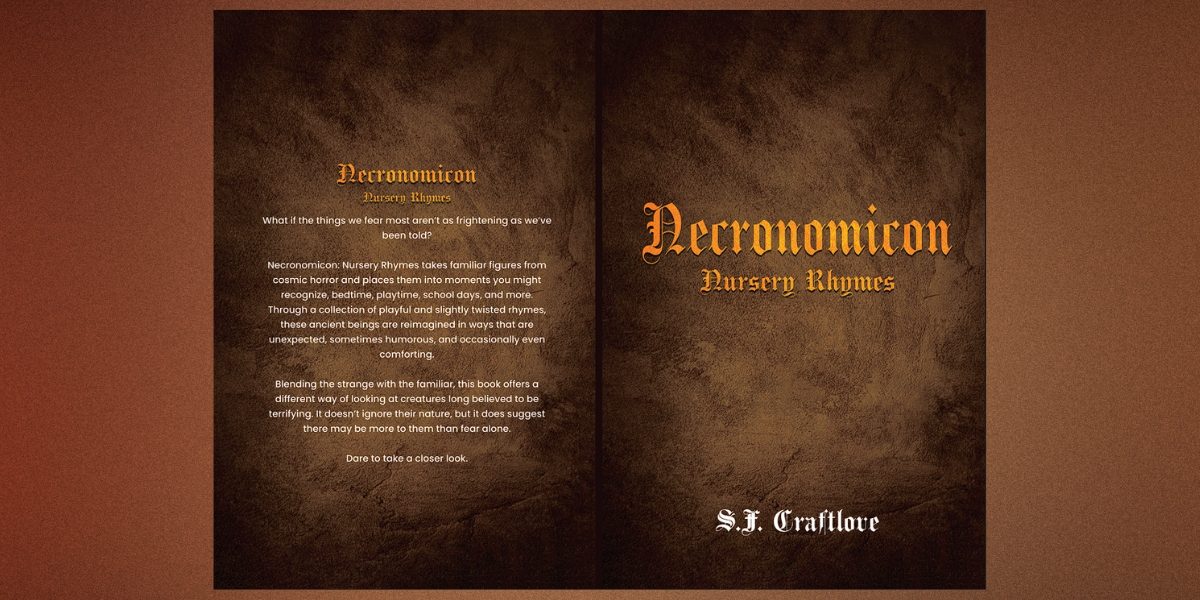

A good title can sell a joke before the first page turns. Necronomicon Nursery Rhymes is one of those titles. It is absurd, specific, and instantly vivid.
You can almost see the book before opening it: a forbidden text redesigned for story time, a grimoire with rounded corners, an occult object smuggled into the children’s section. S. F. Craftlove’s manuscript lives up to that promise with enthusiasm.
The book is built as a collection of illustrated rhymes, each pairing a figure from cosmic horror with a familiar childhood scene. The table of contents alone creates momentum. Bath time, jump rope, bedtime, snow days, swimming lessons, movies, lazy days, and school all become occasions for encounters with beings more commonly associated with madness, worship, or the end of ordinary reality.
The pleasure comes from contrast. Craftlove does not need to overexplain the joke because the pairings do the work. A name like Azathoth beside bedtime is funny. Dagon, besides swimming lessons, is funny. Yog-Sothoth beside the school is funny. These combinations turn cosmic dread into situational comedy, but they also reveal how flexible myth can be. A terrifying figure placed in a new frame becomes newly legible.
The book’s opening letter gives that comedy a surprisingly humane purpose. The narrator tells the reader that the old stories may have misrepresented these beings. The poems, we are told, come from forgotten manuscripts, modernized for us. It is a clever device, because it allows the book to act as both parody and correction. It pretends to be a recovered truth: not a warning against the Old Ones, but a defense of their softer side.
The illustrations are crucial to the book’s accessibility. They do not chase glossy perfection. Their charm is in the odd shapes, comic expressions, and bright, simple staging. The creatures look strange enough to be memorable, but expressive enough to become characters. The art makes room for affection without eliminating unease. It gives the reader permission to laugh at a tentacle without forgetting that tentacles are, by nature, unsettling.
Craftlove’s humor is also helped by the manuscript’s larger fictional apparatus. The dedication nods to Miskatonic University and Abdul Alhazred. The mock copyright page mentions summoning liability. The author biography transforms Craftlove into a suspicious academic figure, one whose scholarship and rituals have not exactly reassured his peers. These flourishes make the book feel like an object with a backstory. It is not only a children ’s-style rhyme collection; it is a prop from a larger comic universe.
What makes Necronomicon Nursery Rhymes commercially appealing is its easy pitch and broad niche. Horror-loving parents will understand it instantly. Gift buyers will recognize its novelty value. Fans of Lovecraftian myth will appreciate the references. Readers who enjoy strange picture books will be drawn to the art. And children, often less bothered by weirdness than adults, may simply enjoy the monsters.
But the book’s strongest quality is its tonal generosity. It does not sneer at horror, and it does not sneer at children’s literature. It respects both enough to let them mingle. The result feels playful rather than gimmicky. It says, in effect, that darkness and delight have always been neighbors.
Necronomicon Nursery Rhymes is the rare novelty book that knows exactly what it is. It is spooky, silly, affectionate, and visually memorable. It takes ancient terror by the hand and leads it, quite cheerfully, to story time.
Step into a picture-book world where ancient horrors come ready to play, nap, swim, and rhyme.
Buy Necronomicon Nursery Rhymes online and invite the Mythos home.