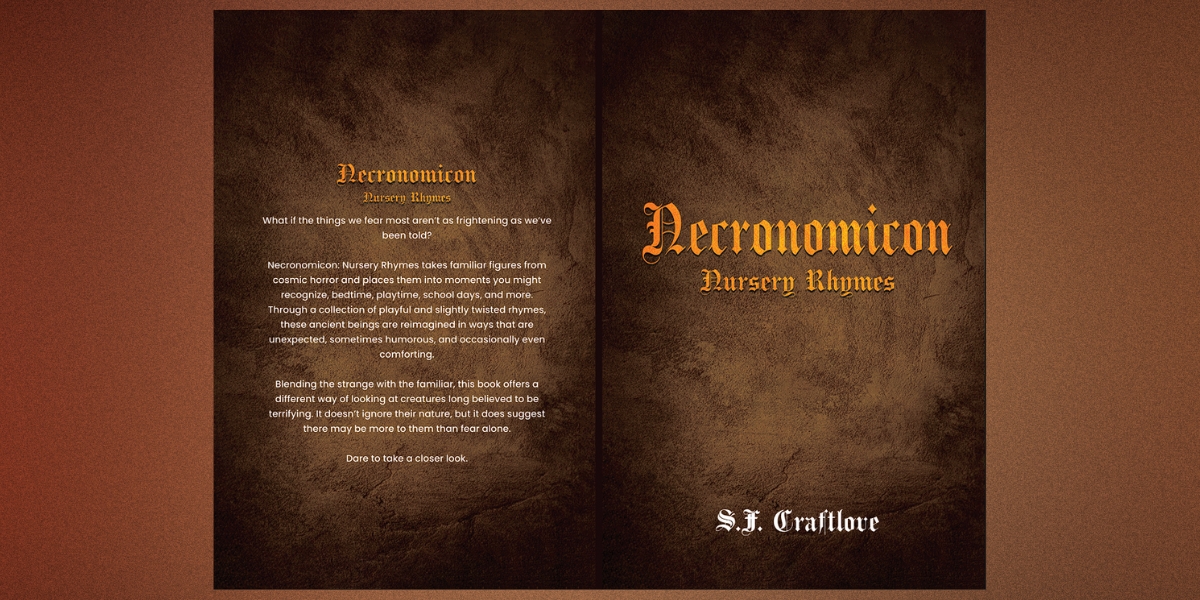
A good title can sell a joke before the first page turns. Necronomicon Nursery Rhymes is one of those titles. It is absurd, specific, and instantly vivid.
You can almost see the book before opening it: a forbidden text redesigned for story time, a grimoire with rounded corners, an occult object smuggled into the children’s section. S. F. Craftlove’s manuscript lives up to that promise with enthusiasm.
The book is built as a collection of illustrated rhymes, each pairing a figure from cosmic horror with a familiar childhood scene. The table of contents alone creates momentum. Bath time, jump rope, bedtime, snow days, swimming lessons, movies, lazy days, and school all become occasions for encounters with beings more commonly associated with madness, worship, or the end of ordinary reality.
The pleasure comes from contrast. Craftlove does not need to overexplain the joke because the pairings do the work. A name like Azathoth beside bedtime is funny. Dagon, besides swimming lessons, is funny. Yog-Sothoth beside the school is funny. These combinations turn cosmic dread into situational comedy, but they also reveal how flexible myth can be. A terrifying figure placed in a new frame becomes newly legible.
The book’s opening letter gives that comedy a surprisingly humane purpose. The narrator tells the reader that the old stories may have misrepresented these beings. The poems, we are told, come from forgotten manuscripts, modernized for us. It is a clever device, because it allows the book to act as both parody and correction. It pretends to be a recovered truth: not a warning against the Old Ones, but a defense of their softer side.
The illustrations are crucial to the book’s accessibility. They do not chase glossy perfection. Their charm is in the odd shapes, comic expressions, and bright, simple staging. The creatures look strange enough to be memorable, but expressive enough to become characters. The art makes room for affection without eliminating unease. It gives the reader permission to laugh at a tentacle without forgetting that tentacles are, by nature, unsettling.
Craftlove’s humor is also helped by the manuscript’s larger fictional apparatus. The dedication nods to Miskatonic University and Abdul Alhazred. The mock copyright page mentions summoning liability. The author biography transforms Craftlove into a suspicious academic figure, one whose scholarship and rituals have not exactly reassured his peers. These flourishes make the book feel like an object with a backstory. It is not only a children ’s-style rhyme collection; it is a prop from a larger comic universe.
What makes Necronomicon Nursery Rhymes commercially appealing is its easy pitch and broad niche. Horror-loving parents will understand it instantly. Gift buyers will recognize its novelty value. Fans of Lovecraftian myth will appreciate the references. Readers who enjoy strange picture books will be drawn to the art. And children, often less bothered by weirdness than adults, may simply enjoy the monsters.
But the book’s strongest quality is its tonal generosity. It does not sneer at horror, and it does not sneer at children’s literature. It respects both enough to let them mingle. The result feels playful rather than gimmicky. It says, in effect, that darkness and delight have always been neighbors.
Necronomicon Nursery Rhymes is the rare novelty book that knows exactly what it is. It is spooky, silly, affectionate, and visually memorable. It takes ancient terror by the hand and leads it, quite cheerfully, to story time.
Step into a picture-book world where ancient horrors come ready to play, nap, swim, and rhyme.
Buy Necronomicon Nursery Rhymes online and invite the Mythos home.
The children’s holiday story places Santa Claus in an Arabian setting, where camels, desert villages, elves, and an unexpected ability to fly shape a Christmas Eve journey centered on generosity and remembrance.
Christmas stories have long relied on familiar imagery: snow-covered villages, reindeer, toy workshops, and Santa Claus traveling through the night on Christmas Eve. In The Arabian Santa – Mustapha The Great, author Chanmattee takes many of those recognizable traditions and places them in a different setting.
At the center of the story is Mustapha the Great, an Arabian Santa preparing to deliver gifts with the help of camels rather than reindeer. His journey moves through deserts, mountains, valleys, villages, and eventually the night sky as he works to bring gifts to children and others along the way.
The story retains several traditional Christmas elements, including a sleigh, elves, toys, and a Christmas Eve journey, but places them within Arabian-inspired landscapes of sand dunes, palm-lined communities, lanterns, and desert skies.
A recurring idea throughout the book is Mustapha’s desire to make sure that children are remembered during the holiday season.
A Workshop Beneath the Sand Dunes
One of the story’s central locations is Mustapha’s workshop, presented as part of a hidden world beneath the Arabian sand dunes.
There, Mustapha and his elves prepare toys and other gifts before the Christmas Eve journey begins. The elves include Sebastian, Jasper, Zara, Pretzel, Dazzle, Frosty Frederick, Jewel, and Wonder.
Their work provides a variation on the traditional Santa workshop while adapting that familiar idea to the book’s setting.
Other members of the caravan also play roles in the journey, including camels named Ginger and Banana Joe. Through these characters, the story presents Christmas Eve as a coordinated effort in which different participants contribute to the same goal.
Lucy and Leopold Take Flight
Two camels, Lucy and Leopold, hold a particularly important place in the story.
They are chosen to help lead Mustapha’s sleigh because of their kindness, intelligence, courage, and wit. At the beginning of the journey, however, they remain ordinary camels traveling across the landscape.
That changes during a quiet moment beneath the night sky.
While Lucy and Leopold are resting, wings unexpectedly appear. The pair begin testing their new ability and eventually rise into the air, pulling Mustapha’s sleigh behind them.
The transformation marks a turning point in the story.
Once the camels can fly, the caravan is no longer limited by desert roads, valleys, or mountains. Mustapha can continue the journey through the sky and travel farther beyond the Arabian villages where the adventure began.
The scene also creates the book’s version of a familiar Christmas image. Instead of reindeer crossing a snowy sky, Chanmattee places decorated camels beneath the moon and stars.
Familiar Traditions in a Different Setting
The setting is one of the clearest ways The Arabian Santa – Mustapha The Great distinguishes itself from more conventional Christmas stories.
Mustapha wears the red-and-white clothing commonly associated with Santa Claus, while the world around him features desert settlements, lanterns, palm trees, sand dunes, and decorated camels.
The combination creates a contrast between familiar Christmas traditions and a less conventional holiday landscape.
Readers still encounter Santa, elves, toys, presents, a sleigh, and Christmas Eve, but those elements are relocated into an Arabian-inspired environment.
The setting also influences the direction of the story. Mustapha and his companions travel across physical landscapes before Lucy and Leopold’s transformation allows the journey to continue through the sky.
Generosity and Being Remembered
Although the book includes magical elements, much of the narrative is organized around the act of giving.
Mustapha’s task is not presented only as transporting presents. The story connects those gifts with kindness, hope, and the idea of making recipients feel remembered.
That theme becomes especially clear near the end.
After Mustapha and his companions have traveled considerable distances and distributed many gifts, one important package remains. It is intended for a child who has waited patiently throughout the year.
Mustapha delivers the gift personally.
The scene shifts the focus from the scale of a worldwide Christmas journey to a single interaction. Rather than emphasizing the size or price of the present, the story focuses on what receiving it represents.
In doing so, the book returns to one of its central ideas: sometimes the meaning of a gift comes from knowing that someone remembered.
By the conclusion, the elves, camels, and Mustapha have each played a role in completing the Christmas Eve journey.
The Arabian Santa – Mustapha The Great combines fantasy, cooperation, and holiday traditions while placing them within an Arabian setting. Rather than replacing familiar Christmas imagery, Chanmattee reworks it through deserts, flying camels, hidden workshops, and a story centered on generosity and remembrance.
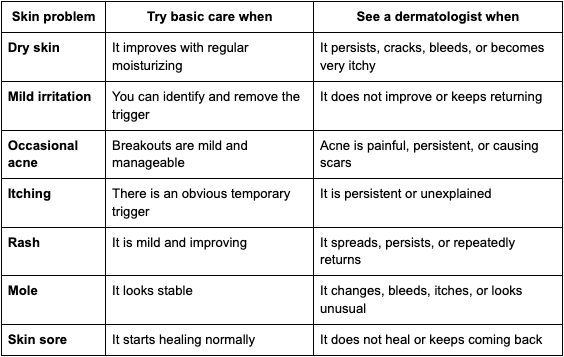
Most minor skin problems improve with simple care, but some changes should not be ignored. A rash that keeps returning, acne that is leaving scars, unexplained itching, a mole that is changing, or a sore that does not heal can all be reasons to see a dermatologist. Skin cancer is another important reason to pay attention to changes in your skin. Early detection can make treatment easier, so it is better to have a suspicious spot checked than to assume it is harmless.
Signs You Should See a Dermatologist
You do not have to wait until a skin problem becomes severe. If something is persistent, getting worse, returning frequently, or affecting your daily life, professional assessment can help identify the cause and the right treatment.
A Mole Or Skin Spot Is Changing
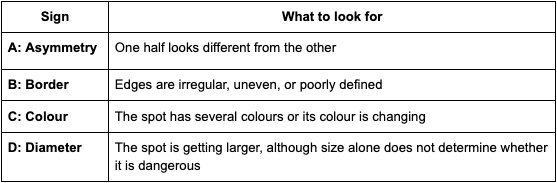
Changes in a mole are one of the most important reasons to arrange a dermatology appointment. One useful way to monitor suspicious moles is the ABCD method, which looks at asymmetry, border, colour, and diameter. The method is also explained by Dr. Shpadaruk in an educational video about how to check moles for possible signs of melanoma. You can use the ABCD approach as a simple reminder when checking your skin at home.
Photo Courtesy: Unsplash.com
Do not wait for a mole to become large before having it checked. A new or changing spot can be worth examining even when it is relatively small.
A Rash Keeps Coming Back
A temporary rash may have an obvious trigger, such as a new skincare product, detergent, heat, or sun exposure. But if the rash continues, spreads, or repeatedly returns without a clear reason, it is worth getting professional advice.
Persistent redness, itching, scaling, swelling, or cracking can be caused by eczema, psoriasis, allergies, infections, or other skin conditions. These problems can look similar but require different treatments, so repeatedly trying random creams may not solve the underlying problem.
Acne Is Persistent Or Leaving Marks
Occasional breakouts are common, but persistent or painful acne deserves more attention. Consider seeing a dermatologist if:
Acne keeps returning despite consistent skincare
Breakouts are painful or widespread
You are developing acne scars
Dark marks remain after spots heal
Acne suddenly becomes much worse
The condition is affecting your confidence or daily life
Professional treatment can target active acne while also helping reduce the risk of long-term scarring and pigmentation.
You Have Unexplained Itching
Itching without an obvious cause can be difficult to manage. Dry skin, eczema, allergies, infections, medication reactions, and several other conditions can cause persistent itching.
If itching continues for weeks, becomes severe, affects your sleep, or keeps returning, a dermatologist can help identify the cause. Before your appointment, make a note of where the itching occurs and whether anything seems to trigger or relieve it.
Skin Changes That Should Not Be Ignored
Not every concerning skin problem looks like a typical mole. Skin cancer can sometimes appear as a rough patch, growing bump, unusual spot, or sore that does not heal. It may also bleed, crust, itch, or repeatedly come back after appearing to heal.
Pay particular attention to:
A new or unusual skin spot
A mole that changes over time
A lesion that repeatedly bleeds or crusts
A sore that does not heal
A growing bump or rough patch
Unusual pigmentation around or underneath a nail
A spot that becomes persistently itchy or painful
A lesion that looks noticeably different from the others on your skin
A dermatologist can examine suspicious areas more closely, use dermatoscopy when appropriate, and provide care for conditions including acne, eczema, psoriasis, skin allergies, and skin cancer. Dr. Shpadaruk’s practice offers dermatoscopy for assessing suspicious skin lesions and help with early detection.
When Can You Try Home Treatment?
Not every skin problem needs immediate medical attention. Basic self-care can be reasonable when you know what caused the problem and the symptoms are mild and improving.
Photo Courtesy: Unsplash.com
Do not rely only on online searches or photographs to decide whether a changing skin lesion is harmless. Taking photographs can be useful for monitoring changes, but a photograph cannot replace a professional examination.
It is also easy to overlook areas such as your scalp, back, soles of your feet, between your toes, and around your nails. Check these areas regularly, especially if you have many moles or frequently spend time in the sun.
Before seeing a dermatologist, write down:
When you first noticed the problem
How it has changed
Any products or treatments you have tried
What makes it better or worse
Whether it comes and goes
Any symptoms such as itching, bleeding, pain, or swelling
If the problem is intermittent, take a photograph when it is most noticeable. This can give the dermatologist useful information even if the skin looks different on the day of your appointment.
A Simple Skin Check at Home
You do not need special equipment to become more familiar with your skin. Check your face, neck, ears, arms, hands, chest, abdomen, legs, and feet. Look at your scalp and back with the help of a mirror or another person.
When you find something unusual, compare it with the rest of your skin. A spot that looks very different from your other moles or lesions deserves more attention. Keep photographs of anything you want to monitor and look for genuine changes in size, shape, colour, or texture.
The goal is not to diagnose yourself. It is simply to notice changes early enough to get them assessed when necessary.
How to Prepare for Your Appointment
A little preparation can make a dermatology consultation more useful. Write down when the problem started and whether it has changed. Make a list of skincare products, medications, and treatments you have used. If you have photographs from previous flare-ups, bring them with you.
For a changing mole or other suspicious lesion, note when you first noticed the change and what has happened since then. You do not need to diagnose the problem yourself. Your job is to provide the dermatologist with an accurate history and point out anything that concerns you.
Disclaimer: The information provided in this article is for general educational and informational purposes only and should not be considered medical advice, diagnosis, or treatment recommendations. Health concerns and skin conditions can vary between individuals. Always consult a qualified healthcare professional for proper evaluation, diagnosis, and guidance regarding any symptoms, concerns, or changes in your health.
New York City’s City of Yes for Housing Opportunity eliminated parking mandates across most of Manhattan below 96th Street, Long Island City, and parts of western Queens and Brooklyn when it passed in December 2024. For much of the development community, the headline read like a resolution: parking minimums were gone, so parking itself was a solved problem.
That reading misses what actually changed, according to industry observers tracking the city’s post-mandate pipeline. Removing the minimum eliminated a compliance requirement. It didn’t eliminate the underlying question of how developers provide parking on sites where lenders, tenants, or the market still expect it.
“The mandate removal solved a zoning problem, not a site problem. On a lot in outer-borough Brooklyn or Queens where a lender still wants parking in the underwriting, the developer is back to the same constrained footprint they had before December 2024; they just don’t have to justify it to the Department of City Planning anymore,” said Christopher Tiessen, President/CEO of KLAUS Multiparking America, the U.S. subsidiary of a manufacturer of mechanical and automated parking systems.
Where the mandate elimination has had its cleanest effect, Tiessen said, is in transit-adjacent projects already built without parking as a market expectation. Those developments can now recapture that footprint outright. But that’s a narrower slice of the pipeline than the initial headlines suggested.
For everything else, including luxury multifamily, mixed-use buildings with ground-floor retail, and outer-borough infill, the relevant question was never mandated compliance. It’s whether a conventional parking structure fits a site’s physical and financial constraints at all.
“On a narrow lot where ramp geometry doesn’t work, or a podium building where every square foot of ground floor is earmarked for retail, a conventional garage was always going to be a hard fit. Mechanical parking systems exist for exactly that scenario: smaller footprint, less excavation, no floor area lost to drive aisles,” Tiessen said.
KLAUS’s own New York work illustrates the pattern. In a high-rise condominium on Manhattan’s Upper East Side, the company installed a MasterVario F2 fully automatic system providing custom parking for 23 cars. A ground-level transfer cabin feeds three levels of parking above grade, in an area of the building otherwise inaccessible to vehicles.
Other post-mandate markets offer a preview of what’s ahead for New York. San Francisco, Seattle, and Minneapolis eliminated parking minimums years earlier, and aggregate parking provision fell in transit-rich corridors, but held steady in outer-ring submarkets where residents and lenders kept requiring it.
“What changed in those markets wasn’t demand for parking. It was how developers built the parking they still needed. New York’s pipeline is going to bifurcate the same way,” Tiessen said.
The developers moving fastest through that adjustment, Tiessen noted, are the ones addressing it at design development, before a structural engineer has locked in a floor plate. Waiting for zoning guidance that isn’t coming leaves less room to solve the problem efficiently later.
New York’s parking mandate is gone. For a meaningful share of the city’s development pipeline, the parking problem it was meant to solve is still on the table.
From a 2002 screenplay to patented funding models and a recording project with a vocalist who contributed to two Grammy-winning projects, DeTitta’s career keeps returning to one question: how do creative people get their work made and paid for?
Most people build a career in one field. John DeTitta has built one across three: film, music and technology.
From a 2002 Screenplay to Independent Film Production
It began with a screenplay. In the summer of 2002, DeTitta wrote 150 pages drawn from his own experiences as an entrepreneur, then took the script from producer to producer. By his account, he secured financial commitments from a producer to turn it into a feature film. Then life intervened. DeTitta stepped away to care for his daughter, and the screenplay was later rewritten and developed into a feature. His website says films he has been involved in, or that were adapted from his writing, have reached wide theatrical release.
He kept producing. DeTitta has raised funds for several movie projects, and IMDb lists him as writer, producer, and director of the 2010 film Ten Talents, and as executive producer of the 2014 series Gibson Music Showcase. His website describes the Showcase as more than 30 productions.
“I’m drawn to true stories, the kind that leave you feeling something. If I can’t say in a sentence why a story matters, I’m not ready to write it.”
Arranging Music the Way a Screenwriter Builds a Script
Music is the second thread. A keyboardist who arranges in many genres, DeTitta approaches a song much as a screenwriter approaches a script, deciding what to build up, what to leave out, and where a piece should breathe.
Among his music projects is Keep on Walking, a 2016 EP featuring Ms. Monet, a session and touring vocalist whose credits include work on Grammy-winning recordings. She sings five songs on the release. An online video shows her performing the title track, written by DeTitta, live before more than a thousand people. He also produced the Gibson Concert Series at the Hit Factory, the well-known recording studio in New York’s Hell’s Kitchen.
A Patent Born From a Funding Problem
The third thread is technology, and it grew directly out of the first. According to his biography, DeTitta built his first artist-funding platform after struggling to finance his own screenplay. He is the named inventor on U.S. Patent No. 10,325,290, granted in 2019, which describes a way for advertisers to finance projects, from films to charitable causes, by buying media whose revenue flows into a project fund. A continuation, No. 11,416,898, followed. Both trace to a 2004 filing.
He says he conceived the idea of sharing advertising revenue with online content creators in 2003, and that his technology is now used by more than 80 social media and gaming websites and has reached more than 20 million creators worldwide.
“When I started, artists had almost no say in how their work got funded. Seeing creators earn from advertising today tells me the idea was worth chasing. Next, I want to build tools that help emerging artists get their first project made.”
What Ties the Three Fields Together
What connects the three fields, DeTitta says, is a preference for building things that help people and can also sustain themselves financially. His website puts it plainly, describing products and services for the greater good that still turn a profit.
The pattern shows in his own work. The screenplay that stalled for lack of funding led to a funding method, and that method now serves the creators who make films, music and video.
DeTitta is based in New York and is available for consulting and speaking engagements in the music and film industries, entrepreneurship, app development, fundraising, and screenwriting.
New York workplaces span industries ranging from finance and healthcare to hospitality, retail, technology, and construction, bringing employees into environments with different policies, management structures, and reporting procedures. When discrimination occurs, workers may face difficult choices about what to record, where to keep sensitive information, and when to seek legal advice. New York employees have protections under federal, state, and, in some locations, city employment laws, but a potential claim can still depend heavily on the quality and credibility of the available evidence. Workplace discrimination cases often depend on details that become harder to verify over time.
A careful record can preserve dates, statements, documents, witnesses, and the effect on employment. Poor documentation can create gaps, expose private information, or allow an employer to question its authenticity. Employees should record events promptly, preserve original materials, and avoid actions that alter evidence. Derek Smith Law Group can advise workers on protecting relevant records as they consider their legal options. This article explains how to build a reliable record without compromising its value.
Document Internal Reports
Record when a complaint was made, who received it, what information was provided, and how the employer responded. Keep copies of written complaints and acknowledgment emails. If a complaint occurred verbally, write a follow-up message that accurately confirms the discussion.
Employees seeking legal guidance about discrimination, retaliation, or harassment can review legal resources before deciding what to do next. A legal professional can assess whether the record supports a claim, identify missing evidence, and explain deadlines that apply to the situation.
Record Facts, Not Conclusions
Write down what happened as soon as possible after each incident. Include the date, time, location, people involved, exact words used, and any witnesses present. Describe employment consequences, such as schedule changes, denied opportunities, discipline, or termination.
Avoid emotional labels that replace facts; instead of writing that a supervisor “targeted” an employee, describe the repeated conduct and explain how it differed from treatment given to coworkers. A factual account gives attorneys and investigators clearer material to assess.
Preserve Original Evidence
Keep original emails, text messages, chat records, schedules, evaluations, pay records, and written warnings in their original form. Do not edit screenshots, crop away timestamps, or forward messages in ways that remove identifying information.
Employees should create a secure personal record outside the employer’s systems, where lawful and practical. A dated chronology can identify patterns, while original files preserve the underlying evidence. Copies should never replace the original version when the original remains available.
Use Personal Devices Carefully
Do not use an employer-owned computer, phone, email account, or cloud drive as the only place to store documentation. Company systems can restrict access after a suspension, resignation, or termination. Personal storage also reduces the risk of losing access to evidence stored under a work login.
However, employees should not take confidential business files unrelated to the discrimination claim. Copying trade secrets, customer data, medical records, or private information about coworkers can create separate legal problems. Preserve material connected to the conduct, and avoid broad downloads.
Protect Witness Information
List witnesses who directly observed the conduct or received relevant communications. Record what each person personally saw or heard, rather than guessing what a witness will say later. Include contact information only in a secure location.
Do not pressure coworkers to provide statements or coordinate accounts. Witnesses should describe their own experiences in their own words. Employees should also avoid posting about the dispute on social media, since public comments can complicate privacy and credibility issues.
Maintain A Reliable Timeline
A timeline should connect each event to the employment action that followed. Record complaints, meetings, warnings, schedule changes, performance reviews, leave requests, and termination decisions in chronological order.
Attach supporting documents to each entry when possible. Note missing records without creating replacements or backdating notes. If you write an entry later, identify when you created it and state that it records an earlier event.
Avoid Altering Or Concealing Evidence
Never delete messages, rename files to change their meaning, backdate documents, or create records that appear contemporaneous. Those actions can damage credibility and raise questions about the entire evidence set.
If an employee discovers that a record contains an error, preserve the original and add a dated correction. A transparent correction is safer than silently changing the first version. Legal counsel can also advise on preserving electronic records and responding to employer requests.
Putting The Record Together
A comprehensive discrimination record is accurate, dated, focused, and preserved in its original form. Employees should document each incident promptly, store copies outside employer systems, limit collection to relevant material, and avoid public discussion. A secure chronology can help a lawyer evaluate patterns, retaliation, and possible deadlines. Next, organize the records by date, identify direct witnesses, and schedule a confidential consultation before deleting, editing, or sharing anything further.
Disclaimer: This article is for general informational purposes only and does not constitute legal advice or create an attorney-client relationship. Consult a licensed attorney about your specific situation.
Wesley Chapel’s rapid development has brought together residential communities, shopping centers, businesses, and busy connecting roads, creating many settings where an unexpected accident can occur. Turning that incident into a legal claim, however, requires more than establishing that someone was injured. The circumstances of the accident, available evidence, medical consequences, and financial losses all need to be connected to a potential claim. Florida Health Charts data shows 8,144 traffic crashes in Pasco County in 2024, reflecting the volume of collisions occurring across the area.
For someone dealing with the aftermath of an accident, the next step is often figuring out what information actually matters. A Wesley Chapel personal injury lawyer can help establish how the incident occurred, identify potentially responsible parties, collect relevant records, and connect the evidence to the losses suffered. Medical documentation, photographs, witness accounts, employment records, and other evidence may all contribute to building the claim. Understanding how those pieces come together can help an injured person move from just reporting an accident to pursuing compensation supported by evidence.
Identifying Who Caused the Accident
A claim begins with liability. The lawyer examines how the accident happened and identifies the person, company, property owner, or other party responsible for the injury.
In a vehicle collision, evidence can include crash reports, traffic-camera footage, photographs, witness accounts, vehicle damage, and phone records. A lawyer compares those details with traffic laws and each driver’s account.
Premises cases require a different review. The investigation can focus on warning signs, lighting, floor conditions, inspection records, maintenance practices, and whether the property owner knew about a dangerous condition.
Preserving Evidence Before It Disappears
Evidence becomes harder to obtain as time passes. Video systems overwrite recordings, damaged vehicles get repaired, witnesses forget details, and digital records become more difficult to locate.
A lawyer sends preservation requests when another party controls relevant evidence. The request can cover surveillance footage, incident reports, maintenance records, employee schedules, vehicle data, and other information tied to the accident.
Records kept by the injured person matter too, including medical records, bills, photographs, pay statements, insurance letters, and accident-related communications. A timeline can organize symptoms, treatment, missed work, and changes in daily activities.
Measuring Medical and Financial Losses
Compensation depends on losses linked to the injury. Medical expenses can include emergency treatment, hospital care, diagnostic testing, prescriptions, physical therapy, surgery, and follow-up appointments.
Lost income requires records showing normal earnings and time missed from work. A claim can also account for reduced earning ability when an injury limits job duties or prevents a return to the same occupation.
Pain and suffering involve physical discomfort and disruption caused by the injury. Medical notes, treatment history, photographs, witness statements, and the injured person’s account can support this part of the claim.
Managing Insurance Communications
Insurance adjusters often contact injured people soon after an accident. Their questions can affect how the insurer interprets fault, injury severity, and the claim’s value.
A lawyer handles written communications, reviews settlement proposals, and identifies statements that conflict with available evidence. The injured person can then focus on treatment without making unsupported admissions.
Medical authorization forms also require care. Some requests seek records unrelated to the accident, which can create confusion about pre-existing conditions or other health issues.
Negotiating a Fair Settlement
After gathering evidence and documenting losses, the lawyer prepares a demand package for the insurer or responsible party. The package explains liability, treatment, financial losses, and the requested compensation.
A settlement should reflect documented losses and the likely effect of the injury. Accepting payment before doctors understand the recovery outlook can leave future expenses without compensation.
Negotiations can involve several rounds of offers and responses. A lawyer evaluates each proposal against the evidence and explains whether accepting, rejecting, or countering serves the claimant’s interests.
Preparing For Court When Necessary
Some insurers deny responsibility or refuse to pay a fair amount. In that situation, the lawyer can file a lawsuit and prepare the case for discovery, depositions, expert testimony, and trial.
Court preparation requires more than filing paperwork. The legal team develops a factual presentation connecting the accident, the defendant’s conduct, the injury, and the claimed losses.
A lawsuit also involves deadlines for exchanging evidence and answering formal requests. The claimant must provide accurate information and follow medical recommendations throughout the case.
Choosing The Right Next Step
Giving a recorded statement, signing a release, or accepting a settlement can affect rights that are difficult to restore later. For that reason, these are decisions many injured people discuss with an attorney first.
A first case review typically covers the accident date, location, involved parties, insurance details, medical treatment, employment impact, and available evidence. Those facts help the lawyer assess liability, damages, deadlines, and the practical path forward.
An accident becomes a claim when evidence connects the injury, responsible party, and financial loss. A lawyer builds that connection while protecting deadlines, communicating with insurers, and preparing for court if negotiations fail. Organized records and careful early communication with insurers often shape how smoothly the rest of the process goes. Early guidance gives the claimant a clearer picture of available options and the work required to pursue compensation.
Disclaimer: This article is intended for general informational purposes only and does not constitute legal advice. Personal injury claims depend on the specific facts of each case, including applicable laws, evidence, liability, medical circumstances, insurance coverage, and procedural requirements. The information provided should not be interpreted as a guarantee of compensation, settlement results, or legal outcomes. Individuals involved in an accident should consult with a qualified attorney regarding their own situation and seek guidance based on the details of their case.
South Jersey, New Jersey, combines busy suburban roads, commercial districts, residential communities, and workplaces where an unexpected accident can quickly disrupt everyday life. For someone hurt because of another party’s actions, the days that follow may bring questions about medical expenses, missed work, insurance coverage, and available legal options. Building a strong claim requires more than describing what happened. Each decision can influence how responsibility and the extent of the harm are ultimately presented. A thoughtful legal approach can help clarify which issues deserve immediate attention and which may develop as recovery continues.
South Jersey personal injury lawyers can examine the circumstances surrounding an accident and help determine how the available information supports a potential claim. This guidance can also give injured people a clearer understanding of what to expect as their case progresses. An injury claim often depends on facts that seem simple at first, so carefully reviewing the circumstances is an important starting point.
Start With Liability
An injured South Jersey resident may manage medical appointments, employment records, and insurance requests at the same time. A lawyer familiar with local courts can organize those facts, assess liability, and identify documented losses. For that reason, consulting personal injury lawyers makes sense before an insurer evaluates the claim or presents a settlement offer.
Liability requires more than proof that an injury occurred. A claim must connect another party’s conduct to the accident and resulting harm. That connection can involve traffic violations, unsafe property conditions, defective equipment, poor medical care, or another documented failure.
Build The Evidence Record
Evidence should support every part of the claim. Medical records establish diagnoses, treatment, restrictions, and prognosis. Photographs can show vehicle damage, visible injuries, or hazardous conditions. Collect witness names and contact details promptly. Memories change, businesses can overwrite video footage, and physical conditions can change before an investigator documents them.
Preserve Medical Proof
Medical treatment creates a timeline insurers use to evaluate injury claims. Gaps in care, missed appointments, or inconsistent descriptions can create disputes about whether the accident caused the condition. An injured person should follow medical instructions and describe symptoms accurately. The claim should include records from every provider involved in diagnosis, treatment, rehabilitation, or follow-up care.
Document Financial Losses
Wage loss requires more than a statement that you missed work. Pay records, employer verification, tax returns, and medical restrictions can connect the absence to the injury. Future losses require careful support because they involve expected treatment, reduced earning ability, or continuing limitations. Each projected cost should have a clear medical or employment basis.
Calculate The Full Claim
A settlement should account for past expenses and losses that continue after payment. Medical bills, prescription costs, transportation, lost wages, property damage, and household assistance can affect the calculation. Non-economic damages require a clear description of pain, reduced mobility, sleep disruption, emotional distress, and changes to daily activities. Personal journals, treatment notes, and testimony from people who observe the injury can support those descriptions.
Control Insurance Communications
Insurance adjusters gather information while evaluating a claim, but their questions can affect later disputes. A recorded statement, broad medical authorization, or rushed release can provide information beyond the accident. Written communication should remain accurate and limited to relevant facts. An injured person should avoid guessing about fault, recovery time, or medical history when records provide a better answer.
Account For Shared Fault
New Jersey allows an injured person to pursue compensation even when they share responsibility for an accident. The award can decrease according to the injured person’s percentage of fault. Evidence should address every alleged contribution to the accident. A driver’s speed, a property visitor’s conduct, or a worker’s compliance with safety instructions can influence negotiations and trial arguments.
Use Deadlines Strategically
New Jersey generally gives an injured person two years from the injury date to file a personal injury lawsuit. Special rules can affect that period, so confirm the deadline early rather than estimate it. A filing deadline does not replace preparation time. Records, witness interviews, expert review, and settlement discussions require time, especially when the injury involves surgery, permanent limitations, or disputed responsibility.
Decide Whether To Settle
A settlement decision should reflect the evidence, medical outlook, liability risks, and available insurance coverage. The greatest initial demand is not automatically the best result when supporting proof remains incomplete. Trial preparation improves settlement analysis because it tests what each side can prove. A claim should move toward resolution only after the injured person understands the payment terms, expenses, liens, and rights being released.
Protect the Claim Early
A personal injury claim becomes easier to manage when each decision follows documented facts. The injured person should report treatment consistently, preserve accident evidence, track financial losses, and avoid signing releases before reviewing their effect. New Jersey’s filing period also makes early legal review practical, especially when fault or long-term harm remains disputed. Next, gather records, write a clear accident timeline, and arrange a case review before evidence or deadlines become harder to protect.
Disclaimer: This article is for general informational purposes only and does not constitute legal advice or create an attorney-client relationship. Laws and filing deadlines vary by state and by the specific facts of each case. Anyone dealing with an injury or potential claim should consult a licensed attorney in their jurisdiction for guidance specific to their situation.
An injury claim begins with paperwork, but filing forms does not prove fault or establish the full value of a loss. Medical records, witness accounts, photographs, insurance correspondence, and deadlines shape the case that follows. A careless filing can leave evidence missing, bills unpaid, or a demand unsupported. Claimants also face questions about liability, treatment, and future expenses. A sound claim requires organized proof and informed decisions from the first report onward. The next steps explain why legal review matters.
After an incident, a claimant must preserve evidence before conditions change. That work includes obtaining a report, recording witness details, photographing injuries, and saving insurer communications. A Queens personal injury lawyer can assess liability theories, identify responsible parties, and calculate losses from available records. This review prevents a rushed statement from weakening the claim before treatment ends. It also establishes deadlines for documents, negotiations, and possible court action.
Liability Requires More Than an Accident Report
An accident report is one of the first documents produced after a crash. However, it only records basic facts and rarely answers every legal question. A claim must connect another party’s conduct to the injury through evidence, timing, and applicable law. For example, a collision claim might involve driver negligence, vehicle ownership, road conditions, or a defective component. A premises claim could require proof that a property owner knew about a dangerous condition and failed to address it. Each theory requires different records and witnesses.
Medical Documentation Establishes the Loss
Medical treatment creates a record connecting an accident to physical harm. Prompt evaluation, consistent follow-up, and complete descriptions of symptoms help document that connection. Medical bills show past expenses, but they do not capture every financial effect. Wage statements, employer records, disability notes, and travel costs can support income losses and treatment-related expenses. A claimant should also keep a private treatment timeline. Appointment dates, symptom changes, prescribed restrictions, and missed work create a useful reference during claim review.
Insurance Communications Can Affect the Case
Insurance companies often request recorded statements, authorizations, and detailed explanations soon after an incident. A claimant’s answers can later influence how the insurer describes fault, prior conditions, or the extent of an injury. A short statement can omit relevant facts or appear inconsistent with later medical records. Claimants should read documents carefully and keep copies of every submission, letter, and email related to the claim. Settlement discussions also require careful valuation. An early payment might address immediate bills while leaving future treatment, reduced earning capacity, or permanent limitations unresolved.
Deadlines Can Control Legal Rights
New York injury claims involve filing deadlines, and some claims against public entities involve earlier notice requirements. The applicable period depends on the parties, the event, and the legal basis for recovery. Missing a deadline can prevent a court from hearing an otherwise valid claim. Counsel can help identify possible defendants, preserve relevant records, and confirm the dates that control the case. Early legal review also helps locate evidence before it disappears. Surveillance footage can be overwritten, damaged property can be repaired, and witnesses can become difficult to locate.
A Complete Claim Must Measure Future Effects
An injury can affect work, household tasks, mobility, and daily activities long after the first appointment. A complete claim records those effects instead of focusing only on emergency treatment. Employment history, job duties, restrictions, and medical opinions can help assess future income losses. Household records and personal accounts can document tasks that require paid assistance or family support. The evidence should remain consistent. Medical records, employment documents, tax information, and personal statements must describe the same injury and its practical effects.
Preparing an Injury Claim for Legal Review
Filing an injury claim starts a legal process that depends on proof, deadlines, medical records, and careful communication. Claimants should preserve evidence, track treatment, document financial losses, and avoid giving incomplete statements to insurers. A practical next step is to gather the accident report, medical records, bills, wage documents, photographs, and correspondence before requesting a case review. That preparation gives counsel the information needed to assess liability and protect the claim’s value.
Disclaimer: This article is provided for general informational purposes only and does not constitute legal advice. Personal injury claims involve case-specific facts, including the circumstances of the incident, applicable laws, evidence, deadlines, and the extent of injuries and losses. The information discussed should not be interpreted as a guarantee of claim value, settlement results, or legal outcomes. Individuals with potential injury claims should consult a qualified attorney to evaluate their specific circumstances and determine the appropriate legal steps.
Engaging with Religious Leaders from Around the World and Advancing Taoist Participation in Global Interfaith Dialogue
On August 29, 2026, Chengze Wu, President of the Taoist Association of New York (TANY), was invited to attend a gathering organized by the World Council of Religious Leaders in New York City. The event brought together religious leaders and representatives from different countries, faith traditions, academic institutions, and civil society organizations for discussions on contemporary issues including peacebuilding, interfaith cooperation, social responsibility, and the ethical challenges arising from technological development.
The gathering continued the World Council of Religious Leaders’ longstanding commitment to fostering global religious cooperation. In 2000, religious and spiritual leaders from around the world convened at the United Nations for the Millennium World Peace Summit of Religious and Spiritual Leaders. The World Council of Religious Leaders, established in the years that followed, has continued to bring together the spiritual and moral resources of diverse religious traditions to address global concerns including peace, justice, and the protection of human dignity.
From Dialogue to Action: How Religious Communities Can Respond to Contemporary Challenges
A central theme of the gathering was the importance of moving “from reflection to action,” expressed through the principle of “Action, Not Symbolism.”
Participants emphasized that gathering together, taking photographs, and affirming shared values should be viewed only as the beginning of interfaith cooperation. The greater challenge is to translate interfaith dialogue into meaningful action that reaches communities, responds to real-world concerns, and creates lasting impact.
Within this framework, participating religious leaders focused on four particularly urgent areas: peacebuilding and the healing of conflict; collective opposition to hatred and violence directed against religious communities; the role of faith communities in supporting human well-being, public health, and responses to addiction and despair; and the relationship among human dignity, ethics, and technology in an era of rapidly advancing artificial intelligence.
Participants were also encouraged to bring a specific commitment to action back to their own communities and to maintain communication and provide periodic updates, helping transform a single gathering of religious leaders into an ongoing process of social engagement.
Exchange with H.E. Bawa Jain, Secretary-General of the World Council of Religious Leaders
During the event, Chengze Wu, President of the Taoist Association of New York, had a friendly exchange with H.E. Bawa Jain, Secretary-General of the World Council of Religious Leaders.
Bawa Jain has long been active in international interfaith dialogue, peace initiatives, and religious diplomacy. He served as Secretary-General of the 2000 Millennium World Peace Summit of Religious and Spiritual Leaders and has continued over the years to foster dialogue and cooperation among religious leaders from diverse faith traditions around issues of peace, human dignity, and shared social responsibility.
The exchange also provided the Taoist Association of New York with an opportunity to strengthen its connections with the international interfaith community and to introduce participants from different religious traditions to Taoism and the Association’s work in New York.
Photo Courtesy: World Council of Religious Leaders
In-Depth Exchanges with Interfaith Leaders and Scholars of Religion
During the gathering, Chengze Wu also engaged in warm and substantive conversations with Guruji His Holiness Dileepkumar Thankappan (Guru Dileepji) and American scholar of religion and interfaith peacebuilder Dr. Frank Kaufmann.
Guru Dileepji is a spiritual leader, Interfaith Minister, humanitarian, and yoga teacher who has long been active in the fields of interfaith engagement, humanitarian work, peace advocacy, and yoga. He has participated extensively in international interfaith initiatives and activities connected with the United Nations. He also holds roles in a number of religious, humanitarian, and nongovernmental organizations and has participated in international exchanges within the United Nations system as an NGO representative, promoting understanding among religious traditions, world peace, humanitarian care, and physical and spiritual well-being.
Over the years, Guru Dileepji has sought to integrate spiritual practice with social action. Through interfaith events, peace initiatives, humanitarian projects, and international exchanges, he has worked to encourage communication and cooperation among people of different cultural and religious backgrounds. His work reflects the idea that religious and spiritual traditions can serve not only as paths of personal cultivation, but also as resources for peacebuilding, social service, and cross-cultural understanding.
Dr. Frank Kaufmann holds a Ph.D. in Religion from Vanderbilt University. He runs several not-for-profit organizations dedicated to religion and peace, integrity in education, social and cultural renewal in America, and responsible US foreign policy. His work in the arena of religion, interfaith relations, peacebuilding, and conflict mediation spans decades.
Dr. Kaufmann combines the academic study of religion with practical peacebuilding efforts. His work has taken him to more than 65 countries and regions and has included engagement in areas affected by conflict and displacement, including Israel and Palestine, India and Kashmir, Croatian refugee camps, the Eritrea–Ethiopia border, the southern Philippines, Sri Lanka and elsewhere.
Throughout his work, Dr. Kaufmann explores how religions can preserve their distinct faith and cultural identities while engaging constructively with one another through dialogue, mediation, and cooperation. This approach closely resonates with this Saturday’s conference emphasis on “Action, Not Symbolism.”
While sitting with Ms. Wu, Guru Dileepji and Dr. Kaufmann expressed a warm and open interest in the Taoist Association of New York and the Taoist tradition. Wu explained some of the beauty of Taoism, and exchanged views with them on mutual understanding among religious traditions, interfaith dialogue, and the role that religious communities can play in contemporary society.
The exchange deepened mutual understanding and laid a positive foundation for the Taoist Association of New York to strengthen its connections with international interfaith leaders, scholars of religion, and related organizations, while bringing Taoist perspectives into a broader landscape of interfaith and cross-cultural dialogue.
Photo Courtesy: World Council of Religious Leaders
Bringing Taoist Voices into New York’s Diverse Interfaith Community
In addition to the guests mentioned above, Chengze Wu engaged in extensive exchanges with religious leaders and representatives from different countries, faith traditions, religious institutions, and sectors of society throughout the gathering.
As a Taoist religious organization rooted in New York, the Taoist Association of New York has continued in recent years to provide Taoist religious services, traditional cultural education, community programs, and cross-cultural exchanges. Participation in the World Council of Religious Leaders gathering provided the Association with an opportunity to introduce the Chinese Taoist tradition within a broader international and interfaith context, while also learning from the experiences of other religious communities in community service, peacebuilding, and public engagement.
Wu noted that different religions have their own distinct histories, teachings, rituals, and cultural traditions. Interfaith dialogue does not mean eliminating these differences. Rather, it is about building understanding on the basis of respect for different traditions and identifying areas where religious communities can work together to serve society, promote peace, and care for life.
For the Taoist Association of New York, participation in this gathering represented not only an opportunity for international interfaith exchange, but also a meaningful step toward building stronger connections for Taoism within New York’s diverse religious community.
Looking ahead, the Taoist Association of New York will continue to remain rooted in the Taoist tradition while preserving its religious lineage and cultural identity. The Association will strengthen exchanges with different religious communities, academic institutions, and civil society organizations; actively participate in the development of New York’s diverse religious community; and bring Taoist wisdom concerning harmony, care for life, and the relationships between human beings and society, and between humanity and nature, into a broader contemporary public dialogue.