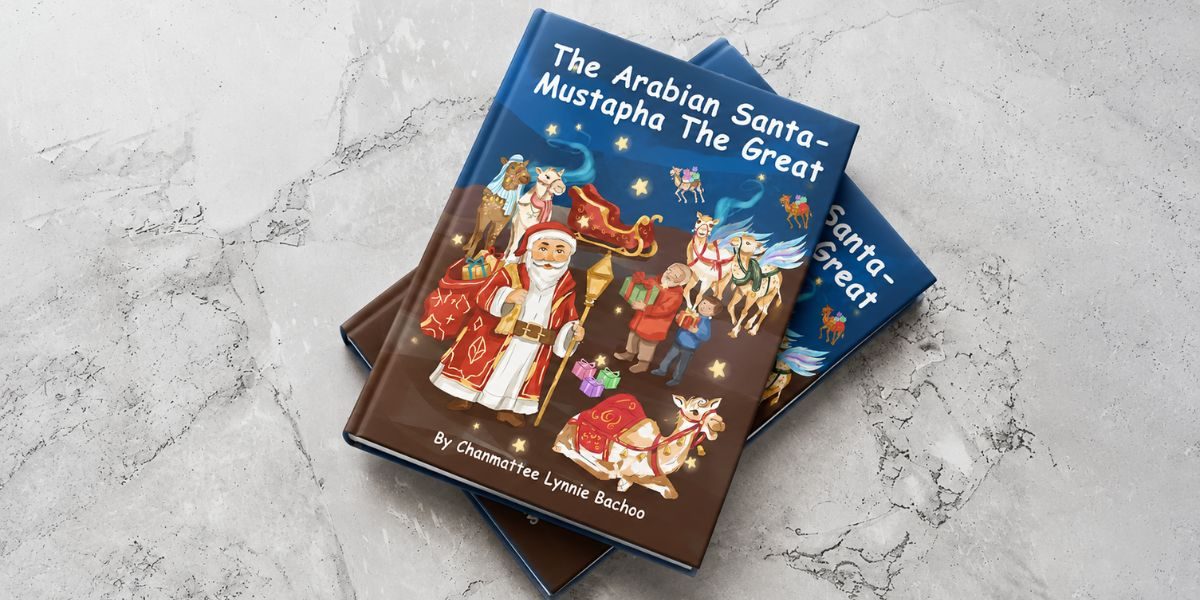

The children’s holiday story places Santa Claus in an Arabian setting, where camels, desert villages, elves, and an unexpected ability to fly shape a Christmas Eve journey centered on generosity and remembrance.
Christmas stories have long relied on familiar imagery: snow-covered villages, reindeer, toy workshops, and Santa Claus traveling through the night on Christmas Eve. In The Arabian Santa – Mustapha The Great, author Chanmattee takes many of those recognizable traditions and places them in a different setting.
At the center of the story is Mustapha the Great, an Arabian Santa preparing to deliver gifts with the help of camels rather than reindeer. His journey moves through deserts, mountains, valleys, villages, and eventually the night sky as he works to bring gifts to children and others along the way.
The story retains several traditional Christmas elements, including a sleigh, elves, toys, and a Christmas Eve journey, but places them within Arabian-inspired landscapes of sand dunes, palm-lined communities, lanterns, and desert skies.
A recurring idea throughout the book is Mustapha’s desire to make sure that children are remembered during the holiday season.
A Workshop Beneath the Sand Dunes
One of the story’s central locations is Mustapha’s workshop, presented as part of a hidden world beneath the Arabian sand dunes.
There, Mustapha and his elves prepare toys and other gifts before the Christmas Eve journey begins. The elves include Sebastian, Jasper, Zara, Pretzel, Dazzle, Frosty Frederick, Jewel, and Wonder.
Their work provides a variation on the traditional Santa workshop while adapting that familiar idea to the book’s setting.
Other members of the caravan also play roles in the journey, including camels named Ginger and Banana Joe. Through these characters, the story presents Christmas Eve as a coordinated effort in which different participants contribute to the same goal.
Lucy and Leopold Take Flight
Two camels, Lucy and Leopold, hold a particularly important place in the story.
They are chosen to help lead Mustapha’s sleigh because of their kindness, intelligence, courage, and wit. At the beginning of the journey, however, they remain ordinary camels traveling across the landscape.
That changes during a quiet moment beneath the night sky.
While Lucy and Leopold are resting, wings unexpectedly appear. The pair begin testing their new ability and eventually rise into the air, pulling Mustapha’s sleigh behind them.
The transformation marks a turning point in the story.
Once the camels can fly, the caravan is no longer limited by desert roads, valleys, or mountains. Mustapha can continue the journey through the sky and travel farther beyond the Arabian villages where the adventure began.
The scene also creates the book’s version of a familiar Christmas image. Instead of reindeer crossing a snowy sky, Chanmattee places decorated camels beneath the moon and stars.
Familiar Traditions in a Different Setting
The setting is one of the clearest ways The Arabian Santa – Mustapha The Great distinguishes itself from more conventional Christmas stories.
Mustapha wears the red-and-white clothing commonly associated with Santa Claus, while the world around him features desert settlements, lanterns, palm trees, sand dunes, and decorated camels.
The combination creates a contrast between familiar Christmas traditions and a less conventional holiday landscape.
Readers still encounter Santa, elves, toys, presents, a sleigh, and Christmas Eve, but those elements are relocated into an Arabian-inspired environment.
The setting also influences the direction of the story. Mustapha and his companions travel across physical landscapes before Lucy and Leopold’s transformation allows the journey to continue through the sky.
Generosity and Being Remembered
Although the book includes magical elements, much of the narrative is organized around the act of giving.
Mustapha’s task is not presented only as transporting presents. The story connects those gifts with kindness, hope, and the idea of making recipients feel remembered.
That theme becomes especially clear near the end.
After Mustapha and his companions have traveled considerable distances and distributed many gifts, one important package remains. It is intended for a child who has waited patiently throughout the year.
Mustapha delivers the gift personally.
The scene shifts the focus from the scale of a worldwide Christmas journey to a single interaction. Rather than emphasizing the size or price of the present, the story focuses on what receiving it represents.
In doing so, the book returns to one of its central ideas: sometimes the meaning of a gift comes from knowing that someone remembered.
By the conclusion, the elves, camels, and Mustapha have each played a role in completing the Christmas Eve journey.
The Arabian Santa – Mustapha The Great combines fantasy, cooperation, and holiday traditions while placing them within an Arabian setting. Rather than replacing familiar Christmas imagery, Chanmattee reworks it through deserts, flying camels, hidden workshops, and a story centered on generosity and remembrance.