
Written by: Dillon Kivo
Dr. Jeremiah Johnston spends his working life dating ancient manuscripts and separating genuine documents from forgeries. The audience for that work was supposed to be other scholars. Instead, his posts about first century artifacts keep stopping the internet cold.
“That is why we are seeing all these things go viral, because the public doesn’t want fluff anymore,” Johnston says. “They want evidence based Christianity.”
Johnston is a New Testament scholar, not a content creator. He earned his doctorate on the resurrection of Jesus, completed his doctoral residency in Oxford, and is an elected member of Studiorum Novi Testamenti Societas, the international New Testament scholarly guild. He describes his own area of expertise as paleography, the dating of ancient manuscripts by handwriting style.
The platforms carrying that work now sit well outside the academy. In January he presented the evidence for the resurrection at USA House during the World Economic Forum in Davos, in a session sponsored by the Washington Post. He made the same case in a long interview on the Shawn Ryan Show.
He did not expect the material to travel. It travels anyway, and the people carrying it are younger than the people he trained alongside.
A generation asking for proof
Numbers on young adults and faith have been moving for several years, and in a direction few forecasters predicted.
Barna Group research released in September 2025 found that the typical Gen Z churchgoer now attends 1.9 weekends per month, slightly ahead of Millennial churchgoers at 1.8.
In England and Wales, a Bible Society report titled The Quiet Revival found that monthly churchgoing among adults aged 18 to 24 rose from 4 percent in 2018 to 16 percent in 2024, with young men climbing from 4 percent to 21 percent. Circana BookScan data reported by Publishers Weekly put 2025 Bible sales in the United States at roughly 19 million copies, a 21 year high and a 12 percent increase over the year before.
Researchers do not all agree on how to read the shift. Some argue the change is concentrated among the already committed rather than spread across a generation. The figures show the appetite clearly. What is causing it is harder to prove.
Johnston believes the appetite has a specific shape. Young people are not asking for a better mood on Sunday morning, he says. They are asking whether any of it happened.
The scholar who did not believe it either
Johnston is an unusual person to be making the case, because for most of his career he was the skeptic in the room.
When he published his previous book, Body of Proof, he laid out the seven strongest pieces of evidence for the resurrection and the empty tomb. He left out the Shroud of Turin on purpose. Interviewers kept noticing.
“I did not believe in the Shroud then,” Johnston says. “I didn’t believe in its authenticity. I was a massive skeptic of it.”
He remembers how he handled the question during that press tour.
“I’m like, oh, I deal in evidence. Let’s not talk about relics,” he says.
He traces the skepticism to his training.
“I tell people all the time I was conditioned that way in Oxford, that this is just some Catholic relic like the other 20,000 relics they have,” he says.
What changed his mind was a habit he credits to his doctoral mentor, Craig Evans, who kept pressing him to remain a lifelong learner.
“The problem with those of us in the scholarly guild is we get so siloed that we stop learning,” Johnston says.
So he made a phone call. Barrie Schwortz was the documenting photographer for the 1978 scientific examination of the Shroud, the last occasion a multidisciplinary team was allowed to examine the cloth in person. Schwortz was Jewish and had no devotional stake in the result. He told Johnston what the team had been like before the work started.
“We were all down in the lobby of the hotel in Italy, and we were having drinks, and we were laughing about, give us fifteen minutes in the scientific method, and we’ll prove that the Shroud was a hoax,” Johnston recalls him saying. “We just got a free trip to Italy out of this deal.”
A few hours into the examination, the laughing stopped.
“In fact, they slept on cots next to the Shroud because they were so shocked by what they were finding,” Johnston says.
Schwortz took seventeen years to reach a conclusion. When he did, he told Johnston plainly that he believed the cloth was authentic. Johnston spent three years working through the science himself, meeting with researchers from Sandia National Laboratories, Los Alamos, and the Jet Propulsion Laboratory before he was willing to say so publicly.
“The greatest scientific minds on the planet cannot tell us how that image is on the cloth,” he says. “That is what took me from skepticism to talking about the authenticity of the Shroud.”
The objection he hears first is the 1988 radiocarbon test, which dated the cloth to between 1260 and 1390 and settled the question for most people.
“No one should use the carbon dating from 1988 as a reason to think that the Shroud is a hoax,” Johnston says.
He argues that the tested sample came from a repaired corner rather than the body of the cloth. He points to a 2019 analysis in Archaeometry that examined raw measurement data the British Museum released only after a freedom of information request, and concluded that the samples were not representative of the cloth as a whole.
The reversal matters for the audience he now reaches. Johnston is not asking young people to believe something he accepted easily.
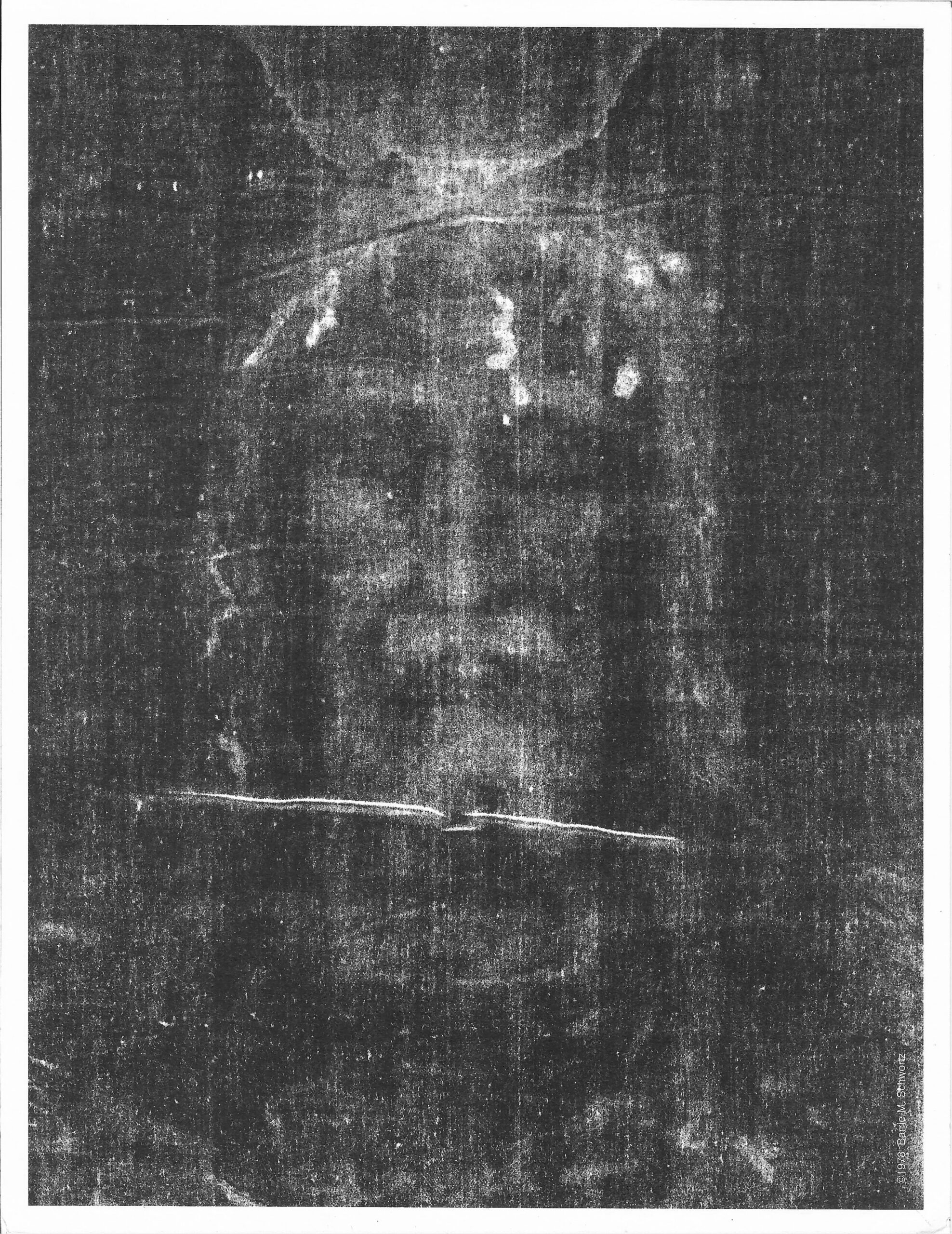
The photographic negative of the face on the Shroud of Turin, from the 1978 scientific examination documented by Barrie Schwortz. Photo copyright 1978 Barrie M. Schwortz.
What actually reaches the next generation
Johnston says he realized the material belonged to younger people at a Friday morning men’s Bible study at his church. His pastor, Dr. Jack Graham, had asked him to talk about what he was learning. His son Justin was in the room.
Johnston described that morning on the Shawn Ryan Show, released at Easter, where he spent close to three hours walking the host through first century artifacts one at a time.
“I saw my son clue in on it,” Johnston said. “This is what’s going to reach the whole next generation. They want to know tangible proof in understandable terms.”
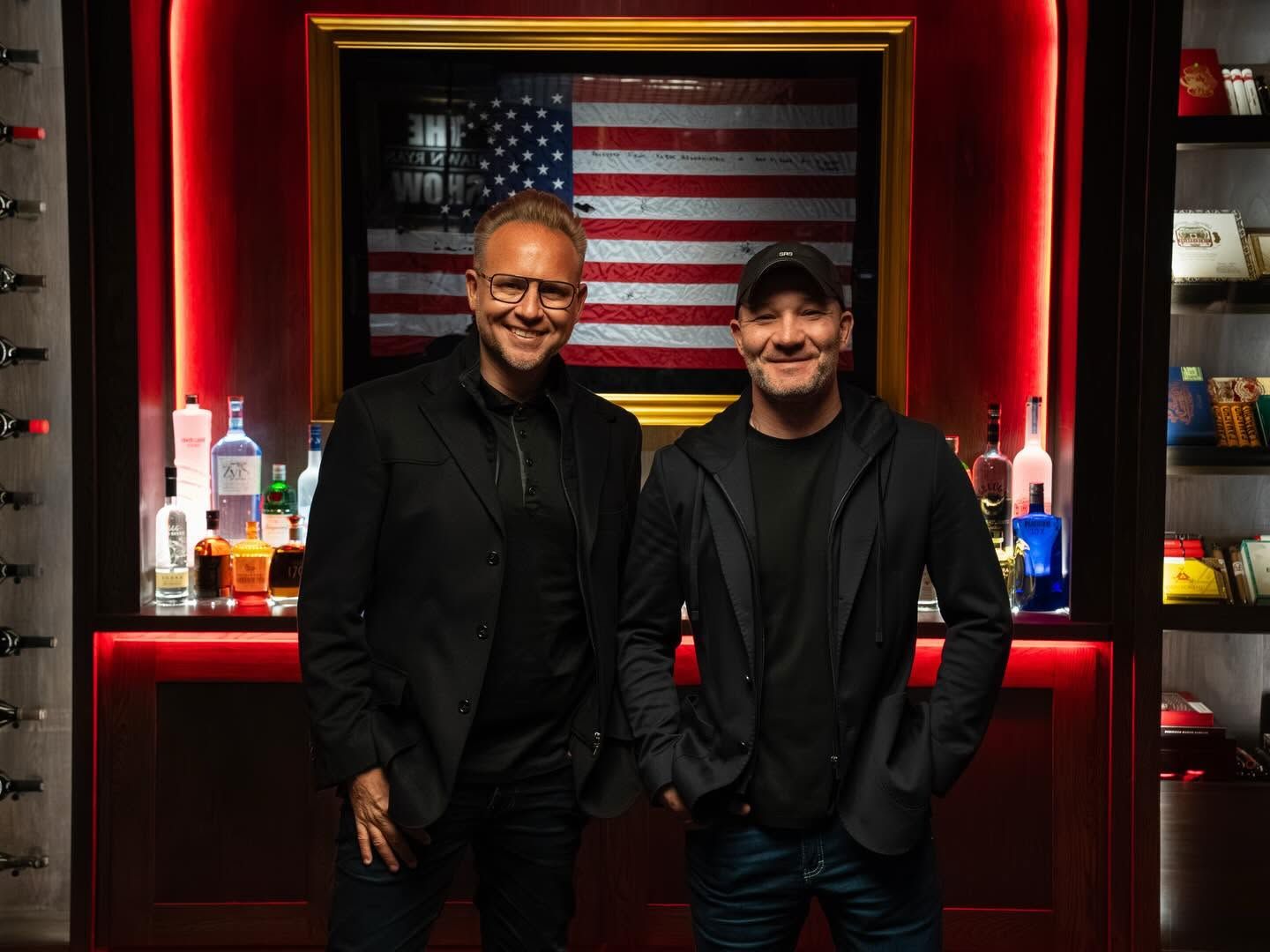
Dr. Jeremiah Johnston and Shawn Ryan following their conversation about the evidence for the resurrection.
That morning also started something else. Johnston and Graham now host a podcast together called Hold the Pattern, built around the charge in 2 Timothy 1:13 to hold to the pattern of sound teaching in ordinary life.
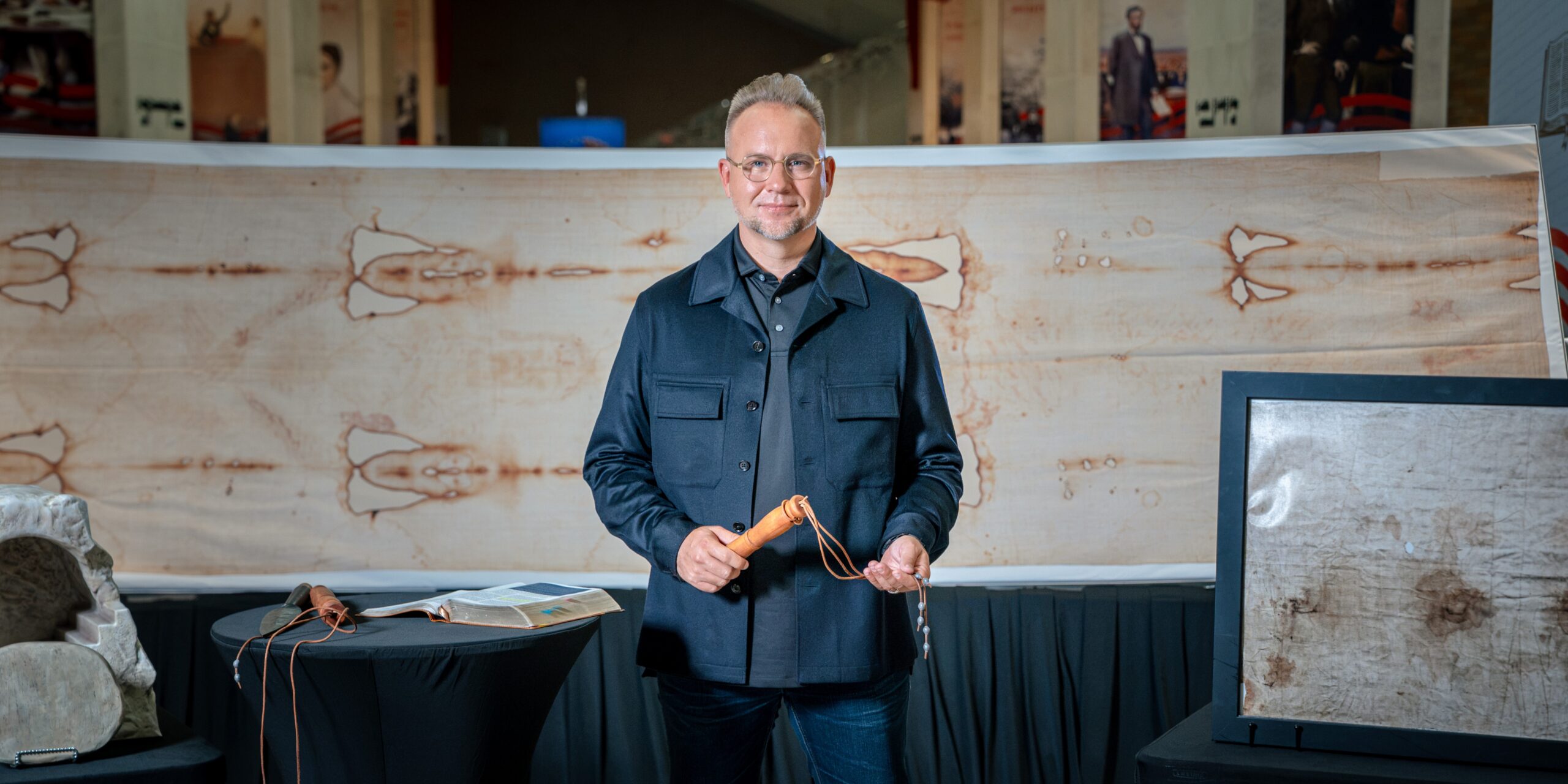
The bigger project became the artifacts themselves. Johnston built a traveling exhibit around what he saw in that room. He brings roughly fifty pieces to churches and sets up a replica of the Shroud. Host sites cover the cost of transporting the collection, but admission is free to the public as a matter of policy. He says roughly thirty exhibitions have drawn hundreds of thousands of people, from Orange County and New Mexico to Kansas City, Knoxville, Nashville and the New York area, with a recent stop at the University of Kentucky. He is planning one in Maine, he brought the Shroud replica to Davos, and he says the invitations are coming faster than he can take them.
The reactions that surprised him came from opposite ends of the room. He says he has watched children come to faith as they walked through the exhibit. He has also watched a Jet
Propulsion Laboratory scientist walk the same room and confirm that the science on display was accurate.
“I have been in the game in ministry for a long time,” Johnston says. “Nothing like the Shroud has ever had the conversion rate that I’ve been part of.”
The nine year olds in the room
Gen Alpha is still too young for researchers to measure, and Johnston does not claim data on it. What he has instead is a house full of nine year olds.
Johnston is the father of five, including triplet boys who are nine. The artifacts are not a work project he leaves at the office. They sit on the kitchen table.
“This book is so cool because my nine year old’s looking at it, and there’s pictures in it, which was a total labor of love to get these pictures,” he told Shawn Ryan.
He describes a recent fast food run with the boys, during which he handed them a set of first century bone dice recovered in Jerusalem.
“My triplets said, Dad, these stink,” Johnston said. “Son, they’re 2,000 years old; they’re made from bone.”
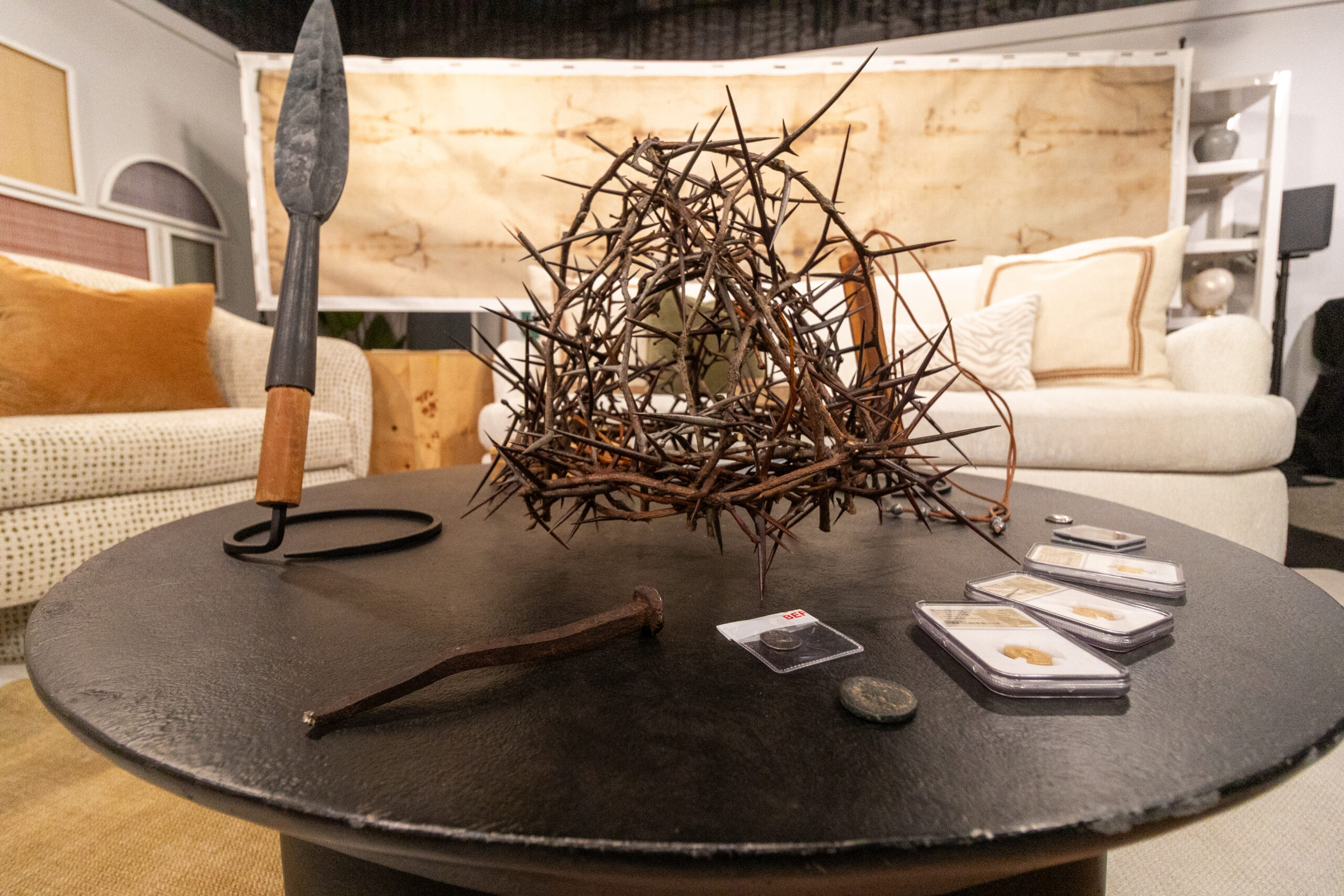
Artifacts and replicas from the traveling exhibit, including a crown of thorns, a spear point, a
Roman flagrum and first century coins, set in front of a full size Shroud replica. Photo courtesy
of Dr. Jeremiah Johnston.
The habit is deliberate. Johnston is blunt that he cannot manufacture belief in his own children, and equally blunt about what he can do.
“My greatest passion in life is passing on faith to my children, a true faith,” he said. “I can’t believe for them, but I can put them in proximity to believe with all the power that I have.”
Proximity is also why admission is always free. Nobody pays to walk through, so families can come together, bring neighbors, and return a second day without paying twice.
The problem with faith in faith
Johnston argues that the church created its own credibility gap, and that young people are refusing to inherit it.
“What I have run into the most is so many Christians today, and this is why we have a worldview crisis, they say things like, I don’t need all that evidence in your book, I just believe, man,” he says. “And it is very much a faith in faith.”
As a scholar, he finds the posture historically strange. He has spent his career inside the roughly 138,000 Greek words of the New Testament, and he says nobody in it held that kind of faith. The first generation of followers scattered when Jesus was crucified. Only John stayed with Jesus’s mother. At one point Jesus asks the remaining disciples whether they intend to leave as well.
“Not until they had 100 percent rock solid proof that Jesus was alive after being massacred did any of them truly come back to faith,” Johnston says.
He points to the first chapter of Acts, where Luke describes Jesus appearing to his followers over forty days.
“If they did not have, quote unquote, and I’m quoting Luke now, convincing proofs, Christianity would not exist today,” he says.
“Christianity has never asked for faith in faith,” Johnston says. “It asks for trust in what happened: an empty tomb, eyewitnesses, and a living Jesus. Faith in faith is sentiment. Faith in a resurrected Christ is history.”
From there he draws the conclusion he most wants young readers to take, and it inverts what many of them were taught.
“So it doesn’t mean you have less faith if you need evidence,” he says. “It means you have biblical faith, because we have evidence.”
He frames the argument in language a generation raised on data already uses.
“We hear so much today about evidence based therapies, evidence based medicine,” Johnston says. “Christianity sets itself apart in that it is actually evidence based. So we have an evidence based faith, we have evidence based belief, and that’s why archaeology is Christianity’s closest cousin.”
Davos and the size of the appetite
The argument left church walls in January, when Johnston presented the material at USA House during the World Economic Forum in Davos.
The invitation came from Rich Strombach, who leads USA House and who had seen one of Johnston’s videos on the Shroud. Johnston brought the replica with him and set it up. The
Washington Post sponsored the session, which was titled “God Took the First Selfie.” He was slotted between a presentation from NASA and a talk by Ambassador Newt Gingrich.
Gillian Tett of the Financial Times, who serves as Provost of King’s College, Cambridge, conducted the interview in a packed room of media, artificial intelligence, and cryptocurrency executives. She asked why any of it mattered.
Johnston had been coached on one point of wording before he went out, and the distinction mattered in that room.
“I was advised by my advisors to say free enterprise, not capitalism,” he says. His answer circulated widely after the session.
“The ideas of loving one’s enemy, praying for those who curse you, forgiving debts,” he told the room. “It does not come from Marxism, it does not come from socialism, it does not come from the ideas of Socrates or Plato. The ideas that built free enterprise come from the event horizon of the resurrection of Jesus Christ.”
He compares the room to Acts 17, where Paul addresses the philosophers of Athens.
“He gets to the resurrection, and it says that many began to ridicule, but some believed,” Johnston says. “And I literally had a lived experience of Acts 17 at WEF.”
The session is public, and Johnston says he has been invited back for next year.
The calling underneath it
Johnston’s newest book, The Jesus Discoveries, collects the ten artifacts he considers strongest. It reached number one on the New York Times and Amazon bestseller lists, and it also landed on the USA Today and Publishers Weekly lists. He wrote it in a single month in May of 2025. The research took sixteen years.
“This book is just a spillover from my life,” he says.
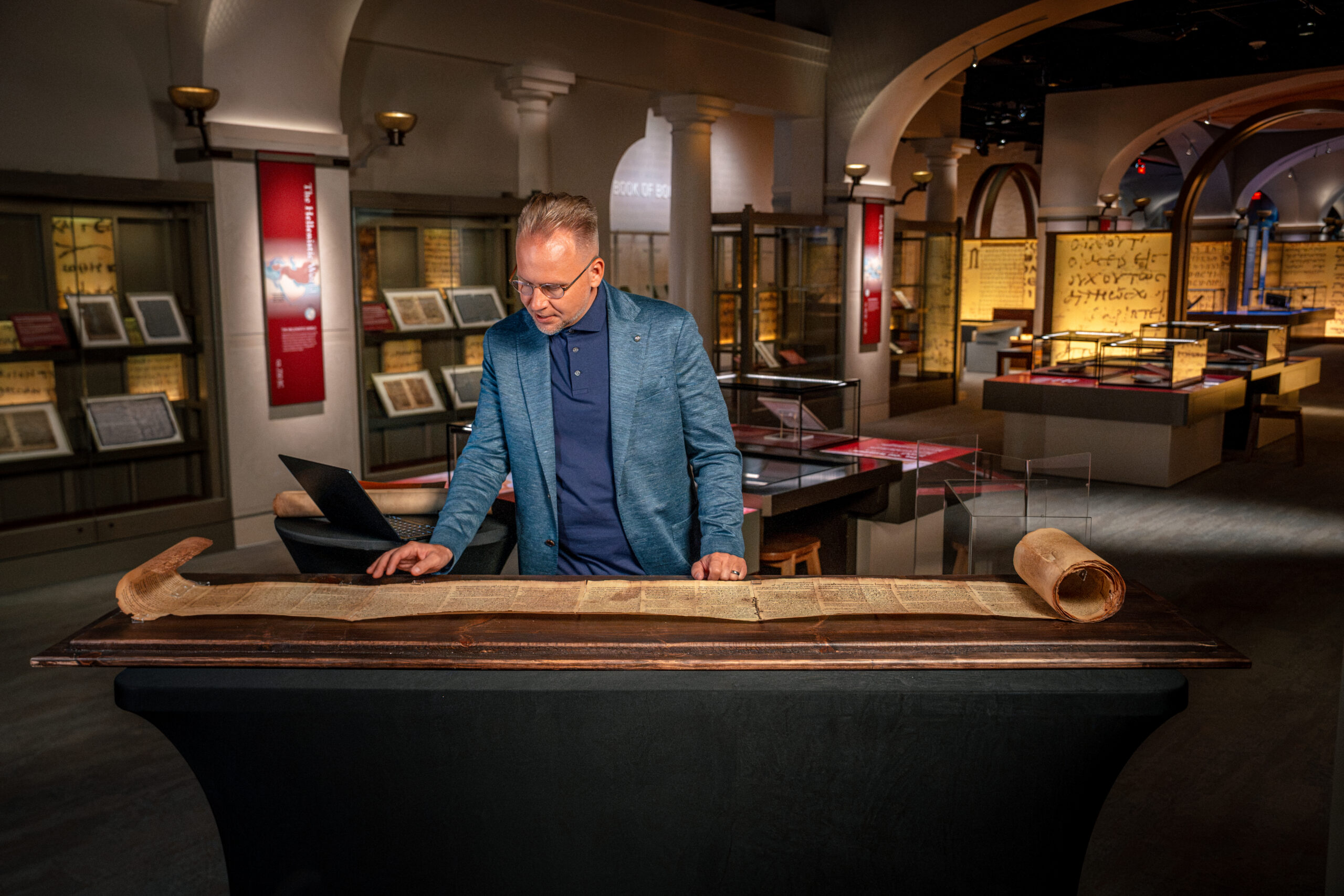
Johnston examines a facsimile of the Great Isaiah Scroll. Photo courtesy of Dr. Jeremiah Johnston.
The reception has not come from the audience he expected. Pastors have told him it deepened their own faith. Believers who described their relationship with Jesus as surface level have told him that the deeper they went, the more solid it became. The group that moves him most arrived not believing anything at all.
“The fact that so many skeptics have read my book and come to faith in Christ, I mean, that is a delight to me,” Johnston says. “Because that’s the whole calling of my life.”
He describes his role now as something closer to a field job than an academic post. He works in tombs. He is an expert in Jewish burial traditions. He is in conversation with Oded Golan, the collector who owns the James Ossuary, and hopes to acquire the box or rent it for public display in 2027.
“That’s what I feel called to do, is kind of this Christian Indiana Jones,” he says.
For all the laboratories and the crowded exhibit halls, he insists the point was never the information itself.
“The cool payoff of all of these discoveries isn’t being smarter,” Johnston says. “It’s, wow, I’m getting to know different aspects of how much Jesus loves me and what he did for me, and what it cost God to send His Son.”