
By Jim Manley
Thomas Ellenson has a line about performing that is funny enough to get a laugh and revealing enough to explain why he makes theater.
“When I’m on stage,” he likes to say, “it’s the only time that people stare at me for the right reasons.”
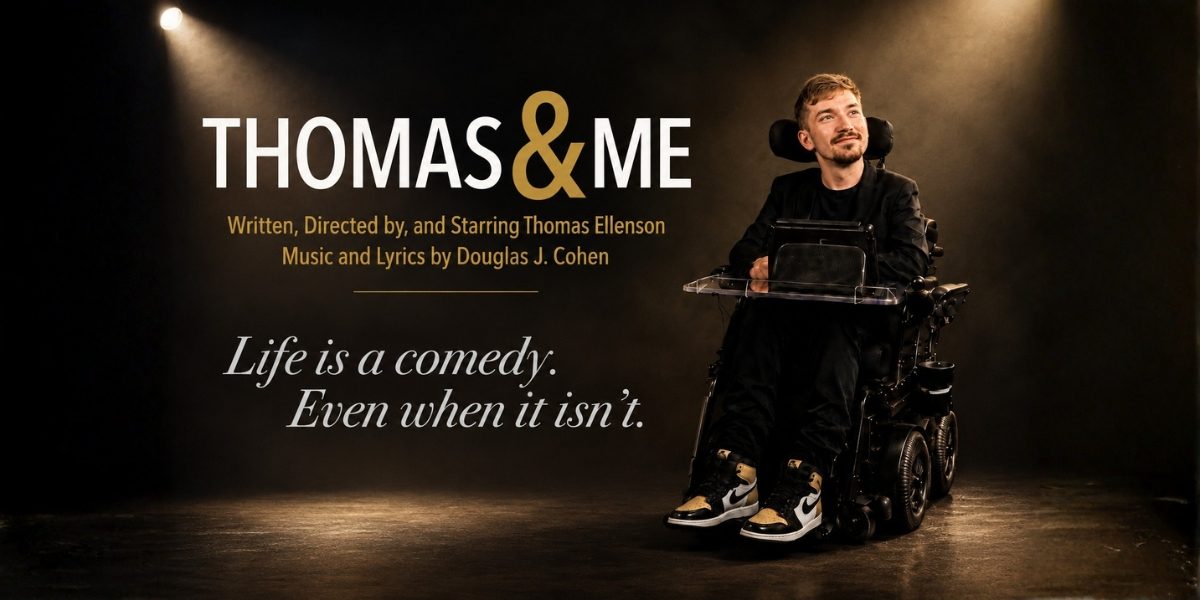
Ellenson, an actor, writer and director with cerebral palsy who uses a power wheelchair and communicates through an iPad, has spent much of his career transforming that gaze. In his newest work, Thomas & Me, arriving at the Frank Shiner Theater for a limited engagement September 24–28 (ticket link), he turns it toward something almost aggressively ordinary: a young man nearing 30, wondering about love, adulthood and whether he is ready to ask his girlfriend to marry him.
“Dating in NYC is so stressful, and when you have a disability, it’s on another level,” he said. “But I try to look at the challenges I have sort of in the same way everyone else has them. I mean, dating in NYC just isn’t easy for anyone.”
That balance, acknowledging disability without allowing it to swallow the rest of a person’s identity, sits at the heart of Thomas & Me. The play follows Ellenson’s character as he prepares for a proposal and decides that before he can commit to someone else, he needs to understand more about himself.
“Imagine that the first thing everyone thinks about you is, you’re different,” he said. “But of course, the first thing I think about myself is, I’m me!”
“I want people to see me as someone wrestling with the same things they do.”
Thomas & Me began as a solo work, winning Best Production at the 2025 United Solo Festival. But Ellenson, an avowed musical-theater devotee, wanted more: more actors, more theatrical possibilities and music.
So he approached Drama Desk-nominated composer and lyricist Douglas J. Cohen. The resulting piece became a full-length play with music, featuring Mairéad O’Neill and Tyler Austin White alongside Ellenson and co-directed by Stephen Santa.
The song “I Am Not a Morning Person” grew from a short description Ellenson sent by text. Then Cohen encountered a line in the script that revealed its comic voice: “I don’t love you for your coffee, and that’s a good thing. Because I hate your coffee.”
“I knew I had to find a rhythm and musical vocabulary that captured these quirky, endearing characters,” Cohen said.
But writing songs for Thomas & Me also meant learning how music could coexist with the technology Ellenson uses to speak.
Ellenson programs his dialogue into Talk Suite on his iPad with precision. A sentence might sit on one button or be divided between two, allowing space for gesture. A comma creates a short pause; a period a longer one. He revises until the timing feels emotionally right.
“My iPad is my tool,” Ellenson said, “but my body is my instrument.”
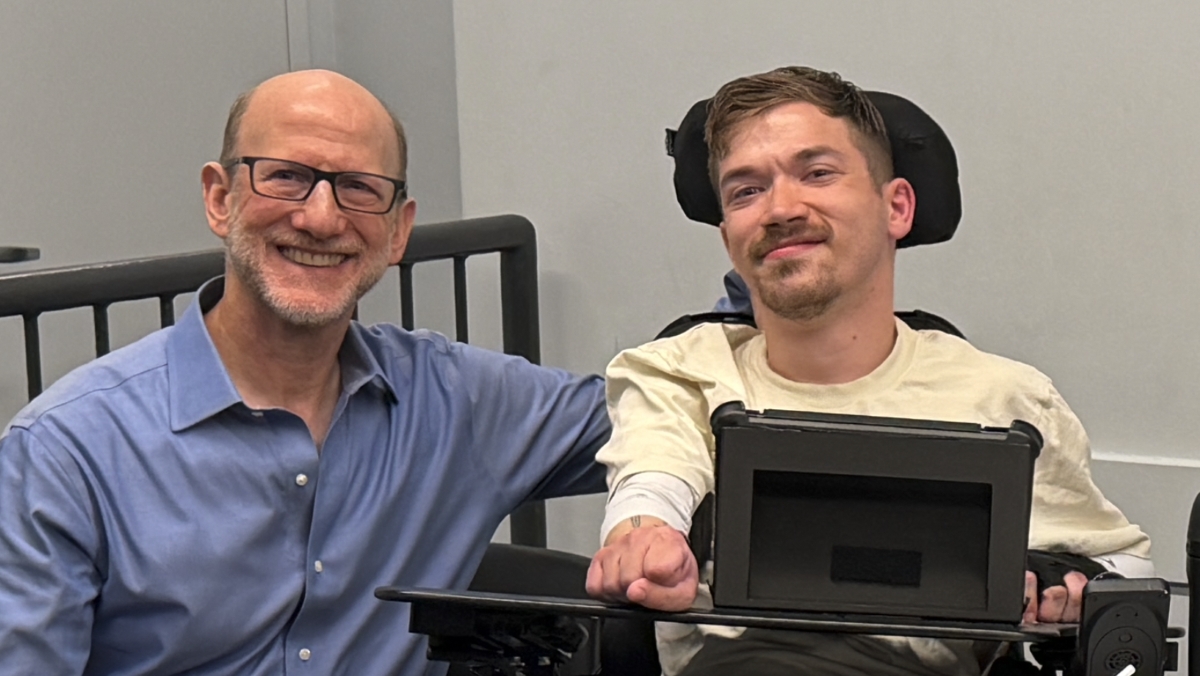
Synthesized speech has limits of pitch and vocal modulation, but Ellenson treats silence, expression, physicality and timing as part of the performance. Cohen adapted in turn.
“I learned to let certain sections of songs ‘breathe,’” he said, creating openings where Ellenson can inject humor, confessions and observations through his iPad. Some numbers are largely sung by Michelle, Thomas’s girlfriend, played by O’Neill, allowing music to explore care, commitment and intimacy.
The collaboration also presented a subtler challenge: how to let emotion arrive without turning Ellenson’s life into a lesson.
“There’s a difference between pathos and bathos,” Cohen said. “You don’t want to hit emotions squarely on the head or it will seem manipulative.”
The answer, he found, was to trust Ellenson’s humor.
“One of the things that I find remarkable about the show is it could easily lean into sentimentality,” Cohen said. “But Thomas is such a joyous person and wants to entertain his audience. So when emotion does occur, I believe it catches the audience off guard.”
After a workshop featuring only three songs, Ellenson rewrote a major section near the play’s conclusion. When he asked Cohen to write a song for it, Cohen preserved as much dialogue as possible, creating what he calls a “seamless marriage between speech and song.”
For Ellenson, the production has also meant learning to work within a larger creative team. “It sure took some getting used to,” he said. But he calls Cohen’s contribution transformational and credits Santa with helping him translate his ideas onstage.
The New York engagement also carries a milestone: according to the production, Ellenson will become the first performer using a speech-generating device to write and perform in a full-length New York play. Yet Ellenson seems happiest when that distinction is not the endpoint.
“This was my first attempt at a play with music,” he said. “My next step is to make a musical.”
And if audiences leave Thomas & Me talking, Ellenson knows what he hopes they take with them.
“Life is hard,” he said, “but it’s the only thing we have. So just live your best life and always remember to appreciate that you’ve been given it.”
Then, with the instinct of someone who knows exactly when sincerity has occupied the stage long enough, he added one final request.
As for what he hopes audiences are not talking about?
“I hope it doesn’t happen that one of my shoes gets untied.”
For Ellenson and his collaborators, the five-performance New York engagement is less an endpoint than a beginning, a chance to put Thomas & Me before audiences in its expanded form and discover what might come next. For a show about a man deciding whether he is ready to take the next step in his life, the production itself now seems poised to do the same.