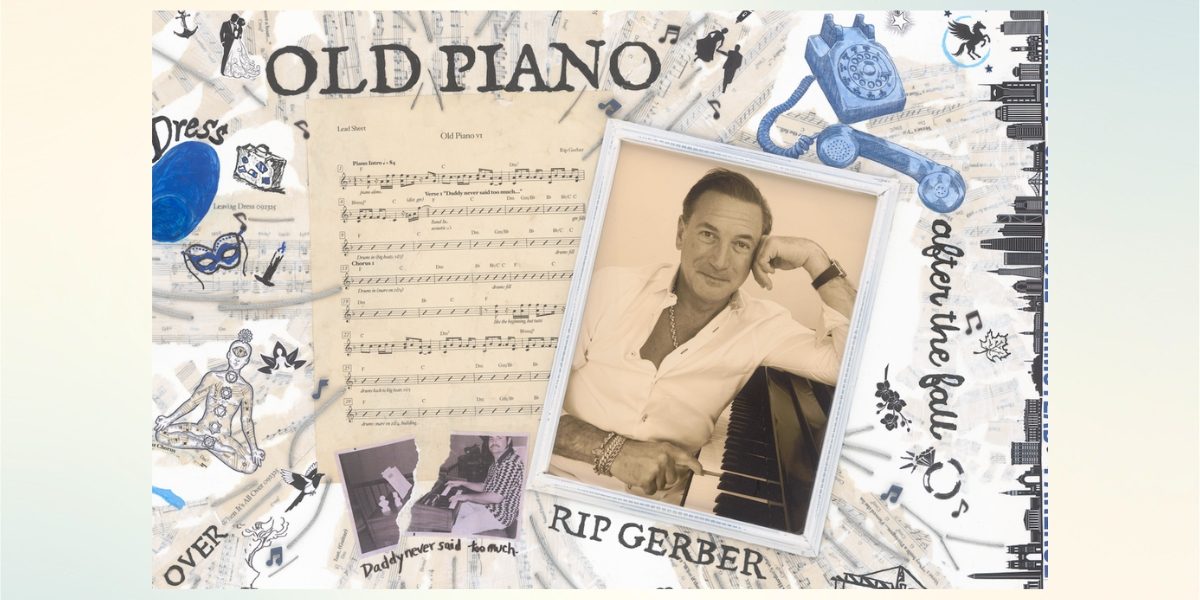

Rip Gerber spent his career in Silicon Valley. He was a tech executive during the years the industry learned to generate a song in thirty seconds. Then he sat down at the piano he learned on as a child and made a debut album with zero AI anywhere in it – not in the writing, not in the tracking, not in the artwork. Old Piano arrives August 7 on Secret Equations Records, and it is the most pointed argument a debut record has made in years.
The current single is already making the case. “Tunnel Royale” peaked at #19 on the iTunes UK Rock chart, a placement earned in a market with no shortage of homegrown competition. It follows two singles that went to #1 on Amazon Music, “Three-Chord Town” and “Y Knot.” Gerber now draws over 200,000 monthly listeners on Spotify, with “Three-Chord Town” past 435,000 streams, “Y Knot” past 258,000, and “Limited Speed” past 236,000. Press has come from SPIN, Billboard, LA Weekly, Forbes, and The Guardian. He has opened for Tom Petty and the Heartbreakers. All of it built independently, in under two years, by a man debuting as a recording artist in his sixties.
That timeline exists because of what came before it. In 2020, Gerber lost his father to COVID, his marriage of twenty-eight years to divorce, his job, and his health, in roughly the span of a single year. What he had left was the instrument in the room. He started playing at three years old on a piano his family had gathered around for generations, going back to a great-great-grandfather who invented the euphonium. Music in the Gerber family was never something consumed. It was something made, in a room, together. When the scaffolding of his life came down, that piano is where he went. Not to perform. To survive.
The record that came out of those nights was made the slow way on purpose. Most albums today are assembled – a beat here, a vocal comped from forty takes there, everything gridded and corrected inside a laptop. Gerber did the opposite. He wrote alone at the piano, then brought the songs into real rooms and cut them live with his band, The Cremators, everyone looking at each other. Takes with flaws stayed if they breathed. What you hear are moments, not assemblies.

The rooms were chosen with the same intent. Sessions ran at Skywalker Sound in Marin and at 2200 Studios in Sausalito, the former Record Plant where Fleetwood Mac made Rumours. Seven-time Grammy winner Jim Scott mixed the album at Plyrz Studios in Valencia on a Neve 8048, the analog console class the classics were cut on. Grammy-nominated engineer Pete Lyman mastered it at Infrasonic Sound in Nashville. Producer and music director Noah Luna arranged and conducted a live orchestra on four of the ten tracks, standing in the room with the players. Gerber has said he wept openly at those sessions more than once.
The refusal to automate did not stop at the audio. The cover is an original acrylic painting Gerber made by hand, three generations at a Steinway. The back cover is a collage built from tea-stained session charts and actual piano wire pulled from the sessions. The vinyl gatefolds are being assembled by hand, in a limited run. Every stage of the record – writing, tracking, mixing, mastering, artwork, packaging – passed through human hands, which was the entire point.
“Tunnel Royale” is also the clearest statement of what the album is reaching for. Cut live with the orchestra, it is a tribute to Princess Diana and the night she died, written to honor her as a mother in a tunnel in the last moments of an extraordinary life rather than as an icon. The video incorporates licensed archival footage. Gerber says the listener response has been unlike anything he has released, and the UK chart placement suggests the country that grieved her first is hearing it.
Sonically, the album sits in heartland American rock, in the lineage of Tom Petty, Billy Joel, Bruce Springsteen, John Mellencamp, and Jason Isbell – piano-led rather than guitar-led, melodic, story-first, unflinching about grief and second chances. The title track is a testimony to generations who could not tell each other how they felt except through music.
Which is the question the record keeps circling. Gerber knows better than most what machines can now produce, and how quickly. His answer was ten songs played by human hands in rooms where people could see each other. If Old Piano convinces even a few listeners to sit down at the instrument gathering dust in their own living rooms, it will have done what he built it to do.
Listen to Rip Gerber on Spotify and follow him on Instagram.