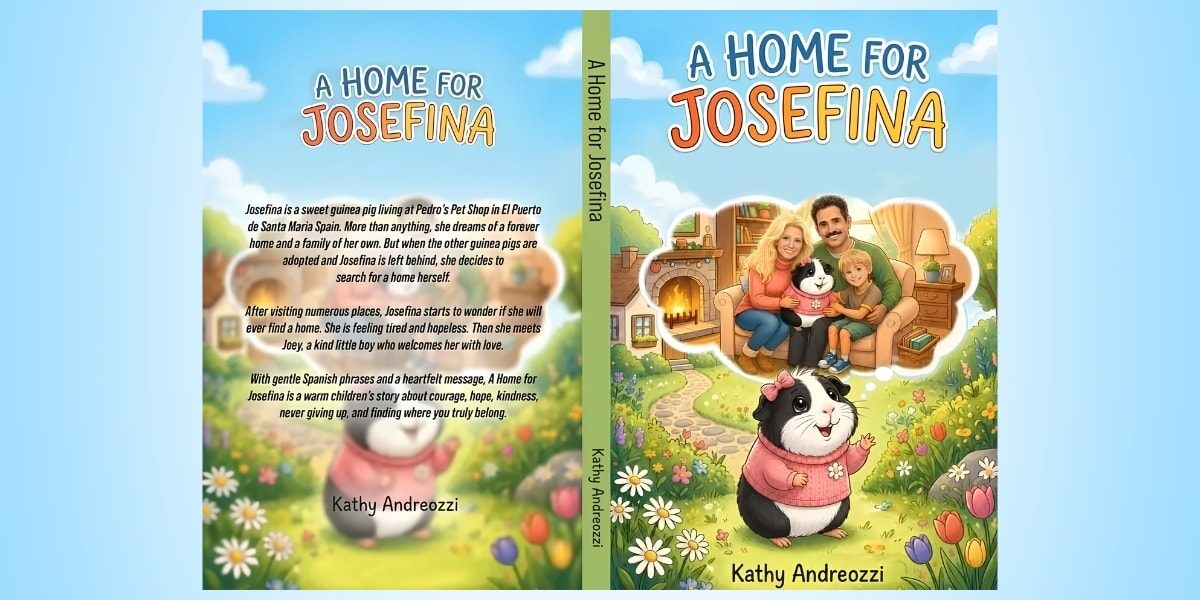

A Children’s Adventure Story Explores Bravery, Misunderstanding, Acceptance, and Finding a True Sense of Belonging.
A Small Character with a Meaningful Wish
Finding a place to belong is a universal desire, and it can be especially meaningful when introduced to children through a warm and accessible story. In A Home for Josefina, author Kathy Andreozzi follows a determined guinea pig whose greatest wish is to find a permanent home and a loving family.
Josefina lives at Pedro’s Pet Shop in the Sud América neighborhood of El Puerto de Santa María, Spain. Pedro treats every animal with care and kindness, but life inside the pet shop is still temporary. The animals hope that someone will eventually choose them and take them home.
Josefina shares that hope. However, as the other guinea pigs are adopted one after another, she remains behind. Watching them leave makes her feel increasingly lonely. She begins to wonder why no one has selected her and whether she will ever experience the comfort of having a family of her own.
Rather than continuing to wait, Josefina decides to take control of her situation.
When the door of her cage is accidentally left open, she sees an opportunity to begin searching for a home herself.
Entering an Unfamiliar World
Josefina’s first moments outside the pet shop are filled with excitement, but that excitement quickly turns into fear. The street is busy with people and moving cars, and the small guinea pig realizes that the world beyond her cage is much larger and more confusing than she expected.
Still, Josefina continues her search.
Her first stop is a grocery store. Surrounded by food, including sweet carrots, she briefly believes she has found an ideal place to live. The store appears to offer everything she needs. However, the customers and workers misunderstand what they see. Mistaking Josefina for a rat, they shout and frighten her away.
The encounter introduces one of the story’s central ideas: people can react negatively when they make assumptions without taking the time to understand.
Josefina has done nothing intentionally harmful. She is simply hungry and searching for safety. Yet because the people in the store do not recognize her for who she is, she is treated as something dangerous or unwanted.
Hope Followed by Disappointment
After escaping the grocery store, Josefina enters a dress shop. The colorful dresses and welcoming interior make her imagine that she may have finally discovered a comfortable home. She even begins looking for a dress that might fit her.
Once again, her hopeful moment is interrupted.
The people in the shop mistake her for a rat and attempt to catch her. Josefina is forced to escape through an open window. She later discovers a bakery filled with freshly prepared bread, cookies, donuts, cakes, and pies. The inviting smells and abundance of food make the bakery appear even more promising than the places she visited earlier.
Josefina climbs onto the counter and begins eating a donut. However, the baker notices her, and the familiar panic begins again. Customers and workers shout while someone suggests using a broom to remove her.
After escaping for the third time, Josefina becomes exhausted and discouraged.
Each location looked welcoming from the outside, but none offered the understanding or acceptance she needed.
Bilingual Dialogue and Cultural Setting
The use of English and Spanish dialogue gives Josefina’s journey a distinctive cultural dimension. Her thoughts and emotions are often expressed in both languages, connecting the story to its setting in Spain while giving young readers an introduction to simple Spanish expressions.
The bilingual dialogue is incorporated into the action rather than presented as a formal language lesson. This allows children to understand the meaning of each phrase through context, emotion, and repetition.
For bilingual households, this approach may provide an opportunity to see familiar language represented in a children’s story. For readers who are beginning to encounter Spanish, the book offers an approachable introduction to commonly understood words and expressions.
The two languages also reinforce the universal nature of Josefina’s emotions.
Whether she expresses herself in English or Spanish, her wish remains the same: she wants to feel safe, loved, and included.
An Unexpected Turning Point
As the day grows late, Josefina becomes tired and hungry. She reaches a beautiful house surrounded by a wall and finds a small opening that allows her to enter the yard. While eating grass in the warm sunlight, she hears a low growl. A large white-and-brown dog named Paco approaches and demands to know why she is in the yard.
Terrified, Josefina hides beneath a woodpile.
Paco remains nearby, leaving her feeling trapped. She eventually attempts to run, only to find herself caught once again.
At this point, Josefina believes she may be in serious danger. Instead, she hears the voice of a young boy named Joey. Joey does not respond with fear or hostility. He sees Josefina as a small animal in need of help. He picks her up gently, comforts her, and asks her name. When Josefina explains that she is searching for a permanent home and family, Joey offers her exactly what she has been hoping to find.
Home as More Than a Place
The story’s conclusion shows that a home is defined by more than food, clothing, shelter, or physical comfort. The grocery store had food. The dress shop offered beautiful surroundings. The bakery was filled with tempting treats. Yet none of those places gave Josefina the acceptance she needed.
Joey and his family provide something different.
They recognize her, listen to her, and welcome her. Paco also apologizes for frightening Josefina and explains that he was protecting the family home. His willingness to make peace allows the two animals to begin their relationship with understanding rather than fear.
Through this resolution, the story presents belonging as an emotional experience. A true home is a place where someone is not merely allowed to stay but is treated with kindness, protection, and affection.
A Story That Encourages Conversation
The book’s themes may support conversations among parents, teachers, librarians, and young readers. Children can discuss why the people in the shops reacted as they did, how Josefina felt when she was misunderstood, and what made Joey’s response different.
The story can also introduce discussions about pet adoption, responsible animal care, courage, cultural language, and the importance of not judging others too quickly. Josefina’s journey remains playful and adventurous, but the message beneath it is clear. Kindness can change the direction of someone’s life, and acceptance can transform an unfamiliar place into a genuine home.
Josefina’s journey closes on the two ideas that carried her through it. Courage keeps hope alive, and kindness gives every heart a place to belong.
Author Name: Kathy Andreozzi
Book Title: A Home for Josefina
Publishing Soon by: Lumera Publishing