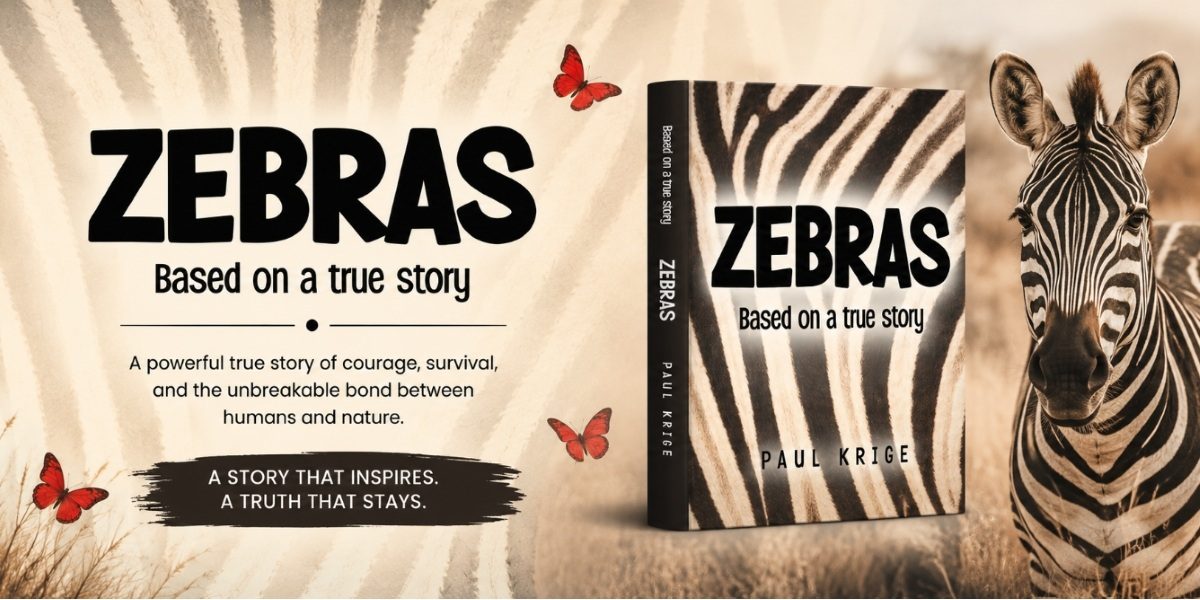

History often remembers political movements through speeches, headlines, and legislation. Far less attention is given to the ordinary people whose daily choices quietly challenged injustice long before history acknowledged their courage. Named after the young soccer team whose journey becomes one of its defining threads, Zebras by Paul Krige follows a group of characters whose lives intersect through football, music, and friendship, revealing how everyday choices can become acts of quiet resistance.
Although presented through the character of Kyle, the book is largely rooted in Paul Krige’s own experiences during apartheid-era South Africa. Many of the people, places, and events readers encounter are based on real individuals and firsthand experiences, offering an unusually personal perspective on a defining period in the nation’s history.
At first glance, the novel appears to celebrate the energy of South Africa’s music industry during one of its most turbulent eras. Beneath the excitement of recording sessions, ambitious artists, and creative freedom lies a thoughtful examination of identity, conscience, and belonging. The result is a narrative that asks an enduring question: What happens when personal integrity conflicts with the rules society demands people accept?
Beyond the World Inherited
Kyle enters the story as a talented young music executive eager to build a career. His enthusiasm is unmistakable, but his greatest education happens far beyond office walls.
Working alongside black musicians introduces him to lives shaped by barriers he was never expected to question. Every recording session, every township visit, and every conversation broadens his understanding of a country divided by law but connected by shared humanity. Music becomes more than entertainment; it becomes common ground where language, culture, and race lose much of their authority.
Those township visits carry particular significance because they are inspired by the author’s own experiences alongside Benny Nchabeleng, whose friendship opened doors into communities that many white South Africans never saw. Witnessing protests, police violence, and everyday life firsthand gave Krige an understanding that challenged the official narratives of the time and ultimately shaped the story readers encounter today.
Rather than presenting Kyle as a flawless hero, the novel allows him to mature gradually. His changing perspective feels earned because it grows from observation, friendship, and lived experience instead of convenient revelation.
Creativity as an Act of Defiance
The music business depicted in Zebras is lively, unpredictable, and filled with unforgettable personalities. Producers, performers, executives, and dreamers create an atmosphere rich with humor, ambition, and creative chaos.
Many of these colorful personalities are inspired by the real people who worked at Sunshine Music, where creativity often flourished despite political tension and corporate absurdity. Their larger-than-life personalities bring warmth and humor to a story that never loses sight of the realities happening beyond the studio walls.
This colourful environment exists beneath the shadow of apartheid. Recording studios become rare spaces where collaboration succeeds despite the divisions enforced outside their doors. Every successful recording carries quiet significance because it affirms talent over prejudice.
The story also reflects Krige’s own experiences promoting black musicians and DJing at the Easy By Night nightclub, where he earned the nickname “Concolo”. Those experiences reinforce the book’s authenticity while illustrating how music created connections that politics sought to prevent.
Friendship That Challenges Every Assumption
Among the novel’s greatest strengths are the relationships Kyle develops with people whose experiences differ dramatically from his own. These friendships are neither sentimental nor symbolic. They are built on trust, humor, loyalty, and mutual respect.
His bond with Benny stands at the emotional center of the story. Based on the real Benny Nchabeleng, this friendship extends far beyond professional collaboration. Benny becomes a guide, protector, and brother figure whose courage and generosity expose Kyle to a South Africa hidden behind segregation, ultimately changing the course of his life.
Equally important is the story of the young soccer team known as Zebras. Their determination culminates in an unforgettable curtain-raiser match that inspires an entire stadium to unite behind them. More than a sporting achievement, their journey demonstrates the book’s central belief that prejudice is learned, while compassion and fairness often come naturally to children.
The supporting cast further enriches the narrative, creating a community whose imperfections make them feel unmistakably authentic. Their conversations, disagreements, and shared ambitions give the novel emotional warmth without diminishing the seriousness of its historical backdrop.
Story Built on Memory
Rather than fictionalising history, Paul Krige preserves many of the extraordinary moments he personally witnessed, allowing readers to experience apartheid not only as a political system but as something that shaped everyday relationships, careers, neighborhoods, and lives. The book reaches beyond its South African setting because its questions remain relevant wherever societies struggle with division, inequality, or fear of difference.
Paul Krige combines lived experience with engaging storytelling, offering readers an account that feels both intimate and expansive. Rather than presenting history as distant or static, the novel reveals it as something shaped by ordinary people making difficult decisions one day at a time.
Takeaway
Zebras ultimately suggests that meaningful change rarely begins with grand declarations. It begins when individuals choose curiosity over prejudice, compassion over comfort, and shared purpose over separation. Whether expressed through music, lifelong friendships, or a youth soccer team that united thousands of spectators, the story reminds readers that ordinary people, especially young people, often become the first to imagine a more hopeful future. That message gives this novel lasting significance, reminding readers that history is often redirected by people who simply decide to stand beside one another when it matters most.
PK Former Managing Director Universal Music Australia Owner difrnt Music PAULKRIGE.COM | paulkrige@hotmail.com