
By: Andrew Jackson
Today, the online jewelry market is highly competitive. To stand out, jewelry business owners need to offer unique, personalized, and ethically sourced pieces, ranging from engagement rings and fashion jewelry to handcrafted items.
Here you will learn how to start an online jewelry store, covering benefits, essential features, costs, marketing, and scaling strategies to help you build a profitable business.
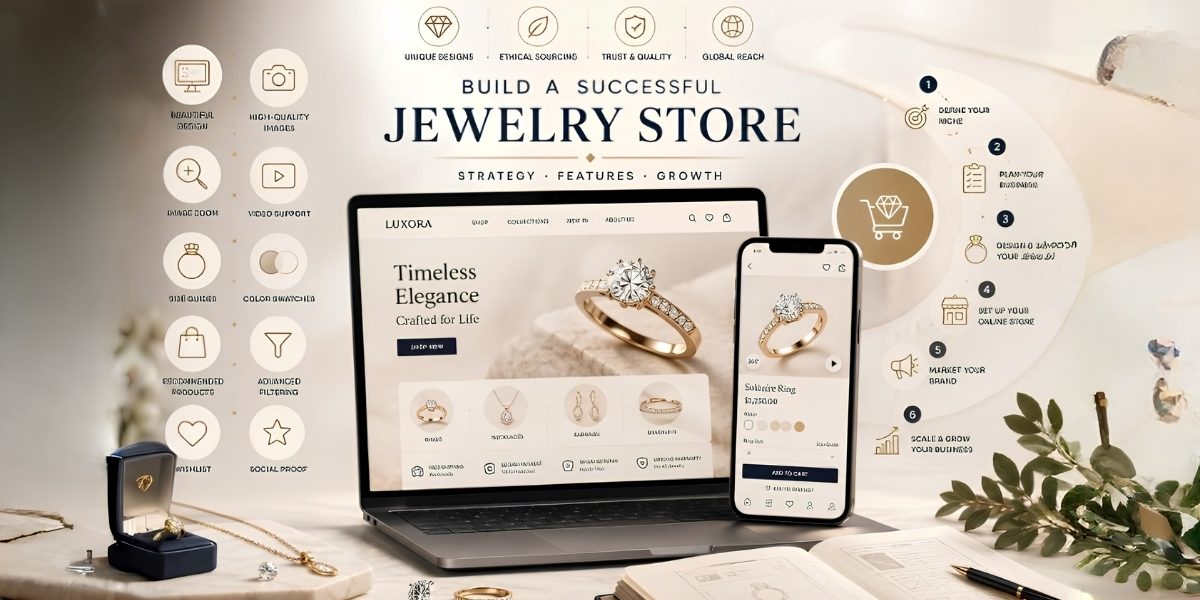
Features of a Modern Jewelry E-commerce Website
Choosing the right functionality is just as important as selecting the right e-commerce platform. A successful jewelry website should combine elegant design, intuitive navigation, and conversion-focused features that inspire trust and encourage purchases. The following functionality will help you create an exceptional shopping experience while maximizing sales.
Amazing Design
Your website design creates the first impression of your brand. It should be intuitive, easy to navigate, and visually appealing. While an attractive design benefits any e-commerce business, it is especially important for jewelry stores, where customers expect elegance, luxury, and sophistication.
High-Quality Images
It is essential for showcasing the craftsmanship and fine details of every jewelry piece. Professional, high-resolution images allow customers to closely examine gemstones, textures, and finishes, helping them feel more confident about purchasing online.
Image Zoom
This functionality enables customers to inspect every detail of a product without leaving the page. With a simple hover or click, shoppers can explore textures, settings, and intricate craftsmanship from multiple angles. It will help to build trust, reduce uncertainty, and improve user experience.
Video Support
This feature helps customers visualize jewelry in real-life situations. A short video can demonstrate how a ring catches the light, how earrings move, or how a necklace drapes when worn. Videos also provide an opportunity to showcase your craftsmanship, explain your design process, and tell your brand story, making customers more confident in their buying decisions.
Size Guides
Selecting the correct ring or bracelet size online can be difficult. Detailed size guides that include measurement instructions, diagrams, or printable templates help customers choose the right size with confidence. As a result, they improve customer satisfaction while reducing returns and exchanges.
Color Swatches
Many jewelry products are available in multiple metal finishes or gemstone variations. Color swatches allow customers to switch between these options instantly without leaving the product page, making comparisons faster and simplifying purchase decisions.
Recommended Products
This feature encourages customers to discover complementary items, such as matching earrings, necklaces, or bracelets. It supports cross-selling and upselling strategies, increases average order value, and creates a more personalized shopping experience.
Advanced Product Filtering
It helps customers quickly narrow their search by price, gemstone, metal type, style, collection, or size. Besides improving navigation, it demonstrates that your store is organized and customer-focused, allowing visitors to find products faster.
Wishlist Functionality
This functionality allows customers to save favorite jewelry items for future purchases. Since jewelry buyers often take time before making a final decision, this feature encourages repeat visits and increases conversion opportunities during promotions or seasonal sales.
Promo Tiles
This feature highlights featured collections, seasonal campaigns, special offers, and new arrivals throughout your jewelry website. Strategically placed promotional banners help attract attention to important products while improving product discovery.
Social Proof
Customer reviews, ratings, testimonials, and user-generated photos build credibility and trust. When visitors see real customers sharing positive experiences with your jewelry, they become more confident in purchasing from your online store.
Step-by-Step Guide on How to Start an Online Jewelry Store
1. Define Your Niche and Target Audience
Before creating your jewelry ecommerce website, clearly define your niche and ideal customer. It helps differentiate your brand, strengthens your marketing strategy, and makes it easier to attract the right audience.
2. Develop a Business Plan
A well-prepared business plan serves as the foundation of your online jewelry store. It outlines your goals, budget, pricing strategy, marketing approach, and long-term growth plans and helps you make informed business decisions.
3. Design and Source Your Jewelry
Your jewelry store defines your brand. Develop a production strategy that aligns with your budget, quality standards, and business model. Whether you create handmade jewelry or work with manufacturers, prioritize craftsmanship, consistency, ethical sourcing, and sustainability to meet modern customer expectations.
4. Set Up Your Online Jewelry Store
Your jewelry ecommerce website is your digital storefront. It should combine attractive design, intuitive navigation, secure payment methods, fast loading speeds, and mobile responsiveness to deliver a seamless shopping experience.
5. Implement Marketing Strategies
Creating beautiful jewelry is only part of building a successful business. To attract customers, develop a comprehensive marketing strategy that combines SEO, content marketing, email campaigns, social media, influencer collaborations, paid advertising, and offline events. This increases brand awareness and drives the right traffic to your website.
6. Scale Your E-commerce Business
Once your jewelry website begins generating consistent revenue, focus on sustainable growth. Expand your product catalog, introduce new collections, or offer personalized jewelry options. Consider wholesale partnerships and international shipping to reach new audiences. With patience, continuous optimization, and a customer-first approach, your online jewelry store can grow into a successful international e-commerce brand.
The Cost of Building a Jewelry E-commerce Website
The cost of building a jewelry ecommerce website depends on several factors, including your chosen platform, website design, level of customization, required features, third-party integrations, and long-term business goals. Additional functionality, such as custom jewelry configurators, advanced product filtering, ERP or CRM integrations, mobile optimization, and ongoing maintenance, can also significantly affect the total project cost.
While SaaS platforms offer an affordable way to launch an online store, growing and enterprise jewelry brands often invest in custom ecommerce development to deliver a premium customer experience, support complex business operations, and scale more efficiently.
Entry-Level (Shopify or Other SaaS Platforms): $3,000–$10,000
This option is ideal for startups, independent jewelry designers, and small businesses launching their first online store. Most projects use pre-built themes with standard e-commerce functionality, allowing businesses to launch quickly while keeping development costs relatively low.
Key features:
• Responsive website design
• Product catalog and collection pages
• Secure payment gateway integration
• Basic shipping configuration
• Product search and filtering
• Mobile-friendly shopping experience
• Essential SEO setup
Mid-Tier (Custom Design & Business Growth): $10,000–$30,000
This pricing tier is designed for growing jewelry brands that need greater flexibility than standard e-commerce platforms can provide. Instead of relying on pre-built templates, businesses receive a custom-designed storefront tailored to their branding, customer journey, and conversion goals.
Key features:
• Custom UI/UX design
• Advanced product filtering and search
• Wishlist functionality and personalized recommendations
• Product videos and interactive image galleries
• Customer reviews and social proof
• Marketing automation integrations
• CRM and email marketing integrations
• Performance optimization
• Advanced SEO implementation
• Selected third-party integrations
Enterprise (Magento / Adobe Commerce): Starting at $40,000+
Enterprise ecommerce development is intended for established jewelry retailers, luxury brands, manufacturers, wholesalers, and businesses with complex operational requirements. Unlike SaaS platforms, Magento and Adobe Commerce provide virtually unlimited flexibility, enabling businesses to build a fully customized e-commerce ecosystem that supports long-term growth.
Key features:
• Fully customized e-commerce architecture
• Bespoke UI/UX tailored to luxury brands
• Advanced product configurators for customizable jewelry
• Multi-store and multi-language capabilities
• B2B and wholesale functionality
• ERP, CRM, PIM, and inventory management integrations
• AI-powered product recommendations and personalization
• Advanced customer segmentation
• High-performance architecture for large product catalogs
• Enterprise-grade security and scalability
• Extensive API integrations with third-party systems
Building a Successful Online Jewelry Store
Nowadays, building a successful jewelry e-commerce website requires much more than an attractive design. The most successful online jewelry stores combine an exceptional user experience, premium product presentation, fast performance, and trust-building features that guide customers confidently through every stage of the buying journey. Thus, by investing in the right ecommerce platform, intuitive UX design, high-quality visuals, and conversion-focused functionality, you can create a digital storefront that not only showcases your jewelry beautifully but also drives sales and builds long-term customer loyalty.
Disclaimer: This article is intended for general informational and educational purposes only. It does not provide financial, legal, tax, business, e-commerce, marketing, or professional development advice, and it should not be relied upon as a substitute for guidance from a qualified professional. Website costs, platform suitability, development timelines, features, integrations, marketing results, sales performance, and business outcomes can vary based on business model, budget, vendor, platform, product offering, market conditions, and execution. No specific revenue, profitability, growth, or customer acquisition results are guaranteed. Readers should independently evaluate any e-commerce platform, development provider, marketing strategy, or business investment before making decisions. Cost ranges and feature descriptions are provided for general context only and should be verified with qualified vendors or advisors.