

Kolkata based entrepreneur, researcher, and business strategist Dr. Bitan Ghosh has created Elevent Index, an integrated framework for smarter startup investment decisions. Designed to bring structure, discipline, and analytical depth to the way startups are assessed, Elevent Index combines Investment Quality Score, Funding Readiness Score, and Capital Readiness Score into a unified model that helps investors look beyond valuation and evaluate the true strength, readiness, and long-term potential of a startup.
At a time when startup investing is often shaped by instinct, hype, and fragmented due diligence, Elevent Index seeks to address a deeper problem in the investment ecosystem. The gap it targets is the lack of a disciplined and integrated method for assessing whether a startup is genuinely investable. The framework moves beyond conventional signals such as founder charisma, valuation stories, pitch deck polish, or market momentum. Instead, it gives investors and founders a structured way to examine the fundamentals beneath a startup’s story.
What Is Elevent Index?
Elevent Index is a structured startup investment assessment framework designed to evaluate a company’s Investment Quality, Funding Readiness, and Capital Readiness through a stage-specific methodology. It brings business fundamentals, fundraising preparedness, and investor decision metrics into one analytical model. The aim is to help investors make more informed decisions while giving founders a clearer understanding of how prepared they are for capital.
One of the key distinctions behind Elevent Index is that it separates startup quality from fundraising readiness. That matters because not every strong business is immediately ready for funding, and not every startup that looks impressive in a pitch meeting is fundamentally investment-worthy.
A startup may have a promising product, a capable founder, or a large market opportunity, but still lack financial clarity, governance discipline, execution planning, or investor communication strength. Conversely, a company may appear polished in front of investors while carrying unresolved weaknesses in its business fundamentals. By assessing these dimensions separately before integrating them, Elevent Index aims to create a more realistic picture of where a startup actually stands.
Why Dr. Bitan Ghosh Built Elevent Index
The creation of Elevent Index reflects Dr. Bitan Ghosh’s broader professional approach, combining analytical discipline with practical business judgment. With an academic background spanning BTech in Civil Engineering, MBA in International Business and Finance, and Doctoral in Business Administration with specialization in Finance, Dr. Ghosh approaches startup assessment through a mix of technical structure, financial reasoning, and strategic decision making.
The framework is not merely a checklist of attractive startup traits. It attempts to formalize a more serious question. How investment ready is this startup, based on what can be assessed today?
In many early-stage investment conversations, decision-making can be inconsistent. Some investors focus heavily on the founder. Others prioritize market size, valuation, traction, product strength, or exit potential. While each factor matters, they are often examined in isolation. Elevent Index attempts to bring these scattered observations into a more coherent assessment structure.
A Framework Built for Better Startup Evaluation
Startup investing will always involve uncertainty. No model can eliminate the risk of backing a young company. Markets change, execution can falter, competitors emerge, and founders often have to make decisions under pressure. But uncertainty should not mean the absence of structure.
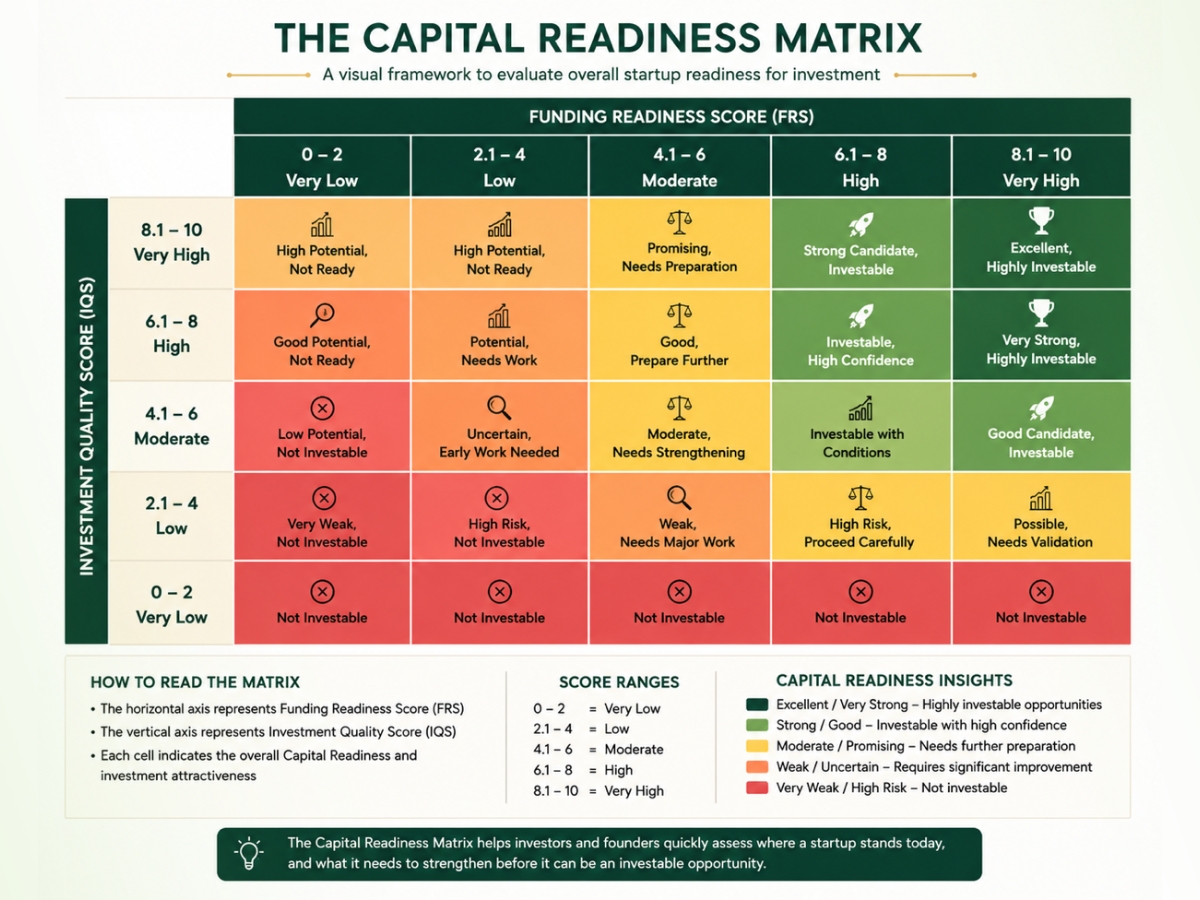
This is one of the central ideas behind Elevent Index. The framework evaluates startups through multiple layers of quality and readiness rather than through a single vague sense of potential. By combining Investment Quality Score (IQS), Funding Readiness Score (FRS), and Capital Readiness Score (CRS), Elevent Index creates a broader view of what investors are actually assessing when they consider deploying capital.
In practical terms, this means moving beyond surface-level signals. A startup is not assessed only on whether it sounds exciting or operates in a fashionable sector. It is examined on whether it has the underlying business quality, operational maturity, fundraising preparedness, and strategic readiness to justify serious investor attention.
For founders, the framework can be equally useful. Fundraising is often treated as a milestone, but readiness for funding is rarely achieved overnight. A company may have a differentiated product or early market traction, yet still struggle to explain its financial model, defend its valuation, demonstrate governance maturity, or present a credible capital deployment plan. Elevent Index gives founders a way to identify such gaps before they become obstacles.

Separating Quality From Readiness
One of the more important ideas behind Elevent Index is that startup quality and fundraising readiness are not the same thing.
A business can be innovative and operationally promising, yet still be unprepared for external capital because of weak investor materials, unclear reporting, inconsistent metrics, limited governance systems, or inadequate documentation. These issues do not always mean the business is weak. They may simply mean the startup is not yet prepared to absorb, justify, or manage investor capital effectively.
At the same time, some startups may appear highly prepared for fundraising while lacking depth in the business itself. A sophisticated pitch deck or confident presentation can create the impression of investment readiness. But without strong fundamentals, durable market positioning, and credible execution capability, that impression may not hold.
By distinguishing between these realities, Elevent Index avoids reducing startup assessment to a single narrative. It creates a more nuanced framework where quality, preparedness, and capital suitability are examined separately before being integrated into an investment view.
A Different Way to Think About Startup Investing
The strongest contribution of Elevent Index may not be simply a new scorecard, but a different mindset around startup investing.
Instead of asking only whether a startup is exciting, fast-growing, or fashionable, the framework encourages more disciplined questions. How strong is the business beneath the story? How prepared is the company to raise capital responsibly? How clear is the link between its fundamentals, fundraising posture, and long-term investment readiness? Can the startup absorb capital effectively and deploy it intelligently?
These questions become more important when capital becomes selective and investors demand greater discipline. The market rewards ambition, but over time, it tests execution. Elevent Index appears to be built around that reality.
For investors, the framework can serve as a decision-support tool. It can help compare startups more consistently, identify red flags earlier, and distinguish between investment quality and presentation quality. For founders, it can work as a preparation framework, helping them understand that capital readiness is not a cosmetic exercise. It is a combination of business quality, documentation, governance, financial clarity, strategic maturity, and investor alignment. The Capital Readiness Matrix gives a clear picture about the startup.
Kolkata’s Place in the Story
The fact that Elevent Index has emerged from Kolkata is also notable. For years, conversations around India’s startup ecosystem have often centered on Bengaluru, Mumbai, Delhi NCR, and Hyderabad. These cities have built strong reputations as hubs for technology, finance, and venture activity. But the emergence of frameworks like Elevent Index reflects a broader truth. Innovation in business thinking is no longer confined to a few established startup geographies.
Kolkata has a long intellectual and commercial history, but its role in India’s new economy is often understated. Elevent Index adds another dimension to that story, positioning Kolkata as a place where businesses can be built and also as a place where investment thinking can evolve.
This matters because the next phase of startup growth in India is likely to be more geographically distributed. Founders from emerging business cities will increasingly seek capital, build digital products, and compete for investor attention. In such an environment, structured assessment frameworks can help bridge the gap between ambition and investor confidence.
The Bigger Vision Behind Elevent Index
For Dr. Bitan Ghosh, Elevent Index appears to fit within a larger philosophy centered on discipline, calculated risk, technical depth, and long-term value creation. His background across engineering, finance, research, and business strategy gives him a distinctive vantage point from which to examine startup readiness.
That may be why Elevent Index feels more substantial than a simple startup checklist. It reflects the thinking of someone who understands that businesses are not evaluated in isolation. They are assessed through the interaction of market opportunity, operational strength, capital planning, governance quality, founder capability, and investor confidence.
In a startup environment where funding conversations often move faster than real evaluation, frameworks like Elevent Index could become increasingly relevant. Investors need better signals. Founders need clearer benchmarks. The market benefits when capital decisions are made with more structure and less noise.
With Elevent Index, Dr. Bitan Ghosh is making the case that smarter startup investing does not begin with valuation. It begins with a better framework for understanding what a startup actually is, how prepared it really is, and whether it deserves capital in the first place.
To learn more about Elevent Index, visit the Elevent Index website.
You can also connect with Dr. Bitan Ghosh through his professional profile on LinkedIn.