
By: Aman Jalan
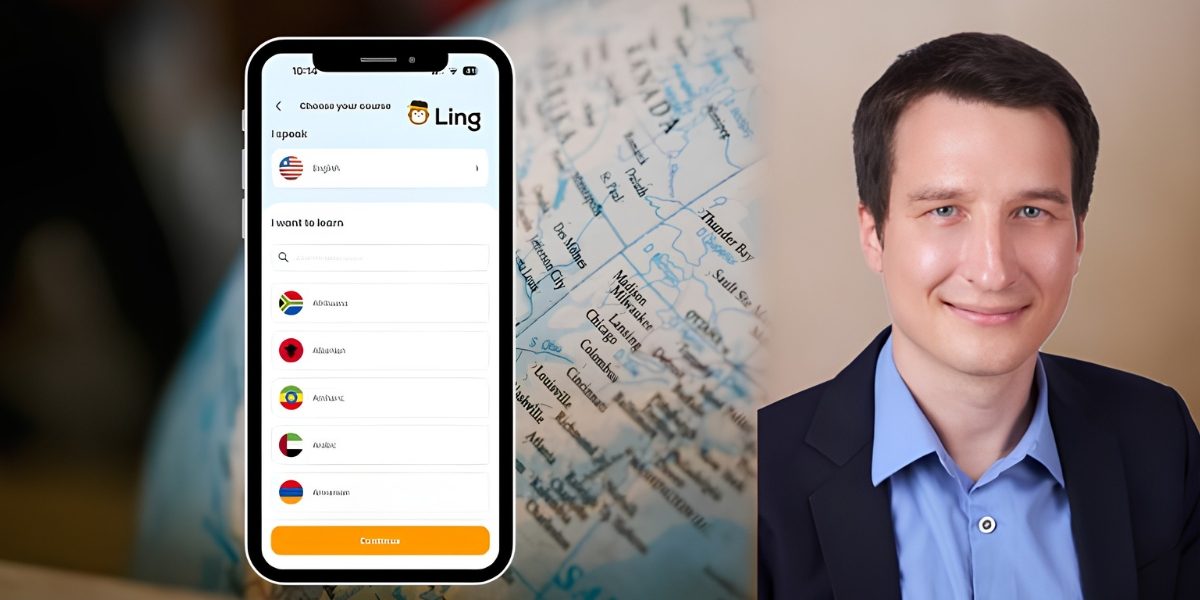
When Simon Bacher landed in Chiang Mai in 2017, he had one urgent goal. He wanted to learn enough Thai to talk to his wife’s family. What he didn’t have was a way to do it.
Babbel didn’t teach Thai. Memrise offered only scattered user-made lessons. Duolingo didn’t have Thai (and still doesn’t).
“Personally, I just didn’t find anything in the market which teaches Thai in an effective, yet fun way,” Bacher said in a 2025 company statement. “The apps and resources that were out there are often either boring, or the content is not tailored towards that particular culture.”
So he built his own. Nine years later, his company teaches 78 languages, most of them rare, from a small office in northern Thailand.
A Side Project That Took Over Their Lives
Bacher, a German native with an IT and business degree from the University of Münster, met his wife and co-founder Kanyarat “Khwan” Nuchangpuek when she was studying in Germany. She had moved there for a master’s in information systems and was working at an IT consultancy when the couple started sketching out a side project on weekends.
“I worked on the development, and my wife handled the design and content when we had extra time on the weekends,” Bacher told the entrepreneurship site Niche Pursuits in 2022. About a year after launching, they quit their jobs to work on the app full-time.
They founded the parent company, Simya Solutions Ltd., in 2016 and registered it in Chiang Mai. Ling launched on the App Store and Google Play in 2017, starting with Thai.
A Real Problem, Not Just a Personal One
The gap Bacher and Nuchangpuek identified wasn’t unique to them. UNESCO catalogues roughly 7,000 living languages worldwide. The agency estimates around 3,000 are at risk of disappearing by the end of the century. A widely cited 2013 study in PLOS ONE argued that fewer than 5% of the world’s languages have a realistic chance of making it onto the internet at all.
The major language apps reflect that imbalance. Babbel teaches 14 languages. Memrise’s structured courses cover around 22. Even Duolingo, the category leader, listed roughly 40 courses before announcing a large AI-assisted expansion in 2025.
If you wanted to learn Sinhala, Cebuano, or Lao, you were essentially out of luck.
Filling the Gaps the Giants Ignored
Ling’s strategy is straightforward. It teaches what nobody else will. As of mid-2025, the company says the app covers 78 target languages, with 76 possible interface languages. That means a speaker of Uzbek can study Serbian without needing to know English first.
The catalogue leans heavily toward Southeast Asian, South Asian, Central Asian, and Eastern European languages: Lao, Khmer, Burmese, Mongolian, Kannada, Malayalam, Armenian, Georgian, Lithuanian, Slovak. An August 2025 release added Javanese, Sundanese, Taiwanese Hokkien, Azerbaijani, Māori, Uzbek, and Kazakh. In 2026 Ling will release Macedonian due to increased demand.
“We believe language learning should reflect the human experience, not just a set of machine outputs,” Bacher said in a company press statement at the time, a clear jab at Duolingo, which had announced earlier that year that it used generative AI to create 148 new courses at once.
What the Critics Say
Independent reviewers have given Ling mixed but generally positive marks. Writing for The Linguist Magazine, Kelly Baker called Ling “one of the few resources that target less commonly learned languages” and praised its consistent quality across courses, though she noted the app isn’t ideal for absolute beginners tackling a new script from scratch.
Shannon Kennedy at the language-learning blog Eurolinguiste described Ling as “a little more scrappy” than Duolingo, but said its breadth, including “Kannada, Mongolian, Armenian, Lithuanian, and Lao,” was the clearest reason to use it.
The app is highly rated across the App Store and Google Play, according to Simya Solutions’ own published figures.
A Company That Stays Quiet About Its Numbers
Measuring Ling’s true scale is harder than measuring its public-market competitors. Simya Solutions is privately held and, according to startup database Tracxn, has not raised outside venture capital.
Bacher has said publicly that Ling has been downloaded more than 5 million times and is used by approximately 500,000 people each month. Crunchbase and ZoomInfo list the company’s headcount at 50 to 80 employees, most based in Thailand. The company has grown steadily since launch.
If those numbers are roughly accurate, Ling occupies an unusual spot in the industry. The broader language-learning app market was valued at around $3.7 billion in 2025 by Business Research Insights, with most of the revenue concentrated in a few giants. Duolingo alone reported $748 million in 2024 revenue and more than 500 million registered users.
Ling isn’t trying to compete for those users. Its bet is that the long tail of the world’s languages, the Cebuano speakers, the Icelandic learners, the diaspora kids trying to talk to a grandparent in Khmer, is big enough and underserved enough to support a profitable business at a fraction of Duolingo’s size.
The AI Question
Whether that bet pays off in the AI era is an open question. Duolingo’s 148-course expansion in 2025, generated largely by AI, was a direct move into the gap Ling built its identity around.
Bacher has pushed back hard in interviews and press releases, arguing that machine-generated courses can’t capture the cultural context that makes a language usable. “Language is not only just words and phrases,” he said in the company’s June 2025 release. “It’s identity, history, and belonging.”
Ling’s courses are written by human linguists and native speakers, and recorded with native-speaker audio.
That distinction, human-authored versus AI-generated content for low-resource languages, is likely to define the next phase of competition in this corner of the market. For now, Ling’s case is that a small team in Chiang Mai can serve learners the industry’s biggest players have, until recently, treated as an afterthought.
The story began, as Bacher has told it many times, with a German IT consultant who wanted to talk to his wife’s family. A decade in, it’s become something his industry will have to reckon with.