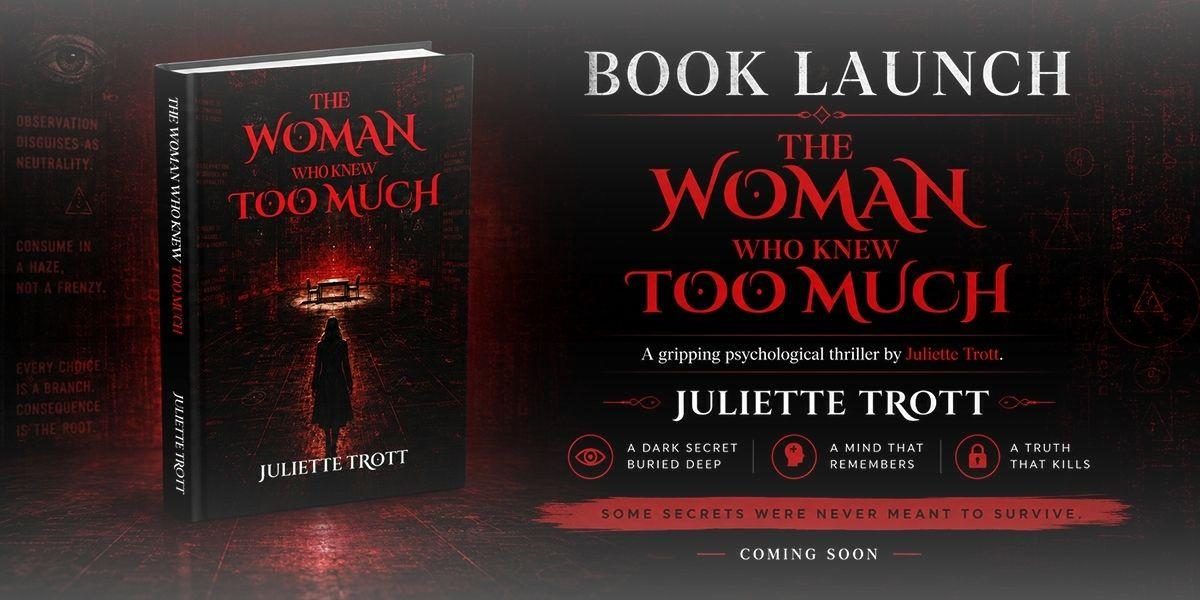

There is something uniquely unsettling about a story that refuses to let certainty exist. Not because it withholds answers, but because it quietly forces readers to question the systems, institutions, and narratives they instinctively trust. Juliette Trott’s The Woman Who Knew Too Much operates in exactly that space. A psychologically layered thriller where truth is not simply hidden, but carefully engineered.
At its surface, the soon-to-be-released novel begins with a familiar image. A woman was found dead in a luxury hotel bathtub, a scene quickly classified as suicide. But from its earliest pages, Trott establishes an atmosphere that feels wrong in ways both subtle and deeply unnerving. The stillness of the water. The precision of the room. A note too clean to belong to someone moments from death. Detective Cal Mercer recognizes what others are too eager to ignore. This is not grief arranged by tragedy, but a performance arranged for belief. That distinction becomes the emotional engine of the novel.
What makes this upcoming book particularly compelling is that it never relies solely on suspense to sustain momentum. Instead, it explores the psychology of control, who shapes narratives, who benefits from silence, and how institutions often protect themselves by manufacturing versions of reality that feel easier to accept. The novel’s recurring imagery of water becomes especially powerful in that context. Here, water is not cleansing or peaceful. It is containment. Distortion. Erasure.
Juliette’s world is populated by people carrying invisible fractures beneath polished exteriors. Mercer himself is not presented as a heroic detective untouched by damage. He is exhausted, isolated, and painfully aware of how systems bend truth for convenience. Meanwhile, Mara Sloane, a professor specializing in ethics and behavioral influence, becomes one of the novel’s most fascinating figures precisely because she exists in moral grayness. She understands manipulation academically long before she realizes she may be trapped inside it personally. That emotional ambiguity gives the novel unusual depth for the genre.
Rather than offering simplistic villains or easy revelations, the author constructs a narrative where fear emerges from recognition. The terror is not only that someone is capable of orchestrating these deaths, but that the machinery enabling it already exists, in bureaucracy, institutional loyalty, public perception, and the human tendency to accept polished explanations over uncomfortable truths.
The novel also succeeds because of its cinematic restraint. The author does not overwhelm scenes with excessive exposition or melodrama. Silence often carries more weight than dialogue. A paused glance, a surveillance blackout, an unfinished sentence. These details accumulate into a suffocating sense of paranoia that steadily tightens around the reader.
Beneath the psychological tension lies something profoundly human: the fear of losing ownership of one’s own reality. The fear that memory itself can be manipulated. That survival may come with consequences worse than exposure. And perhaps most hauntingly, that the people trusted to protect truth may be the ones most invested in burying it.
In an era increasingly shaped by misinformation, curated narratives, and institutional distrust, the book feels strikingly timely. It is not simply a thriller about murder. It is a story about perception, control, and the terrifying ease with which truth can be rewritten when powerful people decide the public should see something else. And once the novel plants that idea in your mind, it becomes impossible to shake.
Some stories entertain. Others linger. The Woman Who Knew Too Much does both and leaves readers questioning every version of the truth long after the final page.
The Woman Who Knew Too Much joins Juliette Trott’s growing list of psychological thrillers. It continues her interest in the secrets that powerful people work hardest to keep buried.