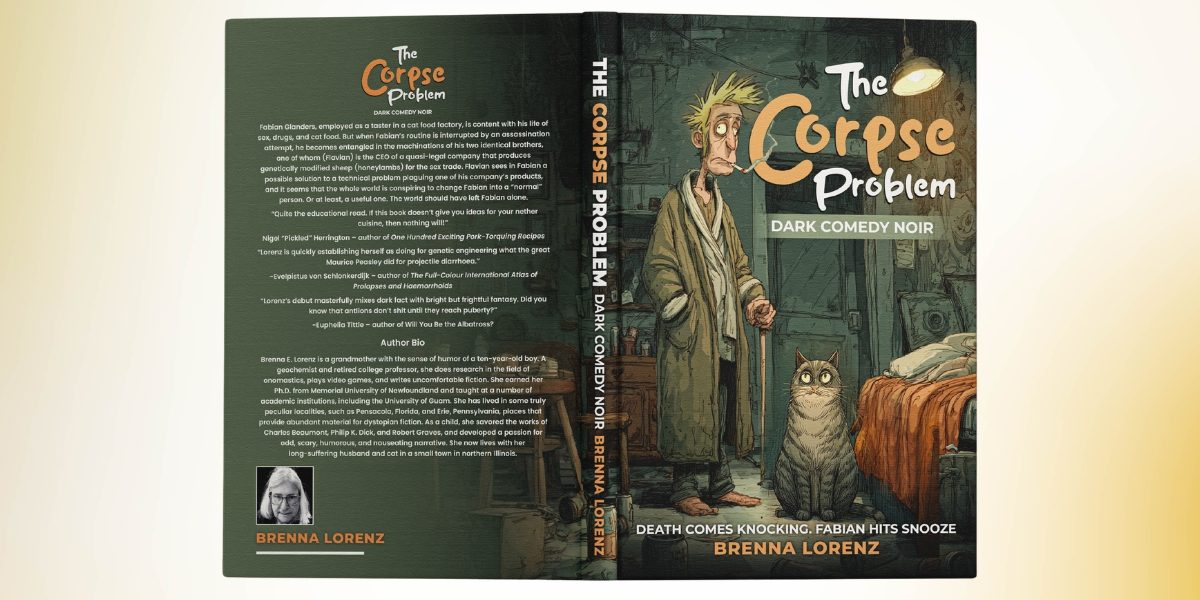

There is a particular kind of novelist who does not enter the room quietly.
Brenna E. Lorenz appears to be one of them.
Her novel, The Corpse Problem, begins with the kind of premise that feels almost rude in its confidence: a man wakes up, sick, confused, and deeply unprepared for the day ahead, only to discover that two dead bodies have somehow become his responsibility.
It is an opening built not around elegance, but momentum. Before the reader has time to settle in, Lorenz has already made the ordinary world collapse.
The man at the center of the chaos is Fabian, one of three estranged triplet brothers. The others, Florian and Flavian, arrive with their own histories, grievances, appetites, and dangers.
The story introduces each brother early, making clear that this is not simply a story about a crime scene. It is a story about family, mistaken identity, resentment, and the strange consequences of lives that have been lived badly for a long time.
That may be the simplest way to describe Lorenz’s fiction: bad decisions, followed all the way down.
But a simple description does not quite prepare a reader for the experience of her work. The Corpse Problem is funny, but not politely funny. It is grotesque, but not carelessly grotesque. It has the shape of a crime novel, the nerve of a black comedy, and the instincts of social satire. Lorenz writes as if absurdity is not a departure from real life, but one of its more honest languages.
Her characters are not designed to be admired from a safe distance. They are weak, hungry, deluded, vain, frightened, cruel, occasionally tender, and often ridiculous. They talk too much, want the wrong things, misread one another, and make situations worse simply by being themselves. In that sense, Lorenz’s fiction has a nasty kind of realism beneath its wild surface. The circumstances may be extreme, but the human behavior is painfully recognizable.
What keeps The Corpse Problem from becoming merely outrageous is Lorenz’s control of escalation. The book begins in one apartment, with one impossible problem. Then the circle widens. Family history enters. The FBI enters. Workplaces, schemes, secrets, and institutions enter. The result is not a tidy mystery moving toward a clean solution, but a comic disaster expanding under its own pressure.
Lorenz does not seem interested in comfort. She is more interested in what people do when comfort is no longer available.
That interest carries into the books she has planned next.
In Placentas, Clem Stubbs is out on parole after ten years in a Florida prison and trying, without much help from the world, to put a life together. He works for a small company that processes placentas for mothers who want to eat them or otherwise use them after birth. His boss is a tyrant. His ex-wife has married his parole officer. His daughter, whom he loves, has been out of reach for a decade. His roommate is romantically involved with an armadillo. Around him, Florida begins to look less like a state than a failing third-world country in the final throes of capitalism. The book includes recipes for cooking placentas, a detail that sounds like a dare until one considers how neatly it fits Lorenz’s larger concerns.
In her fiction, consumption is rarely just consumption. It is business. It is a ritual. It is desperation. It is identity. It is the body turned into a marketplace.
That idea appears again in Eat Me, set in a near-future United States where cultured human meat has become the basis of a national fad. Franklin Honeycutt, a college student and practiced slacker, has no particular desire to eat human meat. What draws him in is money. The promise of it. The machinery around it. The sense that he might profit without quite understanding the terms. The lesson he learns is a simple one, and therefore probably too late: read the fine print.
Then there is The Gilgul, which moves into a different register. Its central figure, Alat, is the fifteen-year-old son of an outcast widow in a small 18th-century steppe community. After he becomes infected by a sentient parasitic slime-mold, he must learn not only how to survive the parasite, but how to live with what it has made of him. The premise belongs to horror, but the emotional territory is older: isolation, transformation, fear of the body, fear of the self, fear of being changed beyond recognition.
Across these works, Lorenz seems drawn to people caught inside systems they did not build and cannot fully escape. A parolee trying to survive Florida’s terminal capitalism. A student pulled into a grotesque consumer craze. A boy infected by a thinking parasite. A man waking up beside death and trying to understand how badly the day has already gone.
Her books are not linked by plot, but by temperament. They are suspicious of cleanliness. Suspicious of respectable language. Suspicious of the easy distance people put between themselves and horror when horror has been properly packaged.
That suspicion may be what makes Lorenz’s work feel unusually pointed. American life is full of euphemism. Industries process things. Companies optimize. Consumers participate. Markets respond. Lorenz pushes past that careful language and asks what is actually being processed, optimized, consumed, and sold. She is not subtle about the body because the systems she writes about are not subtle in what they demand from it.
Still, there is more to her work than provocation. Lorenz has a gift for comic setup, for the terrible logic of farce, for scenes in which one absurdity gives way to another until the reader is laughing and wincing at the same time. Her humor often comes from precision: the wrong word at the wrong time, the ridiculous thought a person has in a moment of danger, the bureaucratic detail that survives when everything else has gone mad.
It is tempting to call her work transgressive, though the word has been worn thin from overuse. What she really seems to be doing is more specific. She takes subjects that polite fiction often steps around — bodies, waste, appetite, lust, decay, stupidity, illness, meat, money — and refuses to look away before the joke has finished turning into an accusation.
Readers can also find Lorenz’s short stories on her website, brennalorenz.com, where her shorter work offers another doorway into the same unruly imagination. For a writer whose novels appear to thrive on escalation, the short story form may be an especially useful showcase: a premise, a pressure point, a sharp turn, and then the uneasy aftertaste.
With The Corpse Problem, Lorenz has written a novel that does not behave like a typical debut into the crime-comedy space. It is stranger than that, rougher-edged, less eager to please. Its appeal lies in the sense that the author is not asking permission from the genre. She is using genre as a container, then seeing how much pressure it can take.
The coming books suggest an author building not just a bibliography, but a territory. It is a territory where capitalism becomes a physical trap, where appetite becomes plot, where identity is unstable, and where comedy survives because horror alone would be too easy.
Not every reader will want to live in Brenna E. Lorenz’s fictional world. That may be part of the point.
But readers tired of tidy premises, softened darkness, and novels that behave too well may find something bracing here: fiction with a pulse, a smell, a sneer, and a very sharp bite.