
Today, Dreame Technology officially opened “DREAME NEXT,” its most ambitious global launch event to date, at the Palace of Fine Arts in San Francisco. Marking the first time a Chinese technology company has claimed Silicon Valley as the stage for its own dedicated launch week, Day One wasted no time setting the tone. This was an opening act built around speed, intelligence, and a declaration of intent.
Two Hypercars, One Stage
The first thing to stop guests in their tracks upon entering the venue was not a presentation screen or a set of specifications. It was two cars, one on each side of the stage, stationed in silence, each commanding the room on its own terms.
On the left, a flame-red hypercar sat low and menacing, its sculpted wide-body form, broad wheel arches, and a fixed rear wing projecting a sense of barely contained force from every angle. On the right, the Nebula NEXT 01 Jet Edition gleamed in emerald green under the event lighting, the undisputed visual centerpiece of the entire venue. Together, the two cars represent the first public, real-world showing of Dreame’s automotive project, Kosmera, formerly known as the “Stellar Program”, a team of nearly one thousand engineers making their presence known not through renderings, but through cars you could walk around and touch. This was Kosmera announcing itself to the world.
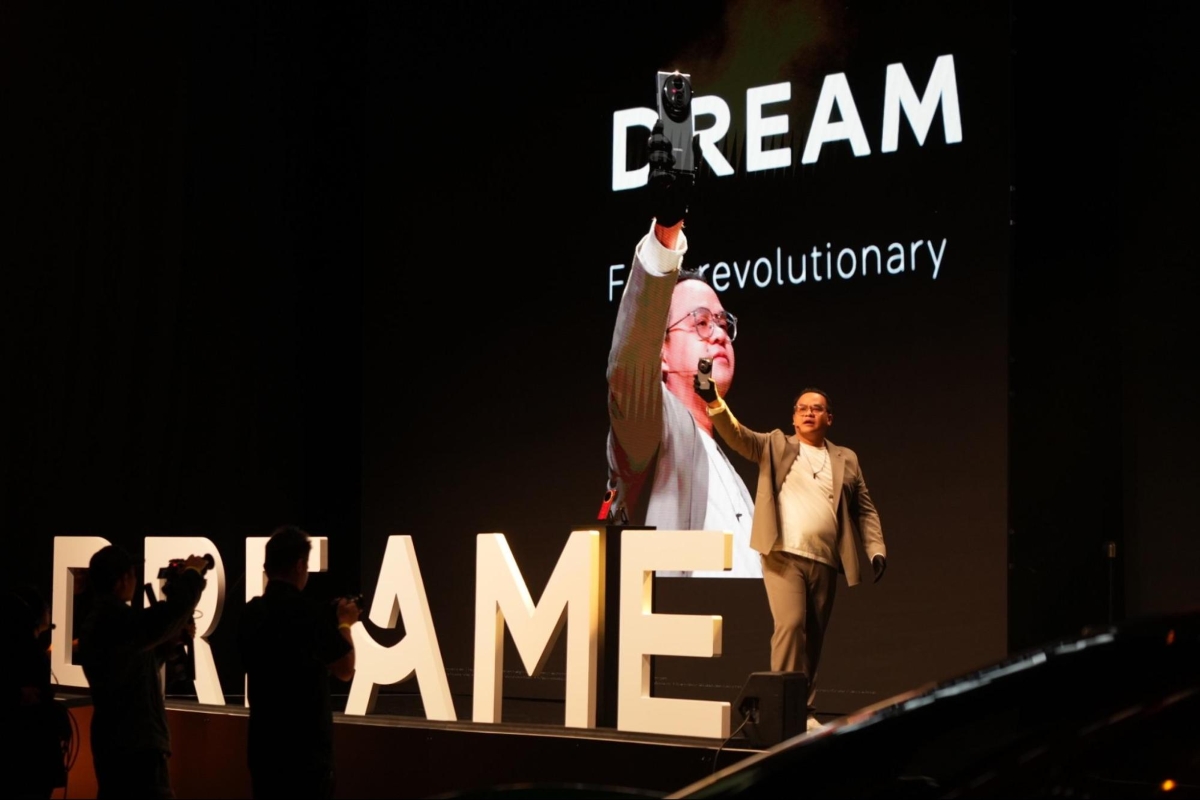
Photo Courtesy: Dwyane Wade
Nebula NEXT 01 Jet Edition: Three Numbers That Silenced the Room
When the presenter took the stage, three figures appeared on the screen behind him. The room went quiet.
150ms, ultra-fast response time 100kN, maximum thrust 0.9s, 0 to 100 km/h acceleration
The 0.9-second sprint figure is not the kind of number that gets rounded up for a press release. It is a genuine physical statement, acceleration on par with a fighter jet launching off a carrier deck, and it landed accordingly.
The green Nebula parked on stage gave those numbers a physical form. The low roofline, the smooth aerodynamic channeling along the flanks, the wide multi-spoke alloy wheels, and the commanding rear spoiler all tell the same story: every surface of this car exists to serve performance.
Underpinning it all is what Dreame calls Intelligent Chassis Architecture 2.0, a fully line-controlled mobile robot platform that serves as the vehicle’s central nervous system. It is also the most direct expression of Dreame’s core thesis: that years of robotics engineering, refined in vacuum cleaners and floor-washing machines, can be transplanted directly into an automobile.
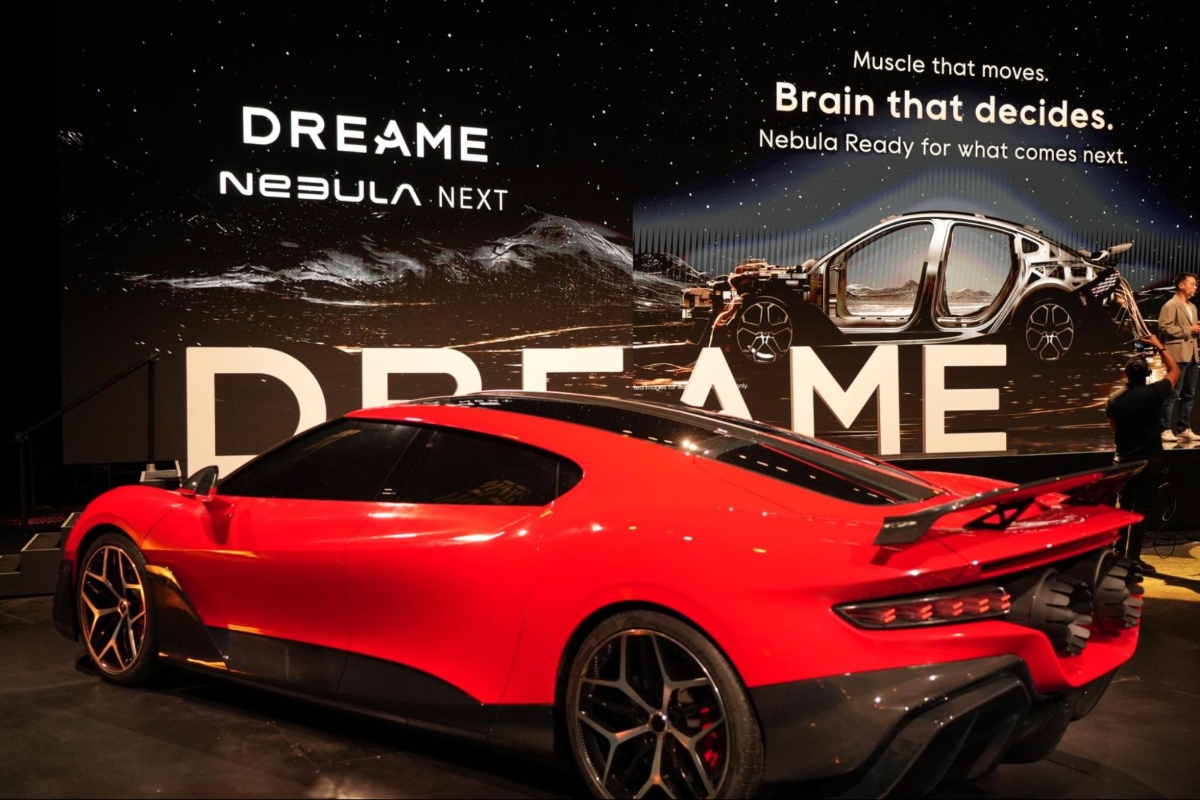
Photo Courtesy: Dreame
The Father of Autonomous Driving Takes the Stage
If the Nebula defined the visual identity of Day One, then the arrival of Sebastian Thrun defined its intellectual weight.
Widely recognized as the father of modern autonomous vehicles, Thrun co-founded Google X and led the Google Self-Driving Car project before going on to establish Udacity. He stands as one of the most consequential figures in the history of artificial intelligence and autonomous mobility. Standing alongside the green Nebula, he addressed an audience of media, investors, and industry observers on where intelligent transportation is headed in the next decade, and how artificial intelligence is poised to fundamentally redefine the way people move through the world.
Thrun’s presence delivered something no specification sheet can manufacture: validation from the person who helped build the field that Dreame’s Nebula is now entering. He was not there as a brand ambassador. He was there as someone who has spent his career at the frontier of exactly this technology, choosing to stand next to this car.
The Engineering Logic Behind the Leap
Dreame’s move into automotive is grounded in a specific engineering argument. The high-speed digital motors the company spent years developing for home appliances share fundamental technical DNA with electric vehicle drivetrain systems. Re-engineered for torque output, that motor technology can produce peak power levels sufficient for hypercar-level performance demands. By the end of 2025, Dreame had filed more than 10,000 patents globally, spanning sensor fusion, motor control, and human-machine interaction, all domains that sit at the core of intelligent vehicle development. The Kosmera team has grown to nearly one thousand people, and site selection for a European manufacturing facility in Germany is already underway.
The Nebula NEXT 01 Jet Edition is on track for mass production in 2027.
A Declaration, Not a Demo
Two cars stood on either side of the stage throughout Day One, one red, one green, like a pair of opening statements from a team that has spent years preparing its argument. The numbers on the screen, the response from the floor, and the image of Sebastian Thrun standing beside that green hypercar all pointed toward the same conclusion.
Dreame did not come to Silicon Valley to observe. It came to compete.