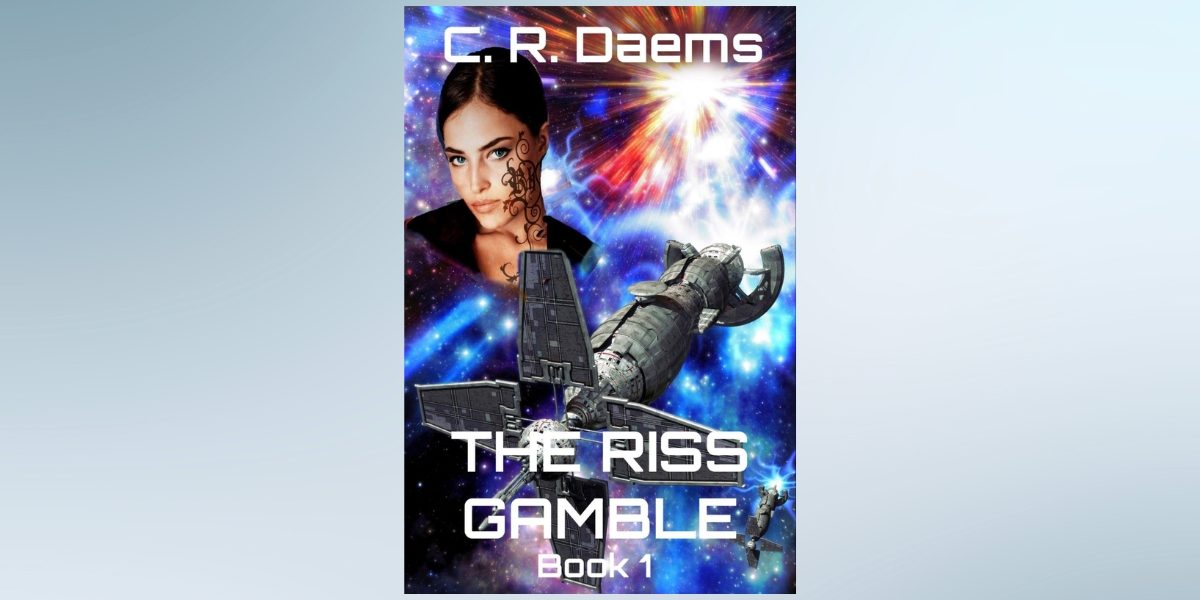

There is a moment in The Riss Gamble when everything changes. A young woman opens a long-awaited letter, expecting rejection, only to discover her life is about to split in two. Not metaphorically. Literally. From that point on, C. R. Daems does not ease the reader into his world. He pulls you straight into it.
The novel follows Nadya Reese, a gifted but socially isolated technician from a gray mining colony called Corona. She is not a hero in the traditional sense. She is quiet, observant, and more comfortable fixing machines than talking to people. Her life is small, predictable, and safe. But like many people who feel stuck, she carries a quiet hunger for something bigger.
That hunger leads her to the Riss Project, an experimental program that promises education, status, and a chance to see the stars. But there is a catch, and it is not a small one. If selected, she will not simply work with an alien. She will host one inside her own body.
That is where The Riss Gamble separates itself from typical science fiction. The Riss are not distant beings communicating across galaxies. They are intimate. They attach themselves directly to the human nervous system, linking mind to mind. It is not just coexistence. It is shared control, shared thought, and at times, shared conflict. Nadya does not just meet an alien. She becomes inseparable from one.
What makes this concept work is not just the originality, but how naturally it unfolds. Daems does not overload the reader with complex exposition. Instead, he lets the experience build through Nadya’s perspective. We feel her hesitation, her fear, and eventually, her reluctant curiosity. The story moves the way real decisions do, slowly at first, then all at once.
The author himself never set out to write like this. After a 22-year career in the Air Force and later working as a software engineer, Daems began writing only after retirement. There was no formal training, no lifelong ambition to become an author, just an idea that refused to leave him. As he explains, the concept began with a simple question: what if one body could hold two minds?
From there, the story grew on its own. That organic approach shapes the entire book. Written in first person, the narrative places the reader directly inside Nadya’s thoughts. It creates a sense of immediacy that feels less like reading and more like living the experience alongside her.
When the Riss finally enters her body, the tone shifts in a way that feels both unsettling and fascinating. There is no dramatic spectacle. Instead, there is confusion, discomfort, and a quiet realization that nothing will ever be the same again. The change is internal, and that makes it more powerful.
The relationship between Nadya and the Riss becomes the true center of the story. It is not a perfect partnership. At times, the alien takes control of her body, leaving her frustrated and powerless. At other times, it enhances her abilities, sharpening her senses and pushing her beyond human limits. What begins as fear slowly evolves into something more layered and complex. Trust does not come easily when you are sharing your own mind.
Beneath the science fiction, there is also a subtle reflection of real-world behavior. Nadya is visibly marked as someone carrying a Riss, and people react to her differently because of it. Without turning into a heavy message, the story quietly explores how people judge what they do not understand. It is not forced. It simply exists within the world, which makes it feel authentic.
Another strength of the book is its pacing. Unlike many science fiction novels that pause to describe every detail, The Riss Gamble keeps moving. Scenes are focused, dialogue is purposeful, and the narrative maintains a steady momentum. This makes the book engaging without feeling overwhelming.
That same clarity may explain why the novel has built a strong following over time. Without heavy marketing, it has grown largely through word of mouth. Readers discover it, enjoy it, and recommend it to others. Consistent reviews and steady popularity suggest that the story resonates on its own merit.
For Daems, that response is more than enough. Writing began as a way to stay mentally active and creatively engaged later in life. It became something more because readers connected with it. Starting a writing career in his seventies, without a traditional background in literature, he has created a series that continues to expand and evolve.
The Riss Gamble is not just about space exploration or alien encounters. It is about transformation, identity, and the uneasy balance between control and coexistence. It asks a simple but powerful question: what happens when you are no longer alone inside your own mind? And once that question is answered, there is no turning back.
Follow the author’s journey, explore the history behind the novel, and order your copy through the links below.
Amazon: https://tinyurl.com/yw2h6vx5
Facebook: https://tinyurl.com/yb4767ej