

By Y.H. Studio
Where Confusion Often Begins
For many patients, the hardest part of treatment is not always the procedure itself. Often, it is the moment before, when medical language feels unfamiliar, pricing feels unclear, and every next step feels heavier than it should. In those moments, even simple decisions can become overwhelming.
That is the space Clarity was designed to change.
Recently recognized with the 2026 iF Design Award in User Experience (UX) / Product UX, Clarity is a mobile app created to help patients better understand treatment plans, costs, and payment options through clearer language and visual summaries. Rather than asking people to decode complicated medical and financial information on their own, the product makes those decisions easier to understand and more manageable to act on. Ming Li was listed among the designers on the award-winning team at Y.H. Studio.
A Career Shaped by Complexity
For Ming Li, the project represents more than an award. It reflects a deeper pattern that has shaped Ming’s work for years: a commitment to making complicated systems feel more human.
Ming has spent much of his career designing products inside environments that are anything but simple. His experience spans enterprise platforms, internal tools, AI-assisted workflows, operational systems, and large-scale SaaS products. Before this current work in enterprise AI, Ming designed workflow-heavy products at Shopee and Tesla, where the challenge was often the same: too many steps, too much friction, too much ambiguity, and users who needed clarity in order to do their jobs well.
That is why Clarity feels so aligned with Ming’s design philosophy.
“I’ve always been drawn to complicated systems,” Ming says. “But design, to me, is not about making complexity look polished. It’s about making it understandable. When people are under pressure, clarity is not just a nice thing to have. It can really change how they feel and how they move forward.”

Photo Courtesy: Clarity
Why Healthcare Makes Clarity Matter More
That belief has stayed consistent across industries. In e-commerce, Ming worked on tools that supported large-scale seller operations and internal review systems. In enterprise environments, Ming has designed workflow and automation experiences for technical and business users. Across those different domains, the role has often been the same: helping people navigate systems that are powerful, but not always easy to understand at first glance.
Healthcare brings that challenge into especially sharp focus.
A patient may be presented with a treatment plan, an estimated cost, insurance limitations, available discounts, or public support options, all in the same moment. Technically, the information may be there. But emotionally and practically, that does not mean it feels clear. Clarity helps translate procedures, pricing, insurance, discounts, and public programs into a more accessible and visual experience, making it easier for patients to understand not only what is being recommended, but also what it means for them.
For Ming, that kind of design problem matters because it sits at the intersection of information, emotion, and trust.
“A lot of products already contain the answer somewhere,” Ming says. “The bigger question is whether people can actually understand it when they need it most. Good UX is not only about showing information. It is about helping people feel less lost.”
Designing With Empathy and Structure
That mix of empathy and structure is central to how Ming works. Ming studied industrial design and later pursued graduate training in business analytics, building a perspective that combines human-centered thinking with systems thinking. Ming is interested not only in how something looks, but in how it works, where it breaks down, and what prevents people from moving forward with confidence.
In practice, that often means asking grounded questions: Where is the friction? What are people confused about? Which decision is being delayed? What part of the experience creates hesitation instead of clarity?
Those questions may sound simple, but they become powerful inside products that affect real decisions. Ming’s work is not centered on making digital experiences feel more decorative. It is centered on making them more legible, more useful, and more supportive in moments that matter.
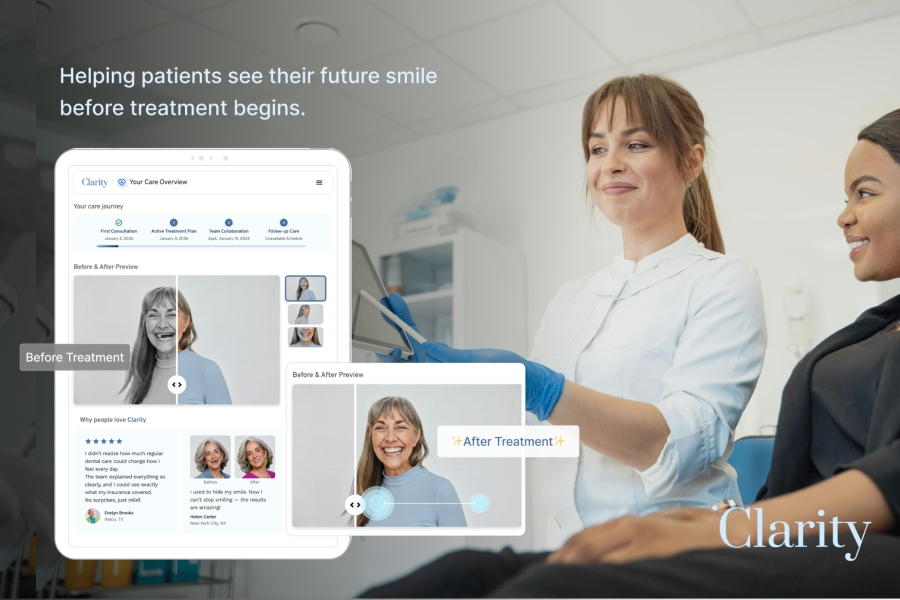
Photo Courtesy: Clarity
Why Collaboration Is Part of the Craft
That perspective also shapes the way Ming thinks about collaboration. Rather than seeing design as a solo act, Ming treats it as a way to help teams build shared understanding. Throughout his career, Ming has worked across product, engineering, operations, data, and business functions, often in fast-moving environments where the workflow itself is fragmented or still evolving. Ming’s strength is not only in interface design, but in helping teams clarify what problem they are really solving and what kind of experience will actually help users.
That is also why the recognition of Clarity matters in the right way. The project was not positioned as a solo statement, but as the result of a thoughtful team effort around a meaningful human problem. The iF certificate lists a broader design team including Zeya Chen, Yuanyuan Hu, Ming Li, Jinda Zhong, Hui Jing, Siqi Wu, Yutong Liu, and Yuting Mao.
“Good design usually comes from a team that is aligned around the user,” Ming says. “It’s not about one person trying to be the smartest in the room. It’s about understanding the problem clearly enough that the team can make good decisions together.”
The Space Ming LI Continues to Care About
In many ways, that mindset feels especially relevant now. As more products become shaped by AI, automation, and increasingly complex systems, users are not automatically getting better experiences. In some cases, technology becomes more powerful while the experience itself becomes more opaque. Tools can do more, but people may still struggle to understand what is happening, what they should trust, or what action to take next.
This is the gap Ming continues to care about most: the space between technical capability and human comprehension.
Whether designing for internal operators, technical users, or patients navigating healthcare decisions, Ming returns to the same essential principle: people should not have to work harder just to understand their situation. Design should reduce cognitive burden, not add to it. It should help people feel oriented, not overwhelmed.
A Philosophy Larger Than One Project
That is what makes Clarity such a fitting milestone in Ming’s journey.
The project’s name is simple, but it captures something much larger in Ming’s work. For Ming Li, clarity is not a visual style. It is not just cleaner screens or better layouts. It is a product value. It is a way of building trust. And in moments when people feel uncertain, it can become a very practical form of care.
As Ming continues designing across enterprise systems, AI-enabled workflows, and human-centered digital products, the direction remains remarkably consistent. Ming is not chasing complexity for its own sake. Ming is interested in what happens after complexity appears, how design can organize it, translate it, and make it feel livable for the people on the other side of the screen.
In a world that keeps becoming more complicated, that kind of work feels increasingly essential.
And for Ming Li, that may be the clearest purpose of all.