
By: Paul White
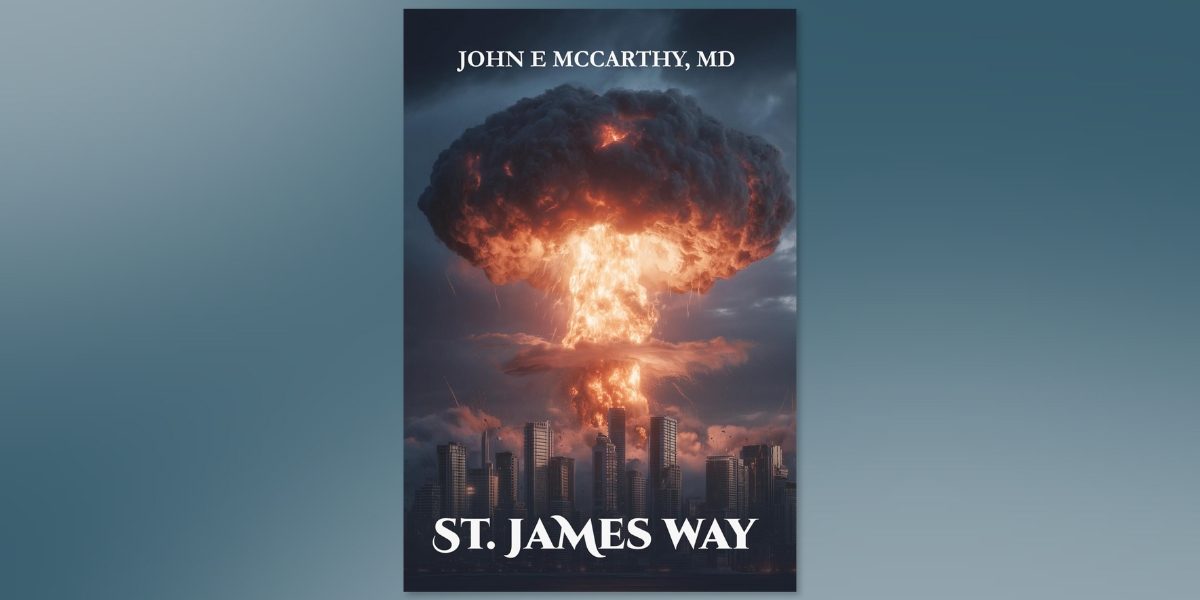
There are stories born out of imagination, and then there are stories born out of the deepest corners of the heart. St. James Way, the perceptive novel by Dr. John McCarthy, belongs to the latter. What began as a journey through the scenic landscapes of Spain became, for McCarthy, a pilgrimage into grief, faith, and the eternal question of what lies beyond death. His book, rich with spiritual symbolism and global settings, finds its roots not in mere fiction but in the author’s personal story, a brother’s love that time never erased. “When I began writing this book,” McCarthy shared, “I was in Spain with my wife. We had traveled through the regions along El Camino de Santiago, the St. James Way.” That path, ancient, revered, and lined with centuries of devotion, stirred something powerful within him. The memory of his brother, James Richard McCarthy, known lovingly as Ricky, resurfaced with expressive clarity. “It had been fifty years since he passed, but I never really got over missing him,” McCarthy said. His brother’s name, his faith, and the sacred road through Spain came together to form the very heart of the novel’s title.
The book opens with a memory: two brothers fishing in the Ozarks, surrounded by the hum of nature and the quiet peace of brotherhood. Rick, the elder, is vibrant, athletic, and full of potential. His death at nineteen from complications after neurosurgery becomes the shadow that follows George, the main character, through the rest of his life. “He was strong, humble, and kind,” McCarthy recalled. “We spent so much time camping together, just the two of us. Writing this book was my way of doing something for him, and maybe healing myself too.” That sentiment runs through every page of St. James Way, blending memory and meaning with the search for divine truth. But McCarthy’s novel doesn’t stay confined to one man’s grief. It expands both geographically and spiritually into a sweeping narrative that crosses Spain, Iran, Israel, Italy, and the United States. Each location becomes a window into humanity’s shared yearning for redemption and understanding. “The theme,” McCarthy explained, “wasn’t just about my brother or myself. It was about the spiritual life of human beings, the journey we all take. I wanted to show that there’s something beyond death, something greater that unites us.”
That conviction shapes some of the novel’s most striking scenes. Readers encounter figures such as Pope Francis, Stephen Hawking, and Iran’s Supreme Cleric, each visited by spiritual messengers who confront them with truths that transcend religious boundaries. In one scene, Pope Francis receives a vision of his grandmother, Rosa, who reminds him that “no one religion holds the whole truth. Earth is one vast garden, even if its flowers are many.” This message, McCarthy said, reflects his hope for a more compassionate world, one where faith becomes a bridge rather than a wall. “We humans,” he said, “have the power to destroy life or to grow into more loving and wise beings. With free will, we get to choose our way.” McCarthy’s inspiration, however, goes beyond theology. It stems from his lifelong fascination with what happens after we die, a curiosity shaped by both science and spirit. As a medical doctor and psychiatrist, he encountered stories from patients and families about near-death experiences that defied explanation. “There are millions of such cases,” he noted. “Doctors, nurses, and even children have spoken of memories or visions that can’t be explained by medicine alone. People who were declared clinically dead described watching their surgeries from above or meeting loved ones who had already passed.” For McCarthy, these accounts were more than anecdotal; they were possible evidence that consciousness might continue beyond the body.
That idea finds form in the novel’s recurring motif of the “spiritual realm,” a place where souls continue their growth and where the boundaries between life and death blur. In one moving chapter, George, now a psychiatrist himself, experiences what he calls “The Wake-Up,” a vision of serenity, love, and wisdom so vivid it alters his understanding of reality. McCarthy described such moments as glimpses of the divine, “something to be cherished forever.” They suggest that our earthly lives are merely one passage in an endless spiritual journey, echoing the belief that death, like birth, is a transition, not an ending. When asked whether writing the book helped him heal from his brother’s death, McCarthy paused. “A little, yes,” he said softly. “It made me feel better to do something for him.” His words, simple yet heavy with emotion, mirror the book’s emotional core: love as both wound and remedy. Through fiction, he transformed personal sorrow into universal hope, a bridge between the living and the departed. In St. James Way, science and spirituality coexist rather than collide. McCarthy’s background in medicine lends authenticity to his exploration of addiction, loss, and the fragile human psyche, while his spiritual insight opens doors to the unknown. His characters, from ordinary people to world leaders, wrestle with doubt and revelation alike. “I wanted the reader to feel,” he said, “that this might have purpose and meaning in our lives today.”
Ultimately, St. James Way is not just a story about one man’s faith but about humanity’s collective soul. It asks significant questions: Can we evolve beyond fear and division? Can we learn from loss and still love freely? Can we see one another not as believers or nonbelievers, but as fellow travelers on the same path? For McCarthy, the answer is perhaps yes. “Love and wisdom give us purpose to grow,” he writes in his introduction. And perhaps that is what his brother Rick represents, the enduring call to love beyond death, to seek light even in darkness. As the sun sets over the hills of Santiago de Compostela, the ancient pilgrims’ path still echoes with footsteps and prayers. And somewhere in that quiet, one can almost hear the whisper that inspired Dr. John McCarthy’s life and art: “It’s going to be okay, George.”