
By: Gabriela Despuig
Creators face rising expectations as demand for polished, high-volume content grows across regions. Renderforest built its platform to meet that pressure with a single environment that integrates writing, visual development, motion, and sound from first thought to final sequence. The idea centers on reducing friction and letting people work inside a single lane without juggling disconnected tools or waiting for complex workflows to settle. The company focused on giving users a direct path through each stage, supported by a technical stack built to maintain clarity and consistency.
Renderforest 1.0 anchors this system. It is a next-generation video model built for cinematic flow, quick generation, and accessible pricing across different user groups. Running on Renderforest’s optimized servers, the engine produces high-quality sequences that hold steady even when prompts stay brief. The company states that the engine “offers creators a base that feels steady and ready to build on.” It adds, “We focused on clarity, speed, and practical use while keeping pricing accessible for different creators.” These lines show how the model gives users a strong first draft instead of a rough cut that needs heavy repair.
The engine supports long-form continuity across minutes rather than seconds. This means characters, style rules, and transitions remain aligned from scene to scene. Marketing teams, solo creators, and production groups gain an environment where scripts, visuals, and motion stay consistent as projects scale. Storyboards move into clips, clips move into complete sequences, and brand elements remain uniform. Users who once had to rebuild content across multiple services now find a complete workflow in a single platform.
A Full Stack Built for Multi-Stage Creation
Renderforest maintains a stack of machine-driven models that perform different tasks without requiring people to export or import material. Text can become video. Text can move into animation. Text can guide visual development. Video can pass through editing, then move back into regeneration loops without breaking style. Each step speaks to the next, keeping tone steady across the sequence and giving users speed without sacrificing control.
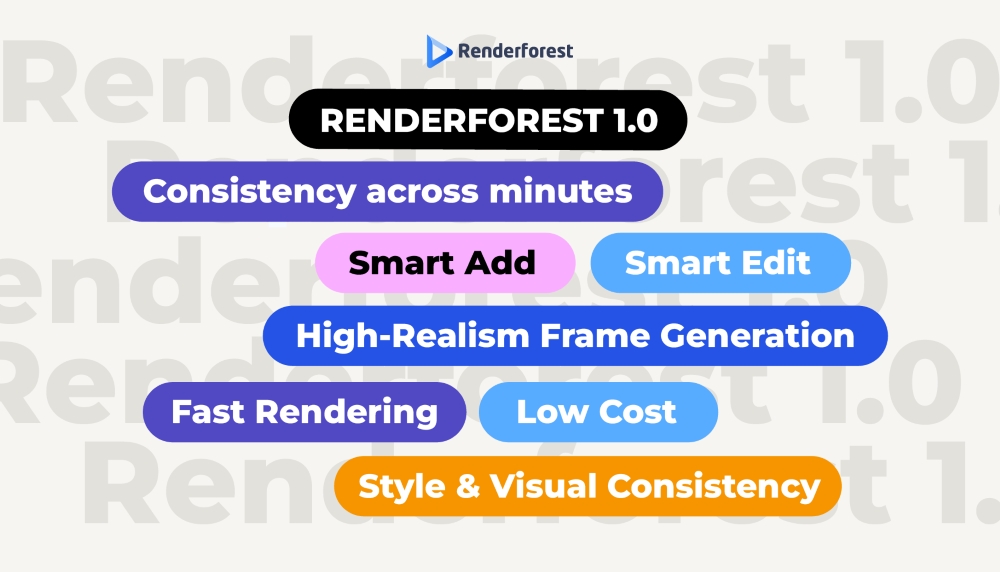
Photo Courtesy: Renderforest
The platform supports an AI-native video editor that lets you manage longer stories without forcing you to cut clips into fragments. Users can extend, modify, and rearrange AI-generated scenes within a single editor while using real tools such as split, replace, regenerate, and pacing adjustment. This hybrid workflow joins AI generation with manual control, giving creators freedom to refine scenes without leaving the platform. The editor operates as a continuous space in which every update propagates through the sequence without drift.
Smart Add is one of Renderforest’s significant advances. A user can add a sentence to the script, and the system automatically expands the video. Missing scenes appear. Timing stays stable. Motion aligns with the new line. Competing tools force creators to rebuild large sections, but Smart Add preserves continuity while still allowing them to reshape the story. This helps teams that revise material during tight reviews.
Smart Edit brings another tier of precision. When users adjust a line of text, the system regenerates only the affected scenes, leaving the rest of the sequence intact. Characters remain steady. Motion arcs follow the established style. The clip’s tone remains consistent across regenerated and untouched sections. Smart Edit reduces manual repair cycles and gives creators greater control than earlier tools did.
A Unified Experience for Businesses and Solo Creators
Photo Courtesy: Renderforest
Renderforest built its platform to simplify creation for people working at any scale. A marketer can begin with a short script, move into structured boards, and then push those boards into motion through Renderforest 1.0. Small edits do not break the full sequence. Instead, updates pass through the project without forcing users to rebuild their work. This helps teams refine voice and pacing without discarding progress.
The editor’s integrated structure supports both long-form storytelling and shorter commercial pieces. Writers, designers, and coordinators work inside one shared environment. Scripts link to visuals. Voices link to timing. Edits apply across scenes instead of isolated parts. The platform compresses production cycles and gives users a single starting point that carries through to final delivery.
Renderforest 1.0 stands out because it shapes cinematic scenes even when prompts remain short. The engine maps facial detail, motion arcs, and background continuity with steady clarity. Movement stays smooth during complex actions, and the sequence holds its style without drifting. This level of consistency helps teams produce material ready for wide distribution.
The combined structure of Renderforest’s stack, AI-native editor, Smart Add, and Smart Edit gives creators a path where the message guides the process rather than technical barriers. Each model works with the next, and each update holds steady across the sequence. This keeps projects focused on content rather than constant repair.
Renderforest 1.0 marks a new phase for creation tools. Its speed, clarity, long-form stability, and accessible economics support users who need production that feels coherent from the first draft to the final export. As content demands rise, Renderforest offers a platform where large and small teams can produce thoughtful, consistent work in a single connected space.