
By: Marisa Kentwell
A Forgotten Manuscript Finds New Life
When Anna Olswanger opened the cardboard box that arrived from the daughter of Rabbi Rafael Grossman, she did not expect her past to look back at her. The box contained papers the rabbi and Anna had written together decades earlier, including the unfinished manuscript of a Holocaust novel they had once poured their energy into. Inside those pages was a scene that Anna had not thought about for years. It was the story the rabbi once told her about a young boy in Moscow who had never stepped outside the room of his birth.
That moment from 1965, shared casually in a writing session in the early eighties, had seemed meaningful at the time, but life intervened. The rabbi’s responsibilities grew. The novel was set aside. Then the years moved on. When Rabbi Grossman passed away in 2018, Anna believed that chapter of her creative life had also come to an end. But seeing those pages again changed everything.
Anna reread the scene about the boy and began searching for the notes she had written back then. As she compared her notes with the manuscript, she realized that she could no longer untangle which pieces belonged to lived memory and which belonged to the story they had been building. Yet something more important remained absolutely clear. The rabbi’s message had always been that every person has the ability to make the world better for someone else. That message refused to be forgotten.
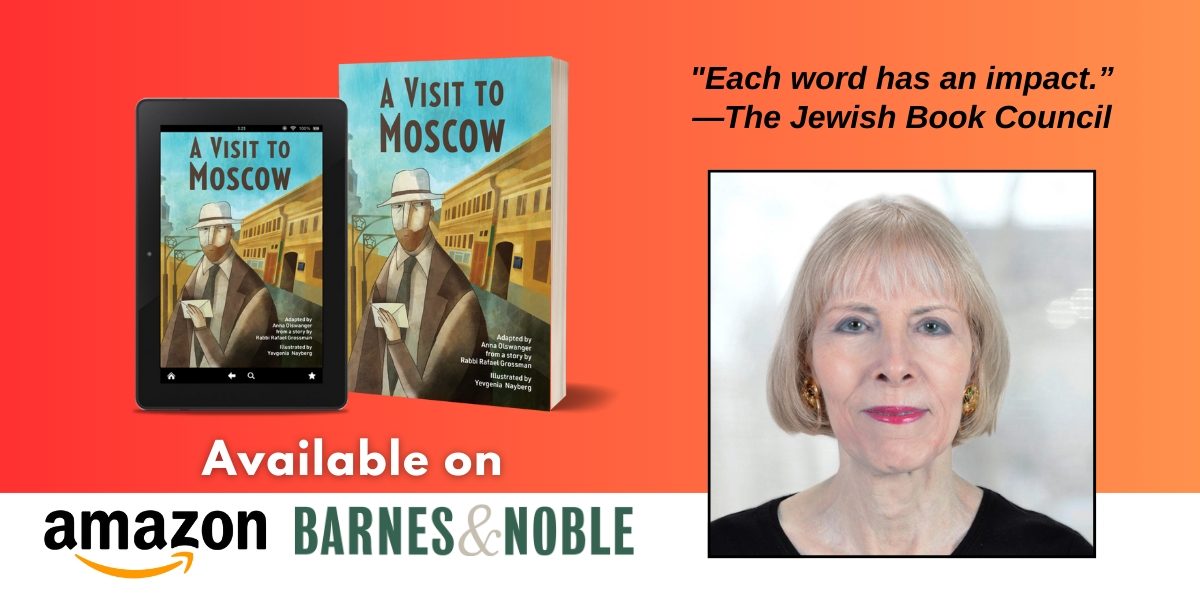
Anna felt the story still needed to be told. Since she could no longer separate fact from invention, nonfiction was no longer possible. Her editor suggested a new approach. Treat it as historical fiction while honoring its roots. Anna embraced that solution, and the book took shape as A Visit to Moscow, adapted from a story told to her by Rabbi Grossman.
Balancing Emotion and History
Although the book is grounded in the political climate of the Soviet Union during the 1960s, Anna wanted the story to reach beyond a single era. She created an additional perspective that frames the narrative. That perspective belongs to the adult Zev, the once hidden boy whose life opens the novel and ends it.
Anna imagined Zev in the seconds after his death, hovering above the Lebanese landscape where he had stepped on a land mine. He looks down at the earth with wonder, thinking he must be gazing at heaven. As his memories begin to fade, he hears a voice and moves toward it. The voice belongs to a man who is preparing to tell his family a story. That man is the fictionalized Rabbi Grossman.
The circular structure gives the book an otherworldly tone that softens the political tension without diminishing its seriousness. For Anna, the spiritual imagination that carried the young Zev through confinement becomes a metaphor for something universal. Zev lived most of his childhood inside a single room with only the window to guide his curiosity, yet he maintained a sense of astonishment about the world. Later, when he and his family traveled to Israel, the wide open spaces became a fulfillment of the inner landscape he had already created.
Anna closes the story with the line about Zev, “He remembers being alive was like being in heaven.” For her, that sentence captures the idea that the world, even with its anguish, can also be a place of deep meaning and beauty.
The Power of Visual Storytelling
The book would not be what it is without the artwork of illustrator Yevgenia Nayberg. Anna describes Yevgenia as someone who understood the emotional architecture of the story from the start because she herself grew up in the Soviet Union. Yevgenia brought to the book a kind of light that feels both luminous and hazy, a look that mirrors memory itself.
She created moments that move without words. In one place, a winter scene of Moscow appears even though the main events of the novel take place in summer. Snow fills the frame. The stillness shows time slipping by without any need for dialogue.
Yevgenia once told Anna that her biggest challenge was keeping the composition alive. The story involves small rooms and only a few characters at a time, with action that is mostly internal. Yet Yevgenia managed to change the tempo through variations in space, expression, and color. Her images create movement that mirrors the emotional shifts in the text.
Why Anna Keeps Returning to Stories of Hidden Lives
Readers familiar with Anna’s earlier books may notice a pattern in her work. She has a quiet fascination with what remains unseen. In Shlemiel Crooks, the hidden force is a horse whose voice only the reader can hear. In Greenhorn, a small box holds a private truth that shapes an entire life. In A Visit to Moscow, the hidden presence is Zev himself, the child whose imagination has kept him afloat.
Anna remembers asking Rabbi Grossman what the real Zev was like. The rabbi told her that Zev never played, yet was always imagining. He wanted to know what synagogues in America looked like and how Torahs felt when held and what children did in other parts of the world. Despite having been confined to one room his whole life, he carried no bitterness. The rabbi believed this was due to the extraordinary love of his parents. Their choices were complicated, but they protected their child from the crushing influence of the Soviet government.
Conversations Anna Hopes the Book Will Inspire
Anna hopes the book encourages readers to think about the courage people have shown through history to preserve their spiritual identity. She hopes those readers will also reflect on their own values and what they hold precious enough to defend.
She also hopes they spend a moment with the idea that being alive can resemble heaven in unexpected ways. She invites readers to consider the epigraph of the book which teaches that saving one life is akin to saving the entire world. For Anna, it is a reminder that acts of compassion often reach farther than we imagine.
Get your copy of A Visit to Moscow today on Amazon and at Barnes & Noble.