

Today, where infrastructure often overlooks difference, Devashree Shah designs for the margins and, in doing so, transforms the mainstream. Her work reimagines architecture as a universal invitation rather than a selective privilege.
Shah is an architect and inclusive design strategist whose work bridges design, policy, and social research. Her professional mission is rooted in the belief that architecture is a civic instrument capable of fostering equity, adaptability, and shared aspiration.
Currently serving as the Manager of Inclusive Design in Public Transit at the Institute for Human Centered Design (IHCD) in Boston, she leads projects that merge architectural thinking with social equity to create environments responsive to the diversity of human experience.
Where Adaptability Began: Mumbai’s Living Classroom
Growing up in Mumbai, Shah was shaped by a city that balances density and scarcity through constant adaptation and collective ingenuity.
These early experiences nurtured her fascination with how space can respond to diverse human needs. She earned her Bachelor of Architecture from NMIMS University, Balwant Sheth School of Architecture, and later her Master of Architecture from the Harvard Graduate School of Design, where she also studied at the Harvard Business School and MIT School of Architecture.
Her academic path deepened her belief that design must engage policy and human behavior as much as form and structure.
Leading Change: Inclusive Design at IHCD
Since joining the Institute for Human Centered Design in 2023, Shah has led inclusive design initiatives across public infrastructure, cultural, and institutional projects, advancing accessibility that fosters dignity, participation, and independence.
As Manager of Inclusive Design in Public Transit, she plays a crucial role in enhancing accessibility throughout the Massachusetts Bay Transportation Authority (MBTA) network.
As Lead Accessibility Consultant for the $2.1 billion Green Line Transformation Program, she guides universal design strategies, reviews architectural plans, and oversees user testing across multiple branches.
She also supports the MBTA System-Wide Accessibility Department, where she is working on creating an internal accessibility checklist consolidating ADA Standards, PROWAG, FTA Directives, 521 CMR, and MBTA Guidelines, which will be used as a benchmark for consistent compliance across projects.
Designing Infrastructure That Feels Human
Her expertise extends beyond the Green Line. On the MBTA North Station Draw Bridge Replacement Project, she evaluated architectural plans for accessibility, safety, and compliance, providing technical recommendations to standardize platform heights and ensure safe egress.
She also contributed to the Newton Corner Long-Term Planning Study with Vanasse Hangen Brustlin, Inc. (VHB), where she conducted accessibility surveys of public streets and spaces and developed universal design strategies that support barrier-free movement. These projects demonstrate her commitment to reconciling large-scale infrastructure with the nuances of individual human experience.
Cultural Impact: Architecture That Includes Everyone
Alongside her infrastructure work, Shah leads accessibility consulting for cultural, institutional, and technology organizations across the United States. Her collaborations with architectural firms span projects for museums, research institutes, and higher education campuses, ensuring that these spaces are inclusive and inspiring.
In these roles, Shah provides comprehensive design reviews and accessibility evaluations, spanning from concept to construction, with a focus on spatial circulation, wayfinding, signage, and inclusive amenities.
Her approach is guided by the principle that accessibility is not a checklist but a language of care that shapes how people feel welcome and included in public life.
She also led the creation of a global library on inclusive design and accessibility for a leading technology and infrastructure organization, consolidating standards and design policies from 18 countries.
In partnership with global technology firms, she has contributed to the development of architectural guidelines for inclusive workplaces, reinforcing her leadership in global accessibility strategy.
Research as Resistance: Building Dialogue Through Academia
Shah’s contributions extend into academic research and publication. As a Research Associate at the Harvard Graduate School of Design and Associate Researcher at the Laxmi Mittal and Family South Asia Institute at Harvard University, she co-curated the project “The State of Architecture in South Asia.”

Photo Courtesy: Devashree Shah
(Image: The exhibition traveled to Chennai in August 2024)
Developed under the State of Architecture in South Asia initiative, the research explores how architecture retains its public agency amid social and ecological transitions. The traveling exhibition has toured cities including Delhi, Bangalore, Kochi, and Kozhikode, creating one of the first regional archives of emergent architectural practice.
Shah is also the co-author of the forthcoming book Architectures of Transition: Emergent Practices in South Asia (Altrim Publishers, 2023), which documents over forty innovative practices redefining architecture’s civic and social agency across the region.
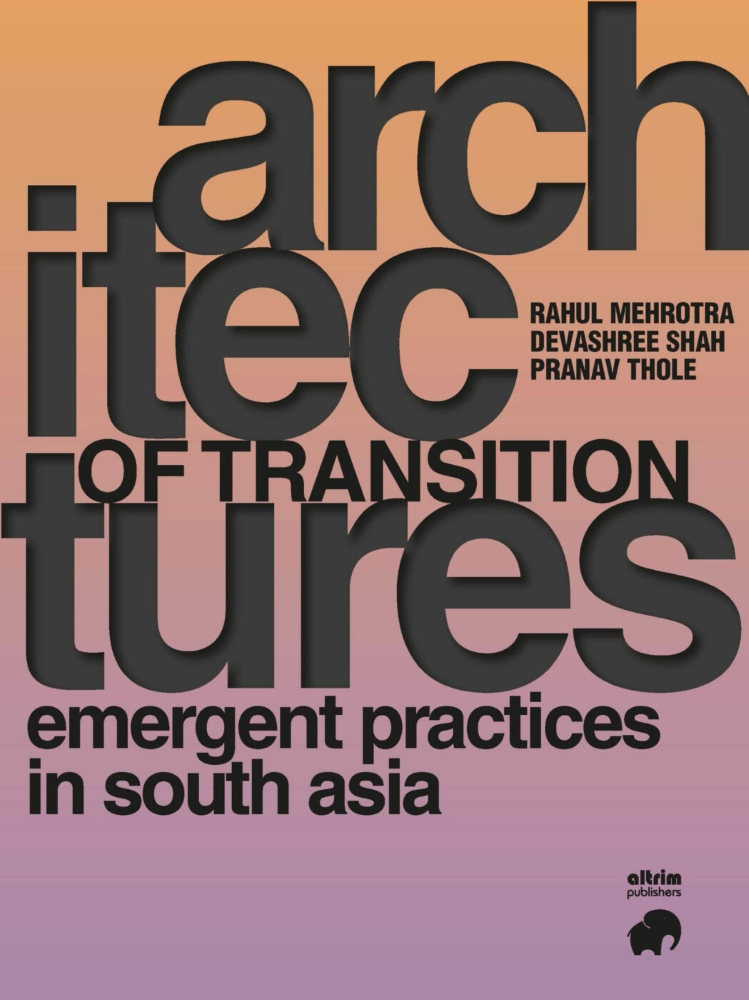
Photo Courtesy: Rahul Mehrotra / Devashree Shah / Pranav Thole
(Image: Architectures of Transition: Emergent Practices in South Asia)
Amplifying Inclusion: Conversations Beyond the Studio
Beyond her professional work, Shah is an active contributor to public and academic discourse. She has presented at Boston Design Week 2024, One Architecture and Urbanism in New York, and Hart Howerton in New York. She was an invited panelist for the IIDA Equity Council in New York, joining a discussion titled “Inclusion is a Superpower.”
She also guest lectures at the Boston Architectural College and Wentworth Institute of Technology, where she teaches topics in universal design, architectural programming, and wayfinding.
Additionally, she has presented peer-reviewed research at the eCAADe Conference 2023, contributing to international dialogues on digital fabrication and material innovation.
Recognition Through Contribution
Shah’s projects and research have appeared in leading publications such as the Journal of Architectural Education and in design exhibitions at Harvard.
Her co-authored work has advanced conversations on material innovation, housing resilience, and climate-responsive design. Each project underscores her ability to unite technical precision with civic empathy.
A Vision for the Future: Accessibility as Opportunity
Looking ahead, Devashree Shah aims to translate inclusive design frameworks into the context of the Global South, integrating accessibility with housing, policy, and public infrastructure. Her vision is to nurture design cultures that regard accessibility not as an obligation but as an innovation.
For Shah, architecture remains a profoundly human act, an intersection of empathy and intellect. Whether designing transit systems or curating exhibitions, she continues to build environments that resonate, adapt, and sustain collective imagination.
Her global blueprint for accessibility is not only about removing barriers but about designing a world that welcomes everyone.
Author
Madeline Bilis, Boston-based freelance journalist covering design/architecture. As an award-winning lifestyle journalist, she covers real estate, travel, design, architecture, hotels, cities, dining, the outdoors, and more.