
Often serving as a complete record of an artist’s achievements, major retrospectives show the evolution of styles, topics, and methods spanning decades. These carefully chosen events provide a prism through which viewers may perceive a growing vision, sometimes long after the artist passes away. Exhibits across continents let viewers follow a creative arc across media or distance. Against this background, the international retrospectives honoring Alexander provide a panoramic glimpse of a half-century career.
Retrospective exhibitions have been common throughout Alexander’s work, highlighting his ongoing interaction with experimental techniques. Viewers who follow these retrospectives will see how mediums like holography, painting, and sculpture combine to create a larger story. A significant turning point is the forthcoming 2026 retrospective scheduled for the first quarter (date yet to be decided) at the VEFA Gallery in Torrance, California. Since Alexander died in 2023, it will be the first significant postmortem study of his American career. Those interested in both past and present events may consult the primary information hub on Alexander’s official website.
Viewers of a retrospective exhibition may chronologically tour an artist’s life work. It emphasizes how styles could change, develop, or merge throughout time to let visitors and historians see changes in medium and method. Retrospectives help place particular artworks in a larger perspective, showing how an artist’s vision interacts with historical or technical developments.
Early retrospectives by Alexander span the late 1980s and early 1990s, including exhibits at the Museo de Arte Contemporanea in São Paulo (1989) and the Modern Museum of Art in Santa Ana (1990). Solo shows at the Seoul Arts Centre Museum in 1991 and 1993 came next. Every exhibition showed a turn from conventional painting to holography and four-dimensional (4D) sculpture, guiding his growth path.
In the late 1980s, Alexander’s major 60-work exhibit in Brazil and Chile introduced a public unfamiliar with holographic media to several projects involving paintings, sculptures, and holograms. By offering technologically advanced creations in a context where classical and modern art had already solid footing, these retrospectives drew diverse audiences who encountered complex intersections of science and aesthetic form.
In 1992, multiple venues throughout London participated in a city-wide celebration of Alexander’s art. This format encouraged viewers to traverse different parts of the city to see separate elements of his oeuvre. The publication of a monograph by Edward Lucie-Smith accompanied the showcases, drawing attention to the conceptual depth in Alexander’s sculptures and holographic works. The combined effect affirmed his standing as a creative figure operating at the edge of conventional categorization.
Edward Lucie-Smith also curated a large-scale retrospective at the National Seoul Art Center Museum, assembling 150 pieces. Among these, “Kumdori”—created for the World’s Fair in Taejon—and the holographic “Christ Leaving The Cross” attracted visitor interest for their blend of religious imagery and cutting-edge technology. These additions offered a window into Alexander’s combined emphasis on thematic exploration and innovative methods.
The forthcoming 2026 exhibition at the VEFA Gallery will be the first major retrospective of Alexander’s work in the United States since his death. Continuing the international tradition of his showcases, it will gather pieces that reflect early, mid-career, and late explorations. Viewers seeking details on scheduling can visit the gallery’s website, which confirms the event is slated for the first quarter of 2026 (date yet to be finalized).
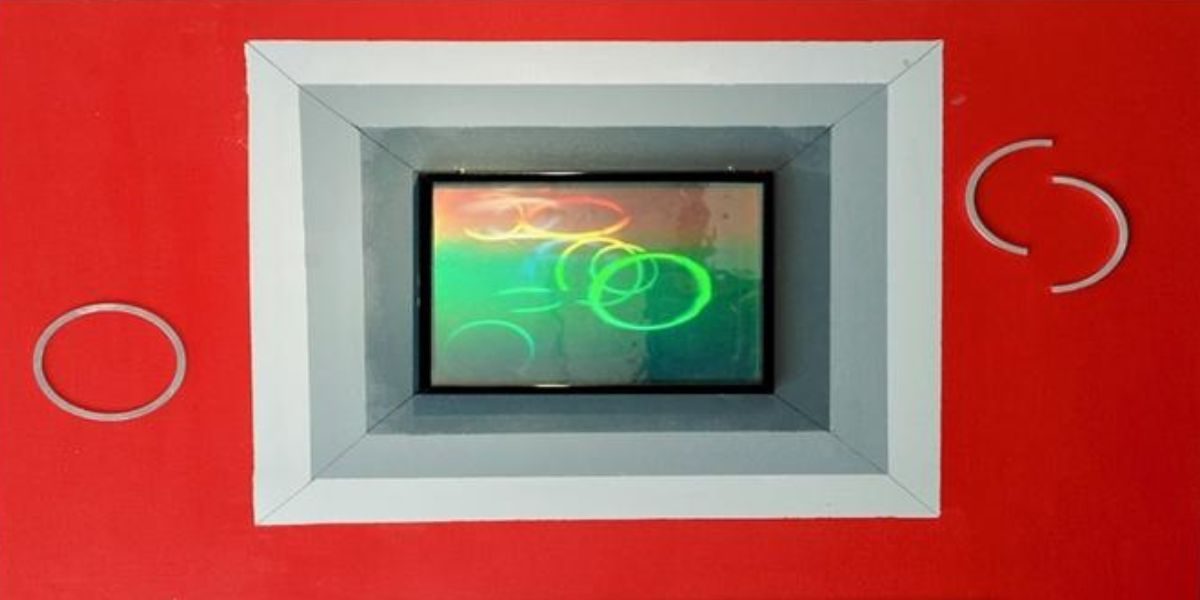
The show may include 4D sculptures, his noted holographic films, and later “Post-Contemporary Art” pieces that span complex aesthetic and technical dimensions. Curators are expected to offer lectures and guided tours, although final programming remains in development. With a focus on legacy, this retrospective will unify decades of production under one roof, allowing new audiences to consider the broader sweep of Alexander’s creativity.
Critics such as Edward Lucie-Smith and Peter Frank have observed that Alexander’s work merges scientific inquiry with artistic vision. While these observers have noted the occasional conceptual difficulty, they often point to his capacity for blending multiple media without committing exclusively to one approach. Critics sometimes label these works controversial for their blend of abstract religious motifs and technical ambition, yet they cite the same aspects as evidence of Alexander’s boundary-challenging inquiries.
Visitors stepping into Alexander’s exhibitions often encounter unfamiliar territory, particularly when confronted by large-scale holography that projects up to 28 feet in front of its plane. Some react with surprise, while others experience hesitation. Over time, many retrospectives have served an educational function, clarifying that the breadth of his career requires some navigational effort. Nevertheless, the curiosity these installations spark remains consistent in audience feedback.
Discussions around mixed-media and digital installations frequently refer to Alexander’s early experimentation with 4D concepts and holography. His work may have paved the way for artists utilizing augmented or virtual reality, particularly those integrating engineering or scientific knowledge. By merging conceptual art with emerging technologies, he signaled that the future of creative practice did not need to be confined to traditional painting or sculpture.
Beyond museum walls, Alexander’s output has stirred philosophical debate about how perception, space, and reality intersect. The suggestion of a fourth dimension in his sculptures raises questions that resonate in scientific, religious, and cultural forums. Contemporary thinkers sometimes interpret these themes as a vehicle for exploring existential considerations, bridging the gap between imaginative artistry and concrete technical design.
Over five decades, Alexander bridged painting, sculpture, holography, and conceptual design in ways that continued to invite scrutiny from critics, technologists, and the general public. The cyclical nature of his retrospectives, set to continue at VEFA Gallery in 2026, reinforces his role in threading new media into established genres. His work resonates with those who value experimental approaches grounded in physical craftsmanship and visual research.
Individuals can review the official archives and updates at Alexander’s official website. Publications such as Edward Lucie-Smith’s monograph and Peter Frank’s writings offer additional context. Readers seeking broader discussions about holographic art might consult resources like the World Art Survey or Global Culture Digest, which address emerging trends in mixed-media installations. Ultimately, the upcoming retrospective at VEFA Gallery underscores how exhibitions worldwide have preserved and interpreted Alexander’s distinctive path, adding another layer to the enduring account of his creative achievements.