Beyond the Abuse, Ester Kraus Examines the Damage Done by Silence and Institutional Failure

Childhood abuse can leave lasting injuries, but the response to a disclosure can shape what happens next. When families or institutions protect their standing instead of a child, the harm extends beyond the original act: trust erodes, survivors may be left isolated, and accountability becomes harder to secure.

Ester Kraus addresses these linked failures in Betrayal Trust and Hope for Victims, Survivors and Warriors, a 2026 book of poetry, personal reflection and narrative passages devoted to abuse, trauma and survivor advocacy. The result is both a personal account and a wider appeal for communities to examine how they respond when vulnerable people speak.

Harm After the Harm

Across 20 chapters, Ester Kraus considers the emotional and psychological effects that can follow abuse, including grief, guilt, triggers, post-traumatic stress disorder and obsessive-compulsive disorder. These effects can persist in relationships and everyday life long after others assume time has healed the past.

The manuscript also challenges common assumptions about disclosure. Fear of being disbelieved can keep victims silent, and Ester Kraus specifically recognizes the barriers boys and men may face when speaking about abuse. The demand to prove one’s pain adds another obstacle to telling the truth.

When Institutions Choose Silence

A central thread concerns the conflict between institutional reputation and the responsibility to protect children. She asks readers to consider not only who commits abuse, but who benefits when the people harmed are discouraged from speaking. She writes about abuse within a religious setting and the isolation that can follow when concerns are minimized or suppressed. Her criticism is directed at systems that confuse loyalty with silence and authority with moral credibility.

Ester does not treat faith itself as the enemy. She questions how religious belonging is used to discourage scrutiny or prioritize institutional unity over vulnerable people. Her perspective is personal. She recounts the abuse experienced by her children and the pain of facing its consequences as a parent.

From Isolation to Advocacy

Ester Kraus describes finding a wider community of support in Silentlambs, an organization associated with survivors of abuse in religious environments. She volunteered with the organization, served as an international volunteer for the Mint Green Ribbon for the Awareness of Abuse initiative, and participated in an abuse awareness panel associated with SNAP, the Survivors Network of those Abused by Priests.

These experiences inform the book’s emphasis on collective recognition. Isolated stories can be dismissed. When survivors are heard together, patterns become harder to ignore. Shared testimony cannot undo trauma, but it can challenge shame and direct attention toward broader responsibility.

Hope Without Simplifying the Pain

The title’s movement from betrayal to trust and hope is not a promise of easy recovery. Ester Kraus recognizes that healing may involve grief, difficult memories, and professional support. Her closing message urges survivors to seek help, connect with advocacy organizations, and speak when they are able. Its warrior is not someone who never suffers, but someone whose identity need not be confined to what was done to them.

Takeaway

At its core, Betrayal Trust and Hope for Victims Survivors and Warriors asks communities to measure their principles by their actions. Listening to survivors is a beginning, not a substitute for protection or accountability.

Explore Ester Kraus’ book and join the essential work of listening, supporting survivors, and insisting that children’s safety must always come first.
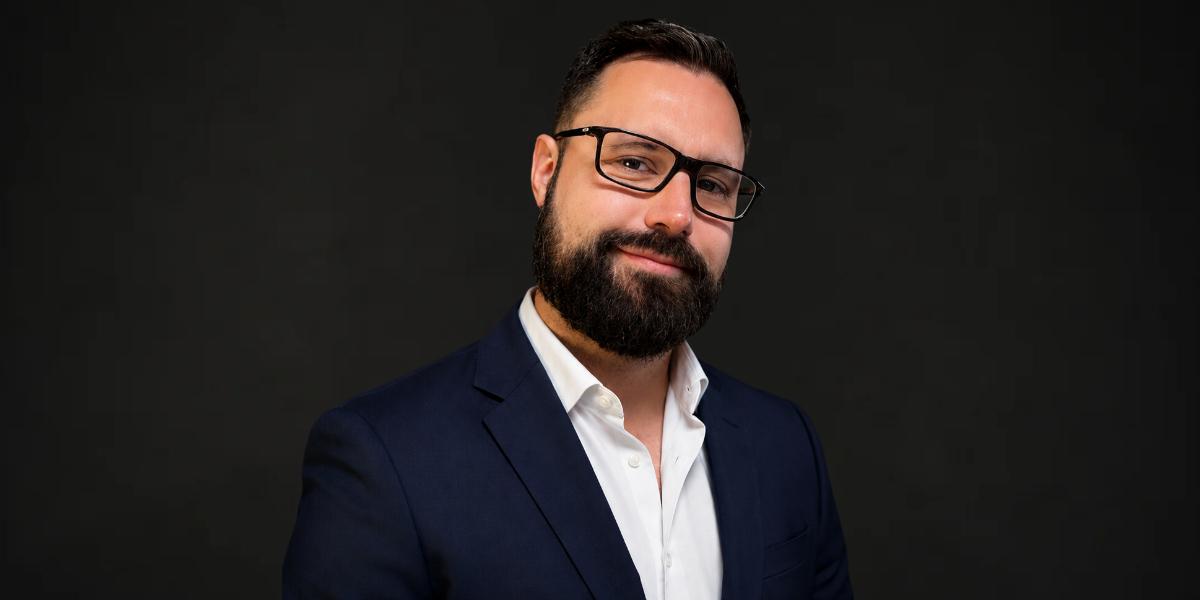
Chris Calitz: How Healthcare Practices Using AI Earn Patient Trust

By: Natalie Johnson

Texas Senate Bill 1188, effective September 1, 2025, requires a healthcare practitioner who uses artificial intelligence (AI) for diagnostic purposes to disclose that use to patients. Walk into a doctor’s office in New York today, and an automated tool may be listening to the conversation or reading medical images. New York has no equivalent disclosure rule, so whether a patient hears about that tool depends on the state where the visit takes place. That gap between state lines is a growing challenge for healthcare leaders who want to move quickly with new technology while keeping patient trust at the center of care.

Hospitals and local clinics are adopting automated tools to help doctors stay on top of their day. Automated charting tools listen to patient visits and turn spoken conversations into draft clinical notes, while other programs review scans and flag findings before a radiologist confirms them. Chris Calitz points out that these tools are already in use in major health systems, and he counts that as good news. As he explains, “AI tools are widely used in healthcare settings across the United States, including the state of New York.” What is missing is disclosure.

Two States, Two Different Playbooks

The market assumes a process built for one location will satisfy the rules in another, but without a single national framework, individual states are building their own. Texas has taken a direct approach by placing clear responsibilities on the physician practice using these systems. New York has taken a different path, with early legislation focused on areas such as insurance decisions and the companies developing large AI models. None of it yet requires a clinician to tell a patient that AI helped with their care.

The result is a patchwork that gives healthcare organizations different requirements depending on where they operate. In the absence of a federal standard, Calitz says, “You see this kind of jigsaw puzzle of different laws across the country.” For healthcare executives, adoption is settled: these tools are already in clinical workflows. The open question is whether every tool in use has a clear owner, a defined purpose, and a process for checking how it performs.

Transparency in Clinical Workflows

When no one mentions the technology, the patient loses an important opportunity to understand how their care is being supported. Informed conversations depend on patients knowing enough to ask reasonable questions about the tools involved in their care. A simple explanation can make the technology part of the conversation rather than something patients discover later.

That matters because trust in healthcare depends on more than the final diagnosis. Patients need to understand how decisions are made and who is responsible for them. If someone discovers after the fact that an automated system helped produce a clinical note or support a diagnosis, the immediate question may be why that information was never mentioned. Calitz describes the underlying issue as “information asymmetry,” where one side knows that AI is involved and the other does not. The solution does not require a long technical explanation. It can be as simple as telling the patient what the tool does, what the physician reviews, and where human judgment remains responsible for the final decision.

Testing AI Tools is Critical

The way states assign responsibility also changes how medical groups evaluate new software. When the physician practice remains responsible for the technology it puts into a clinical workflow, the practice has a direct reason to understand how that system performs before relying on it. That responsibility should extend beyond reading a vendor’s sales material. A clinical organization can establish its own process for checking accuracy, reviewing outputs, documenting problems, and deciding when to change or remove a tool.

The goal is to scale up AI faster, under controls the organization can show. Calitz frames the operational reality: “The obligation to test the accuracy and reliability of the AI tools used in healthcare settings is owned by the physician practices, not the vendors.” That ownership gives clinical leaders a practical way to manage new technology. Instead of treating governance as a separate exercise that happens after deployment, the organization can build Audit-Based Controls into the workflow from the start: oversight that operators, clinical boards, and regulators can see and trust in real time.

Setting Clinical Standards

Medical leaders do not need to wait for a state law before they start being open with patients. A practice can train its staff to answer basic questions about how automated tools support clinical work, who reviews the output, and what happens when the system gets something wrong. The strongest approach is to explain the technology before the patient has to ask. A short explanation removes uncertainty and allows the physician to reinforce the role of human judgment. It also gives the organization a consistent answer when patients, staff, or board members ask how a new tool is being used.

What moves a practice to act is the peer organization down the road that can already answer these questions. Until lawmakers establish a clear national standard, healthcare executives can set a practical internal standard of their own and test it next quarter: give every clinical AI tool an owner, a defined use, a process for checking its output, and a plain explanation for patients. The best technology policy is one the patient can understand.

Follow Chris Calitz on LinkedIn or visit Amplify Impact Consulting at www.amplify-impact.ai.

Disclaimer: This article is for general informational purposes only and does not constitute legal advice. Laws and regulations change and vary by jurisdiction, and the application of any law depends on the specific facts involved. Readers should consult a qualified attorney for advice regarding their own situation.

NYC Marathon 2026 Route Marks 50 Years Across Five Boroughs With First Bronx Change Since 2011

The New York City Marathon runs Sunday, November 1, 2026, marking 50 years since the race first crossed all five boroughs. This year’s course also brings the first route change since 2011, a Bronx reroute between miles 20 and 21 that keeps a Mott Haven block open to residents on race day.

Key Takeaways

  • About 60,000 runners are expected, following 59,226 finishers in 2025.
  • The Bronx reroute cuts the turns in that stretch from seven to five, and the course still measures 26.2 miles.
  • General waves start at 9:10, 9:45, 10:20 and 10:55 a.m., with Wave 5 at 11:30 a.m.
  • The Willis Avenue and Madison Avenue bridges close from 7:30 a.m. to 6:30 p.m. on race day.
  • New York Road Runners has set a goal of more than $100 million for over 670 Official Charity Partners.
  • The 2024 race generated $692 million in incremental economic impact for New York City.

Fifty Years Since The Marathon Left Central Park

The New York City Marathon began in 1970 as just over four loops of Central Park, with 55 finishers. On October 24, 1976, organizers sent the race through Staten Island, Brooklyn, Queens, the Bronx and Manhattan to mark the U.S. Bicentennial. That decision turned a club race into a neighborhood event, putting runners on residential blocks and commercial strips that had never hosted a sporting crowd.

New York Road Runners, the nonprofit that organizes the race, is treating 2026 as an anniversary year. Bill Rodgers, the 1976 men’s champion, joins race-week festivities alongside Danielle Mika Nagel, daughter of 1976 women’s champion Miki Gorman. The 2026 finisher medal also honors 50 years of medals, which were first awarded at that 1976 race.

Bronx Reroute Gives Mott Haven Residents Their Block Back

The 2026 TCS New York City Marathon keeps the familiar entry into the Bronx. Runners cross the Willis Avenue Bridge, turn left onto East 135th Street and right onto Alexander Avenue. From there, the course changes. Instead of turning at East 138th Street, runners continue to East 141st Street, turn left onto Third Avenue, then right onto East 138th Street toward the Madison Avenue Bridge.

The old route looped around a block on East 140th Street that holds a supermarket and a 24-hour laundromat, cutting residents off from both for much of the day. Ted Metellus, the Bronx-born race director for New York Road Runners, has said keeping food retailers within reach drove the change. The new path was one of two options presented to the City and the NYPD, which approved it.

The adjustment is small on a map, but it reflects how much Mott Haven has changed into a more residential neighborhood since the old loop was drawn. For runners, it removes two turns at mile 20, one of the hardest points in any marathon.

Race Day Start Times Stretch Across Three And A Half Hours

The New York City Marathon starts at Fort Wadsworth on Staten Island. The men’s professional wheelchair division leaves at 8:00 a.m., followed by the women’s wheelchair division at 8:02 a.m. and handcycles and select athletes with disabilities at 8:22 a.m. The professional women start at 8:35 a.m., and the professional men at 9:05 a.m.

General runners go out in five waves, at 9:10, 9:45, 10:20, 10:55 and 11:30 a.m. Spectators should also note that daylight saving time ends at 2 a.m. that morning, so clocks fall back an hour before the first start.

Bridge Closures And Transit Changes Shape Marathon Sunday

Closures begin the night before. The upper level of the Verrazzano-Narrows Bridge closes Saturday at 11 p.m., and both levels close Sunday morning. The Pulaski Bridge stays closed until 6:30 p.m., the Queensboro Bridge loses its eastbound lanes during race hours, and the FDR Drive sees phased exit closures through the day.

In Brooklyn, Fourth Avenue and Bedford Avenue close from 7 a.m. to 4 p.m. In Manhattan, First Avenue and Fifth Avenue are closed to vehicles for most of Sunday. Buses cannot cross Fifth Avenue during the race, and the Central Park transverse roads at 65th, 79th and 96th Streets stay closed to buses all day. The MTA will run extra trains near the 72 St, 66 St and 59 St-Columbus Circle stations to handle finish-line crowds. Viewers at home can watch on ABC7 and ESPN2, with coverage starting at 7 a.m.

Race Week Events Fill Grand Central And The Javits Center

NYC Marathon 2026 Route Marks 50 Years Across Five Boroughs With First Bronx Change Since 2011

Photo Credit: Unsplash.com

New York Road Runners opened “50 Years Through the Five Boroughs,” a free pop-up in Vanderbilt Hall at Grand Central Terminal, on Tuesday, October 27. It runs through Friday, October 30, from 10 a.m. to 7 p.m. on opening day and 8 a.m. to 7 p.m. on the remaining days.

The marathon Expo at the Jacob K. Javits Convention Center runs Thursday and Friday from 10 a.m. to 8 p.m., and Saturday, October 31, from 9 a.m. to 5 p.m. Bib pickup closes 30 minutes before the Expo each day. Saturday evening also brings the Village Halloween Parade on Sixth Avenue the night before the race, stacking two of the city’s large public events into one weekend.

A $692 Million Event Chasing A $100 Million Charity Goal

The New York City Marathon is also a significant economic event. A study commissioned by New York Road Runners found the 2024 race generated $692 million in incremental economic impact, up 139% from 2019. Across all of its races from April 2024 to March 2025, the organization contributed $934 million in local spending.

Charity fundraising has grown alongside that. In 2025, more than 14,000 charity runners raised a record $80 million for over 600 organizations, a 14% increase from 2024. For 2026, the program expands to more than 670 Official Charity Partners with a goal of more than $100 million. The program, now in its 20th year, has raised nearly $700 million for over 1,000 nonprofits since 2006.

New Sustainability Measures Debut Along The Course

New York Road Runners set a goal in 2021 of reaching net zero emissions by 2040. In 2024, it launched Team for Climate, an entry method tied to sustainability fundraising, which made the New York City Marathon the first Abbott World Marathon Majors race to offer one. This year adds self-serve water refill stations on the course, nine waste diversion stations staffed by 130 Green Team volunteers, and donations of leftover food to City Harvest. In 2025, the race recycled 152.81 tons of material and donated 17,620 pounds of food.

FAQs

How Many People Run The NYC Marathon?

About 60,000 runners are expected for the 2026 race. The 2025 edition had 59,226 finishers, a world record for a marathon field for the second straight year.

What Changed On The NYC Marathon 2026 Route?

Only the Bronx section changed. Runners now stay on Alexander Avenue to East 141st Street, then take Third Avenue and East 138th Street to the Madison Avenue Bridge, which cuts the turns in that stretch from seven to five. The total distance remains 26.2 miles.

When Did The NYC Marathon Start Going Through All Five Boroughs?

The race first ran through all five boroughs on October 24, 1976, to celebrate the U.S. Bicentennial. Before that, from 1970 to 1975, the course was just over four loops of Central Park.

How Much Money Does The NYC Marathon Bring To New York City?

The 2024 race generated $692 million in incremental economic impact, according to a study commissioned by New York Road Runners. That figure was up 139% from 2019.

Anna Kashuba Brings Advanced Beauty and Wellness Technologies to New York City Through KAS Aesthetics

In a city where time is a luxury, a beauty appointment needs to offer more than a momentary escape. For Anna Kashuba, licensed esthetician and founder of KAS Aesthetics Beauty & Wellness, it is an opportunity to bring together thoughtful personal care, advanced technology, and the restorative experience of a spa.

Based in Manhattan, KAS Aesthetics reflects Kashuba’s interest in European beauty innovations and her commitment to making them accessible to New York clients. Since establishing the business in 2019, she has built its identity around a carefully selected combination of face and body treatments, professional skincare, and hands-on expertise.

At the center of that approach are two signature technologies: icoone® Laser MED and INDIBA®.

Photo Courtesy: icoone Laser MED

Introducing Innovation to New York. Adopting advanced treatments early has been an important part of KAS Aesthetics’ story. According to the center, KAS introduced icoone Laser MED treatments to New York City in 2019 and identifies itself as the city’s first icoone Laser MED and INDIBA center. These technologies remain central to its treatment offering. (kasaesthetics.com)

For Kashuba, introducing a device is only the beginning. Her work focuses on understanding how a treatment fits the individual: their concerns, their comfort, and the amount of time they can realistically dedicate to ongoing care.

Her training in Italy with icoone also informs this approach, combining familiarity with the technology with the practical experience of working closely with clients.

icoone Laser MED: A Signature Face and Body Experience

icoone Laser MED combines mechanical microstimulation with LED and laser technologies. At KAS Aesthetics, it is offered for both the face and body, with treatments tailored to different areas and aesthetic goals.

Clients often come to the center’s body protocols with concerns such as the visible appearance of cellulite and uneven skin texture, while facial treatments focus on a refreshed, more contoured appearance. The technology’s massage component also makes the experience appealing to clients seeking a sense of relaxation and lighter-feeling legs. (kasaesthetics.com)

Rather than treating every appointment as an identical session, Kashuba emphasizes targeted attention. A client’s priorities may change over time, and the treatment plan can evolve with them.

INDIBA: Another Dimension of Personalized Care

Alongside icoone, INDIBA brings radiofrequency technology into the center’s face and body offering. The brand’s beauty technology operates at 448 kHz and uses controlled thermal and subthermal effects. (indiba.com)

At KAS, INDIBA is incorporated into appointments focused on skin appearance and personalized face and body care. Facial sessions are complemented by massage, preserving the human touch within a technology-led experience.

The availability of both icoone and INDIBA gives Kashuba flexibility when designing a course of treatments. Depending on suitability and individual goals, clients can explore different modalities within one center.

Photo Courtesy: Natura Bisse

A Carefully Selected Portfolio of Brands

KAS Aesthetics’ offering extends beyond its two signature technologies. The center also works with Ballancer® Pro pressotherapy and i-shape EMS, alongside facial and full-body LED experiences. Together, these services provide different options for clients building a regular beauty and wellness routine. (kasaesthetics.com)

Professional skincare is equally important. KAS offers treatments with Natura Bissé, the Spanish luxury skincare brand, and is listed in the brand’s official spa directory. Its inclusion brings a complementary focus on formulations, textures, and the sensory details of a facial. (naturabisse.com)

The treatment menu also includes Celluma LED, PRX-T33, and BioRePeel, alongside microcurrent, dermaplaning, and facial massage. These options allow the center to approach skincare through several methods rather than relying on a single device or protocol.

The Person Behind the Technology

Kashuba’s role extends beyond selecting equipment and skincare. As both a practitioner and beauty content creator, she helps clients understand the treatments they are considering and how professional care can fit into everyday life.

Her clientele includes busy professionals, mothers, and men seeking dedicated time for face and body care. Their priorities vary, but the intention behind the experience remains consistent: attentive service, an individualized approach, and room to pause.

Through KAS Aesthetics, Anna Kashuba is building a beauty and wellness destination where innovation is supported by personal attention, and where the quality of the experience matters alongside the technology itself.

KAS Aesthetics Beauty & Wellness is located at 515 Madison Avenue, Room 700, New York, NY 10022. Learn more at kasaesthetics.com.

Disclaimer: This article is for general informational purposes only and does not constitute medical advice, diagnosis, or treatment. The suitability, results, and potential risks of aesthetic treatments and technologies vary by individual. Anyone considering an aesthetic procedure or treatment should consult with a qualified and appropriately licensed professional to determine whether it is suitable for their individual needs.

The Weekend Home Fix List: How to Tackle Several Small Projects in One Visit

Let’s be honest, a cabinet handle that’s come loose isn’t exactly urgent. Neither is that picture propped up against the wall for weeks, or the curtain rod you keep meaning to install. But let these minor jobs pile up, and suddenly your house feels like one giant, never-ending to-do list.

It’s not really the size of each repair that gets in the way. It’s about finding time, grabbing the right tools, and figuring out what order to tackle everything.

So, here’s how to make home maintenance feel less overwhelming: Batch those jobs into one big, planned session. Don’t deal with each task separately; make a list, organize it by room, and really make use of the time by choosing 4-hour handyman services.

1. Start With the Stuff You Keep Ignoring

Every home has those annoying little projects you just keep postponing. Maybe a door sticks, a shelf still isn’t up, or a new piece of furniture is sitting in a box, waiting for assembly. Grab a pad and walk through your space, jotting down each unfinished job. Stick to tasks that don’t need major construction; think repairs, installations, adjustments, and tiny upgrades.

Your list could look like this:

– Tighten up loose cabinet handles

– Hang artwork and wall decor

– Install curtain rods

– Put together a desk or bookshelf

– Fix a sticky door

– Patch up a small drywall hole

– Replace or install minor fixtures

Some jobs might take longer than others, so write them all out. That way, you know where you’re starting and can focus on what matters most.

2. Organize Your List by Room

Looking at a random mix of ten jobs can feel overwhelming. Split them up by room instead. Maybe the living room needs pictures hung, a shelf mounted, and a cabinet door adjusted. Bedrooms might need curtain rods and furniture put together. The entryway could use a coat rack and a few fixes.

Thinking this way helps you look at the bigger picture; plus, you’ll need fewer trips back and forth for tools and hardware.

Pick your priorities, too. If a wobbly handle drives you nuts every day, fix it before worrying about hanging up artwork that can wait a little longer.

3. Check Your Materials Before Starting

You know how a little project can drag on because you’re missing something? Maybe you need a bracket for a shelf, or a screw that vanished during your last move. Review your list and see what you’ve already got. Stash product manuals, mounting hardware, and any purchased fixtures together.

For wall-mounted stuff, pick your spot ahead of time and think about what you need; different wall types need different fasteners. No need to solve every technical detail yourself, but sharing a clear list and where things go really helps when planning.

4. Be Realistic About What You Can Accomplish in Four Hours

Four hours is a good block of time; enough for lots of small projects, but you’re not going to finish every single thing on a long list. How much you get done depends on the type of jobs, the condition of your home, materials, and any surprises that pop up. Assembling a big wardrobe will probably eat up more time than tightening cabinet hardware.

Make three groups:

– Must-dos: Priorities for your daily routine.

– Would-be-nice: Upgrades that you’ll do if there’s time.

– Can-wait: The least urgent stuff or jobs needing special tools.

This keeps you focused without expecting to get everything done in one marathon session.

5. Try a 4-Hour Handyman Service If Your List’s Getting Long

If you’ve collected a bunch of minor repairs and installations, calling in separate visits for each job gets really inconvenient. A 4-Hour Handyman Service is perfect for anyone wanting to handle several tasks in one go; especially when moving in, setting up a guest space, updating a home office, or catching up on routine repairs.

Write a clear list ahead of time. Highlight what matters most, share details about furniture or fixtures, get your products and materials ready.

Remember, bigger projects like construction, remodeling, or specialized trades; aren’t usually part of a regular handyman service. Double-check what fits before building your plan.

6. Prep Your Home to Save Time

Even simple projects get delayed by clutter, blocked workspaces, or moving furniture out of the way. Clear spaces around your task list before any visit. Move fragile items, clear shelves or cabinets needing repair, and make rooms easy to access.

For furniture assembly, make sure there’s enough floor space to lay out parts. For wall installations, remove nearby decor and pick your spot ahead of time.

It sounds minor, but this keeps the focus on the real work, not just setting up the workspace.

7. Plan the Sequence for Smarter Results

The order you tackle jobs matters. If you hang a shelf without deciding where the desk goes, you could end up with an awkward layout. If you hang curtains before moving furniture, you’ll have trouble reaching the window.

Think about how each task connects. Are you setting up a home office? Decide desk placement before putting up a storage shelf. Preparing a bedroom? Figure out furniture layout before hanging artwork.

Some jobs make dust or need extra space, get those messy tasks out of the way before finishing with decorations.

Talk through the preferred sequence at the start and adjust as you go.

8. Use Your Session for Improvements, Not Just Fixes

A handyman visit doesn’t just mean repairing broken stuff; it’s a chance to make daily life easier. Think about small tweaks that would help. A coat rack near the entrance keeps clutter down. Shelves free up desk space. Curtain rods positioned right boost privacy and control light. A fully assembled desk turns a spare room into a workspace.

9. Know When You Need Another Pro

Some jobs won’t fit the handyman list. Think big electrical work, plumbing, HVAC, anything structural, or remodeling. If safety, complicated installs, permits, or special gear are involved, get clear about those needs.

Building a realistic task list saves you time and avoids frustration when certain jobs need a specialist.

Make Your Home To-Do List Less Overwhelming

Small tasks love to multiply until they feel huge. The real fix: organize them, prep your materials, and prioritize the jobs that will really impact your daily life.

Whether you’re settling in, updating a workspace, or catching up on repairs, planning a bunch of compatible jobs for one visit helps you use your time so much better.

A realistic list, a prepped workspace, and a clear handle on whatfour hours can cover- that’s how you turn that scattered pile of unfinished jobs into a manageable home improvement plan.

Your Company’s Old Job Tickets May Be Its Overlooked AI Asset

By: Jaxon Lee

Established service businesses record years of hard-won decisions, and some of those archives could have a real AI licensing use if the rights hold up.

In plenty of established New York service businesses, one person gets the call when a client problem turns strange. At an illustrative Midtown staffing agency, it is the account lead who knows which exceptions a contract allows; at a Queens logistics firm, the dispatcher who knows when to reroute.

Now think about where that judgment has been written down over, say, eight years: job tickets, CRM notes, dispatch logs, approval threads. Nobody built that archive on purpose. It grew while people did their jobs.

That is the real question behind business archives and AI revenue: could selected records that explain real tasks be licensed by a company with the authority to do it?

It starts with an honest assessment, not a promise that every company on the block is sitting on millions.

The valuable part is the reasoning, not the reply

A single client email may explain only part of the job. A connected case can show more: how an account lead noticed a missing timesheet signature, checked the contract and chose an approved next step.

That sequence is the interesting part. A polite reply is easy to find anywhere; the reasoning of a team that has handled the same tricky placement or failed delivery hundreds of times is not. A status field or a folder of sent emails often leaves out why a decision made sense.

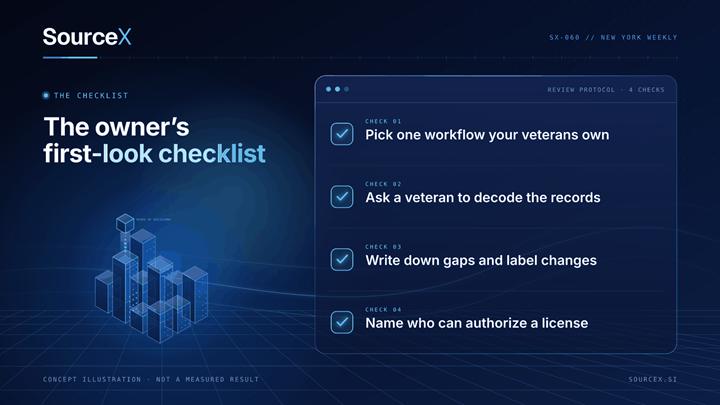
Try a quick test with your operations lead: rebuild one job from the system records alone, covering what came in, what was checked, what was decided and how it ended. If the story holds together, the archive explains your work; if it falls apart, it only proves that activity happened.

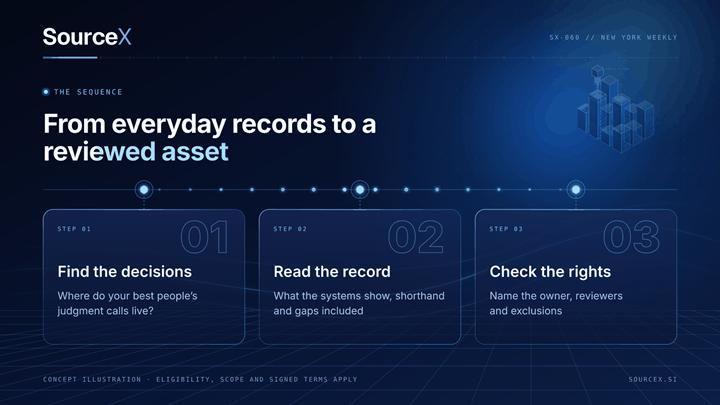
Photo Courtesy: SourceX Inc. (From everyday records to a reviewed asset. A conceptual sequence drawn from this article, not a measured result or a completed transaction.)

Years of history means years of mess

Businesses switch software, rewrite policies and rename things. Older records use different labels, attachments go missing, and a dispatch note written in shorthand in 2019 may mean nothing to anyone hired since.

Those limits do not automatically rule out a collection, but some may make a task unsuitable. Document them honestly; a narrower period or different use may be more defensible than claiming a complete history.

This is where your experienced staff matter twice. Your veterans are the decoder ring for your own archive. An outsider sees codes and abbreviations; the people who did the work know which ones meant trouble.

Does owning the server give you licensing rights?

Client information, vendor content and confidential correspondence often sit right next to company-created records. Having access to a system does not automatically give you the right to license what is in it.

Before anything is extracted, name the person authorized to decide, plus the people who will review rights and security. Some material will need to be excluded or specially prepared.

Removing names reduces exposure, but remaining context can still identify a person or a business. Understand that residual risk alongside any commercial terms.

Your veterans are the decoder ring for your own archive.

Photo Courtesy: SourceX Inc.

How does SourceX assess a company archive?

SourceX, headquartered in Los Angeles, licenses approved business records directly from companies for AI training and evaluation. The contract is with SourceX itself, which manages qualification, scope, rights review, preparation and payout under signed terms.

Its stated core fit is a company with at least 50 full-time employees at peak and several years of operating history. The initial fit check is a short set of questions about the company, with no uploads of client or employee files and no commitment.

SourceX publishes a maximum licensing fee for the largest enterprise datasets. A published ceiling is not a typical payout, a guaranteed offer or evidence of a New York business receiving any particular amount. A signed Dataset Deal Confirmation fixes the actual records, rights and compensation, and acceptance and Closing still have to follow.

Extraction and delivery require a signed Master Supplier Licensing Agreement, a signed Dataset Deal Confirmation and SourceX’s go-ahead. Signing does not guarantee a purchase: SourceX may decline the delivered data. Written acceptance and every Closing condition lead to a Closing Notice, then an invoice. Under standard terms, payment is due within 60 calendar days after SourceX receives a valid invoice, unless different terms are signed. Data that does not reach Closing earns no payment.

Does a license mean giving up the original records?

No. SourceX’s public terms say the company retains ownership of its original records. That does not make the grant over the de-identified dataset temporary or easy to reverse. Review:

● Permitted uses, including training, evaluation and use in products

● Exclusivity for AI training, for a term fixed in the Dataset Deal Confirmation

● Transferable and sublicensable rights, including onward distribution

● Perpetual, irrevocable de-identified data rights that survive termination once the fee is paid, with no obligation to untrain or delete models. The fee is usually one-time, with no royalties or usage fees.

What should an owner do first?

Ask one question at your next leadership meeting: where does this business record the decisions your best people make over and over? Put the answer on one page, with the systems named, the years covered and the person who could authorize a license.

That page is the start. AI revenue from business archives begins with a clear view of what your company spent years building without ever meaning to.

Bring that one-page inventory to SourceX‘s company fit check, with no client or employee files attached. If the fit is plausible, review the selected records, enduring rights and conditions for payment before signing.

About the founder

Noah Loul is a four-time founder and the founder and CEO of SourceX, which licenses business data directly from companies for AI training and evaluation. He previously founded B2B Rocket, acquired by Blackpearl Group. His work focuses on building permission-based data infrastructure for AI.