New York City Gained Half a Million Seniors in Two Decades, and Its Supply Chain Is Still Catching Up

Every borough in New York City has gotten noticeably older over the past twenty years, and the shift is large enough to reshape entire categories of local healthcare infrastructure. For clinics, home health agencies, and the families navigating care for aging relatives, that demographic reality translates directly into a more practical question: where does a city this size actually source the medical supplies and equipment that keep its healthcare system running.

The Stat Behind the Demand

New York City’s population of residents aged 65 and older grew by nearly half a million people over the last two decades, an increase of 53 percent, according to a report from New York State Comptroller Thomas DiNapoli. That growth has outpaced the city’s total population increase by a wide margin, and it shows no sign of leveling off, placing sustained pressure on every part of the system that supports senior and chronic care, including the supply chain behind it.

For procurement teams, clinics, and home health providers across the five boroughs, this growth has turned dependable local sourcing from a convenience into something closer to a necessity.

What a Full-Service Medical Supply Store Actually Stocks

The range of products involved is wider than most people outside healthcare administration realize, spanning both high-volume daily consumables and specialized equipment.

Mobility and Long-Term Equipment: Durable Medical Equipment providers stock everything from wheelchairs and walkers to home hospital beds, supporting patients transitioning out of inpatient care or managing long-term mobility limitations at home. With New York’s senior population growing this quickly, demand for this category has become a near-constant rather than a seasonal fluctuation.

Protective and Procedural Supplies: Nitrile gloves remain one of the highest-turnover items any facility orders, used across nearly every patient interaction regardless of setting. Surgical instruments require a different level of sourcing precision entirely, since material quality and sterility directly affect procedural outcomes. Infection control supplies tie both categories together, forming the baseline protective layer that clinics, urgent care centers, and home health visits all depend on.

Diagnostic Tools: A pulse oximeter is one of the simplest and most frequently used pieces of equipment in any clinical or home care setting, providing immediate readings that inform care decisions in real time, whether in a hospital room or a patient’s living room.

Respiratory and Wound Care: Respiratory Equipment spans basic oxygen delivery devices through more advanced home ventilation support, an especially relevant category given the city’s aging population and associated rise in chronic respiratory conditions. Wound Care Supplies cover a similarly broad range, from basic dressings to advanced therapeutic products used in managing chronic wounds, increasingly common among older patients with diabetes or circulatory conditions.

Specialty Categories: Dental Supplies providers support outpatient dental practices across the city, while Pharmaceutical Supplies represent their own distinct procurement challenge, requiring suppliers who can navigate the periodic shortages that have affected hundreds of medications nationally in recent years. Home Health Care Supplies round out the picture, supporting the growing share of care now delivered directly inside patients’ homes rather than in a clinical setting.

Photo Courtesy: Unsplash.com

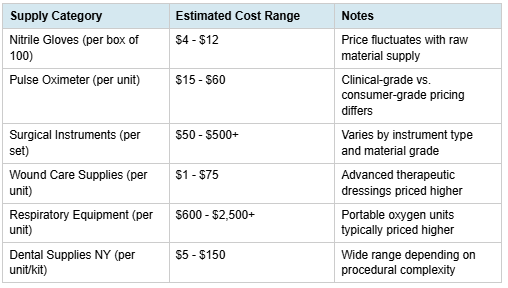
Cost Reference for Common Medical Supply Categories in NYC

Pricing varies by order volume, specification, and whether items are sourced individually or through bulk distributor arrangements. Below is a general cost reference.

Sources: General wholesale medical supply pricing compiled from distributor catalogs and industry pricing data (2025-2026).

Why Borough-by-Borough Coverage Matters

New York’s senior population is not concentrated in one part of the region. Growth has occurred across all five boroughs, with the largest numerical increases over the past decade recorded in Manhattan, Queens, and the Bronx, followed closely by Brooklyn and Staten Island. This distribution means that a single centralized supply point cannot efficiently serve every clinic, home health agency, and care facility.

As a result, medical supply providers across the metropolitan area maintain a local presence to support faster access and reliable delivery. In healthcare logistics, last-mile delivery speed is critical, especially when a facility urgently needs supplies such as gloves, dressings, or monitoring equipment during ongoing operations.

A Hospital Supply Store with genuine multi-borough reach, rather than a single centralized warehouse serving the entire metro area, is generally better positioned to handle the kind of urgent, short-notice reorders that clinics and home health providers regularly face.

Finding the Right Supplier in a Growing Market

As demand continues to rise alongside the aging population, the question for most facilities is no longer whether to consolidate vendors, but which supplier can reliably cover the full range of categories without requiring separate relationships for each one. A medical supply store in New York that handles everything from durable medical equipment to pharmaceutical supplies under a single account simplifies sourcing considerably. HSS Medical Supply is a medical equipment supplier in NYC that serves clinics, home health agencies, and care facilities across the region’s growing healthcare sector.

Photo Courtesy: Unsplash.com

What the Trend Line Suggests

New York’s senior population is not projected to plateau anytime soon, and the supply chain supporting senior and chronic care will need to keep pace accordingly. Facilities that build supplier relationships now, rather than scrambling reactively as demand continues climbing, will be in a far stronger position to keep serving patients without the gaps that strain both budgets and care quality.

Portable Power Stations Are Redefining How Modern Travelers Stay Connected Off the Grid

The New Reality of Travel Is Powered by Preparedness

Modern journeys are no longer solely about packing light, charting a scenic route, or booking a cozy place to crash. It is increasingly about staying juiced in terrains where wall outlets are scarce, erratic, or entirely nonexistent. For campers, RV nomads, road warriors, remote professionals, photographers, and families bracing for turbulent weather, energy access has become the travel experience itself. A dead smartphone is never merely an inconvenience when it harbors your maps, SOS contacts, booking receipts, digital memories, and storm alerts. A warm fridge, a powerless CPAP machine, or broken campsite illumination can instantly twist a serene getaway into a logistical nightmare. This is exactly where the modern portable power station graduates from a “cool luxury toy” into an indispensable travel ally. Brands like UDPOWER are joining this dialogue by targeting real-world demands: capacity, wattage, solar integration, safety, and runtime, rather than blindly peddling raw voltage as a lifeless technical specification.

Why Off-Grid Travel Now Demands Smarter Power Planning

The concept of vanishing off the grid previously meant disconnecting absolutely. These days, it primarily entails striking a wiser balance: fewer screen addictions, deeper woods, and storing enough energy to be connected, safe, and functional. This change has given rise to a contemporary dilemma for explorers. These days, a short backcountry getaway can require iPhones, wireless boomboxes, LED lights, electric iceboxes, quadcopters, GoPros, miniature ventilators, and essential medical equipment. Another issue that comes with motorhome touring is the severe competition for limited juice between culinary appliances, laptops, modems, and televisions. The brutal lesson many adventurers discover the hard way is that battery percentages evaporate rapidly when multiple gadgets are engaged. A tiny pocket bank might rescue one phone, but it categorically fails a complete campsite or road-trip ecosystem. This is why consumers must think past mere convenience and prioritize strategic energy planning. The ideal backup system minimizes anxiety, shields crucial electronics, and makes outdoor roaming feel wonderfully invincible without sacrificing the untamed wild freedom, making expeditions alluring in the first place.

The Real Buying Challenge: Capacity Is Only Part of the Story

One of the frequent blunders shoppers make is presuming massive capacity equals the ultimate choice. Capacity matters, absolutely, yet it remains merely one fraction of the puzzle. While output wattage determines the precise workload a battery can actively handle each second, watt-hours quantify the amount of energy a battery can store. Every time someone attempts to turn on a chiller, microwave, espresso machine, fan, drone charger, or CPAP machine, this boundary becomes critical. A simple device works perfectly with phones, lights, and laptops, but it buckles with large appliances right away. A bulkier rig handles demanding requirements, but costs more and proves heavier to haul. This is where UDPOWER’s market positioning proves highly practical: rather than treating every customer uniformly, their catalog grants buyers distinct tiers of emergency electricity for weekend excursions, RV living, household staples, or intense survival scenarios. Finding the equipment you truly need, calculating watts, estimating runtimes, and selecting a very practical arrangement are all part of the wiser strategy as opposed to making impulsive purchases.

Solar Charging Changes the Travel Equation, But It Requires Realistic Expectations

The primary motivation for nomads’ ambitious distant power upgrades is still to harness sunshine. The ability to capture sunbeams gives overland veterans and dirtbaggers a ferocious type of independence that old-fashioned chained bricks just cannot match. This can power a secret outpost, drastically extend a trip, or sustain critical communications during extended blackouts. However, solar equipment should not be viewed as a perfect solution but rather as a significant strategic instrument. Local weather, sun strength, panel angles, transient shadows, ambient heat, and matching panel outputs with battery limitations are all critical factors in real backcountry charging success. Anyone attempting to juice gear beneath an overcast sky quickly realizes slick marketing specs rarely manifest perfectly in the wild. The ultimate takeaway? Always engineer a buffer. If a freezer, ventilator, or editing laptop remains non-negotiable, users must never gamble on pristine charging scenarios. A solar-ready powerhouse thrives flawlessly only when tethered to grounded expectations, disciplined consumption, and a battery capacious enough to navigate through thoroughly suboptimal atmospheric conditions.

Safety and Battery Chemistry Are Becoming Part of the Consumer Conversation

Historically, shoppers evaluated backup batteries strictly through the dual metrics of price and storage capacity. That paradigm is cracking. Today’s adventurers demand to know if a generator remains harmless indoors, steadfast during rigorous deployment, and rugged enough to survive decades of seasonal treks alongside emergency hibernation. This shift elevates LiFePO4 battery chemistry into a compelling centerpiece. Renowned for exceptional cycle longevity and resilient safety thresholds, this tech heavily appeals to users intending to drain their systems consistently instead of annually. A suburban family stockpiling emergency voltage holds drastically different non-negotiables than a lone backpacker topping off an iPhone. Fire safety, intelligent thermal management, ruggedized ports, and pure sine wave inversion collectively anchor the purchasing choice. The sleekest mental framework is straightforward: this machinery isn’t merely fueling toys; it resides inside a truck, canvas tent, basement, or bedroom. Consequently, foolproof protection features and unshakeable reliability easily outrank brute-force numerical specs.

From Camping Gear to Household Essentials: The Use Case Is Expanding

The most fascinating pivot within this industry is how these powerboxes have transcended beyond outdoor junkies. They undeniably remain vital for mountaineers, overlanders, van-lifers, and photographers, yet they simultaneously double as brilliant domestic lifesavers. A sudden blizzard, grid collapse, or random blackout instantly renders mundane household routines agonizing. Fridges demand backup. Phones require juice. Routers, headlamps, heaters, and medical apparatuses turn critical. This expanded utility is exactly where UDPOWER’s marketing surrounding camping, RV cruising, home emergencies, and essential electronics feels impeccably timed. The precise battery illuminating a forest bivouac can seamlessly sustain a living room through a rolling blackout. That identical solar-capable unit powering an epic road trip effortlessly anchors a household survival strategy. From any consumer’s viewpoint, such extreme versatility is paramount. Rather than buying an isolated, single-use gizmo, modern users are treating backup energy as a practical investment guarding travel, productivity, health, and domestic resilience.

The Smartest Power Choice Starts With Honest Needs

The rise in off-grid adventuring clarifies one reality: staying connected is no longer about staring at a screen. It is about securing access to vital instruments, keeping a trip safe, comfortable, and managed. A portable generator supports that shift, but only when shoppers choose with intention. The ultimate purchase starts from honest self-interrogation. What devices matter most? How many watts do they devour? How many hours must they operate? Will solar deploy regularly, or purely as a fallback? Is the box destined for tent camping, RV touring, home emergencies, or absolutely everything? UDPOWER elegantly tackles this friction by packaging backup voltage around tangible lifestyle applications rather than abstract metrics. For today’s wanderers, the objective isn’t merely dragging extra microchips into the wilderness. It is to journey confidently, reduce chaos, and remain fiercely equipped when the outlet is miles away.

How to Create Realistic AI Videos?

Creativity and skill determine how realistic an AI video appears. The tools used matter far less. Many creators run into the same problem when they use AI to make videos. The clips come out the right length with real-looking content, yet they still carry an unmistakable artificial quality. There is a reason AI-generated videos so often miss the mark. Usually, the creator overlooks a few subtle details that leave the footage feeling unreal, the so-called “AI feel.” A handful of principles apply to every creator, no matter the project. Whether you are making social media content, AI avatars, or brand marketing videos, the following 10 tried-and-true principles, shared by many experienced creators, can help your AI-generated videos look as realistic as possible.

Why Do AI Videos Look Like They Were Actually Filmed?

Whether a video made with artificial intelligence reads as authentic or plainly fake usually has little to do with which AI tool produced it. What matters more is how closely it follows the fundamental principles of real filmmaking. Most AI-generated videos share a set of telltale signs, and those signs come from the same handful of techniques that create an artificial look.

Several key factors affect the realism of AI videos.

Visual Consistency

Throughout the video, facial features, clothing, props, and backdrops should remain consistent from one shot to the next. Frequent changes to how a character looks, or abrupt scene shifts, make it obvious that AI software produced the footage.

Realistic Movement

The movement of both characters and the surrounding environment needs to look like it belongs in the real world. Realistic motion also reflects a character’s weight. A figure that moves too fast or with too little control reads as AI almost instantly.

Consistent and Reasonable Lighting and Shadow

Light and shadow have to relate logically to each other and to the surrounding space. Only when shadows line up sensibly with their light sources does the lighting look believable and natural in the frame.

Natural Camera Language

Realism comes partly from the quality of the image and partly from how well the virtual camera mimics the motion of a real one. Smooth camera movement helps the viewer accept the image as real. Stiff or random camera motion makes the footage look amateurish.

Realistic Material Representation

In the real world, images are never perfectly clean. Realism often lives in the small flaws of real footage, a touch of motion blur, slight texture variation, or minor imperfections. Chasing flawless accuracy can actually make a clip feel less real, so a little imperfection goes a long way.

Moderately Retaining Real-World Imperfections

A character’s surfaces, skin, hair, fabric, glass, or water, must respond to light in a believable way. When a surface looks too smooth, lacks detail, or comes across as plastic, viewers sense that something about the image is off.

Sound Design Matching the Scene

When your video includes generated audio, build in ambient sound, breathing, footsteps, and natural pauses. Strong sound detail raises the overall fidelity and helps the viewer feel that what they are watching is real.

A realistic AI video is never the product of a single factor. It comes from the way an image looks, moves, handles light, holds detail, and sounds, all working together. When those elements align, the result starts to resemble something captured in real life.

Tips to Make Videos More Realistic

1. Start with a reference image, not text.

Plain text prompts often produce inconsistencies in style and level of detail. Feeding the AI a proper, high-quality reference image instead gives the model a definitive visual anchor.

A reference image helps the model maintain character design, scene lighting, and color palettes, leading to more stable video quality. For that reason, reaching for image to video AI tools is often a smart starting point.

2. Select a video model suitable for the scene.

Every model has its own strengths and weaknesses. Some excel at facial expression and fine detail, while others handle motion or shot transitions better. To pick the right model for your content, first test how each one performs, then choose the best fit for your production.

3. Maintain a consistent light source.

Lighting drives the realism of a scene. Picture an actor’s face lit by a strong source from the left while the shadows behind them fall to the right. The audience spots that contradiction at once. As you design your video, keep every element tied to a single primary light source, and specify both the direction of the light and the mood of the environment.

Consistent lighting tends to shape how real a video feels far more than a pile of geometric cues ever could.

4. Control moving elements in the scene.

AI performs best with fewer moving subjects. Pack multiple characters, vehicles, animals, and busy background motion into a single frame, and the model is far more likely to clip, distort, or stumble on the movement. Limiting each frame to one or two primary moving subjects can sharply improve the quality of every shot.

5. Prioritize the use of medium and close-up shots.

Wide-angle scenes can look grand, but they are exactly where AI is most likely to make mistakes. The smaller a person appears in the frame, the more detail the model has to process, which raises the chance of error. A medium shot or close-up devotes far more of the model’s computational attention to the subject, allowing for more realistic skin, clothing, and facial expression.

6. Maintain a stable character image.

A common flaw in AI-generated video is that characters drift in appearance from shot to shot, through small shifts in facial features or even body proportions. Those slight variations can pull viewers right out of the story. To keep things steady, build a clear character design guideline before you start, then reuse the same character reference images in every shot.

7. Keep movements as simple and natural as possible.

Familiar, everyday motion picks up less distortion from video models than complex movement does. Head tilts, a steady walk, gentle camera moves, and clothing shifting in the breeze usually generate cleaner output than fast running, an aggressive fight, or an intricate dance. In many high-quality AI clips, the real secret is simply moving less.

8. Give the video a clear shooting style.

A description like “cinematic video” is far too broad. You get better results by naming a specific shooting method, such as a handheld vlog, street documentary, drone aerial footage, product advertising shoot, or news interview. A clear style gives the AI a unified visual logic, and the generated results come out more believable.

9. Do not rely on a single generated result.

Even with excellent models, landing a perfect video on the first try is rare. Professional creators usually generate several versions of the same scene, then stitch together the best-performing parts. That approach yields quality well beyond what any single generation delivers.

10. Enhance realism through post-processing.

AI-generated video often looks too clean and too smooth. A measured dose of film grain, sensor noise, slight vignetting, or lens distortion in post can push the image much closer to footage shot on a real camera. These small touches are frequently the final step that sells the realism.

Which AI Video Model Is Best Suited for Generating Realistic Videos?

No single AI video model wins in every situation. Each one, Kling, Veo, and Wan among them, brings its own strengths, and every assignment calls for a different mix of capabilities. Rather than burning hours testing options and hopping between platforms, you can use the Viddo AI Video Generator to reach multiple AI video models in one place and pick the best result for your specific needs. That keeps creative work efficient and helps you produce more realistic, more consistent output over time.

Putting These Principles Into Practice

AI video technology keeps improving, and model-generated content grows sharper with each release. Even so, the standout work still depends on the creator’s eye and the way the content is designed. Learning these skills helps reduce the artifacts that give AI away and improves the overall quality, naturalness, professionalism, and visual appeal of your videos.