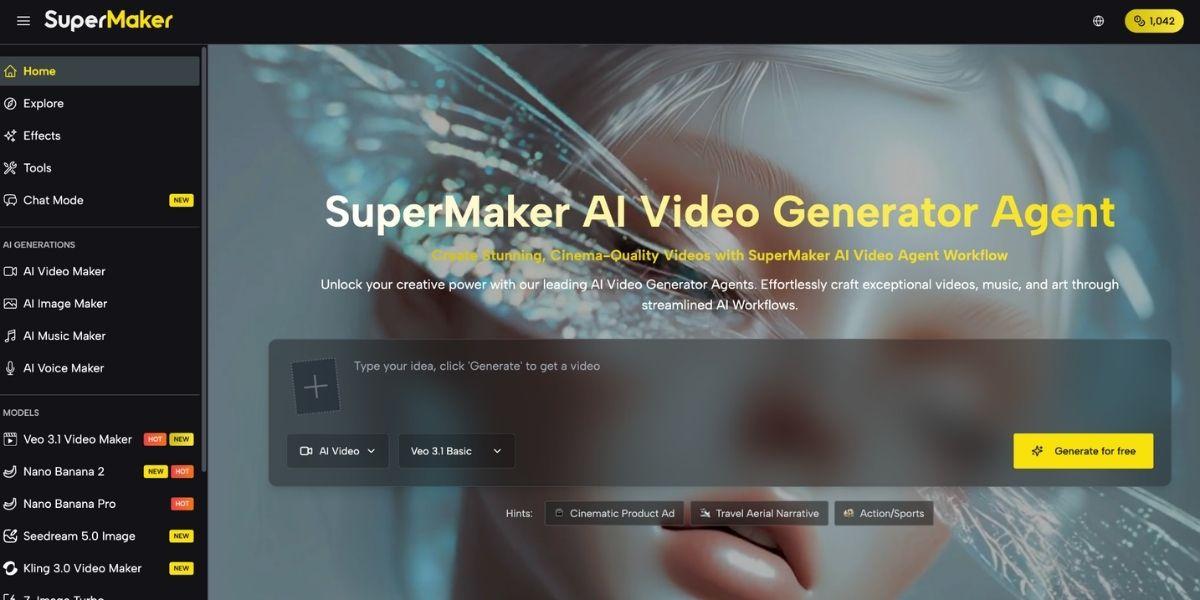
AI Video Effects That Work Inside Your Workflow

Most video effect tools give you a transformation. One click, one output, one file to download and drag into yet another platform. The effect looks great in isolation, but getting it into a finished video with synced audio, narration, and the right aspect ratio for each platform is a whole separate project.

AI Video Maker works differently. Every effect you apply lives inside the same workspace as your video generator, voice tool, and music composer, so the transformed clip is already part of your project, already paired with audio, and ready to export as finished content without touching another app.

Why Standalone Effect Tools Create More Work Than They Save

The demand for visually distinctive content has never been higher. Trending formats cycle faster than ever. One week it’s AI red carpet videos, the next it’s baseball fancam edits or sketch-to-video transformations. Dedicated effect tools and filter apps can execute these formats well. But they all share the same structural problem. They exist outside your production workflow.

You apply the effect, export the clip, import it into your video editor, sync a voiceover you generated somewhere else, add background music from yet another platform, and reassemble everything before you can publish. By the time the content is ready, the trend has moved. The current reality for most creators looks something like this:

CapCut or a filter app for trending visual effects

Runway or Kling for base video generation

ElevenLabs for voiceover narration

Suno for background music

Premiere or a mobile editor to put it all together

Every tool does its job well. None of them talk to each other. And you’re spending more time on logistics than on creating.

Everything in One Workflow

This platform integrates a 100+ effect library directly into a full AI production suite, so applying a trending visual transformation is one step in a continuous workflow, not a detour through a separate app. Your transformed clip, your voiceover, and your background music all live in the same project from the moment you start.

Here’s how the platform is organized:

Pre-Production: Build Your Visual Foundation

AI Image Maker: Generate source visuals (portraits, product shots, concept art, and scene references) using models like GPT Image 2, Nano Banana Pro, Seedream 5.0, and Flux Kontext, with built-in editing tools including magic erase, smart uncrop, and photo restoration, ready to feed directly into the effects pipeline.

Production: Transform, Narrate, and Score

AI Effects Library: Apply 100+ trending one-click video and image transformations, including AI Red Carpet Video, baseball fancam, sketch-to-video, photo-to-dance, cartoon conversion, and virtual try-on, optimized for TikTok, Instagram Reels, and YouTube Shorts, updated regularly as new formats emerge.

AI Video Maker: Generate original footage using 30+ models, including Google Veo 3.1, Kling 3.0, Seedance 2.0, and Sora, with text-to-video, image-to-video, lip-sync, batch generation, and full commercial licensing on premium outputs.

AI Voice Maker: Convert scripts into professional narration across multiple languages, accents, and voice styles, from conversational to broadcast-ready, saved natively to your project library and ready to sync with any clip in seconds.

AI Music Maker: Generate original, royalty-free background tracks from a text description, with full control over genre, mood, tempo, and instrumentation, permanently licensed on paid plans, ready in 1-3 minutes.

Post-Production: Scale and Automate

AI Studio (Canvas Workflow): Chain image generation, effects, video animation, voiceover, and music into a single automated pipeline on an infinite no-code canvas, with batch processing of up to 4 variations per node, auto-save, and reusable workflow templates for high-volume content production.

The tool runs entirely in the browser, with no download or installation required. A mobile app is also available for iOS and Android.

From Photo to Finished Video in One Session

1. Upload or generate your source visual. Start with an existing photo or generate a new image using the built-in image maker. Your source file is saved directly to your project library.

2. Apply your effect. Browse the effects library, select the format you want (AI Red Carpet, fancam, sketch-to-video, or any of the 100+ available styles) and apply with one click.

3. Generate your video. Send the transformed visual into the video generator, select a motion style and duration, and animate. Output saves automatically to your library.

4. Add a voiceover and music. Generate narration from your script and an original background track from a mood description. Both are saved to the same project and ready to layer.

5. Combine and export. Layer your video, voiceover, and music in the built-in editor, adjust timing and volume, and export as MP4, ready to upload.
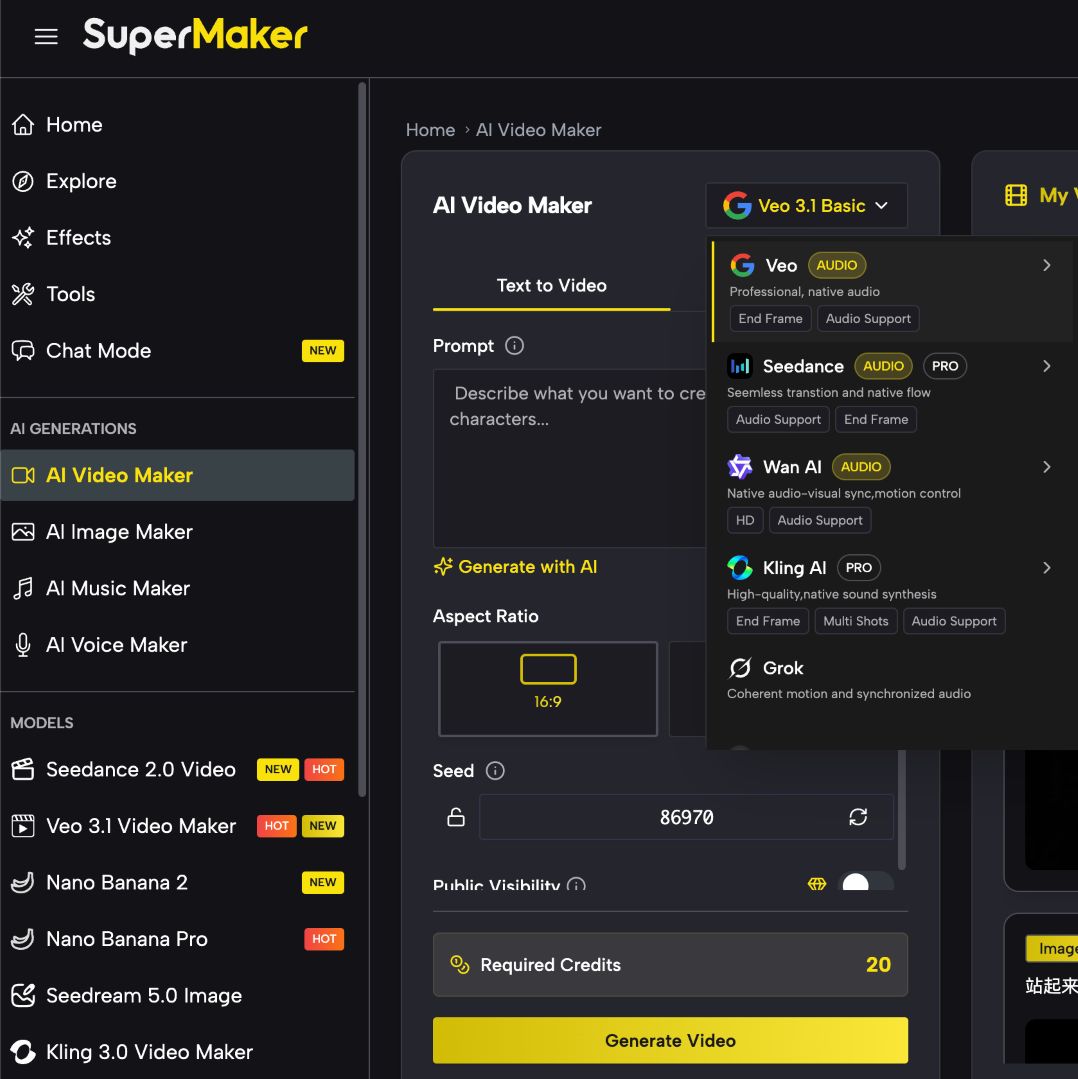
Photo Courtesy: SuperMaker AI

Real Use Cases: Social Media, YouTube, and Ads

Social Media Creators

Trending effect formats have a short window. The faster you can go from a photo to a published video in that format, the more views you capture before the cycle moves on. Having effects, video generation, and audio all in the same platform compresses that window from hours to minutes.

YouTube Creators

Intro sequences, b-roll transitions, and stylized visual segments all benefit from consistent effect treatment. Generating those effects inside the same platform as the main footage means visual consistency across an entire video, without manually matching styles between different tools.

Marketers and Ad Teams

Product visuals transformed through AI effects (virtual try-on, lifestyle animation, brand-style conversions) can move directly into finished ad formats with narration and music layered on top. Run multiple visual variations in batch, apply different effect styles to each, and deploy a full creative set without leaving the platform.

Pricing: What You Get at Each Tier

The platform offers a free plan and three paid tiers, all billed annually with no hidden fees. Unused credits roll over, and all paid plans include HD watermark-free downloads, unlimited Canvas projects, faster generation speed, and private generation.

The free plan is a genuine starting point, with no credit card required, and the weekly credit check-in means you can keep generating without committing to a subscription. For creators producing content regularly, the Basic plan at $8.30/month replaces four to five separate tool subscriptions that would otherwise cost $95-$180+ per month combined. A 10-day refund is available on paid plans if unused.

Why a Connected Pipeline Matters

Trending visual formats are only valuable if you can execute them fast enough to matter. When your effect tool, your video generator, your voice tool, and your music composer are all in separate tabs, the speed advantage of one-click effects disappears in the handoffs between platforms. If your current workflow requires moving transformed clips through multiple tools before they become publishable content, it’s worth seeing how a connected pipeline changes the pace. The free tier requires no credit card to find out.

This platform makes effects the starting point of a production workflow, not a detour away from one. Apply the transformation, animate the result, add narration and music, and export, without the file handling and context switching that standalone effect tools make unavoidable.

Paris Saint-Germain Pop-Up Opens at Union Square June 17–21 as World Cup Fuels NYC Brand Activations

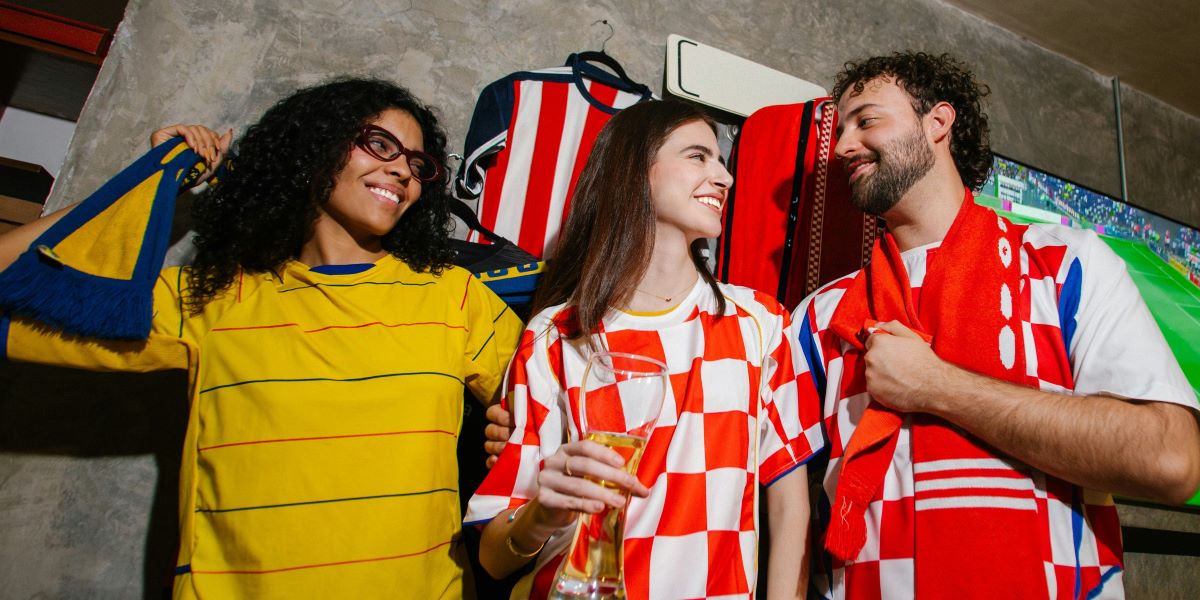
Paris Saint-Germain plants its global brand campaign in Union Square this week, opening “Ici C’est Paris – La Maison New York” from June 17 through June 21. The free, registration-based pop-up arrives mid-World Cup window and closes out PSG’s international roadshow for the season, following stops in Tokyo, London, and Los Angeles. For Manhattan, it lands as another European sports property treating New York as the marketing capital it already is — a stretch of pavement where club identity, retail strategy, and tournament adjacency share a single block.

A Five-Day Takeover Built for Foot Traffic and Conversion

The activation runs 11 a.m. to 8 p.m. June 17–20, then closes earlier on June 21 at 5:30 p.m. PSG selected Union Square at 31 E 17th Street, a placement that puts the brand inside a high-traffic public square in Lower Manhattan during a stretch when international football fans are circulating through the city for tournament matches. Admission is free, with prior registration available through PSG’s official channels for fast-lane access. Several inner experiences require their own reservation and are subject to availability.

The format reflects a deliberate shift in how elite European clubs build out the U.S. market. Rather than pairing the brand with a home match — PSG is not playing in New York — the club is staging an extended commercial moment with the cultural calendar carrying the foot traffic. The World Cup window supplies the demand. The pop-up supplies the venue.

What’s Inside the Building

Programming covers familiar PSG pillars and a few New York-specific add-ons. L’Atelier handles retail and reveal, debuting the club’s 2026/27 home jersey alongside exclusive collaborations created for the New York edition only. A dedicated trophy room displays the silverware PSG collected in 2025, including the club’s first UEFA Champions League title from last May’s 5-0 win over Inter Milan. The PSG Focus Studio brings in Rebalance technology, the same recovery tool used by the senior squad, and offers an immersive demo for visitors.

The Playground sits at the casual end with video games, Formula 1 simulators, an EA FC competitive zone, and short-form football activations sized for all ages. A Wall of Fame produced by beIN SPORTS asks fans to leave a participatory mark, and a “Destination Unknown” installation presented by Visit Qatar runs alongside it.

Food and music get equal billing. A café and concept store anchor the daytime hours, and on June 19, La Maison hosts a Comedy Night featuring Marie Faustin, Usama Siddiquee, Jamie Wolf, and Judah Friedlander — a deliberate nod to the city’s stand-up tradition and a smart way to keep the venue active beyond watch-party hours. La Maison also opened its doors early on June 16, from 2:30 to 5:00 p.m., to host the France versus Senegal viewing.

Why Union Square, and Why Now

PSG’s New York pop-up sits inside a wider pattern. NYC Tourism + Conventions has been running its “Where the World Comes to Play” campaign across twenty global markets through June 2026, and the city’s commercial inventory has tilted toward fan engagement for the duration of the tournament. Borough-level fan zones, the Five Borough Winner Special restaurant promotion, and the NYNJ World Cup Concierge platform have all gone live in the past month, turning Manhattan and the outer boroughs into a continuous brand environment.

PSG enters that environment as a private commercial actor, not a tournament sponsor — which is precisely the play. La Maison is not paying into FIFA’s official brand corridor. It is renting public attention adjacent to it, in a venue and format the club controls end to end. The trophy room, the jersey reveal, the Visit Qatar partnership, and the New York-only collaborations function as a single commercial system. Visitors walk through it for free. The brand collects engagement, sign-ups, jersey sales, and content for distribution across PSG’s owned channels.

That model — global club, local cultural reskin, tournament adjacency — is the template PSG used in Tokyo’s Shibuya in May, in London’s Cavendish Square in February, and at the Hollywood Athletic Club the week before opening in New York. Each stop trades on the host city’s identity. The New York edition leans into urban culture, comedy, and gaming. The Tokyo edition leaned on Maison Kayser pastries and Sega arcade machines. The wrapper changes. The brand stays constant.

La Maison is a useful data point. Foreign brands with no permanent New York footprint are willing to spend on five-day takeovers in heavily trafficked public squares during defined commercial windows. The city is no longer just a destination market for those activations. It is the closing act of a global tour, which carries its own marketing weight. Union Square’s mix of subway access, dwell time, and downtown reach made it the logical venue choice over SoHo or Brooklyn alternatives.

Registration and full programming for Ici C’est Paris – La Maison New York are available through PSG’s official New York landing page at psg.fr/en/icp-new-york.

From Wall Street to Wall Printing, Why Adam Herz Is Championing a New Category Beyond Traditional Vinyl Graphics

By: Ethan Rogers

EastCoast MuralPros CEO Adam Herz is helping introduce architects, designers, schools, workplaces, and institutions to direct-to-wall printing, a technology that offers an alternative to traditional vinyl wall graphics.

For decades, the wall graphics industry has largely relied on the same approach. Whether in schools, hospitals, corporate offices, hospitality venues, or public facilities, graphics are typically produced on vinyl materials and then applied to walls using adhesives.

The process is familiar, widely available, and deeply ingrained within the architectural and design community.

Adam Herz believes there is another option that many decision-makers have yet to discover.

After spending more than twenty years working on Wall Street, Herz found himself drawn toward an entirely different industry, one focused not on finance, but on how physical spaces influence the people who use them every day.

Today, as CEO and Partner of EastCoast MuralPros, Herz is working to raise awareness about direct-to-wall printing, a technology that allows high-resolution graphics to be printed directly onto interior and exterior surfaces without the use of vinyl, adhesives, or seams.

His mission is not centered on replacing one company with another. Instead, it is focused on introducing what he believes is an emerging category within environmental graphics.

“Most people don’t realize another option exists,” says Herz. “When they think about wall graphics, they immediately think of vinyl because that’s what the industry has used for years. What we’re trying to do is educate people that graphics can now be printed directly onto the wall itself.”

The distinction may seem subtle, but Herz believes it has meaningful implications for architects, designers, facility operators, and organizations looking to enhance their spaces.

An Unexpected Career Transition

Herz’s path into commercial wall printing was anything but conventional.

For more than two decades, his professional career was spent in the financial sector, navigating the fast-moving and highly competitive environment of Wall Street.

Like many entrepreneurs, however, his next chapter began with a discovery.

When Herz first encountered NextGen WallPrinting technology, he was immediately intrigued by both the visual quality and the practical applications.

Unlike traditional wall graphics that require a printed material to be physically attached to a wall, direct-to-wall printing uses specialized equipment to print graphics directly onto the surface itself.

The result is a finished graphic that becomes part of the wall rather than an applied layer on top of it.

For Herz, the technology represented something larger than a new product.

“It felt like one of those moments where you realize an industry is about to evolve,” he says. “The more I learned about it, the more I felt there was an opportunity to help people understand that wall graphics don’t necessarily have to be vinyl.”

That realization ultimately led him to leave a successful career in finance and dedicate himself to building awareness around direct-to-wall printing.

Solving an Awareness Problem

While many businesses face challenges related to competition, Herz says one of the biggest obstacles for EastCoast MuralPros has been something much simpler: awareness.

Because direct-to-wall printing remains unfamiliar to many buyers, architects, and facility managers, potential customers often don’t know the option exists.

“People can’t evaluate a solution they’ve never heard of,” Herz explains. “The challenge isn’t convincing people after they’ve seen it. The challenge is introducing them to it in the first place.”

According to Herz, the response tends to be immediate once individuals encounter the technology in person.

Seeing a graphic printed directly onto a wall often changes how people think about environmental graphics, branding, and visual storytelling within physical spaces.

That reaction has reinforced the company’s educational approach.

Rather than focusing exclusively on sales conversations, EastCoast MuralPros has invested significant effort into demonstrations, presentations, and industry education designed to help architects, designers, and institutional buyers understand how the technology works and where it may fit within future projects.

Growing Interest Across Multiple Industries

As awareness grows, Herz has seen interest emerge from a wide range of sectors.

Educational institutions use wall graphics to create immersive learning environments. Universities leverage environmental branding to strengthen campus identity and student engagement. Corporate workplaces use visual elements to reinforce culture and communicate brand values. Healthcare organizations often explore environmental graphics as part of broader patient and visitor experiences.

The versatility of direct-to-wall printing has also expanded its use into locations that many people might not immediately associate with wall graphics.

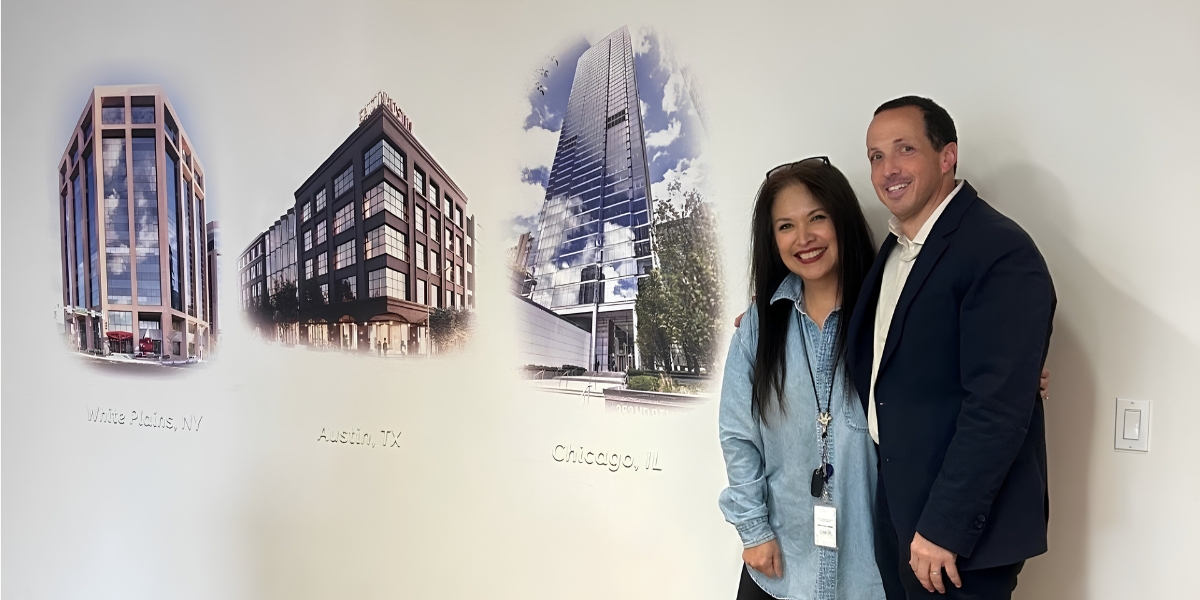
During the past year, EastCoast MuralPros has completed projects in a variety of environments, including a prominent New York tourist destination located within a flagship supertall tower, healthcare facilities, and correctional institutions.

The diversity of those applications highlights a broader trend: organizations increasingly recognize the impact that physical environments can have on people.

Whether the goal is education, branding, navigation, engagement, or atmosphere, visual environments are becoming a larger part of the conversation.

The Connection Between Environment and Experience

For Herz, the growing interest in environmental graphics reflects a larger shift in how organizations think about space.

Historically, wall graphics were often viewed primarily as decorative elements. Today, many organizations see them as tools that support culture, identity, communication, and experience.

Research appears to support that perspective.

Gensler’s 2025 Global Workplace Survey, which gathered insights from more than 16,000 workers worldwide, found significant opportunities for improvement within workplace environments. The report identified strong connections between employee satisfaction, workplace experience, and organizational engagement.

Among respondents who viewed their workplace positively, many also reported stronger connections to their employers and greater pride in their organizations.

For Herz, findings like these reinforce conversations he has with clients on a regular basis.

“When organizations invest in their spaces, they’re ultimately investing in the people who spend time there,” he says. “Whether it’s a student, an employee, a patient, or a visitor, the environment contributes to the experience.”

That philosophy has become a recurring theme across many of the projects EastCoast MuralPros undertakes.

Educating the Architectural Community

One milestone Herz views as particularly important is the development of an continuing education course focused on direct-to-wall printing.

The course was created to help licensed architects better understand how the technology functions, where it may fit within project specifications, and how it can be incorporated into broader design strategies.

According to Herz, educational initiatives like this are critical because many decisions about environmental graphics occur long before construction is completed.

Architects and designers often determine visual elements during the planning phase, making awareness and specification knowledge essential.

By creating an accredited educational resource, EastCoast MuralPros hopes to provide industry professionals with practical information they can evaluate alongside other design solutions.

“Our goal is education,” Herz says. “Architects want options. Designers want options. We want them to understand what’s available so they can decide what makes sense for their projects.”

Sustainability Considerations

Another factor contributing to increased interest in direct-to-wall printing is sustainability.

Traditional wall graphics often involve vinyl materials, adhesives, transportation, installation processes, and eventual disposal. Direct-to-wall printing reduces reliance on several of those components by applying graphics directly to the surface itself.

While sustainability priorities vary by organization, Herz believes environmental considerations will continue playing a larger role in design and facility decisions.

“Organizations are paying closer attention to how materials are used and where waste is generated,” he says. “As those conversations continue, people naturally become interested in alternatives.”

For institutions balancing design goals with environmental objectives, that conversation is becoming increasingly relevant.

Looking Ahead

As the direct-to-wall printing industry continues to evolve, Herz sees significant opportunities ahead.

His vision for the next several years is centered on continued education, broader industry awareness, and deeper collaboration with architects, designers, and institutional organizations.

Rather than viewing growth solely through the lens of market share, Herz measures success by how many people become aware that another option exists.

“We’re still early in the awareness cycle,” he says. “The more people learn about direct-to-wall printing, the more creative possibilities they begin to see.”

For a former Wall Street professional who unexpectedly found a new passion in transforming physical environments, the mission remains straightforward: help organizations discover a different way to think about walls, branding, and the spaces people experience every day.

About Adam Herz

Adam Herz is CEO and Partner of EastCoast MuralPros, a commercial wall-printing company specializing in NextGen WallPrinting technology. The company prints high-resolution graphics directly onto interior and exterior surfaces without vinyl, adhesives, or seams. EastCoast MuralPros works with schools, universities, healthcare organizations, workplaces, hospitality venues, and institutional facilities seeking environmental graphics, branding solutions, wayfinding systems, and wall-design applications.

Automat-it Launches North America Operations to Help US Startups Scale AI on AWS

By Jake Smiths

Automat-it has launched operations in North America, expanding its AWS-focused cloud services to US startups that need help deploying AI, modernizing infrastructure, and controlling cloud costs.

The company is an AWS Premier Partner and Managed Services Provider specializing in cloud management and optimization for startups. Its US launch is backed by a $1.4 billion Strategic Collaboration Agreement with Amazon Web Services, which is designed to drive mutual business value over the next four years.

Expansion After Strong EMEA Growth

The North America launch follows a record year for Automat-it in EMEA. The company reported 110% year-over-year growth in 2025 and said it helped customers reduce cloud bills by thousands of dollars a month, build production-grade agentic AI workflows, and migrate infrastructure without downtime.

Automat-it is now bringing that model to the United States, where it aims to serve startups facing pressure to innovate quickly while managing market volatility and infrastructure costs.

A Cloud Partner for Startup AI Workloads

Automat-it’s US expansion is centered on startups building and scaling AI products. The company became a launch partner in AWS’ new Agentic AI Services competency and was among the first partners selected for the new Anthropic reseller agreement.

Those developments support Automat-it’s position as a partner for companies that need help moving AI systems into production. The company’s services span agentic AI deployment, DevOps, FinOps, rapid cloud migration, cloud modernization, implementation, compliance, and 24/7 operational support.

AWS Agreement Supports the US Strategy

The Strategic Collaboration Agreement with AWS is a central part of Automat-it’s North America launch. The company said the agreement will help customers access AWS resources and scaling expertise.

Automat-it said the SCA also allows it to extend its “startup-first” methodology to the US market. That methodology prioritizes rapid deployment and cash-flow preservation, which are important for startups trying to grow without allowing cloud costs to expand too quickly.

CEO Emphasizes Cost Control and Production Readiness

“US Startups face pressure to innovate rapidly and launch AI products without letting cloud costs spiral out of control,” said Ziv Kashtan, CEO of Automat-it. “This is the same challenge we have helped hundreds of fast-growth companies solve already by combining expert-led cloud consultancy with hands-on engineers that act as an extension of your core team.

“We are thrilled to formally bring our expertise in AI, DevOps and FinOps to the US market alongside AWS to deliver rapid deployment, aggressive cost optimization, and production-grade AI in the biggest startup ecosystem in the world.”

More Than 800 Startups Already Supported

Automat-it currently supports more than 800 startups across fintech, healthcare, gaming, ecommerce, and other verticals. The company said its work covers every step of the cloud journey, from implementation and compliance to 24/7 operational support.

US founders will also be able to access Automat-it’s team of more than 150 engineers. Their specialties include agentic AI deployment for complex workflows, cash-flow positive FinOps, rapid cloud migration, cloud modernization, and AI implementation.

Automat-it said it is targeting more than 100 US startups within its first 12 months in North America.

Migration and Market Traction

The company reported more than 450% year-over-year growth in Migrations Won ARR in 2025, making migration one of the major growth points behind the US expansion.

Automat-it is entering the North American market with existing relationships that include US-headquartered clients such as Penlink and partners with significant US operations such as Vanta. The announcement describes Vanta as the fastest-growing cloud security company in history.

Automat-it by the Numbers

Automat-it reports more than 800 customers, a 9.8 CSAT score, seven AWS Competencies, more than 500 AWS certifications, and more than 450% year-over-year growth in Migrations Won ARR.

The company is now accepting new customer inquiries in North America for cloud modernization, cost optimization, and AI implementation. Automat-it will be present at AWS Summit New York on June 17, 2026.

The expansion gives Automat-it a larger market for its startup-focused AWS services. With the $1.4 billion AWS agreement, agentic AI competency work, Anthropic reseller access, and a target of more than 100 US startups in its first year, Automat-it is positioning its North America launch around faster AI production and stronger cloud cost control.