Why Katherine Wilks Is Writing for an Emotionally Exhausted Age

At some point in the last decade, the language of survival quietly replaced the language of living. Therapists began speaking in the vocabulary of nervous systems and attachment wounds. Social media changed terms like trauma response, gaslighting, and emotional regulation into everyday shorthand. Entire generations learned to narrate their inner lives not through religion or romance, but through psychology. We became a culture obsessed with decoding itself, diagnosing pain while simultaneously broadcasting curated versions of wellness. And yet, for all the discourse, modern suffering remains strangely private.

A woman dissociates during a work meeting and calls it burnout. A father sits in a parking lot after a divorce, unable to remember who he was before the life he built collapsed around him. A child asks where love goes when someone dies. Somewhere else, someone quietly Googles the phrase: Why do I feel unsafe even when nothing is wrong?

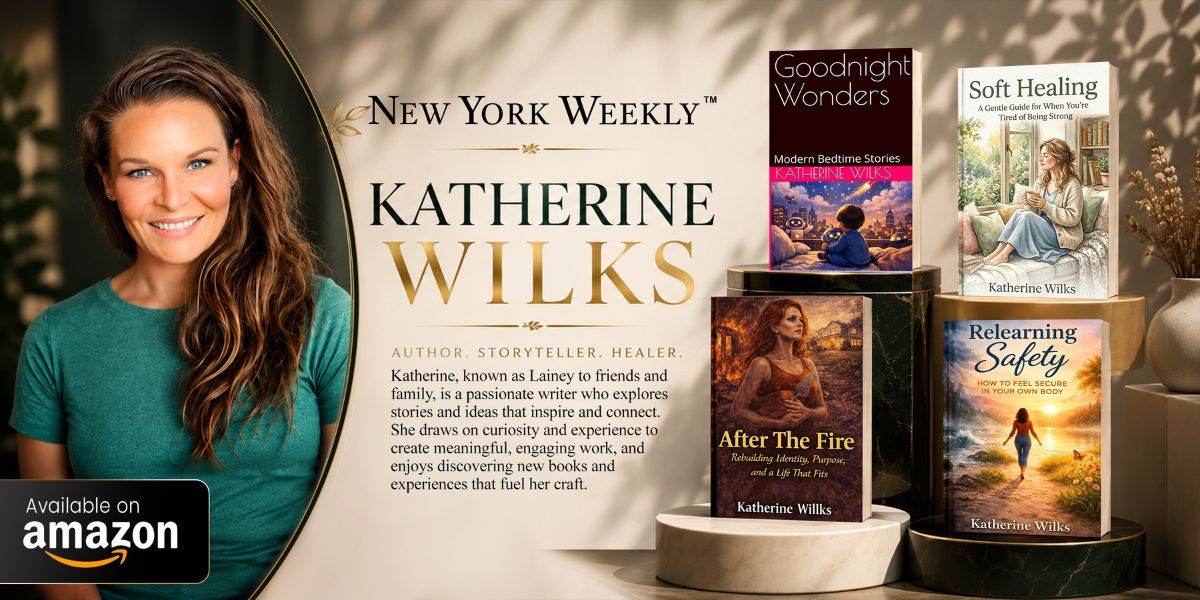
It is into this fractured emotional landscape that Katherine Wilks has been writing. Not with the polished detachment of academia, nor with the sensationalism of self-help publishing, but with the unnerving intimacy of someone documenting emotional life as it is actually lived. Contradictory, exhausted, spiritual, wounded, tender. Her growing catalog of books, sprawling across psychological recovery, faith, grief, nutrition, childhood imagination, and emotional abuse, reads less like a conventional author’s bibliography than a map of modern emotional survival itself.

In Relearning Safety: How to Feel Secure in Your Own Body, she confronts one of the defining paradoxes of contemporary life. People who intellectually understand they are safe but physiologically remain trapped in states of fear. In her rendering, the body becomes an archive of unresolved experience. Safety is no longer merely external. It is biological, emotional, almost existential. The book joins a broader cultural movement fascinated by trauma theory and somatic healing, but she distinguishes herself by refusing the sterile language that often accompanies therapeutic discourse. Her prose remains grounded in lived texture, exhaustion, hypervigilance, numbness, the quiet terror of never fully relaxing.

But she is not simply chronicling pathology. Across books like Soft Healing, After the Fire, and the sprawling The Narcissist’s Web series, she is attempting something more ambitious. She is tracing the emotional architecture of collapse and reconstruction in modern adulthood. Her characters and readers are not heroic in the traditional literary sense. They are people surviving divorce proceedings, emotional coercion, spiritual confusion, chronic stress, loneliness, and parental grief. In another era, such subjects may have been relegated to private diaries or church basements. Today, she places them at the center of cultural conversation.

What makes her body of work unusual is not merely its thematic range, but its refusal to separate emotional life into categories respectable publishing often keeps apart. In her universe, a children’s story about a cloud afraid of rain exists beside explorations of narcissistic abuse and books about fasting, biblical womanhood, and nervous system repair. This eclecticism should feel chaotic. Instead, it reveals a deeper coherence. An author preoccupied with what human beings require in order to feel safe enough to exist honestly.

Still, there is tension beneath her work, and it is precisely this tension that makes it culturally significant. Contemporary therapeutic culture increasingly encourages individuals to interpret every discomfort through the framework of trauma. Emotional harm becomes identity. Healing becomes endless optimization. Katherine occasionally edges close to this cultural tendency, particularly in the language surrounding survival and restoration. One wonders whether modern society risks transforming pain into its own permanent ecosystem, where recovery itself becomes another unattainable performance.

Her writing resists nihilism in one crucial way. She remains deeply interested in tenderness. In children’s books like Grandpa’s Invisible Powers and Goodnight Wonders, ordinary affection becomes quietly sacred. In her faith-centered works, restoration is not framed as self-perfection but as reconnection to God, to identity, to the body, to family, to stillness itself. And perhaps that is why her work resonates now.

Because beneath the clinical language of modern psychology and the algorithmic performance of online wellness culture lies a far older human desire. It is to feel held together in a world constantly threatening fragmentation. The remarkable thing about Katherine Wilks is not simply that she writes across genres. It is that she seems to understand they were never truly separate to begin with.

Why Rasoul Bahari Is Playing the Long Game in an Industry Obsessed With Virality

By: Aman Jalan

The modern music industry moves faster than ever.

Songs rise and fall within days. Social media trends appear overnight and disappear just as quickly. Artists often find themselves under constant pressure to chase algorithms, viral moments, and short-term attention.

Yet while many musicians focus on what is happening today, independent artist and producer Rasoul Bahari has quietly built his career around a very different philosophy: consistency over hype, long-term vision over short-term attention, and sustainable growth over temporary success.

It is a strategy that has helped him establish an international audience while continuing to evolve creatively in one of the most competitive industries in the world.

For Bahari, music has never been about a single release. Instead, it has been about building something that can continue growing year after year.

That mindset can be traced back through a catalog of releases that gradually expanded his reach beyond local audiences. One of his most notable milestones came when his track “Rave Party” reached the number-one position on Spotify charts in Austria, demonstrating the global potential of independent music in the streaming era.

Additional releases such as “Be Mine,” “Can’t You See,” and “Great Night” continued to attract listeners across multiple platforms and helped establish a foundation for future growth.

While many artists might have viewed those achievements as a destination, Bahari viewed them as a starting point.

“The music industry rewards consistency,” he explains. “Success is rarely one moment. It’s the result of years of work, learning, adapting, and continuing to move forward.”

That philosophy has become increasingly visible through his recent activity.

Rather than releasing music sporadically, Bahari has committed himself to a structured release strategy designed to maintain creative momentum while continually expanding his audience. Through BW Music, he has mapped out a long-term schedule that extends well beyond individual singles.

Among the projects currently scheduled for release are:

  • Midnight Tire Smoke (June 19, 2026)
  • Ash On The Rain (July 3, 2026)
  • NOX (July 31, 2026)
  • FUNK HEX (August 28, 2026)
  • BODY DOME (September 25, 2026)
  • CRIMSON LIGHTS (October 23, 2026)

The schedule reflects a level of planning that is increasingly rare among independent artists. Instead of waiting for opportunities to appear, Bahari is actively creating a roadmap designed to support long-term artistic development.

His latest chapter began with MATADORA, a release that introduced listeners to a more modern phonk-inspired direction while simultaneously demonstrating the importance of digital culture in today’s music ecosystem.

Unlike traditional releases that rely solely on streaming platforms, MATADORA was supported through a content-driven strategy built around social media engagement, creator participation, and short-form video platforms.

Photo Courtesy: Rasoul Bahari

The results have been encouraging. As creators began incorporating the track into videos, edits, and AI-generated content, the song gained visibility among audiences who may never have discovered it through traditional channels.

For Bahari, this evolution represents more than a marketing tactic. It reflects a broader understanding of how music is consumed in the digital age.

Today’s listeners do not simply stream songs. They interact with them. They create content around them. They become part of the story.

Recognizing this shift, Bahari has embraced new technologies as part of his creative workflow. Artificial intelligence has become one of the tools helping him explore visual storytelling, content production, and audience engagement. While debates surrounding AI continue across the creative industries, he views the technology as a way to expand artistic possibilities rather than replace human creativity.

“The vision always comes from the artist,” he says. “Technology changes. Platforms change. But creativity is still the foundation. AI simply gives independent creators more opportunities to bring ideas to life.”

That willingness to adapt has become one of the defining characteristics of his career.

In addition to maintaining an active release schedule, Bahari has continued building a growing digital presence, attracting hundreds of thousands of followers across social platforms while steadily expanding his reach through streaming services and creator-driven communities.

For many artists, social media has become a requirement. For Bahari, it has become an extension of the creative process.

Rather than viewing platforms such as Instagram and TikTok purely as promotional tools, he sees them as environments where music, storytelling, technology, and audience participation can coexist.

This perspective is particularly relevant as independent artists increasingly seek alternatives to traditional industry models. The barriers that once limited access to global audiences have largely disappeared. At the same time, competition has become more intense than ever.

In that environment, sustainability often becomes more valuable than virality. A single viral moment can create attention. A long-term vision can create a career.

That distinction helps explain why Bahari continues investing heavily in future projects rather than focusing solely on immediate results. His upcoming releases are not isolated songs. They are chapters within a broader strategy designed to strengthen his artistic identity, expand his audience, and establish a recognizable brand capable of evolving for years to come.

Industry observers often discuss the future of music in terms of technology, algorithms, and emerging platforms. While those factors will undoubtedly continue shaping the business, artists who combine innovation with consistency may ultimately be the ones who build lasting careers.

Rasoul Bahari appears determined to be one of them. As new releases continue arriving throughout 2026 and beyond, his focus remains remarkably simple: keep creating, keep improving, and keep building.

In an industry that frequently rewards short-term attention, that long-term mindset may prove to be one of his greatest competitive advantages.

About Rasoul Bahari

Rasoul Bahari is an independent music producer, artist, and founder of BW Music. Known for releases including Rave Party, Be Mine, Can’t You See, Great Night, and MATADORA, he continues to expand his international audience through a combination of music production, digital innovation, and long-term artist development.

Social Links

How Paws and Whiskers Came to Make Dog Supplements

Plenty of pet brands start in a boardroom. This one started with a couple of aging dogs and a slow-building frustration. Matt and Joanne were not people by trade. They were dog people who kept buying products off the shelf, reading the backs of the jars, and coming away unsure what they were actually feeding their animals. Paws and Whiskers, the dog supplement brand they later built with veterinarian Dr. Petar Petrov, grew straight out of that doubt. The plan fits in a sentence. Make a natural dog supplement that they would trust enough to give their own dogs, and hide nothing about what went into it.

Two Dogs and an Unconvincing Shelf

The push came from home. Matt watched his German Shepherd, Hans, slow down as the years added up, and Joanne saw the same thing creep into her Goldendoodles, Sandy and Minnie. Wanting to do something, the two of them went shopping, as any owner would. What they found left them flat. Loud claims, fuzzy ingredient panels, barely a word on why any of it belonged in a dog. The more labels they turned over, the more the whole aisle seemed designed to impress shoppers rather than inform them.

Why Bring In a Veterinarian From Day One?

Neither founder claimed to be a formulator, so they went and found one. Dr. Petar Petrov had already spent more than 20 years in animal nutrition, and his role was not a badge bolted on after the fact for marketing. He shaped the formulas from the beginning, deciding which ingredients earned a spot and how much of each one made sense for a dog. That single choice set the tone for everything that followed. A person can adore dogs and still get the science wrong. Pairing that affection with a vet who does this for a living is how Paws and Whiskers avoided turning into one more hopeful label.

What Matt and Joanne Wanted on the Label

Transparency was the founding rule rather than a feature added once sales mattered. Matt and Joanne wanted every ingredient named and measured, the sourcing stated plainly, and the filler simply gone. The first Paws and Whiskers products turned that thinking into something you could hold. Their joint-support chew put glucosamine, MSM, and collagen right out in the open, and the calming soft chew did the same with chamomile, melatonin, and L-theanine. No proprietary mystery. No padding the recipe with soy or corn. An owner who wanted to know exactly what their dog was getting found the answer on the package.

Photo Courtesy: Paws and Whiskers

How That Start Still Shapes Paws and Whiskers

Years on, the origin still shows. Paws and Whiskers tends to describe its products by what sits inside them and what they are made for, and it leaves the overpromising to other companies. The restraint is not an accident. It goes back to two owners who got tired of being sold to and chose to build the thing they had wanted as customers. For a younger brand, that is the slower road. Trust earned through plain disclosure takes longer to build than attention grabbed with a bold headline, though it tends to last once it is there. Matt and Joanne appear to have made their peace with that trade.

Disclaimer: This article is for general informational purposes only and should not be taken as veterinary, medical, or professional advice. Pet owners should consult a licensed veterinarian before giving any supplement to their dog, especially if the dog has an existing health condition, is taking medication, is pregnant, nursing, or has known allergies. Product information, ingredients, and claims should be reviewed carefully before use.

What Illinois Residents Should Know About Class Action Lawsuits

Class action lawsuits are a legal process that allows a group of people with similar claims to be represented together in one case. In Illinois, these lawsuits may involve consumer issues, employment-related disputes, data privacy matters, product concerns, or other situations where multiple people may have been affected in a similar way. Law firms such as Saltz, Mongeluzzi, & Bendesky P.C. may provide information about class action matters, but readers should review official case materials and consult qualified legal counsel for guidance related to their specific situation.

This article is for general informational purposes only. It is not legal advice and does not create an attorney-client relationship. Anyone with questions about a specific legal matter should consult a qualified attorney or appropriate legal resource.

What Is a Class Action Lawsuit?

A class action lawsuit is a case filed on behalf of a group of people, often called a class, who share similar legal claims. Instead of each person filing a separate lawsuit, one or more individuals may act as representatives for the larger group.

Class actions are often used when many people are affected by the same company policy, product, service, employment practice, or data-related issue. The purpose of this legal structure is to allow similar claims to be handled in a more organized way through the court system.

Not every case qualifies as a class action. Courts typically review whether the claims are similar enough, whether the proposed class is large enough, and whether the case can be managed fairly as a group matter.

Common Types of Class Action Cases

Class actions can involve different areas of law. In Illinois and other states, common categories may include consumer protection, workplace disputes, privacy concerns, and product-related claims.

Consumer-related cases may involve allegations that customers were misled about pricing, fees, product features, or service terms. Employment-related cases may involve wage, hour, or workplace policy issues. Data privacy cases may involve allegations that personal information was collected, stored, shared, or exposed in a way that raised legal concerns.

These examples are general categories and should not be understood as confirmation that any specific company or case is currently involved in litigation.

How People May Learn About a Class Action

Individuals may learn about a class action through court-approved notices, mail, email, official settlement websites, legal notices, or public court records. In some situations, people may be included in a proposed class automatically if they meet the criteria described in the case.

A notice may explain the nature of the case, who may be affected, important deadlines, available options, and where to find more information. Depending on the case, individuals may have the option to remain in the class, submit a claim, object, or opt out. The available options vary by case and should be reviewed carefully.

Important Considerations Before Taking Action

Class action lawsuits can involve detailed legal procedures, deadlines, and eligibility requirements. A person’s rights and options may depend on the facts of the case, the court handling the matter, and the terms of any proposed settlement or judgment.

Participation in a class action does not guarantee compensation or a specific result. Some cases may settle, some may be dismissed, and others may continue through litigation. In certain cases, relief may involve money, policy changes, product changes, credits, or other forms of resolution.

Because legal outcomes vary, individuals should review official case materials and consider speaking with a qualified attorney if they have questions about their situation.

Individual Lawsuits and Class Actions

An individual lawsuit and a class action are different legal paths. An individual lawsuit usually focuses on one person’s specific claims and circumstances. A class action focuses on claims shared by a larger group.

Each approach may involve different costs, procedures, timelines, and possible outcomes. Whether one option is appropriate depends on the facts, the type of claim, and the available legal remedies.

People who receive a class action notice should read the materials carefully, especially sections related to deadlines, eligibility, claim forms, opt-out rights, objections, and the possible effect on future legal claims.

Where to Find General Legal Information

General information about Illinois courts and legal procedures may be available through official court websites, public legal aid organizations, and government resources. Court-approved class action notices and settlement websites may also provide case-specific information.

Readers should rely on official sources when reviewing deadlines, eligibility requirements, and case status. Information from unofficial sources may be incomplete, outdated, or inaccurate.

Class action lawsuits can be complex, and the details of each case matter. Understanding the general process can help individuals review notices, ask informed questions, and seek appropriate guidance when needed.

Disclaimer: This article is for general informational purposes only and should not be considered legal advice. The information provided does not create an attorney-client relationship and should not be relied upon as guidance for any specific legal matter. Class action procedures, eligibility requirements, deadlines, and outcomes vary by case. Readers should review official court notices, settlement documents, and other verified legal resources, and consult a qualified attorney if they have questions about their individual circumstances.

Lisa L. Baker Launches Fall Coaching Cohort for Senior Leaders

12-week virtual coaching program set to launch in Fall 2026

Lisa L. Baker, founder of Ascentim, has announced the launch of a 12-week virtual group coaching program for senior leaders designed to address the pressure many experience at the highest levels of leadership.

Baker, a former Fortune 500 executive with more than two decades of experience leading teams at organizations including Citigroup, Microsoft, and Synchrony, launched Ascentim after stepping away from her corporate career to build a leadership development firm focused on helping leaders operate in greater alignment with how they want to lead and live. Her work has since expanded from individual coaching into leadership development for teams and organizations across industries.

The fall cohort marks an evolution of that work, introducing a group coaching experience for a select group of senior leaders managing high expectations, complex decisions, and sustained performance demands.

Why Leadership Development Demand Is Growing

Over the past five years, Baker has worked closely with leaders in one-on-one settings. The fall cohort brings that experience into a more focused, group-based environment designed to deepen insight, reflection, and application.

According to DDI’s Global Leadership Forecast 2025, 80% of organizations lack confidence in their leadership pipelines, and only 20% of HR leaders report having successors ready for critical roles. The gap highlights not only a need for leadership development, but how leaders are operating under pressure and the decisions they are making as a result.

“Many leaders have built successful careers, but they’re operating under constant pressure,” Baker said. “Over time, that pressure shapes how they think, what they believe they should do, and how they lead.”

How the Cohort Helps Leaders Reconnect to Purpose

The program is designed to help leaders identify and move beyond those “shoulds” and reconnect to what they actually want, how they want to lead, what they want to create, and what matters most to them.

At the center of the experience is Baker’s concept of the Area of Greatness, the place where a leader’s strengths, passions, and purpose align. From that place, leaders are able to make more intentional decisions and lead in a way that is both effective and personally meaningful.

Inside the G.R.O.W. Framework

The program is built on Baker’s G.R.O.W. framework (Gain insight, Realize new possibilities, Overcome obstacles, and Win at life and leadership). Over the course of the 12-week experience, participants examine the patterns and expectations shaping how they lead, identify their Area of Greatness, and translate those insights into clear, intentional decisions about how they operate and what they want going forward.

Ascentim’s broader leadership development work has been recognized with awards including Inc. Best in Business and Globee® Woman-Owned Startup of the Year. The firm works with organizations to strengthen leadership, alignment, and culture by changing how leaders think, connect, lead, and act.

The launch reflects a growing demand for leadership development that goes beyond performance and addresses how leaders sustain success over time.

About Lisa L. Baker

Lisa L. Baker is the Founder of Ascentim, an award-winning leadership development firm that works with leaders and their teams to strengthen how they lead, make decisions, and operate in high-pressure environments.

A former Fortune 500 executive with more than 20 years of leadership experience at organizations including Citigroup, Microsoft, and Synchrony, she now works with senior leaders across industries.

Her work focuses on helping leaders move beyond external expectations and operate in greater alignment with their strengths, values, and purpose.

How to Innovate Your Brand in 2026 with AI and One Connected App

By: Maria Williams

Every entrepreneur knows the feeling. The idea is clear, the vision is strong, the ambition is there, but the moment it’s time to bring the brand to life, everything slows down. The designer is fully booked. The photographer is expensive. The consultant is unavailable. The logo doesn’t match the strategy, and the content feels disconnected from the visuals. Before long, what began as momentum becomes delay, confusion, and rising costs.

For Ana-Maria Ciubota, founder of Exclusive Branding Edge, this is one of the biggest reasons promising brands never reach their full potential. “It’s almost never a lack of talent or ambition,” she says. “Most people already have the idea. What they don’t have is the speed, structure, and execution to turn that idea into a brand before the opportunity passes.”

That gap between vision and execution inspired her newest venture, the Exclusive Branding Edge app, an AI-powered platform designed to bring the entire brand-building process into one intelligent space. At a time when artificial intelligence is transforming how businesses work, create, and compete, Ciubota believes the future belongs to those who can move faster without losing strategy.

“Speed has become one of the most valuable assets in business,” she says. “The brands that win aren’t always the ones with the biggest budgets. They’re the ones that move with clarity while everyone else is still getting ready.”

Her timing is intentional. According to the World Economic Forum’s Future of Jobs Report 2025, major technological shifts, including AI, are expected to reshape jobs, skills, and business models between 2025 and 2030. For Ciubota, the message is clear: AI isn’t simply changing how brands are built. It’s changing who gets to build them.

For years, professional branding has been expensive, fragmented, and often out of reach for early-stage entrepreneurs, consultants, coaches, creators, and business owners, frequently costing thousands before a business secures its first major client. Ciubota knows this journey personally, having built her own brand the difficult way, through trial, investment, and years of refining what actually works.

“I know what it feels like to have the vision but not the right people, tools, or timing around you,” she says. “That’s why I wanted to create something that lets ambitious people start building immediately, without waiting months or spending money in ten different places.”

Instead of offering disconnected tools, the platform begins with a strategic brand interview led by an AI brand strategist trained specifically to build your foundation. From there, it shapes positioning, brand DNA, visual direction, messaging, identity, content, and product development inside one connected workspace. To Ciubota, that connection is the real innovation.

“A brand isn’t a pile of assets,” she says. “It’s one story expressed through different touchpoints. The reason so many brands feel scattered is that they were built in pieces, by different people, at different times, without one clear strategy holding everything together.”

Within a single portal, users can develop their brand foundation, create professional logos, generate editorial photography, shape campaign visuals, write articles, and build products. Rather than starting from scratch each time, the platform remembers the brand and lets it evolve. “You log in, and your brand is where you left it,” Ciubota explains. “You’re not jumping between ten tools that don’t understand your positioning. You have one space that knows your brand and grows with it.”

One of the app’s standout features is its approach to imagery, and Ciubota is quick to distinguish ordinary headshots from true editorial photography. “A headshot shows your face,” she says. “Editorial photography shows your brand. It communicates your mood, your message, your authority, and the story you want people to feel before they read a word.” Through the platform, users generate complete editorial visuals for websites, campaigns, magazine-style features, and product launches, not generic images but the kind of visual authority usually reserved for established brands with larger budgets.

The same philosophy applies to writing. After building her own visibility through international publications, Ciubota developed a sharp understanding of what makes an article credible, readable, and editorially powerful, an experience that now informs the platform’s writing tools. “When it helps you write, it isn’t producing random text,” she says. “It’s built around structure, positioning, and authority. The goal is to help people communicate like experts, not sound like everyone else online.”

Her vision reflects a larger market movement. Grand View Research reports that the global generative AI in content creation market, valued at $14.8 billion in 2024, is projected to reach $80.12 billion by 2030. For Ciubota, those numbers confirm what she already sees: serious brands are no longer treating AI as a trend, but as infrastructure. Still, she’s careful to make one thing clear. “This isn’t about removing the person from the brand,” she says. “It’s about removing the friction that stops people from building. AI can help with the structure, the speed, and the execution, but the vision, the judgment, and the story still have to come from you.”

The app operates as a membership with three tiers. Startup focuses on the foundation, giving beginners the structure to clarify and shape their brand. Professional is built for those actively developing their visual identity, with logo creation, editorial photography, and additional brand resources. Elite is the full experience, adding advanced product development for entrepreneurs who want to create courses, workshops, books, and other branded offers. For Ciubota, Elite is the complete version of what she wishes she’d had at the start. “It’s for people serious about building something bigger than a logo, who want the strategy, the visibility, the visuals, the content, and the product development all working together.”

In a market where speed, clarity, and visibility are becoming essential, Ciubota believes platforms like hers will close the gap between those who have ideas and those who execute them. “This isn’t a shortcut, and I’d never call it that,” she says. “Building a brand still takes vision, consistency, and courage. But it’s a studio, complete, intelligent, and always there when you’re ready to move.” And in 2026, that may be exactly what modern entrepreneurs need most: not more scattered tools, but one intelligent place where their ideas can finally become a brand.

About Ana-Maria Ciubota

Ana-Maria Ciubota is the Founder and Chief Executive of Exclusive Branding Edge Academy, a personal branding and authority-positioning consultancy. A multi-award-winning entrepreneur, public relations strategist, and author, she established a recognized international authority brand within thirteen months. Her distinctions include Best Business Branding UK 2025, the Brand Excellence Award 2025, a Top 50 Female Entrepreneur UK ranking, and Top 30 CEOs Europe and Best CEO 2025. She holds an MBA in International Business, with a background in international marketing and luxury branding, and her work has been featured in Forbes, Business Insider, Yahoo Finance, MSN, and more than eighty international publications.

Kenneth Anderson Takes the Stage at the Leadership Experience Tour

When Kenneth Anderson steps onto the stage at the Leadership Experience Tour, audiences meet a speaker who has spent more than four decades studying how people grow. He is a nationally certified mental health counselor, and his approach to leadership development rests on a simple conviction. Growth is possible for anyone who genuinely wants it. That belief shapes every seminar he leads and every individual he coaches.

Anderson is the Executive Director of Leadership Empowerment Enterprise, a 501(c)(3) nonprofit dedicated to leadership and professional development, life coaching, and philanthropy. The organization grew out of a career that blends mental health counseling, higher education, and community service. For Anderson, the work is less about delivering a polished talk and more about giving people practical tools they can use long after the event ends.

A Career Built on Service and Education

Before founding his nonprofit, Anderson spent 16 years at Calhoun Community College, most recently serving as Dean of the Humanities and Social Sciences Division. He retired from that role in October 2024. On January 25, 2013, Mayor Tommy Battle appointed him Multicultural Affairs Officer for the City of Huntsville, a position that placed him at the center of community engagement and public dialogue.

Those years in education and public service gave Anderson a close look at how organizations function and where people get stuck. He saw talented individuals stall because they lacked clarity about their goals. He watched teams struggle when accountability was missing. These observations informed the methodology he now brings to his leadership development seminars and coaching sessions, where the focus stays on measurable, sustainable change rather than quick motivation.

What Pathways to Purpose Offers

Photo Courtesy: Dokk Savage Photography

The signature platform of Leadership Empowerment Enterprise is Pathways to Purpose, a life coaching initiative. The program helps individuals align their personal and professional journeys with clarity, intention, and meaningful impact. Rather than applying one formula to everyone, Anderson designs each engagement around the person in front of him.

“This is not a cookie-cutter approach to an individual’s success in life,” Anderson explains. Each client receives customized care to determine what works best for them, with consistent support grounded in accountability to the mission and the process. He describes the journey as transformative, one that supports growth across both professional and personal areas of life.

That philosophy comes through clearly in how he talks about his own role. “Kenny operates in the belief that when people leverage self-awareness, introspection and accountability, they can achieve their fullest potential by walking in their purpose. I’m committed to helping others grow as I value and celebrate that in others,” he says. The statement captures the throughline of his work, a steady focus on self-awareness and responsibility as the engines of real change.

Why His Voice Resonates on Stage

Photo Courtesy: Dokk Savage Photography

Anderson’s background as a business management and educational consultant has kept him in demand as a speaker for more than three decades. He has addressed major corporations, national conferences, academic institutions, and faith-based organizations. His range allows him to read a room and adjust, whether he is speaking to a corporate leadership team or a group of students just beginning to think about their futures.

Three decades of work in human behavior and leadership development training have positioned him to build effective tools for inspiring and sustaining long-term growth. His determination is rooted in a clear premise. Anyone who desires growth can achieve it, provided they are willing to do the introspective work that lasting change requires. You can follow his ongoing work through his professional updates on Instagram or learn more about his coaching practice through Pathways to Purpose.

For audiences at the Leadership Experience Tour, the takeaway is consistent. Leadership development is not a destination but an ongoing practice, and the people most likely to grow are the ones who commit to self-awareness, introspection, and accountability over time. Anderson’s career, from the classroom to city service to the stage, reflects that same long view of what it means to lead well.

Lance Dion: Why Fashion Matters More in Business Than a Lot of People Realize

For years, fashion has been dismissed by some business professionals as something superficial. Many entrepreneurs focus exclusively on sales, marketing, operations, and growth while overlooking one of their most powerful tools: personal presentation.

According to Lance Dion, fashion is not about vanity. It’s about communication.

Before a word is spoken, before a pitch is delivered, and before a business relationship is formed, people are already making decisions based on visual perception. Whether we like it or not, appearance influences first impressions, confidence, credibility, and even opportunity.

In today’s digital world, where meetings happen on Zoom, social media profiles serve as digital resumes, and personal brands are more important than ever, fashion has become a business asset.

Fashion Is Part of Your Personal Brand

Lance Dion believes every entrepreneur has a personal brand, whether they intentionally build one or not.

The way you dress communicates who you are, what you value, and how seriously you take yourself. Just as companies invest in logos, websites, and marketing materials, professionals should invest in developing a consistent image aligned with their goals.

Your style becomes part of your identity.

People remember confidence.

People remember professionalism.

People remember consistency.

Fashion helps reinforce all three.

First Impressions Still Matter

Many people claim first impressions shouldn’t matter, but human psychology suggests otherwise.

Research consistently shows that people make judgments within seconds of meeting someone. Those judgments influence trust, authority, and credibility.

Lance Dion often points out that entrepreneurs spend thousands of dollars improving websites, advertising campaigns, and branding while ignoring the image they personally present to the world.

Your appearance is often the first advertisement people see.

Whether attending a networking event, meeting investors, speaking on stage, or posting content online, the way you present yourself shapes how others perceive your business.

Confidence Creates Opportunity

One of the most overlooked benefits of fashion is confidence.

Lance Dion believes the right outfit can influence mindset, posture, energy, and communication.

When people feel confident, they often perform better.

They speak more clearly.

They engage more effectively.

They take more opportunities.

They negotiate with greater certainty.

Fashion doesn’t create success on its own, but confidence often creates the conditions that lead to success.

The Rise of the Entrepreneurial Lifestyle Brand

Today’s consumers are increasingly connected to the people behind businesses.

Entrepreneurs are no longer hidden behind corporate logos. Customers follow founders, watch content, listen to podcasts, and engage with personal brands daily.

According to Lance Dion, this shift has made personal presentation more important than ever.

Consumers often associate the founder’s image with the quality of the company itself.

This is why many successful entrepreneurs invest time into developing a recognizable personal style that reflects their values and vision.

Fashion Communicates Attention to Detail

The way someone presents themselves often signals how they approach other areas of life and business.

While clothing alone does not determine competence, attention to detail sends a message.

Lance Dion believes fashion can communicate:

  • Professionalism
  • Discipline
  • Confidence
  • Self-respect
  • Consistency
  • Brand awareness

These qualities matter in business because they influence how people perceive leadership and credibility.

Fashion and Modern Business Go Hand in Hand

The modern business world is increasingly visual.

Social media, video content, podcasts, livestreams, conferences, and networking events all place entrepreneurs in front of audiences more frequently than ever before.

According to Lance Dion, fashion should be viewed as an extension of branding rather than a separate category.

Just as businesses carefully design their logos and websites, professionals should be intentional about the image they present to the marketplace.

The goal isn’t to impress everyone.

The goal is to create alignment between who you are, what you stand for, and how you present yourself.

Final Thoughts

Fashion is often misunderstood in business conversations.

It’s not about wearing the most expensive clothes or chasing trends. It’s about understanding the power of perception and recognizing that every entrepreneur has a brand.

Lance Dion believes that personal presentation, confidence, and consistency can play a meaningful role in professional success. As business becomes increasingly personal and digital, entrepreneurs who understand the relationship between image and influence will continue to have an advantage.

In a competitive marketplace, how you present yourself may be speaking long before you ever get the chance to introduce yourself.

DoorDash Outage Hits Tens Of Thousands Of Users

The Tuesday morning routine for millions of DoorDash customers and delivery drivers came to an abrupt halt on June 16, 2026, when the food delivery platform experienced a widespread outage that rendered its app and web portal largely unusable across the United States and Australia.

Reports Surged Past 30,000 Within The First Hour

Problems began surfacing shortly after 9:30 a.m. Eastern, with users reporting login failures, blank screens, 404 error messages, and an inability to place or track orders. By 10:15 a.m., outage tracking platform Downdetector had logged more than 30,000 individual reports, a spike significant enough to distinguish the disruption from a routine service hiccup.

The breakdown of those reports revealed a platform-level failure rather than a narrow feature glitch. Roughly 75 percent of the complaints centered on the app refusing to load entirely, while another 23 percent involved login authentication errors. The remaining reports cited issues with order tracking, notifications, and the web-based ordering portal, which confirmed the disruption was not limited to one access point or device type.

DoorDash acknowledged the situation through its @DoorDash_Help account on X at approximately 10:15 a.m. Eastern, stating the company was “aware of an issue affecting our platform and are working urgently to resolve it.” The statement offered no technical explanation for the failure, no estimated timeline for resolution, and no guidance for users with orders already in progress.

Delivery Drivers Caught In Operational Limbo

For customers, the outage meant canceled breakfast orders and frozen screens. For the platform’s independent delivery contractors, known as Dashers, the situation carried more immediate financial consequences. Drivers who had already picked up food found themselves unable to access delivery instructions, complete drop-offs, or communicate with customers through the app. Some posted on social media about sitting in parking lots with bags of food and no way to finish the job.

The ripple effect extended to restaurant partners as well. Businesses that rely on DoorDash for a significant share of their order volume reported interruptions in incoming requests. For smaller operations that have built their revenue models around delivery platforms, even a few hours of downtime during a morning rush can represent a measurable hit to daily sales.

The compensation question quickly became a point of discussion online. One user on X pointed out the layered financial exposure the company faces from a single outage: customers who paid for food they never received, restaurants that prepared orders with no delivery fulfillment, and Dashers who spent time and fuel on trips that could not be completed. DoorDash has historically issued credits and refunds following service disruptions, though the company made no public commitment to a specific remediation plan during the active outage window.

A Simultaneous Spotify Disruption Raised Infrastructure Questions

DoorDash Outage June 2026 App Crashes for Tens of Thousands of Users

Photo Credit: Unsplash.com

The DoorDash outage did not occur in isolation. Spotify, the music streaming platform, experienced its own service disruption beginning at nearly the same time, generating roughly 4,000 Downdetector reports by mid-morning. Spotify users reported playback failures, “something went wrong” error messages, and login difficulties across both the app and desktop client.

Spotify acknowledged the issue and indicated it had cleared relatively quickly, while DoorDash continued to experience problems. The near-simultaneous timing prompted speculation on social media and across tech outlets about whether a shared cloud infrastructure provider was experiencing upstream issues that cascaded into both services. Neither company confirmed or denied a common root cause, and no major cloud providers issued public incident reports during the same window.

The overlap is worth noting because it illustrates a broader vulnerability in the modern app economy. When multiple consumer platforms rely on overlapping backend services, a single point of failure can produce disruptions that appear unrelated on the surface but trace back to the same infrastructure layer.

DoorDash Faces Scrutiny Over Outage Frequency

Tuesday’s disruption was not an isolated event for DoorDash. Outage monitoring platform IsDown has tracked 229 separate DoorDash incidents since July 2021, with a median resolution time of approximately 141 minutes. Eight incidents have occurred in the past 90 days alone, including two classified as major outages. A similar large-scale disruption in July 2025 left users unable to place orders for several hours during peak delivery time.

For a company operating at the scale DoorDash now commands, the frequency raises questions about infrastructure resilience. DoorDash (NASDAQ: DASH) reported 903 million total orders in the fourth quarter of 2025, with revenue of $4 billion for that quarter alone. Its Q1 2026 earnings report cited record membership signups and a new high for monthly active users. The company completed its acquisition of Deliveroo in October 2025 and now operates across more than 40 countries, carrying a market capitalization of approximately $66 billion as of mid-June 2026.

That scale means an outage does not just inconvenience individual users. It disrupts a logistics network that connects millions of consumers, hundreds of thousands of restaurant partners, and a contractor workforce that depends on the platform for daily income. Each hour of downtime compounds across every node in that chain.

As of Tuesday afternoon, DoorDash had not provided a detailed explanation for the outage or confirmed full service restoration. Users were advised to avoid repeated order attempts while the company worked through the issue, though that guidance offered limited comfort to anyone relying on the platform for their next meal or their next paycheck.

Richard Turrentine Is Reimagining Independent Film Distribution

Independent filmmakers have never had more tools to make a movie, or fewer dependable ways to get it watched. Festivals are crowded, streaming catalogs are saturated, and the path from a finished film to a paying audience runs through a shrinking set of intermediaries. Richard Turrentine has spent more than a decade inside that tension. A filmmaker and entrepreneur, he now leads Screen Indie, a company rethinking independent film distribution around the creators who make the work rather than the platforms that license it.

Turrentine’s background spans commercials, music videos, branded campaigns, short films, and digital content for global brands such as Amazon, SKIMS, and Target, along with campaigns featuring artists including Christina Aguilera, Kevin Hart, and Doja Cat. That commercial work taught him how the entertainment business operates at scale. His independent projects taught him a harder lesson about how difficult it is for a talented filmmaker without studio backing to reach an audience and earn a living from a finished film.

Why Independent Film Distribution Often Shuts Out New Voices

The traditional route to independent film distribution was built for a different era. A filmmaker typically needed a sales agent, a festival premiere, and a distributor willing to take on the title before audiences ever saw it. Each step adds a gatekeeper, and each gatekeeper takes a share of both the revenue and the relationship with viewers.

For established names, that system still works well enough. Emerging and independent creators often find it closed. Many finish strong work only to watch it stall before release, caught in licensing talks or lost among thousands of titles competing for placement on large services. The filmmaker rarely keeps a direct line to the people who watch and value their films.

Richard Turrentine saw this pattern repeatedly among peers. “Talented independent filmmakers create incredible work, but they struggle to find distribution, build audiences, and earn a sustainable living,” he has said of the gap he set out to close. The problem, in his view, was structural rather than a matter of talent.

What Led a Working Filmmaker to Build His Own Platform

Most distribution and streaming companies are designed from a corporate vantage point, optimized for catalogs, licensing deals, and shareholder returns. Richard Turrentine approached the question differently because he had lived the creator’s side of it first. He also runs a five-acre creative production property used by filmmakers, musicians, and brands, which keeps him close to the daily realities of making work, not only moving it to market.

He founded Screen Indie on a straightforward belief: creators deserve ownership, transparency, and direct access to their audiences. Rather than treating filmmakers as suppliers of content, the company places them at the center of the business. “I’ve experienced the frustrations of independent filmmakers firsthand,” he said, “which allows me to build solutions that directly address their needs.”

That dual perspective, part director and part technology founder, shapes how he frames the company’s purpose. His aim is not to add one more catalog to a saturated market. It is to give independent filmmakers a structure where they keep control of their work and their connection to viewers.

Photo Courtesy: Kelsee Taylor

How Does Screen Indie Differ From Traditional Streaming?

The clearest difference is ownership. On most large platforms, a film becomes one entry in a sprawling library, and the service holds the audience data, the discovery algorithm, and the direct relationship with the viewer. Screen Indie is built around the reverse arrangement, where filmmakers retain ownership of their work and reach audiences directly.

This creator-first design carries through to how films find viewers and how filmmakers earn from them. Instead of routing every fan and every dollar through an intermediary, the platform is structured so creators can distribute their films and build a direct audience relationship, the kind of model that has already reshaped music, writing, and online video. The goal is a sustainable career built on direct support rather than a single licensing deal.

Richard Turrentine is careful to frame the company as part of a broader shift rather than a standalone product. The same forces that let musicians and independent writers reach fans without a label or a publisher are now reaching film. He sees independent filmmakers as the next group positioned to benefit from creator-owned media.

Where the Creator Economy Is Taking Independent Film

Looking further out, Richard Turrentine ties the company to a wider change in how creative careers are built. He envisions Screen Indie growing into a leading destination for independent film and creator monetization, an ambition rooted in shifts already underway across the creator economy.

Audiences increasingly want a direct connection to the people whose work they admire, and creators increasingly expect to own that connection. Film has been slower to make the change, partly because production and distribution have long been expensive and tightly held. Turrentine believes that it is shifting and that independent storytellers stand to gain the most from it.

His broader mission is to widen access for voices that traditional pipelines often overlook. By lowering the barriers between a finished film and its audience, he wants to open more room for underrepresented storytellers to be seen and to sustain a career on their own terms. “Creators need better tools and opportunities to succeed independently,” he said, a conviction that runs through what the company builds.

For filmmakers watching the industry change, the point is less about technology and more about agency. Turrentine’s argument is that the future of independent film distribution will favor creators who keep ownership of their work, not the intermediaries who have long stood between them and their audiences. His work can be followed through Richard Turrentine’s LinkedIn profile, Screen Indie on Instagram, and his studio work at Turrentine Studios on Instagram.