Why Process and Proof Now Matter More Than Promises

By: William Jones

Dental tourism has entered a more mature phase, and this is evident in how patients evaluate clinics. The conversation is no longer dominated by airfare, hotel photos, and headline discounts. It is increasingly driven by questions that sound closer to due diligence: What is the diagnostic workflow? How is the plan validated? What happens if revisions are needed? Who owns quality control?

This shift is happening for the same reason many consumer categories evolved in the past decade. Buyers became better informed, expectations rose, and the market began rewarding operators who could demonstrate systems rather than rely on vague outcomes. In dentistry, that means clinics with measurable planning, clear materials logic, and transparent patient coordination are gaining the trust that used to be reserved for local care.

The Consumerization Of Dentistry: Patients Want Verifiability

Dental care has always been personal, but international patients now approach it with a higher standard of verification. They want a plan that is explainable and trackable, not a sales pitch wrapped in glossy before and after photos.

Digital workflows are part of this. Intraoral scanning, 3D imaging, and CAD/CAM production are not marketing terms, they are control mechanisms. They reduce variability, improve communication, and make it easier to align expectations before irreversible steps begin. For a patient traveling across borders, that structure matters because time is limited and the opportunity to correct misalignment is smaller.

The clinics winning in this environment are the ones that operate like a process, not a promotion.

Why The “Big Three” Treatments Expose Real Quality

Most international dental travel demand clusters around three treatment categories: Hollywood Smile, zirconium crowns, and dental implants. Each one tests the discipline of a clinic in different ways.

Hollywood Smile cases are not just about whitening. They are design decisions around proportion, symmetry, smile line, and facial harmony. The difference between a premium result and an artificial one is rarely the marketing label. It is how accurately the plan is designed and how well it is executed.

Zirconium crowns bring a different test. Strength is often the selling point, but long-term comfort depends on precision: marginal integrity, bite alignment, and consistency across multiple units. Crowns are a manufacturing outcome as much as a clinical one, which is why workflow matters.

Dental implants are the most unforgiving. They are structural solutions that depend on diagnostics, placement strategy, prosthetic planning, and maintenance expectations. When implant cases go wrong, the root cause is often planning gaps or communication failures, not the concept of implants itself.

Turkey’s Competitive Advantage Is Shifting From Price To Operational Maturity

Turkey became a leading destination for dental tourism partly because of pricing dynamics. But in 2026, the competitive edge is increasingly about operational maturity. Patients want clinics that can define a timeline, explain why the plan is correct, and deliver with consistency. That pushes providers to invest in standardized diagnostics, digital planning, and tighter patient coordination.

One clinic aligned with this direction is DentPrime, an international patient focused provider based in Antalya. Their positioning leans on structured coordination and clear treatment pathways, which reflects where the broader market is heading. You can review their approach and patient journey at DentPrime.

For patients comparing options, the most useful evaluation method is not asking who promises the fastest transformation. It is asking which clinic can describe its process in a way that feels accountable. If a provider can clearly explain diagnostics, planning logic, revision checkpoints, and aftercare expectations, the probability of a stable outcome typically improves.

Why Process and Proof Now Matter More Than Promises


Photo Courtesy: DentPrime

Dental Implants As A Case Study In Accountability

Implants illustrate the difference between surface-level marketing and system-level delivery. The procedure spans multiple decision layers: imaging, bone evaluation, placement, soft tissue considerations, restoration design, and bite integration. Any weak link can create downstream problems.

A simple way to assess seriousness is to look at how a clinic presents its implant pathway and what it emphasizes first. If the message starts with planning and diagnostics, that is generally a better signal than messaging that starts with price and speed.

For a clear reference point, start with a dedicated overview like dental implants in Turkey and evaluate the language. Does it focus on planning discipline, case suitability, and long-term expectations? Or does it rush to outcomes without explaining the chain of decisions required to get there?

What Reputable Organizations Reinforce: Maintenance Is Part Of The Deal

A mature dental tourism market also requires patients to understand that long-term success is not a single moment. Maintenance, oral hygiene, and realistic expectations are part of the outcome. Global organizations like FDI World Dental Federation consistently emphasize prevention and patient education, which is a useful baseline for anyone considering major interventions. A reliable reference point is the FDI World Dental Federation.

The Bottom Line

Dental tourism is being re-rated. As the market becomes more competitive and patients become more informed, the winners will be clinics that can demonstrate systems: diagnostics, planning, controlled production, revision checkpoints, and aftercare clarity.

For international patients, the most important upgrade is not just cosmetic. It is informational. When a clinic can show its work, confidence follows.

Disclaimer: The outcomes and procedures discussed in this article, including those involving dental tourism in Turkey and specific clinics, may vary based on individual circumstances and clinic-specific processes. No guarantees of results are made, and all information is for informational purposes only


Why No Two Acoustic Pianos Sound Exactly Alike

Walk into any piano showroom, and you’ll find rows of instruments that look virtually identical. Same brand, same model, same finish. Sit down at each one and play the same chord, though, and something surprising happens. They don’t sound the same. One feels brighter, one warmer. One seems to bloom when you hold a note, another cuts off more cleanly. If you asked most people to explain why, they’d probably shrug. The pianos look the same, so shouldn’t they sound the same?

The answer is no, and the reasons why reach deep into the physics of sound, the nature of the materials, and the particular way the piano works as an instrument.

The Myth of the Identical Instrument

Mass manufacturing gives us the impression of perfect replication. A Yamaha U1 built in 2018 should be identical to a Yamaha U1 built in 2019, right? In terms of design specifications, largely yes. In terms of acoustic outcome, not quite.

The piano is made primarily of organic materials, including wood, felt, leather, and steel strings wound with copper. None of these materials are perfectly uniform. Two soundboards cut from adjacent sections of the same spruce tree will have slightly different densities, grain patterns, and resonant properties. The felt on the hammers compresses differently over time, depending on how hard the instrument has been played. Even the way a piano was stored before sale, such as humidity levels in the warehouse or the temperature fluctuations during shipping, can affect how the wood settles and how the strings behave by the time it reaches a buyer.

This is just the natural character of organic materials, and they’re part of why serious pianists shopping for an instrument will play dozens before choosing one.

What Inharmonicity Actually Means

Here’s where the physics gets interesting. Most of us learned in school that a vibrating string produces a fundamental note plus harmonics, clean multiples of that base frequency. In theory, if you play middle C, the string vibrates at 261.6 Hz, and the harmonics stack neatly above it at 523.2 Hz, 784.8 Hz, and so on.

Real piano strings don’t behave quite that neatly. Because strings have physical stiffness and aren’t perfectly elastic, the upper harmonics come out slightly sharper than the mathematical ideal. This is called inharmonicity, and every piano has its own inharmonicity profile depending on the length, thickness, and tension of its strings.

What this means in practice is that a skilled tuner doesn’t tune every piano the same way. They measure that piano’s specific inharmonicity and adjust accordingly, stretching the octaves slightly so that the instrument sounds in tune with itself, even if it wouldn’t technically match another piano tuned by the same method. 

Two pianos of the same model will have similar but not identical inharmonicity profiles. Two pianos of different sizes will differ significantly. A full concert grand has much longer strings than a studio upright, which is a large part of why it sounds cleaner and more resonant.

James Han, a Denver piano tuner and technician shares, “One of the things I love about this work is that every piano is its own puzzle. Even two instruments from the same manufacturer, the same year, the same model, each have their own voice. You have to listen to what the piano is telling you before you can do your job properly.”

The Soundboard’s Quiet Role

Most people point to the strings when they think about piano tone, but the soundboard is doing an enormous amount of work. When a string vibrates, it transfers that energy to the bridge, which transmits it to the soundboard, the large, thin panel of spruce that amplifies and projects the sound into the room.

The soundboard is essentially the piano’s voice. Its thickness, its grain, the way it’s braced underneath, the humidity it’s absorbed over its lifetime all shape how it responds to the string’s energy. A soundboard that has dried out slightly will respond differently from one in an ideal environment. One that has developed microscopic cracks from years of humidity cycling will project sound differently than it did when new.

This is one of the reasons older pianos develop such distinct personalities. The soundboard isn’t deteriorating so much as it’s evolving, settling into patterns of resonance that reflect its particular history.

Why the Room Adds Another Layer

Beyond the instrument itself, where a piano lives affects how it sounds. Hard floors and bare walls reflect high frequencies back into the room, making the piano sound brighter. Carpeting and upholstered furniture absorb those frequencies, producing a warmer, more muted tone. A piano pushed into a corner reinforces bass frequencies differently than one sitting in the center of a room.

Professional recording engineers spend enormous amounts of time thinking about room acoustics for exactly this reason. Two identical pianos, recorded in different rooms, can sound like entirely different instruments.

What This Means for Tuning

This is where it all becomes practically relevant. Because every piano has its own voice, tuning isn’t a one-size-fits-all process applied the same way to every instrument. A good tuner listens to the piano first, assessing its inharmonicity profile, noting how the soundboard responds, and identifying any idiosyncrasies in the behavior of particular registers.

The goal isn’t to make the piano match some external standard. It’s to make the piano sound its best relative to its own acoustic character. An older upright with a slightly dry soundboard needs different treatment than a newer grand with fresh strings. A piano at Denver’s altitude, where low humidity is a constant factor, requires attention to issues that wouldn’t come up at sea level.

This is the part of piano tuning that doesn’t appear on a spec sheet. It’s not just a mechanical adjustment; it requires listening closely to what a particular instrument needs and responding to that rather than working from a fixed template.

The Personality Is the Point

For pianists who take their instrument seriously, none of this is frustrating news. It’s part of what makes the acoustic piano worth choosing over a digital instrument in the first place. A digital piano produces the same sound every time because it’s playing back samples. An acoustic piano produces its own sound through a living, evolving system of wood, felt, and steel, shaped by everything that has happened to it.

The variation isn’t a manufacturing defect; rather, it’s the acoustic signature of a physical object with a history. When a pianist talks about loving a particular piano, they’re not talking about a model number. They’re talking about that specific instrument, with its particular voice, developed over time in a particular place. No two will ever be exactly the same,  and that’s exactly as it should be.

The Wired “Just Works” Setup: iPhone, IEMs, and Why Connector Type Matters

Most of us treat the iPhone like a universal remote for daily life. Music, podcasts, calls, long work sessions, and the “one more episode” commute all run through a single device in your pocket. Wireless earbuds match that rhythm perfectly, and for everyday convenience, they are hard to beat.

Still, there is a particular kind of annoyance that tends to show up when you least need it. Just imagine: you are already late, your case is at 8%, and one earbud decides it is “not connected.” Or you are on a call, and the audio does that tiny handoff dance, jumping to another device for no good reason. Annoying? But there is nothing catastrophic, just enough friction to break your focus.

That is the moment wired starts to make sense again. It is not a manifesto, and it is not nostalgia: it is a practical tool you keep around for the days you want audio to be steady and boring in a good way.

In-ear monitors, or IEMs, are wired headphones built for a secure fit and consistent seal. They are common in stage and studio settings, but they also work well for everyday listening on a phone. The detail that trips people up most often is compatibility, and connector type is usually the key.

Wired vs Wireless: Different Jobs, No Need to Choose Just One

Wireless is built for flexibility. You can move freely, switch devices fast, and, on many models, use noise-cancelling and transparency features. It is great to be unwired when convenience is the priority.

But if you focus on consistency, you go wired: there is no battery to manage, no pairing loops, and no codec negotiation; you also get fewer “why did it do that?” moments. If you want a setup that behaves the same way every time you connect it, wired still has a place.

Bluetooth is a quick, everyday assistant, but wired is the reliable option that rarely asks for attention.

The Wired Chain for iPhone in Under 2 Minutes

You do not need a complicated audiophile stack to get the calm benefits of wired audio.

The basic wired chain looks like this:
iPhone → Lightning or USB-C adapter (dongle) or portable DAC → IEMs

A dongle can be a simple adapter. A portable DAC is a small external device that converts digital audio to analog and can provide more consistent output. It can also provide more power for some earphones. Either way, you remove the wireless layer and keep the signal path straightforward.

The Overlooked Detail: Connector Type

Many “my IEMs are acting weird” stories start with something similar. Simply, the connection is often the culprit.

If your IEM uses a 0.78mm 2-pin connector, the cable plugs into two tiny pins on the earpiece. That fixed connection is stable when it is seated properly, but it also means you need the correct cable and careful alignment. Connector type also matters because it determines what will fit and how stable the contact will be.

The two connector types you will see most often are 2-pin and MMCX.

2-pin (often 0.78mm)

  • Provides a fixed, firm connection
  • Provides stable contact when properly seated
  • But needs careful alignment when attaching

MMCX

  • Rotating connector
  • Convenient if you detach often
  • But can loosen over time with heavy use

Neither connector is better in every scenario. The correct choice is the one your IEM actually uses.

Why the Cable Often Fails First

Even when your earphones sound fine, the cable is the part that quietly absorbs the daily wear and tear: it bends in pockets and bags, rubs against clothing, and takes strain near the plug and connectors. It also moves constantly as you walk, turn your head, or reach for your phone.

You feel cable wear in small, very familiar moments: for example, you are walking outside, and the cable taps your jacket with every step, sending that dull thump straight into your ears; or you sit at a laptop, and the cable keeps tugging at one side when you shift in your chair; or, maybe, you turn your head slightly, and one channel fades for a second, then comes back, and so on…

Common signs your cable is the problem

  • Brief channel dropouts when you move
  • Crackling when the wire flexes
  • Stiffness that makes the cable uncomfortable
  • Increased microphonics (cable noise) when walking
  • A connector that feels loose

None of these symptoms are glamorous, but they usually point to the most stressed component in the chain.

What to Look for in a Practical IEM Cable

In that case, you’ve got to set marketing slogans aside – daily usability is what matters most – so pay attention to:

  • The correct connector type (2-pin or MMCX)
  • Stable contacts and a clean fit
  • Proper strain relief near the plug
  • A flexible jacket that helps reduce microphonics
  • A length that works for phone use

If you want a reference point for cables that match a 0.78mm connector, start here: 2-pin IEM cables.

Quick Checklist Before You Buy

  • Confirm whether your IEM is 2-pin or MMCX
  • Identify the symptom (dropouts, noise, stiffness, microphonics)
  • Based on how you use them, decide whether you need phone portability or more desk length
  • Pick a cable built for daily movement, not just looks

Final Thoughts

Wired IEMs on an iPhone are not a rejection of wireless. They are simply a different tool for different days.

When you want audio to be predictable, wired is still the cleanest path. It has fewer layers and fewer surprises. When something starts to feel unreliable, it is often the cable, not the earphones. Know your connector type, replace the stressed component, and the whole setup goes back to feeling calm and easy to live with.

Booking a Tattoo Just Got Smarter With PRIC’D’s Real-Time 3D Design Tools

By: Georgette Virgo

Few decisions are as permanent as getting a tattoo. The moment the needle touches skin, a fleeting idea becomes a lifelong companion. Once it’s done, it’s done. No erasers, no take-backs.

For many, the anticipation brings a full range of emotions, from excitement to anxiety: what if the design doesn’t look right? What if the placement is off? What if the vision in your head doesn’t match the reality on your arm, back, or ankle? The stakes are high, and the margin for error is razor-thin.

The journey from inspiration to ink has been a maze of emails, WhatsApp messages, and awkward consultations for years. Customers describe their dream tattoos in words, artists try to interpret them, and details get lost somewhere in the translation. 

The result? Misunderstandings, mismatched expectations, and sometimes, regret. But what if there was a way to take the guesswork out of the process—a tool that could leap from idea to ink not just easier, but smarter?

Saying Goodbye to Guesswork

The tattoo industry has long been defined by its rituals: the sketchbook consultation, the nervous wait, the back-and-forth over size and placement. For customers, this process can feel like a leap of faith. Once a design is chosen, there’s little room for second thoughts. The permanence of ink means that even minor miscommunications can have lasting consequences.

PRIC’D, a new platform developed by UK-based tattoo expert and INK’D founder Kayhan Kiani, is rewriting the rules of clarity and certainty in the tattoo booking process, powered by its revolutionary 3D tattoo visualization technology.

Booking a Tattoo Just Got Smarter With PRIC’D’s Real-Time 3D Design Tools

Photo Courtesy: PRIC’D
Photo visualization by PRIC’D

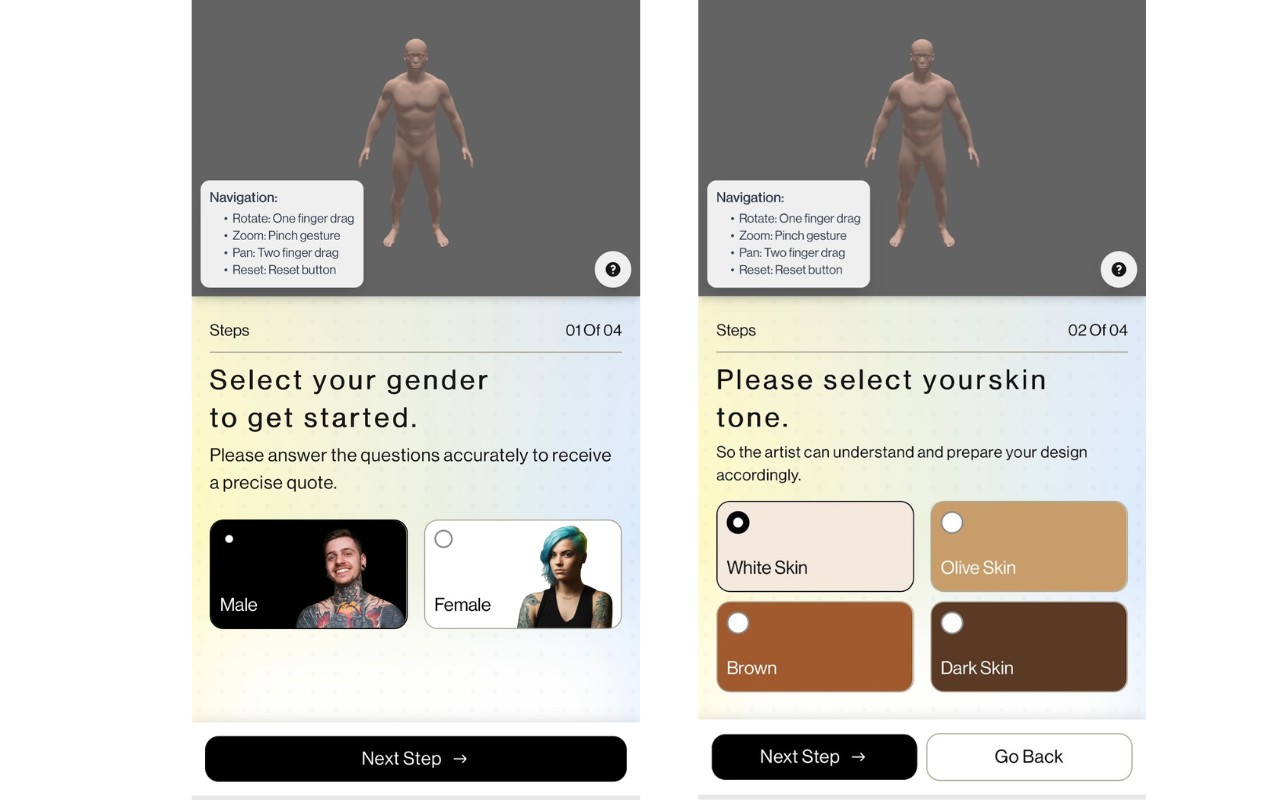
The platform’s sophisticated rendering engine accounts for how tattoos appear on different body parts. With a simple upload, customers can see how their design is positioned on a digital model that accounts for factors like muscle definition, skin texture, and natural body curves that traditional sketches cannot capture. 

Its 3D visualization tools also allow users to experiment with placement and scale, making adjustments until everything feels just right. The process is interactive and intuitive, giving users the confidence to move forward without second-guessing their choices.

“Tattoos are for everyone, but not every booking system has gotten the memo,” Kiani argues. “PRIC’D changes that by letting you preview your design on a model that matches your skin tone. No more wondering if that pastel flower will pop or if your intricate design will show up how you want.”

A Step to the Dream Tattoo

The PRIC’D impact is immediate. Customers who once hesitated now find themselves empowered to make decisions with clarity. The anxiety that once accompanied the booking process is replaced by excitement and anticipation. The leap of faith becomes a calculated step, an assurance that both parties are on the same page from start to finish, guided by real-time feedback and visual certainty.

What’s more, Kiani takes pride in how easy the app is to use. Whether for a first-timer or a tattoo veteran, users can experiment with designs, placements, and colors until they are satisfied. And if they are nervous? They are not alone, as the PRIC’D team available online is ready to assist. According to Kiani, nearly a third of early PRIC’D users had never set foot in a tattoo studio before. The app gave them the confidence to take the plunge.

Smarter Booking, Happier Customers

Beyond design, one of the most significant pain points in tattoo booking has always been the quote. How much will it cost? Will the price change if the design is tweaked? Traditionally, clients wait days for a reply, only to find the quote doesn’t match their budget, sending the process back to square one.

PRIC’D’s real-time and instant tattoo pricing engine tackles this head-on. As clients adjust their design on the 3D model—shrinking, enlarging, or moving it to a different spot—the platform instantly updates the estimated price, based on the studio’s preset parameters. There are no hidden fees or surprise add-ons. The transparency is immediate and empowering.

This feature isn’t just about convenience; it’s about trust. Clients know exactly what to expect, and artists can spend less time haggling over quotes and more time doing what they love—creating art.

Once the design and price are settled, booking an appointment is just a tap away. The platform syncs with studio calendars, allowing clients to see real-time availability, pay deposits, and secure their spot—all without a single phone call or email chain. 

Studios and solo artists benefit, too. PRIC’D’s dashboard tracks leads, bookings, deposits, and sales, streamlining operations and reducing administrative headaches. Artists can focus on their craft, while studios see up to an 80% increase in sales conversion, with fewer no-shows and a smoother overall experience. 

“People don’t realize how much time artists spend just answering the same questions repeatedly,” Kiani reveals. “With PRIC’D, we’ve cut that admin work by more than half, freeing up artists with time to actually create art.”

A Smart Way to Get Inked

Tattoos are about telling your story, marking a moment, or just having fun with a look. But the booking process? That’s been stuck in the past—until now. PRIC’D is here to make getting a tattoo as bright, smooth, and enjoyable as the art itself. No more crossed wires, no more mystery quotes, no more “I hope this turns out okay.” Just a smarter, friendlier, and more colorful way to bring ideas to life.

Booking a Tattoo Just Got Smarter With PRIC’D’s Real-Time 3D Design Tools

Photo Courtesy: Kayhan Kiani

Kiani mentions, “When you take the guesswork out of the experience, you make room for creativity and connection. That’s what makes the experience truly unforgettable. That gives them confidence to make a decision they’ll love for life. PRIC’D makes that happen.”

So, next time someone is ready to get inked, remember: booking a tattoo just got a whole lot smarter—and a lot more fun.

Renderforest Launches Unlimited AI Image and Video Generation to Keep Workflows Moving

By: Andi Stark

Renderforest has expanded its Pro AI and higher plans to include unlimited AI image generation and continued AI video creation after monthly credits are used, aiming to reduce production interruptions for creators and teams. Renderforest frames the move as a push against the credit-meter anxiety that can stall production halfway through an idea.

Credit limits have become the quiet tax on generative creation, a toll collected in hesitation. For brand managers, founders, and social media marketing teams, that hesitation can mean settling for a second-best draft instead of iterating toward the version that actually performs. Renderforest’s updated setup takes a different tack on the video side for its upper plans, pairing monthly credits with “unlimited continuation” using the company’s Lite model once credits are spent. Plan details show unlimited HD720 video creations with the Lite model at the Pro tier carrying the “Pro AI” name, with unlimited HD1080 video creations on the Business tier, plus 4K template exports on Business.

Unlimited image generation sits in the mix, too, tied to paid subscriptions. So for teams that rely on fast visual testing across ads, landing pages, and socials, unlimited generation reduces that friction between the concept and the execution of the concept. Renderforest’s pricing page lists “Unlimited” image processing on Pro, and “Unlimited” for images continuing through the higher tiers. Pricing and tier labels vary by billing cycle and promos, yet the message stays plain: fewer forced stops, more finished drafts.

The Credit Wall Gets a Crack

Creative teams rarely land the first try, and Renderforest is betting that repetition is the point rather than a flaw. The company says many tools behave like a meter that slows work once credits hit zero, while its higher plans now keep video generation going via the Lite model after premium credits are consumed. In marketing spheres, performance often improves through controlled iteration, not single-shot perfection. Renderforest’s own plan grid backs up the “unlimited” promise on the Lite-model lane for video generation at the upper tiers.

One quiet detail matters for buyers who read the fine print. Monthly credits still exist, and Renderforest still distinguishes between higher-level generation that spends credits and the Lite-model continuation that keeps output flowing when the credits end. That split is less a loophole than a choice about where the company wants to draw its line between premium compute and steady throughput.​ For teams that are trying to balance quality with speed, that distinction clarifies when to use higher-fidelity outputs and when to prioritize volume instead. 

Pressure builds in the moments between drafts, when a brand manager needs one more version before sunrise, or a founder wants the cadence tightened before a pitch. Iteration turns into a kind of negotiation with the clock, and credits can turn that negotiation sour fast, especially when a team has to decide whether another run is worth the spend. Renderforest’s new posture tries to remove that mental math from the room, leaving teams to concentrate on ideas instead of credits.​ The value proposition shifts here from raw generation power to uninterrupted creative momentum. 

Tension still remains, because unlimited output can tempt creators into endless tinkering, the kind that produces many files and few decisions. Deadlines, budgets, and taste keep that urge in check, yet the tools set the mood, and tools built for continuous output tend to invite bolder experimentation. If a team is performance-driven, experimentation can translate into stronger hooks and clearer messaging, leading to better conversions. Renderforest appears to be courting that behavior while betting it will convert into loyalty, brand recognition, and a larger share of teams that refuse to juggle multiple creation suites.

Pricing Changes, Sharper Stakes

Subscription pages rarely read like drama, yet they sit at the center of who gets to make what, and how often. Renderforest’s pricing tiers spell out different monthly credit pools and different ceilings for export quality, storage, and what “unlimited” means across formats. Pro lists 1600 credits per month and unlimited image processing with the Renderforest model, while the next tier up lists 3000 credits per month and unlimited HD720 video creations with the Lite model.​

Business, positioned for teams, raises monthly credits and promises unlimited HD1080 video creations with the Lite model, plus unlimited 4K template exports where templates support it. That is a familiar ladder in subscription software, yet the “unlimited continuation” framing shifts the emotional pitch from features to flow, from what you buy to how often you get interrupted. For organizations managing multiple campaigns, that difference can affect production planning, team bandwidth, and launch timelines. 

Competition keeps tightening the screws. Renderforest’s own competitor set, cited by the company, includes Veed, InVideo, and Canva, three brands that already occupy mindshare for quick creation, editing, and brand assets. Renderforest is trying to turn breadth into a habit by positioning itself as a single environment for generating, refining, and publishing content, arguing that speed, consistency, and reduced tool sprawl matter more to marketing teams than another layer of settings.

Marketing language can blur into a fog, so the practical question stays blunt: : can a plan sustain a campaign through the first broken draft and the second generic version until the third iteration finally works? Renderforest is betting that it can, based on the notion that interruptions cost more than compute. . In that context, unlimited continuation becomes less of a technical feature and more of a safeguard for campaign performance.

One Suite, One Brand Fight

Renderforest has spent years pitching itself as an all-in-one suite for video, brand assets, and sites, and the company says more than a decade of building has pushed it toward a single promise, creation that stays quick, accessible, and campaign-ready even without specialist skills. Plan copy and plan structure reinforce that theme, with template exports, stock libraries, and generation tools unified inside one subscription workflow.  For small businesses and lean marketing teams, consolidation reduces both cost and the operational drag that slows campaign execution.

Product teams love grand claims, yet customers tend to judge by friction, and friction usually shows up in small places. Renderforest’s announcement about the update leans into those small places, calling out the moment credits run out as the moment flow gets cut off, then arguing its upper plans remove that stop by shifting into Lite-model generation. That argument speaks to anyone who has watched a good idea die in the gap between “almost” and “done.”​ For teams measured on output and results, that gap often carries measurable financial impact.

Multi-image prompting, mentioned alongside the unlimited continuation message, signals another part of the strategy: tighter control when brand consistency and visual alignment matter.. Renderforest describes the feature as a way to upload multiple reference images with one prompt so outputs look more cohesive and aligned across campaigns. Control is the missing ingredient in many generation tools, and the brands that win tend to win by making results repeatable rather than merely surprising.​

To bring more of the pipeline under its control, Renderforest has launched two in-house AI models: Renderforest Lite and Renderforest Pro. Lite focuses on speed, ideal for simple scenes with render times as low as one minute per scene, supporting faster iteration cycles. Pro focuses on quality, producing more detailed, visually rich, cinematic outputs suited for higher-impact brand content. Together, they signal a move toward owning the core engine behind delivery, where time-to-output is the real competitive advantage.

Disclaimer: The term ‘unlimited’ applies only to certain aspects of the service, including limited resolution options and usage tiers. Restrictions may apply based on the plan selected and usage limits for specific features.

Modern Exhaust Innovations That Transform Vehicle Performance

Are you tired of leaving untapped power potential on the table with your performance build? While many enthusiasts rush to bolt on the latest intake or tune their ECU, they often overlook one of the most critical components for unlocking true performance.

A thoughtfully engineered exhaust system serves as the foundation for any serious performance build, working in harmony with other modifications to optimize power output and engine efficiency.

From advanced flow dynamics to cutting-edge materials and acoustic engineering, modern exhaust technology has evolved far beyond simple pipes, offering enthusiasts the ability to achieve notable gains while maintaining street-legal compliance and daily drivability.

Unlocking Hidden Power with Exhaust Innovations

Smart exhaust system design plays a pivotal role in maximizing vehicle performance, yet many builders skip this crucial step. A well-engineered exhaust setup can achieve up to a 13.56% reduction in backpressure, creating significant improvements in both power output and overall efficiency.

By installing high-performance aftermarket exhaust components, car enthusiasts can tap into advanced engineering features that factory systems may not offer.

Starting with exhaust upgrades creates an excellent base for future modifications. The right system can potentially transform your vehicle’s performance characteristics, delivering measurable gains in throttle response and power delivery.

Modern exhaust systems leverage cutting-edge flow modeling and precision manufacturing to maximize performance benefits. The combination of computer-aided design and advanced materials results in systems that deliver substantial improvements across the entire power band.

These innovations help create a more responsive and efficient engine, making exhaust modifications an essential first step in any serious performance build.

Material Choices and Noise Control Solutions

The selection of exhaust materials stands as a critical factor in achieving peak performance and longevity. Stainless steel and titanium components offer distinct advantages, with each material bringing unique properties to enhance system efficiency.

While stainless steel delivers impressive durability and cost-effectiveness, titanium shines through its outstanding strength-to-weight ratio and superior heat dissipation characteristics. Smart material choices impact these key performance aspects:

  • Thermal conductivity and heat distribution

  • Overall system weight and balance

  • Resistance to corrosion and wear

  • Vibration-damping capabilities

  • Long-term structural integrity

Modern acoustic engineering techniques have revolutionized exhaust design. Recent advances show that tailpipe noise can be reduced by 5-10 dB through strategic material placement and innovative dampening solutions.

This improvement doesn’t just create a more pleasant driving experience; it helps vehicles stay within legal sound limits while maintaining optimal flow characteristics.

Performance enthusiasts can now enjoy enhanced power gains without sacrificing refinement or facing legal issues. The fusion of advanced materials with cutting-edge noise control technology creates exhaust systems that deliver power and precision, transforming the driving experience into something extraordinary.

Optimized Gas Flow and Engine Efficiency

Smart exhaust design plays a pivotal role in maximizing engine performance through volumetric efficiency. The science behind proper gas flow isn’t just about making noise; it’s about creating a system that helps your engine breathe more easily.

When exhaust gases flow smoothly, your engine doesn’t have to work as hard to push them out, resulting in improved power delivery and better overall performance.

A well-designed exhaust system creates a scavenging effect that actively helps pull spent gases from the combustion chamber. This enhanced evacuation allows fresh air and fuel to enter more efficiently, creating a continuous cycle that boosts engine output.

The results are noticeable across the entire power band, from smoother idle characteristics to stronger mid-range torque and improved top-end power. Racing enthusiasts and daily drivers alike benefit from the enhanced throttle response and linear power delivery that comes with proper exhaust flow optimization.

Thermal Management and Energy Recovery Advances

Smart thermal management in exhaust systems has become a game-changer for modern performance builds. Advanced heat exchangers have transformed how we handle exhaust energy, turning what was once wasted heat into a valuable resource for enhanced efficiency.

These innovations don’t just boost performance; they’re reshaping how engines operate at their core.

Heat exchange technology has made remarkable strides, with modern systems showing that fuel efficiency gains can reach up to 0.8% through exhaust gas-to-oil exchanges. This thermal recovery process creates a ripple effect throughout the engine, improving overall performance while reducing wasted energy.

The benefits extend beyond just power gains – these systems help maintain optimal operating temperatures, leading to better component durability and stricter emissions compliance. More details on these advancements can be found in the SAE technical paper.

Here are some of the key performance and durability benefits provided by these advanced thermal management systems:

  • Reduced engine warm-up times in cold conditions

  • Better oil temperature control during high-performance driving

  • Decreased thermal stress on critical engine components

  • Improved fuel atomization through pre-heated intake charge

The integration of heat exchangers marks a significant shift in exhaust system design. By capturing and reusing thermal energy, these systems create a more efficient and sustainable approach to performance enhancement.

This technology isn’t just about power gains; it’s about creating smarter, more efficient engines that perform better while using less fuel.

Customization Strategies to Meet Regulations

Performance enthusiasts often face the challenge of balancing their desire for increased power with strict emissions standards and noise regulations. Creating a street-legal exhaust system requires smart engineering choices that maintain optimal flow while meeting legal requirements.

Modern catalytic converters and resonator technology have evolved significantly, offering options that don’t undermine engine performance while still keeping harmful emissions in check.

Being proactive about regulatory compliance during the planning phase helps avoid expensive modifications later. By incorporating these elements thoughtfully, you’ll create an exhaust system that strikes a balance between performance and street legality, ensuring your vehicle remains both powerful and compliant with local regulations.

Holistic Upgrade Planning for Maximum Gains

Car exhaust pipe

Photo; Unsplash.com

Alt text: Car exhaust pipe

Smart performance enthusiasts know that exhaust modifications work best as part of a bigger picture. The exhaust system doesn’t work in isolation – it’s a vital piece in the complex puzzle of engine performance.

Consider checking out aftermarket exhaust components that complement your existing setup while planning future upgrades. The true magic happens when you match exhaust improvements with complementary modifications.

By taking this approach, you’ll create a balanced powertrain that performs better and lasts longer. Your engine’s breathing ability improves significantly when intake and exhaust work together in harmony.

Each component in your engine’s system affects the others, making careful planning crucial. For instance, upgrading your turbocharger without improving exhaust flow could create dangerous backpressure.

Similarly, installing larger injectors without addressing exhaust restrictions won’t deliver optimal gains. It’s this interconnected nature of engine components that makes a systematic approach so important for achieving meaningful performance improvements.

Power, Flow, and Future Potential

Exhaust system design represents the cornerstone of performance enhancement, yet its potential remains vastly underutilized in many building projects.

Through strategic material selection, optimized flow dynamics, and advanced thermal management, enthusiasts can unlock substantial power gains while maintaining street legality and daily drivability.

The future of performance exhaust systems lies at the intersection of innovative engineering and practical application, suggesting even greater efficiency gains for those willing to invest in quality components and proper planning.

From Laboratory to Industrial Value Chain Yazhu Jiang’s Interdisciplinary Journey and the Intelligent Future of Critical Mineral Recycling

By: Sophia Smith

In today’s global landscape of technological competition, the independent supply of critical minerals has become a key indicator of a nation’s industrial resilience and security. In this strategically vital field shaping the future, a young scientist named Yazhu Jiang is charting a clear path from fundamental research to industrial intelligence through her unique interdisciplinary background and solid technological achievements.

A Nonlinear Academic Journey: Assembling a Complete Cognitive Framework

In 2017, Yazhu Jiang enrolled at Pennsylvania State University, pursuing a dual major in Materials Science and Mathematics. For her, this marked the starting point of building a mindset centered on the symbiosis between technological implementation and value creation.

Yet she did not stop there. She later advanced to Johns Hopkins University to pursue a master’s degree in Financial Mathematics. This decision represented a leap in perspective. The rigorous training in financial mathematics enabled her to move beyond a single-disciplinary lens and examine the relationship between technological innovation and market value from a broader, more strategic dimension.

As the wave of artificial intelligence swept across the globe, Jiang once again demonstrated a keen sensitivity to the pulse of the times. She went on to earn a master’s degree in Data Science at University of San Francisco. This time, her objective was to master the “last mile” of translating cutting-edge technologies into real-world productivity. From foundational research to analytical reasoning and finally to technology-driven empowerment, she completed a full cognitive loop in her intellectual framework.

Technical Rigor and Real-World Impact: The Industrial Vision Behind the Patents

If Yazhu Jiang’s academic background forms the foundation of her intellectual framework, then the series of patented technologies she participated in and led during her time in China stand as clear proof of her commitment to turning ideas into practice.

At Tongxiang Siyuan Environmental Technology Co., Ltd., Jiang served as a core inventor in the development of multiple patented technologies covering the full lifecycle of solid waste and wastewater treatment. These patents were far from theoretical concepts confined to paper. In industrial parks across Jiangxi and Zhejiang provinces, they were implemented in real operational settings. Waste residues and liquids that once required costly disposal began generating tangible economic value: resource recovery rates increased, processing costs declined, and environmental emissions were significantly reduced. More importantly, this circular economy model effectively lowered dependence on primary mineral resources.

A New Identity as an AI Engineer: Powering Intelligent Transformation

In June 2025, Jiang joined Detect Technologies Inc. as an AI Engineer. While this role may appear distant from her earlier background in materials engineering, for Jiang it represented a natural extension—and an inevitable evolution—of her accumulated expertise. She began applying technologies such as large language models to industrial risk management and decision-support systems, using algorithms and data models to reexamine complex industrial processes.

This position opened a new doorway: a transition from a traditional engineer solving problems through experience and technical know-how to an AI-driven specialist defining solutions through data and computational models. A clear blueprint gradually emerged—collecting massive datasets throughout recycling processes and leveraging AI models to precisely control critical parameters such as electrolysis temperature and chemical dosing ratios. Tasks once dependent on manual expertise are being transformed into intelligent workflows that are quantifiable, monitorable, and continuously optimizable.

A Vision for the Future: Empowering Sustainable Global Industry

Every step Yazhu Jiang has taken is building toward her long-term objective: advancing an AI-driven critical mineral regeneration initiative that supports global industrial upgrading through technological innovation. This vision directly addresses one of today’s most pressing global industrial concerns—the resilience and security of critical mineral supply chains.

Currently, the global supply chains for strategic metals such as zinc, copper, and lead face widespread challenges, including heavy import dependence and limited stability, creating bottlenecks for high-quality industrial development. Jiang’s initiative seeks to harness technology to efficiently and intelligently extract valuable “urban minerals” from vast quantities of industrial solid waste and hazardous waste streams. By doing so, it aims to provide a stable and sustainable supplementary supply for global critical mineral markets while supporting the transition toward greener, low-carbon industries.

From laboratories in Pennsylvania to technology companies in San Francisco, from factory floors in China to a global strategic vision, Yazhu Jiang’s journey demonstrates that true innovation is never confined within the boundaries of a single discipline. It emerges from deep insight into industrial challenges, takes shape through the integration of cross-domain knowledge, and ultimately succeeds by transforming technology into a powerful force for societal progress. Her story is only just beginning.

Inside F*Ck You Money, A Dark Satire About the People Who Make Billionaires’ Messes Disappear and What it Costs Them

By: Ethan Rogers

“There’s a moment,” Aron Moldovanyi says, “where you realize the guy you’re working for doesn’t think the rules apply to him, not because he’s delusional, but because he’s right.”

Like any good interviewee, Moldovanyi is someone who probably shouldn’t be telling us any of this. He’s spent the last 18 years inside the private family offices of some of the wealthiest individuals in the world as the person whose job it is to make whatever needs to happen, happen. Period. In certain circles, he is referred to as “The Billionaire’s Genie.” The nickname is half-flattering and half-diagnostic. He operates at the intersection of unlimited budgets and impossible requests. His entire value is in his ability to make reality bend slightly in his boss’s direction.

Now that world is the basis for F*ck You Money, a forthcoming dark satire developed by screenwriters Jared Brandon Brewer and Karl Williams, who spent months in deep conversation with Moldovanyi working to understand a world that, for most people, is simply unknowable. The film has been moving through development with the kind of controlled urgency that suggests the people behind it know exactly what they have.

“You’re not hearing about corruption,” Brewer says. “You’re hearing about a system that works exactly as designed, for the people it was designed for. That’s a different and more disturbing thing.”

The film’s protagonist is not the billionaire, but his chief of staff, a stand-in for the real-life “Genie” whose job is to stand between the boss and the blast radius. If the billionaire moves through the world like a weather system, then the chief of staff is the bellwether, deciding whether to issue a tornado warning or tell everyone it’s sunny.

“If you center the billionaire,” Brewer says, “you’re back in a familiar story. Ego, rise, fall, maybe redemption. We’ve seen it. The chief of staff gives you something more uncomfortable. Someone who is complicit, who is good at what they do, and who has to keep deciding, in real time, whether any of this is okay.”

The tonal register they’re aiming for sits in the neighborhood of The Wolf of Wall Street, but the camera angle is different. Jordan Belfort narrated his own mythology. The chief of staff in F*ck You Money narrates someone else’s, which is a stranger and more corrosive position to occupy. 

There’s an appetite for excess on screen that audiences absolutely have,” Williams says. “But the more interesting version isn’t watching someone spend money. It’s watching someone manage the fallout from how that money gets spent. Or misspent. The excess is the setup. The cleanup is the story.”

The project has drawn early attention in packaging discussions, with representation conversations underway as the script moves toward a wider market introduction. Legal clearance work has already begun, a process that, given the specificity of the world being depicted, is as much creative archaeology as it is liability management. 

“It sharpens everything,” Brewer says. “You find out very quickly which details are essential and which ones you were using as atmosphere. The ones that survive that process are the ones that are doing real work.”

Casting conversations, while preliminary, have centered on finding someone who can carry the particular register the role demands. Someone whose moral compromise is so gradual and so well-compensated that the audience doesn’t notice it happening until it already has.

Moldovanyi describes the project with the careful precision of someone who has spent a career knowing exactly what to say and what to leave in the room. He is not interested in burning anyone down. He is interested, he says, in accuracy.

“People think that the world is hidden,” he says. “It’s not hidden. It’s just fast. By the time you’ve processed what happened, it’s three moves ahead and someone else is managing the story.”

The script is not a roman à clef. It is not a documentary dressed as fiction. It is a film that uses one man’s granular knowledge of a world most people only see in headlines, and even then, only the version of the headline that survived the cleanup, to build something that works on the level of character and consequence.

The title will make some people uncomfortable before they’ve seen a frame. That’s not an accident. The discomfort is the point of entry. 

Disclaimer: The views and opinions expressed in this article are those of the writers and are intended for informational and entertainment purposes only. The article discusses a forthcoming satirical film, Fck You Money*, and its fictionalized portrayal of billionaire culture and private family offices. Any resemblance to real individuals or events is purely coincidental. The content is meant to provide insight into the fictional narrative and themes explored in the film and does not reflect real-world facts or actual experiences.

What You Need to Know: 9 Tips for Handling Your Construction Accident Claim

Construction sites are filled with activity, noise, and movement, but behind that controlled chaos, dangers can appear suddenly. One misstep or overlooked safety measure can lead to injuries that change a worker’s life overnight. Handling a construction accident claim adds another layer of stress on top of recovery, paperwork, and medical care. Knowing what steps to take and having a clear plan can give you control during an unpredictable time.

If you’re navigating this process, here are practical ways to strengthen your case and make your claim count.

1. Report the Accident Immediately

The first and most important step after an accident is to let your supervisor or site manager know right away. Reporting quickly ensures that the incident is officially recorded. This documentation can help establish what happened, when it happened, and who was present. A timely report can prevent misunderstandings later and keep your account consistent with the official record.

2. Seek Medical Attention Without Delay

Medical records are more than just proof of injury—they are essential for evaluating the extent of your injuries and determining compensation. Even if the injury feels minor at first, a check-up can identify hidden issues that might appear later. Documenting your medical care from the beginning strengthens your position if you decide to file a lawsuit for a construction site accident.

3. Preserve Evidence from the Site

Photographs, videos, and any tools or equipment involved in the incident are valuable pieces of evidence. Take note of hazards, signage, and environmental factors that may have contributed to the incident. Preserving this evidence ensures you can show exactly what conditions led to the injury. It is easier to capture these details immediately after the incident than to try to remember or gather them later.

4. Keep Detailed Records of Expenses

Injuries often come with a long list of costs—hospital visits, prescriptions, physical therapy, transportation, and lost wages. Maintaining organized records of all expenses can significantly impact the outcome of a claim. When you have clear documentation of financial impacts, it becomes easier to justify the compensation you need to cover your losses.

5. Avoid Giving Recorded Statements Without Legal Guidance

Insurance companies often want statements right after an accident. Speaking to them without legal guidance can unintentionally affect your claim. Details may be taken out of context or used against you. Waiting to provide recorded statements until you consult a construction accident attorney ensures your account is accurate and protected.

6. Understand Your Legal Rights

Workers’ compensation laws and personal injury regulations vary depending on circumstances, but every worker has rights designed to protect them. Knowing your legal standing helps you avoid pitfalls and ensures fair treatment. A clear understanding of your rights can prevent mistakes that reduce your claim or delay recovery.

7. Communicate Clearly and Consistently

Accuracy is key. Provide consistent information in all reports, medical documents, and communications with insurers. Avoid exaggerations or guesses. Consistency in your account builds credibility and avoids unnecessary complications that could harm the claim.

8. Hire an Experienced Construction Accident Attorney

An attorney with experience in construction claims can guide you through each stage of the process. From negotiating with insurers to filing legal documents, their expertise ensures your claim is handled professionally. Legal support can significantly increase the chances of receiving fair compensation and help you navigate complicated rules.

9. Stay Patient and Persistent

Construction accident claims can take time. Insurance companies and legal proceedings move at their own pace, so patience is essential. At the same time, persistence is necessary. Keep organized records, follow up on requests, and ensure nothing is overlooked. Persistence combined with preparation can give you an edge.

Closing Thoughts

Construction accidents can feel overwhelming, but taking careful, deliberate steps can help workers feel more in control. Following these tips ensures that claims are built on solid evidence, accurate records, and expert guidance. Those who approach the process strategically increase their chances of a fair outcome.

From documenting the incident to seeking legal support, every step matters. Filing a lawsuit for a construction site accident with well-prepared evidence and clear records improves the likelihood of receiving compensation that truly reflects the impact of the injury.

Disclaimer: The information provided in this article is for general informational purposes only and is not intended as legal advice. For advice regarding your specific situation, please consult with a qualified attorney.

The Sound of Productivity: Why Modern Offices Need High-Performance Acoustic Design

The way we work has changed, but the physics of sound has remained the same. In 2026, the shift toward open-plan collaboration and glass-fronted boardrooms has created a significant byproduct: acoustic chaos. High noise levels are no longer just a minor annoyance; they are a primary driver of employee burnout and decreased cognitive performance.

A modern office that looks beautiful but sounds like a train station is a failed design. As businesses compete to bring talent back into physical workspaces, the focus has shifted toward creating sensory-friendly environments. Achieving a “quiet” office doesn’t mean total silence—it means controlling sound so that it works for you, rather than against you.

Here is how cutting-edge acoustic interventions are redefining the professional landscape this year.

The Evolution of Office Acoustic Solutions for Open Plan Spaces

Open-plan offices were designed to break down silos, yet they often create “noise silos” where team members struggle to concentrate. The challenge lies in hard surfaces—concrete floors, glass walls, and metal ceilings—that bounce sound waves around like a pinball machine.

To combat this, interior designers are moving away from reactive fixes and toward holistic office acoustic solutions. By treating the environment as a living ecosystem, businesses can create specific “acoustic zones.” This allows for a vibrant, collaborative atmosphere in the breakroom while maintaining library-like silence in the focus hubs.

  • Zonal Planning: Using furniture and layout to naturally block the path of sound.
  • Absorption over Isolation: Using soft materials to “soak up” sound energy before it becomes an echo.
  • Visual Privacy: Integrating sound-dampening elements that also act as visual shields to reduce “spatial” distractions.
The Sound of Productivity: Why Modern Offices Need High-Performance Acoustic Design

Photo: Unsplash.com

Transforming the Ceiling with Acoustic Panels for Office Noise Reduction

The ceiling is the largest unobstructed surface in any office, making it the most critical area for acoustic treatment. Traditional office ceilings were often neglected, but in 2026, they are being utilized as the primary engine for sound control.

Using acoustic ceiling panels for office noise reduction is the most effective way to lower the overall decibel level of a room. These panels are engineered to trap sound waves, preventing them from reflecting back down to the desks below.

Modern ceiling systems come in several forms to suit different architectural styles:

  1. Acoustic Rafts: “Floating” horizontal panels that provide high-level absorption while allowing access to the original ceiling structure.
  2. Baffles: Vertical panels that hang from the ceiling, ideal for high-ceiling industrial spaces where air circulation is a priority.
  3. Integrated Systems: Seamless panels that look like standard drywall but offer professional-grade sound dampening.

Creating High-Impact Feature Walls with Modular Acoustic Tiles

Walls are the second most common surface for sound reflection. When a person speaks, the sound waves hit the opposite wall and bounce back, creating an “echo chamber” effect. This is particularly problematic in narrow corridors or small meeting rooms.

A popular design trend involves using modular acoustic tiles for feature walls. This approach turns functional soundproofing into a piece of architectural art. Because these tiles are modular, they can be arranged in various patterns, colors, and textures to match a company’s branding.

  • Geometric Patterns: Using 3D shapes to diffuse sound waves in multiple directions.
  • Fabric Finishes: Offering a tactile, warm aesthetic that softens the “cold” feel of modern glass offices.
  • Sustainability First: Many modular tiles are now made from recycled PET or sustainable timber, appealing to the eco-conscious corporate world.
The Sound of Productivity: Why Modern Offices Need High-Performance Acoustic Design

Photo: Unsplash.com

The Impact of Acoustics on Employee Well-being

We often talk about acoustics in terms of productivity, but the human element is even more important. Constant background noise triggers a “fight or flight” response in the brain, increasing cortisol levels and leads to physical fatigue.

  1. Reduced Stress: A quieter environment lowers heart rates and helps employees feel more in control of their day.
  2. Better Inclusion: For neurodivergent employees or those with hearing impairments, poor acoustics can be a major barrier to participation.
  3. Confidentiality: Proper acoustic treatment ensures that sensitive conversations in HR or executive offices stay private, protecting both the company and the employee.

Integrating Light and Sound

One of the most exciting trends for 2026 is the convergence of lighting and acoustics. In spaces where wall and ceiling space is limited, “Acoustic Lighting” is filling the gap. These are high-performance LED fixtures wrapped in sound-absorbing materials.

By placing these fixtures directly over workstations or boardroom tables, you are catching the sound at the source—the human voice. This dual-purpose technology saves on installation costs and keeps the ceiling looking clean and uncluttered.

In Summary

Designing for the ears is just as important as designing for the eyes. As we navigate the complexities of hybrid work and high-density managed office noise, the demand for sophisticated sound control will only grow.

By investing in high-quality ceiling systems, modular wall tiles, and comprehensive acoustic strategies, you aren’t just buying panels—you are buying focus, health, and a more harmonious workplace. The future of the office isn’t just open; it’s optimized.

Frequently Asked Questions (FAQ)

Q: Can I improve my office acoustics without doing a full renovation? A: Yes! Many solutions, such as acoustic desk screens and modular wall tiles, are designed for “retrofitting.” These can be installed over a weekend without the need for structural changes or messy construction.

Q: What is the difference between sound absorption and soundproofing? A: This is the most common question in the industry. Sound absorption (using panels and tiles) improves the sound quality inside the room by stopping echoes. Soundproofing involves adding mass to walls to stop sound from traveling between rooms. Most offices need a combination of both.

Q: Are acoustic panels environmentally friendly? A: Many modern options are! We prioritize products made from recycled PET (plastic bottles) and sustainable natural fibers. These materials are not only eco-friendly but are also non-toxic and safe for indoor air quality.

Q: How do I know where to place the panels for the best results? A: Placement is key. Generally, panels should be placed at “ear level” on walls or directly above noise sources on the ceiling. For meeting rooms, treating the wall opposite the speaker is the best place to start.